
TL;DR:
- A web browsing checklist for AI agents ensures sites support reliable autonomous navigation by verifying technical, semantic, discovery, and session aspects. Proper configuration of robots.txt, semantic navigation using ARIA roles, discovery artifacts like llms.txt, and session persistence practices improve task success rates. Implementing these criteria helps create robust AI-driven web interactions and prevents silent failures.
An AI agent web browsing checklist is a structured set of criteria developers use to verify their web environments allow autonomous agents to browse, extract, and interact reliably. Without this checklist, agents hit silent failures: blocked crawlers, unrendered JavaScript, invisible form fields, and sessions that drop mid-task. The checklist covers four domains: technical performance, semantic navigation, discovery artifacts, and session management. Each domain maps directly to a failure mode that kills agent task completion rates. Gyrence builds its entire API around these failure modes, returning typed responses so your agent knows exactly what went wrong.
1. What are the technical performance requirements on your AI agent web browsing checklist?

Technical performance is the foundation of any automated web navigation guide. Robust agent-ready audits require at least 15–18 key performance and compatibility checks, starting with Time to First Byte under 2 seconds and fully green Core Web Vitals. Slow servers force agents to time out before content loads, which registers as a task failure rather than a network error.
Server-side rendered or static HTML is non-negotiable for most AI browsing assistants. Many agents cannot execute complex client-side JavaScript, so pages that rely on React or Vue hydration to display content are effectively blank to the agent. Check your rendering pipeline before deploying any virtual agent web tasks.
Key technical checks:
- TTFB: Under 2 seconds on all primary pages
- Core Web Vitals: LCP, CLS, and FID all in the green range
- Rendering type: Server-side rendered or static HTML preferred
- CDN configuration: No bot-blocking rules that catch AI user-agents
- TLS/SSL: Valid certificates with no redirect chains longer than two hops
Pro Tip: Run your target URLs through a headless browser with JavaScript disabled. If the page content disappears, your agent will see the same blank result.
2. How does your robots.txt handle AI crawlers?
A properly configured robots.txt explicitly allows AI bots like GPTBot and ClaudeBot by name. Incorrect bot-blocking prevents autonomous agents from accessing site content entirely. This is the single most common misconfiguration in web browsing compliance checklists, and it is invisible until your agent returns empty results.
Check your robots.txt against the following:
GPTBot: Allowed on all pages you want indexed or crawledClaudeBot: Allowed explicitly, not just via wildcardGooglebot-Extended: Allowed if you want AI-powered search features- Crawl-delay directives: Set to 1–2 seconds to avoid rate-limit bans
- Disallow rules: Audit for overly broad patterns that block agent paths
Wildcard Allow: * rules do not always cover named AI user-agents in all CDN and WAF configurations. Test with curl -A "GPTBot/1.0" against your server to confirm the response code.
3. How does semantic navigation improve agent task success?
Recon-first navigation requires an agent to request a list of elements grouped by semantic roles before any interaction. This approach reduces navigation errors caused by dynamic layouts. Agents using models like Claude Sonnet 4.6 achieve higher task completion rates with semantic navigation compared to coordinate-based clicking.
Coordinate and pixel-based clicking is unreliable and effectively obsolete for production agents. Page layouts shift across viewport sizes, A/B tests, and CMS updates. An agent clicking at coordinates (340, 210) will hit the wrong element after a single layout change.
Best practices for semantic interaction:
- Map all interactive elements by ARIA role before any click or form fill
- Prefer
aria-labelandaria-labelledbyattributes over positional selectors - Use
role="button"androle="link"to identify actionable elements - Avoid relying on CSS class names, which change with every build
- Validate that all form fields carry programmatic labels, not just placeholder text
Pro Tip: Ask your agent to output its accessibility tree snapshot before acting. If a button shows up as "unlabeled interactive element," your markup needs fixing before the agent can reliably click it.
4. What discovery artifacts support efficient agent browsing?
The llms.txt file placed at the domain root accelerates agent navigation by providing machine-readable summaries and key links. Agents use it to skip exhaustive crawling and go directly to relevant pages. This is the next frontier for agent site navigation, beyond traditional SEO artifacts like sitemaps.
Sitemaps alone are insufficient for agent discovery. Agents now prioritize artifacts like llms.txt and agent-card.json to improve navigation accuracy and reduce hallucination risk. Structured JSON-LD schema accelerates this further by giving agents typed facts about your content.
| Artifact | Format | Primary benefit |
|---|---|---|
llms.txt | Plain text | Machine-readable site summary at root |
agent-card.json | JSON | Declares agent capabilities and endpoints |
sitemap.xml | XML | URL inventory for crawl planning |
| JSON-LD schema | Embedded JSON | Typed facts: Organization, Product, FAQPage |
| Agent Skills Discovery RFC | JSON | Interoperability for multi-agent workflows |
Implement JSON-LD schema types for Organization, Product, Article, and FAQPage on every relevant page. Agents extract these typed facts without parsing prose, which cuts extraction errors significantly. For a deeper look at structured JSON extraction, the pattern applies directly to agent-side data consumption.
5. How do you manage session persistence for long-running agent tasks?
Long-running autonomous tasks fail most frequently due to missing session persistence and poor anti-bot management. A headless browser that loses its session mid-task forces the agent to restart from scratch, with no memory of prior state. This is not a recoverable error without explicit retry logic.
The recon-act-verify loop is the correct pattern for sustained browsing. The agent recons the current page state, acts on one element, then verifies the result before proceeding. This loop catches state changes from dynamic content, login redirects, and CAPTCHA challenges before they cascade into full task failures.
Anti-bot management checklist:
- Rotate user-agent strings across requests to avoid fingerprint bans
- Introduce randomized delays between actions (1–4 seconds)
- Handle CAPTCHA triggers with a fallback to human-in-the-loop or a solver service
- Persist cookies and local storage across agent sessions
- Implement exponential backoff on 429 and 503 responses
Maintaining a recon-act-verify cycle is considered best practice for robust autonomous agent workflows. Pair this with domain URL mapping to give your agent a full picture of site structure before it starts navigating.
Key Takeaways
A reliable AI agent web browsing checklist requires technical performance, semantic markup, discovery artifacts, and session management to work together as a single system.
| Point | Details |
|---|---|
| Technical performance first | TTFB under 2 seconds and green Core Web Vitals prevent agent timeouts before content loads. |
| Allow AI crawlers explicitly | Name GPTBot and ClaudeBot in robots.txt to prevent silent access failures. |
| Use semantic navigation | Recon-first navigation with ARIA roles outperforms coordinate-based clicking in every dynamic layout. |
| Deploy discovery artifacts | llms.txt and agent-card.json reduce hallucinations and speed up initial site exploration. |
| Enforce session persistence | A recon-act-verify loop with retry logic prevents long-running tasks from failing silently. |
The mistake I keep seeing in agent projects
Developers treat AI agents like slightly faster human users. They are not. An agent interacting with a page does not see your beautiful UI. It sees the accessibility tree, a flat list of labeled elements with roles and states. Every unlabeled button, every CSS-only tooltip, every JavaScript-rendered nav menu is invisible to it.
The teams that ship reliable agents stop asking "does this look right?" and start asking "does this element have a programmatic label?" That shift in thinking changes how you write markup, how you configure your CDN, and how you structure your discovery files. I have watched projects spend weeks debugging agent failures that traced back to a single missing aria-label on a search input.
Adopt llms.txt now, before it becomes a standard requirement. The agents hitting your site in 2026 already know to look for it. The ones hitting your site in 2027 will expect it. Getting ahead of agentic web browsing protocols early costs almost nothing and pays off every time a new agent framework ships.
— Glen
Gyrence: web data infrastructure built for agents
Gyrence turns the open web into structured, agent-ready data through five composable API primitives: Search, Traverse, Fetch, Extract, and Map. Every call returns a typed, discriminated-union response that includes the failure cases, so your agent reasons about results instead of guessing.
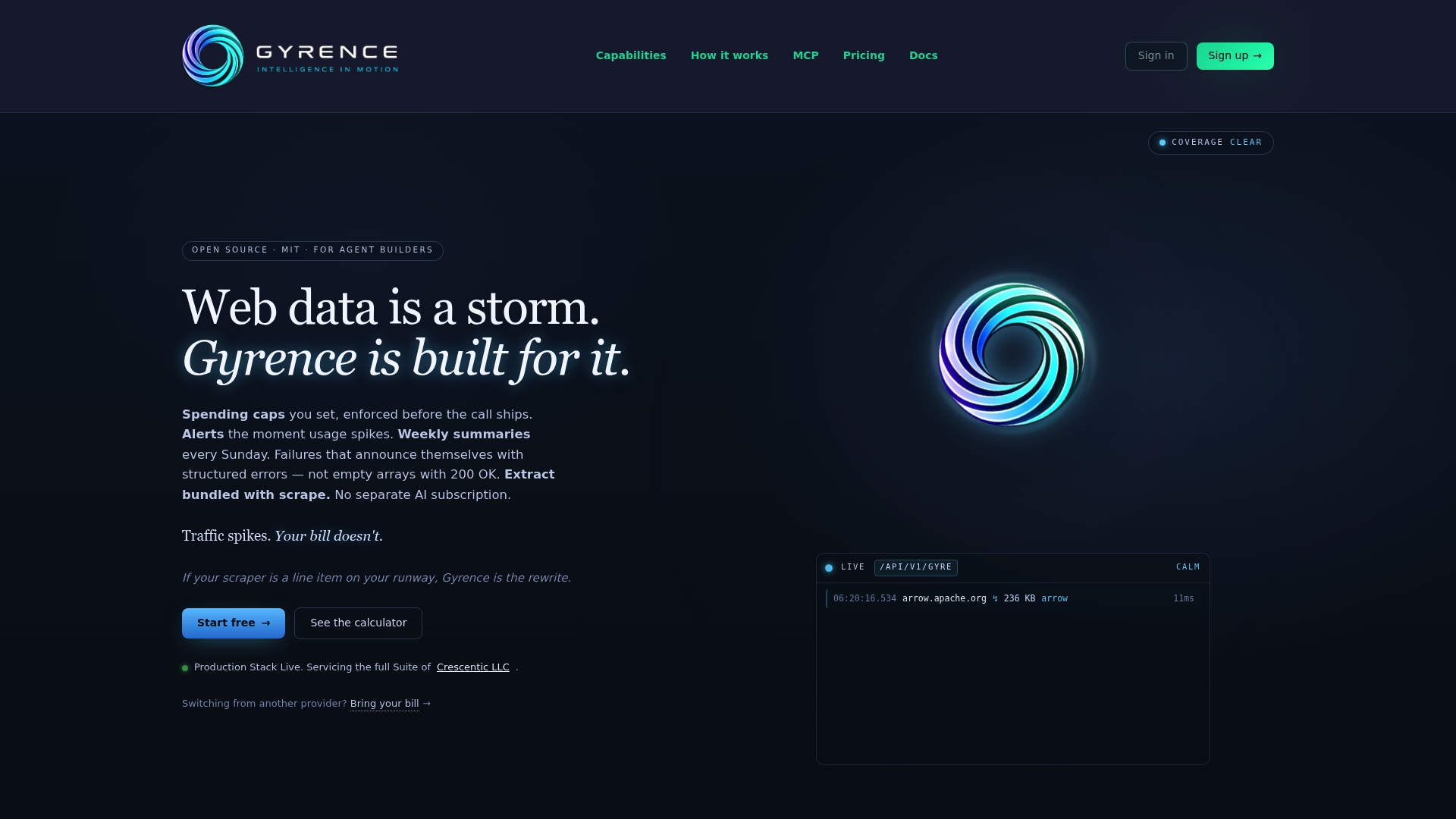
Gyrence handles the hard parts of web browsing compliance: cleaning pages to LLM-friendly markdown, extracting structured JSON with a prompt or schema, and mapping a domain's full URL graph. Spending caps mean your scraping bill never surprises you. If you are building agents that need reliable web data, Gyrence's web data infrastructure is where to start.
FAQ
What is an AI agent web browsing checklist?
An AI agent web browsing checklist is a structured set of technical and interaction criteria that developers verify to confirm their web environments support reliable autonomous agent browsing, extraction, and task completion.
Why do AI agents need server-side rendered HTML?
Most AI agents cannot execute complex client-side JavaScript, so pages that rely on JS hydration to display content appear blank to the agent. Server-rendered content is the baseline requirement for agent-readable pages.
What is the recon-first navigation pattern?
Recon-first navigation means the agent maps all page elements by semantic role before taking any action. This approach reduces errors from dynamic layouts and is the current best practice for AI browser automation.
How does llms.txt help AI agents?
The llms.txt file at the domain root gives agents a machine-readable site summary and key navigation links. It reduces exhaustive crawling and cuts the hallucination risk that comes from agents guessing at site structure.
How do I stop anti-bot systems from blocking my agent?
Rotate user-agent strings, introduce randomized delays between requests, persist cookies across sessions, and implement exponential backoff on rate-limit responses. Pairing these techniques with a recon-act-verify loop prevents most common bot-detection triggers.