
TL;DR:
- AI agent web data primitives are typed, composable operations that enable reliable web interactions without fragile click automation.
- Most top websites are only about half agent-ready, underscoring the need for structured data and new standards like WebMCP to improve accessibility for AI agents.
AI agent web data primitives are the typed, composable building blocks that let AI agents search, fetch, extract, and map web content without brittle click automation. The industry term for this concept is "agent-ready web data," and primitives are its atomic units. Gyrence formalizes five of them: Search, Traverse, Fetch, Extract, and Map. Each returns a typed, discriminated-union response, including failure cases, so your agent can reason about results rather than guess. This guide covers what each primitive does, how emerging standards like WebMCP are reshaping the field, and what best practices separate production-grade agent architectures from fragile prototypes.
1. What are AI agent web data primitives?

A web data primitive is a single, typed operation that an AI agent calls to interact with the web. Think of it as a verb with a strict input schema and a predictable output schema. The primitive handles the messy implementation details. The agent receives clean, structured data.
The five core primitives that appear consistently across agent architectures are Search (query the open web), Traverse (crawl outward from a seed URL), Fetch (retrieve and clean a page to markdown), Extract (pull structured JSON using a prompt or schema), and Map (build a domain's URL graph). Each primitive is composable. You chain them to build workflows without rewriting parsing logic at every step.
The contrast with older approaches is stark. Early agent designs relied on click-based browsing, which tied agents to fragile DOM selectors and pixel coordinates. Typed primitives raise the abstraction level. They expose API-like interfaces that abstract the underlying implementation, making agents more reliable and auditable.
Pro Tip: When designing a primitive, write the output schema before the implementation. If you cannot describe the output in a JSON schema, the primitive is not ready for an agent to consume.
2. Reasoning and model selection as a primitive
Reasoning is the first primitive in any agent architecture. The agent selects a model, constructs a prompt, and interprets a response. This step sets the quality ceiling for everything downstream.
Strict input/output schemas are the single most effective way to reduce reasoning errors. When the model receives compact, structured data instead of raw HTML noise, it spends fewer tokens on parsing and more on the actual task. This is not a minor efficiency gain. It directly affects the accuracy of every downstream action.
Model selection also belongs in the primitive layer. Different tasks warrant different models. A lightweight classification step does not need the same model as a multi-step extraction workflow. Encoding that logic in the primitive keeps the orchestration layer clean.
3. Tools and actions: typed web verbs
Tools are the primitives agents call to act on the world. In the web context, that means HTTP requests, form submissions, and structured queries. The key design principle is that typed actions with explicit schemas replace unreliable click automation.
A typed web verb looks like a function call: extract(url, schema) returns a typed JSON object or a typed failure. The agent never sees raw HTML. It never guesses whether a button click succeeded. The primitive either returns a valid result or returns a structured error the agent can reason about.
This design also makes auditing straightforward. Every call has a logged input, a logged output, and a logged failure mode. When an agent misbehaves in production, you trace the primitive call log rather than replay a browser session frame by frame.
4. Memory: keeping state outside the LLM
LLMs are stateless. Every call starts with a blank context window. This is the most commonly underestimated constraint in agent architecture design.
Successful primitives handle stateful session management entirely outside the model. Cookies, session tokens, and multi-step interaction state live in the primitive layer, not in the prompt. When state leaks into the prompt, agents become brittle and prone to infinite loops where the model re-requests data it already retrieved.
The practical fix is straightforward. Your Fetch or Traverse primitive maintains a session object. It passes the session context forward between calls. The LLM receives only the structured output of each step, not the raw session state.
5. Orchestration: composing primitives into workflows
Orchestration is the layer that sequences primitive calls based on agent goals. A well-designed orchestration layer treats each primitive as a black box with a typed interface. It does not care how Fetch cleans a page. It cares that Fetch returns a predictable markdown string or a typed error.
The web map tools pattern illustrates this well. An agent maps a domain's URL graph first, then selects target URLs, then fetches and extracts in parallel. Each step is a discrete primitive call. The orchestration layer handles retries, branching, and replanning when a primitive returns a failure type.
Composability is what makes this architecture durable. You swap out the Extract primitive for a different schema without touching the orchestration logic.
6. Control plane and governance
The control plane governs what agents are allowed to do. It enforces spending caps, rate limits, and consent boundaries. Without it, a misconfigured agent can exhaust a budget or hammer a target site in minutes.
Gyrence builds the control plane into the API layer. Spending caps are set at the account level. Every call returns a typed response that includes cost metadata. The agent knows before it proceeds whether it has budget remaining. This is the "honest-by-design" principle in practice: the failure mode is explicit, not silent.
Governance also covers consent. Agents must respect robots.txt, rate limits, and terms of service. Encoding these checks in the primitive layer means developers do not have to reimplement them in every workflow.
7. How modern standards improve agent-ready web data
The web was not built for agents. As of may 2026, the top 100 websites average only a 55% agent readiness score, with 99% failing basic content negotiation like returning markdown or JSON on request. That number shows how far the ecosystem still has to go.
WebMCP, introduced in Chrome 146, is the most significant structural change. It exposes structured interaction surfaces directly to agents, moving beyond DOM scraping entirely. Sites that implement WebMCP publish a machine-readable catalog of actions agents can call. Audit tools at isitagentready.com let developers check a site's readiness score before building against it.
Content negotiation is the other critical gap. Sending raw HTML to an LLM is an anti-pattern that inflates token consumption by 60–80% and degrades reasoning quality. Primitives that request markdown or JSON responses by default solve this at the infrastructure level. Developers should not have to strip HTML noise manually in every workflow.
- Check the target site's agent readiness score before building.
- Request markdown or JSON via content negotiation headers.
- Use WebMCP-compatible endpoints where available.
- Fall back to a typed Fetch primitive that cleans HTML to markdown automatically.
Pro Tip: Use the agent readiness audit checklist to distinguish between "agent-readable" (machine-parseable) and "agent-addressable" (entity-identifiable) capabilities before committing to a data source.
8. Best practices for designing web data primitives
Typed parameters and structured outputs are non-negotiable. Agents perform best with compact, structured data and strict schemas that minimize token usage on noise. Every primitive should define its input schema, its success output schema, and its failure output schema before any implementation begins.
Separate content parsing from action execution. A Fetch primitive retrieves and cleans content. An Extract primitive interprets it. Mixing these two responsibilities in one function creates a primitive that is hard to test, hard to debug, and hard to reuse. Keep the I/O contracts explicit and narrow.
Avoid brittle DOM-based interactions wherever possible. Stable CSS selectors or unique element IDs are more reliable than textual labels for addressing page elements. When a site updates its layout, a selector-based primitive degrades gracefully. A text-label-based primitive fails silently. For a deeper look at why unstructured HTML breaks agents, the agents fail on unstructured HTML guide covers the failure modes in detail.
9. Comparing primitive categories by use case
Different workflows demand different primitive designs. Modern browser automation APIs can return full-page maps with interactive elements and structured schemas in approximately 30ms. That latency profile suits lightweight agents doing real-time reconnaissance. It does not suit batch extraction workflows where throughput matters more than speed.
| Feature category | Low-level scraping | Typed web verbs | Structured API primitives |
|---|---|---|---|
| Output format | Raw HTML | Typed JSON or markdown | Typed JSON with schema |
| Failure handling | Silent or exception | Typed error response | Typed discriminated union |
| State management | Manual | Primitive-managed | Primitive-managed |
| Token efficiency | Low | High | Highest |
| Auditability | Low | Medium | High |
| Agent replanning support | None | Partial | Full |
Lightweight agents doing single-page lookups can tolerate low-level scraping if the target site is stable. Production-grade orchestration workflows require typed primitives with explicit failure modes. The table above shows why: silent failures and raw HTML are incompatible with agents that need to replan on error.
Key takeaways
Agent-ready web data requires typed, composable primitives with explicit failure modes, structured outputs, and state management outside the LLM context window.
| Point | Details |
|---|---|
| Typed primitives beat click automation | Typed web verbs with explicit schemas are more reliable and auditable than DOM-based interactions. |
| State belongs outside the LLM | Session management in the primitive layer prevents brittle loops and context overflow. |
| Content negotiation cuts token waste | Requesting markdown instead of raw HTML reduces token consumption by 60–80%. |
| Agent readiness is still low | The top 100 websites average only 55% agent readiness; audit before building against any source. |
| Composability is the design goal | Primitives chained with clear I/O contracts let you swap components without rewriting orchestration logic. |
The shift I keep watching in agent architecture
The most underappreciated change in agent development right now is not the model quality. It is the move from "automate the browser" to "call the primitive." Developers who built their first agents in 2023 spent enormous effort on CSS selectors, screenshot parsing, and retry logic. That work is now largely avoidable if you design at the right abstraction level.
What I find interesting is that the bottleneck has shifted from the agent to the web itself. The 55% average readiness score is not a number to dismiss. It means nearly half of what agents encounter is structurally hostile to machine consumption. WebMCP and content negotiation are the right responses, but adoption will be slow. Sites have no immediate incentive to publish agent-friendly interfaces unless agents drive measurable traffic or revenue.
The practical implication for developers is to build defensively. Assume the target site will not cooperate. Design your primitives to clean, normalize, and type the output regardless of what the source delivers. The agent should never know whether the upstream data came from a WebMCP endpoint or a raw HTML scrape. That is the job of the primitive layer.
Security and consent boundaries are the next hard problem. Typed primitives make auditing easier, but they do not automatically enforce what an agent is allowed to do. The control plane has to carry that weight. Build it early, not as an afterthought.
— Glen
Gyrence: web data infrastructure built for agents
Gyrence gives you five composable primitives (Search, Traverse, Fetch, Extract, Map) through a single API or a hosted Model Context Protocol endpoint. Every call returns a typed, discriminated-union response, including the failure cases, so your agent can replan instead of crash. Spending caps are built in at the account level, and bundled LLM extraction means your token costs are predictable.
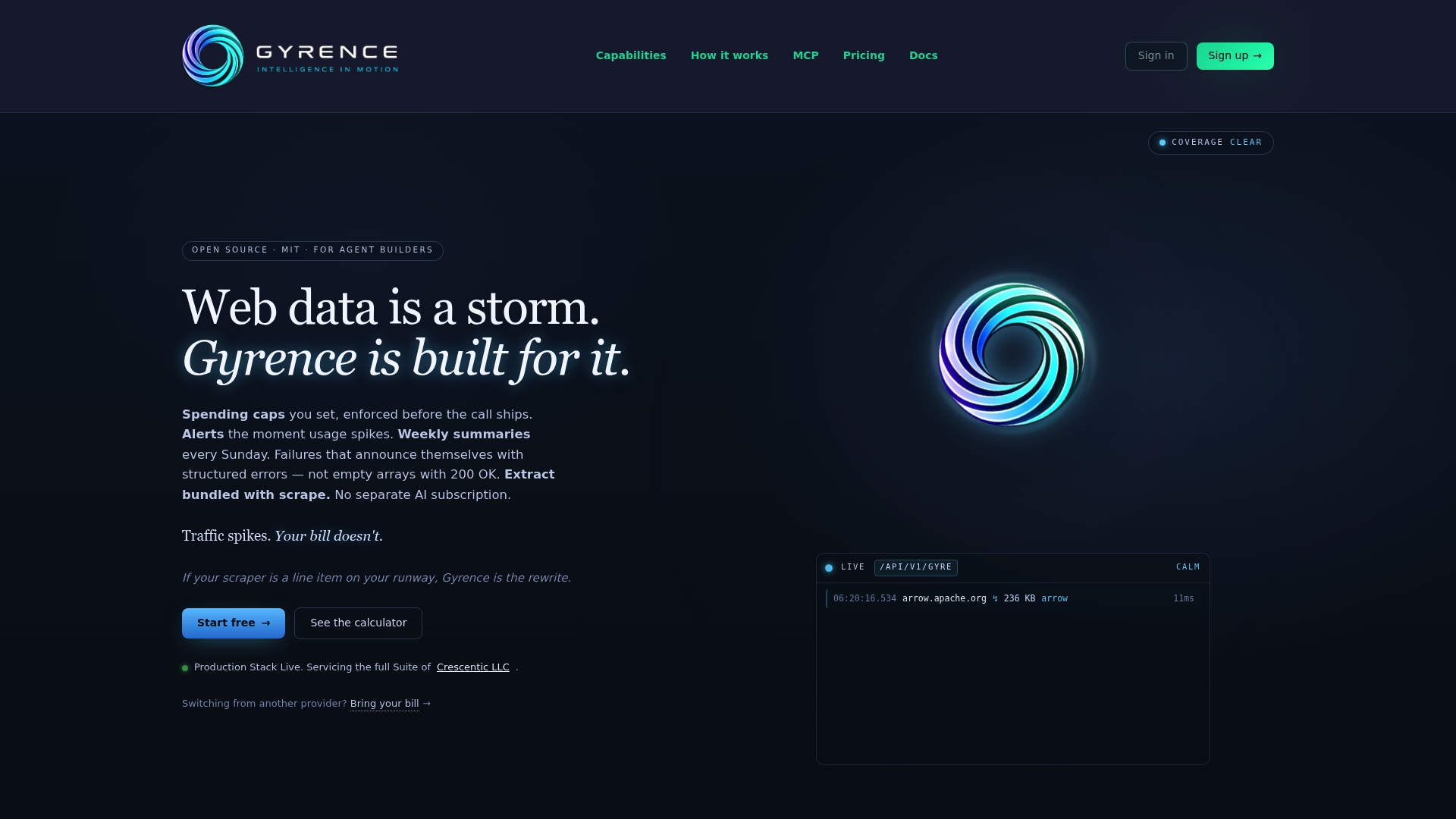
If you are building agent workflows that depend on structured web data extraction, Gyrence handles the primitive layer so you can focus on the orchestration logic. Read the Gyrence docs or connect directly from the console.
FAQ
What is a web data primitive for agents?
A web data primitive is a single, typed operation (such as Fetch, Extract, or Search) that an AI agent calls to interact with web content. It returns a structured output with explicit failure modes, so the agent can reason about results rather than parse raw HTML.
What is agent-ready web data?
Agent-ready web data is machine-parseable, structured content that an AI agent can consume without additional cleaning. As of 2026, only 55% of top websites meet basic agent readiness criteria, with 99% failing content negotiation for markdown or JSON output.
Why do AI agents fail on raw HTML?
Raw HTML inflates token consumption by 60–80% and introduces noise that degrades LLM reasoning. Primitives that convert HTML to clean markdown or structured JSON before passing data to the model solve this at the infrastructure level.
What is WebMCP and why does it matter?
WebMCP is a browser specification introduced in Chrome 146 that lets websites expose structured, machine-readable interaction surfaces directly to AI agents. It replaces fragile DOM scraping with typed, auditable action catalogs that agents can call like API endpoints.
How should primitives handle stateful web interactions?
Session state, cookies, and multi-step interaction context must live in the primitive layer, not in the LLM prompt. Stateless LLMs cannot manage session continuity on their own, and pushing state into the context window causes brittle loops and unpredictable agent behavior.