
TL;DR:
- An API response schema defines the expected data structure, types, and constraints, acting as a formal contract. It improves integration by enabling validation and early detection of contract drift, but does not guarantee data correctness. Proper schema design, versioning, and layered validation are essential for reliable and maintainable API interactions.
An API response schema is a machine-readable blueprint that specifies exactly how an API's returned data is structured, typed, and constrained. The schema acts as a formal contract between the API provider and every client consuming that data. JSON Schema Draft 2020-12 is the prevailing standard, covering constraints like minLength, maximum, pattern, and format hints such as uuid and date-time. Without a schema, clients parse responses by assumption. Assumptions break in production.
What is API response schema? Core components and keywords
An API response schema is built from a small set of JSON Schema keywords that together describe every field a client should expect. These keywords form the vocabulary developers use to declare rules about shape, type, and allowed values.
The most critical keywords are:
type— declares the data type:string,number,boolean,array, orobjectrequired— lists fields the response must always includeproperties— defines each field and its own sub-schemaenum— restricts a field to a fixed set of allowed valuesadditionalProperties— controls whether extra, undeclared fields are permitted
Constraint keywords add precision beyond type checking:
minimum/maximum— numeric bounds (e.g., a price field cannot be negative)minLength/maxLength— string length limitspattern— a regex the string value must matchformat— a hint for semantic formats:email,date-time,uuid
A practical schema segment for an order object looks like this:
| Keyword | Example value | What it enforces |
|---|---|---|
type | "object" | Field must be a JSON object |
required | ["id", "status"] | Both fields must be present |
enum | ["pending", "shipped"] | Status limited to two values |
pattern | "^ORD-[0-9]{6}$" | Order ID must match format |
additionalProperties | false | No undeclared fields allowed |

Setting additionalProperties: false is especially useful when you want to catch unexpected data early. Any field the provider adds without updating the schema triggers a validation error immediately, surfacing contract drift before it corrupts downstream data.
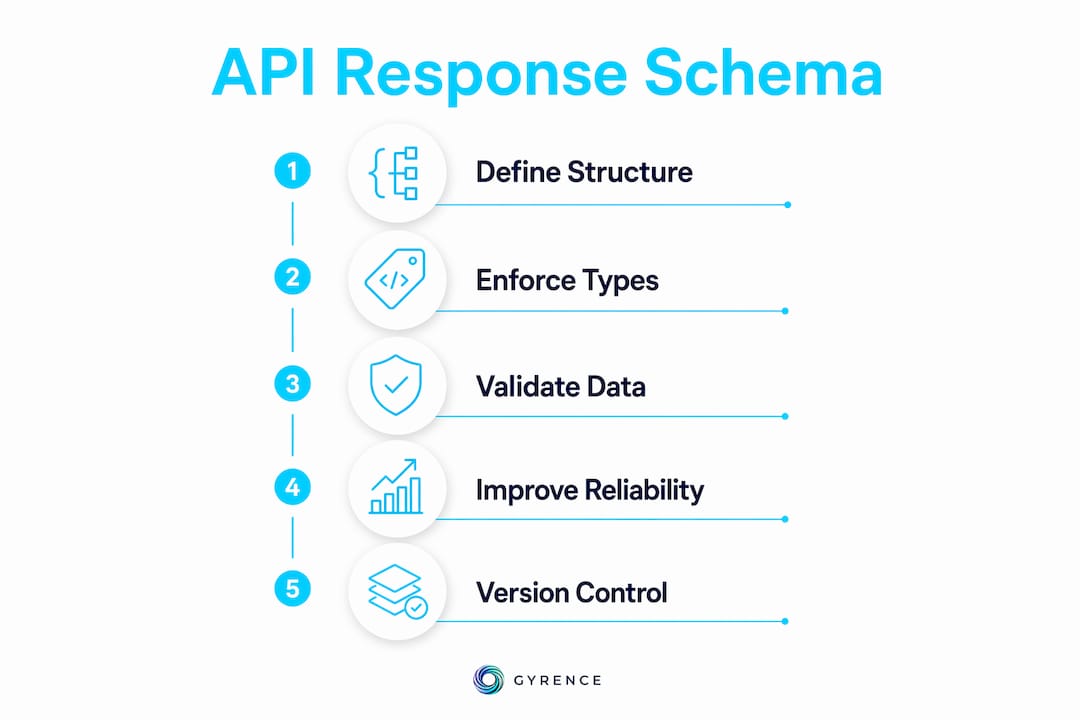
How do schemas enable validation and improve integration reliability?
Schema validation is the practice of running an API response against its schema at test time or runtime to confirm the response conforms to the contract. Libraries like AJV (JavaScript), Pydantic (Python), and Zod (TypeScript) each accept a schema and a response object, then return a pass or a structured list of violations.
The practical benefits are concrete:
- Fewer integration bugs. Clients parse fields they know exist, typed as expected.
- Contract drift detection. Automated tests catch when a provider silently removes or renames a field.
- Uniform error handling. RFC 9457 Problem Details standardizes error responses with
type,title,status,detail, andinstancefields, so every error is machine-parseable by the same code path. - Faster onboarding. A new developer reads the schema and understands the API without reading source code.
Pro Tip: Run schema validation in your CI pipeline against recorded API fixtures. When a provider updates their API, your tests fail before your production code does.
Validation libraries differ in their approach. AJV compiles schemas to fast validator functions. Pydantic uses Python type annotations and runs validators at model instantiation. Zod infers TypeScript types directly from the schema definition. The right choice depends on your stack, but all three enforce the same JSON Schema vocabulary. Pairing any of them with API design best practices reduces the surface area for integration failures significantly.
What are the limits of schema validation?
The most common misconception in API development is treating schema validation as a guarantee of data correctness. Schema only ensures shape correctness. It confirms that a field named total is a number. It does not confirm that the number is logically consistent with the line items in the same response.
Schema is a type signature. It tells you a field is present and typed correctly. It does not tell you the value makes sense. A response with
"total": 0and ten $50 line items passes schema validation without complaint.
This gap matters most in financial pipelines, data extraction workflows, and AI-driven structured output. Constrained-grammar decoding in AI strict mode reduces malformed JSON errors to near zero. That is a genuine improvement. But a structurally valid response can still contain a date range where the end date precedes the start date, or a discount that exceeds the subtotal.
Common pitfalls and how to address them:
- Structural pass, semantic fail. Add Pydantic validators or Zod
.refine()calls to check cross-field logic after schema validation passes. - Truncation errors in AI output. Long nested objects can be truncated at token limits. Validate that arrays have the expected item count, not just the expected type.
- Schema conversion mismatches. Different providers interpret JSON Schema subsets differently. Design schemas to be provider-specific when working across multiple AI APIs.
- Silent contract breaks. A provider adds a new required field. Your schema does not include it. Validation passes because your schema never declared it as required.
Pro Tip: Use property-based testing with Hypothesis (Python) alongside Pydantic models to generate adversarial inputs. This catches edge cases like invalid date ranges or logically inconsistent totals that schema validation alone will never surface.
Semantic validation is not optional in production pipelines. It is the layer that catches what schema validation cannot.
API response best practices for schema design and versioning
Good schema design starts with simplicity. Schemas that become black boxes lose developer trust. If a schema requires a separate document to explain its constraints, the schema is too complex.
Follow these design principles:
- Use the envelope pattern. Structure every response with
data,meta, anderrortop-level fields. API responses should return eitherdataorerror, never both. This makes client-side branching logic trivial. - Version your schema. Include a
schema_versionfield in themetaenvelope. Schema versioning lets downstream systems reject stale contracts and gives your observability stack a signal when a schema change ships. - Separate request and response schemas. Request schemas omit server-generated fields like
idandcreated_at. Response schemas include them. Mixing the two creates ambiguity about which fields are required in which direction. - Classify failures explicitly. Distinguish between validation errors (client fault, do not retry), server errors (retry with backoff), and semantic errors (route to a dead-letter queue for review).
- Treat documentation as a first-class artifact. Publish the schema alongside the API reference. Developers who can read the schema without reading source code integrate faster and file fewer bugs.
Pro Tip: Implement dead-letter queues for semantic validation failures in data pipelines. Corrupt or logically inconsistent records get isolated for review without blocking the entire processing job.
| Response pattern | When to use it | Key benefit |
|---|---|---|
Envelope (data/error) | All public APIs | Predictable client branching |
| Schema versioning | APIs with evolving contracts | Safe incremental evolution |
| RFC 9457 error body | Error responses | Uniform programmatic handling |
Implementing schema validation in development workflows
Schema validation delivers the most value when it runs at every stage of development, not just in production.
- Write schemas for critical endpoints first. Start with the endpoints your application depends on most. Define the schema before writing the client code, not after.
- Validate in tests against real fixtures. Record actual API responses and run them through your schema validator in CI. When the provider changes their API, your fixture tests fail immediately.
- Validate at runtime on ingestion. For data extraction pipelines, validate each response as it arrives. Log violations with the full response body for debugging. Do not silently discard invalid responses.
- Handle violations gracefully. A schema violation in production should trigger an alert and route the payload to a dead-letter queue, not crash the process.
- Automate schema updates. When you update a schema, run the full fixture suite before deploying. This catches regressions in both directions: fields you removed that clients still send, and fields providers added that you have not yet declared.
Contract-first development, where the schema is written before the implementation, produces fewer integration surprises than schema-last approaches. The structured data extraction pattern applies this principle directly to web data pipelines.
Key Takeaways
A well-designed API response schema is a typed contract that enforces structure, enables automated validation, and requires semantic checks to guarantee data correctness end to end.
| Point | Details |
|---|---|
| Schema defines structure, not correctness | Schema validates shape and types; semantic logic requires separate application-level checks. |
| JSON Schema Draft 2020-12 is the standard | Use keywords like type, required, enum, and additionalProperties to define precise contracts. |
| Envelope pattern simplifies clients | Return either data or error at the top level; never both in the same response. |
| Version schemas in response metadata | A schema_version field lets downstream systems detect and reject stale contracts safely. |
| Validate at every pipeline stage | Run schema checks in CI fixtures, at runtime ingestion, and route violations to dead-letter queues. |
Schema is a contract, not a trust boundary
The framing I see developers get wrong most often is treating schema validation as the finish line. It is not. It is the starting line.
A schema tells you the data arrived in the right shape. It does not tell you the data is trustworthy. I have seen financial pipelines pass schema validation on every record while silently accumulating logically inconsistent totals for weeks. The schema was correct. The data was garbage.
The fix is not a better schema. The fix is layered validation: schema for structure, Pydantic or Zod validators for cross-field logic, and dead-letter queues for anything that fails semantic checks. Schema versioning is the other piece most teams skip until a silent contract break costs them a weekend. Add schema_version to your response envelope now, before you need it.
The teams I have seen handle this well treat the schema as a living document, versioned alongside the API, tested against real fixtures in CI, and published as a first-class artifact in their developer docs. The web data schema design principles that apply to analyst-facing pipelines map directly to API response contracts. The discipline is the same.
— Glen
Gyrence and typed API responses for data teams
Gyrence is built around the principle that every API response should be typed, predictable, and honest about failure. Every call to the Gyrence API returns a discriminated-union response that includes the failure cases explicitly, so your agent or pipeline never has to guess whether an empty result means success or a silent error.
The Extract primitive accepts a JSON Schema or a natural-language prompt and returns structured JSON validated against that schema. The Gyrence API enforces spending caps and structured failure modes so your data pipeline knows exactly what it received and why. If you are building a web data integration that depends on reliable, schema-driven extraction, Gyrence gives you the typed contract your downstream systems need.
FAQ
What is an API response schema?
An API response schema is a machine-readable specification, typically written in JSON Schema, that defines the structure, data types, required fields, and value constraints of data an API returns. It acts as a formal contract between the API provider and its clients.
What is JSON Schema Draft 2020-12?
JSON Schema Draft 2020-12 is the current standard vocabulary for describing and validating JSON data. It covers keywords like type, required, properties, enum, minimum, maximum, pattern, and format hints such as date-time and uuid.
Does schema validation guarantee data correctness?
No. Schema validation confirms that a response has the correct shape and field types. Semantic correctness, such as whether a total matches its line items, requires separate application-level validation using tools like Pydantic validators or Zod .refine() methods.
What is the envelope pattern in API responses?
The envelope pattern structures every API response with top-level data, meta, and error fields. A response returns either data or error, never both, which makes client-side parsing logic predictable and consistent across all endpoints.
How does schema versioning prevent integration failures?
Including a schema_version field in the response metadata lets downstream systems detect when a contract has changed. Systems can reject stale schemas and alert teams to update their validation logic before a silent contract break corrupts production data.