
An audit trail is an append-only, time-ordered, tamper-evident record that answers who, what, when, where, and why for every web-data event: a fetch, an extraction, a mutation. It applies to a scraper the same way it applies to a database write.
An audit-grade trail for web data needs four things at minimum: immutable storage (append-only or WORM), high-precision timestamps synced to a trusted clock, pseudonymized actor identifiers, and cryptographic tamper evidence, usually a hash chain linking each event to the last. Without those four, you have logs. With them, you have evidence.
- Append-only: events are written once, never edited or deleted
- Precise timestamps: RFC 3339 / ISO 8601 with UTC and millisecond precision
- Actor pseudonymization: hashed or tokenized identifiers instead of raw PII
- Diffs or snapshots: every change traceable to a before/after state
- Tamper evidence: hash chaining or signed timestamps
NIST's Computer Security Resource Center defines an audit trail as exactly this kind of chronological record, and frameworks like HIPAA and PCI DSS build their evidentiary requirements on the same foundation.
Key Takeaways
An audit-grade web-data trail requires append-only storage, synchronized timestamps, pseudonymized actors, and cryptographic tamper evidence, or it won't survive a compliance review.
| Point | Details |
|---|---|
| Definition matters | An audit trail is append-only and tamper-evident; a debug log is neither, and conflating them creates compliance gaps. |
| Required fields | Every event needs eventId, actorId, action, resource, ISO 8601 timestamp, context, outcome, and a hash chain. |
| Use JSON Patch for diffs | RFC 6902 patches keep mutation events compact; reserve full snapshots for critical resources only. |
| Separate duties | The database role writing audit events should never hold delete or update privileges on that table. |
| Gyrence surfaces provenance natively | Gyrence's typed responses expose job IDs, status codes, and parser versions that map directly to audit-event fields. |
Table of Contents
- Audit Trail Web Data Examples: What Actually Distinguishes One
- Why Web-Data Audit Trails Matter: The Jobs They Actually Do
- Types of Audit Trails and Where Web Data Fits
- What a Web-Data Audit Trail Should Include
- Copy-Pasteable Web-Data Audit Trail Examples
- How to Architect Reliable Audit-Trail Collection
- Retention, Integrity, and Compliance Mapping
- Common Challenges at Scale (and How to Fix Them)
- How Web-Data Collection Primitives Map to Audit Fields
- What I've Learned Reviewing Web-Data Audit Pipelines
- Capturing Provenance Without Building It Yourself
- Sources
- FAQ
Audit Trail Web Data Examples: What Actually Distinguishes One
An audit trail is a chronological, append-only record of activity built specifically to answer who did what, to which resource, when, and with what result. That's the definition. What trips people up is assuming their existing application logs already qualify.
A real audit trail carries a specific set of attributes:
- Append-only structure with no in-place edits or silent deletes
- Immutability or tamper-evidence, typically via hash chaining or write-once storage
- Precise, synchronized timestamps tied to a trusted time source
- Structured actor/action/resource/outcome fields on every event
- Non-repudiation, meaning the actor can't credibly deny the action occurred
Debug logs and audit trails solve different problems, and conflating them is one of the most common compliance gaps. A debug log exists to help an engineer trace a stack trace at 2 AM. It gets rotated, truncated, or dropped without ceremony because nobody needs it after the bug is fixed. An audit trail exists to survive a subpoena, a SOC 2 assessment, or a regulator's request two years later. Viruchith Ganesan's analysis of compliance-grade audit trails makes the point directly: an audit trail must be legally defensible and structurally separate from operational logging, or it collapses under scrutiny the moment someone asks whether it could have been altered.
Why Web-Data Audit Trails Matter: The Jobs They Actually Do
Audit trails for web data serve four core jobs: reconstructing incidents, proving compliance, tracking changes, and establishing data provenance for legal or research defense.
- Incident investigation: rebuild the exact sequence of fetches, extractions, and access events during a suspected breach
- Compliance evidence: produce logs on demand for SOC 2, HIPAA, or PCI DSS auditors who need proof, not assurances
- Data provenance: document where a dataset came from and how it was transformed, critical for legal defense or academic citation
- Change tracking: show exactly what a record looked like before and after a modification, and who made it
Think about the job-to-be-done in concrete terms. "Reconstruct which employee accessed customer records during a three-day window" is a HIPAA audit ask. "Prove this scraped price dataset wasn't tampered with before litigation" is a provenance ask. Same underlying infrastructure, different questions.
Types of Audit Trails and Where Web Data Fits
There are five broad types of audit trails: system, application, transaction/database, network/HTTP, and collection/provenance, and web-data work usually touches at least three of them at once.
- System audit trails capture OS-level and infrastructure events (logins, permission changes, config edits)
- Application audit trails capture business-logic events inside your own codebase (user actions, feature usage)
- Transaction/database audit trails capture row-level changes, often via native features like SQL Server Audit
- Network/HTTP audit trails capture request-response pairs, status codes, and headers at the transport layer
- Collection/provenance audit trails capture how a piece of web data was acquired, parsed, and transformed
Web-data provenance is its own animal because it has to track a chain of custody that doesn't exist in typical application logging: crawl job metadata (job ID, crawl version), fetch response provenance (source URL, status code, response headers), parse and extraction lineage (which parser version, which schema), and finally the linkage from raw fetch to derived dataset. If you can't answer "which crawl job produced this row, and what did the source page actually say at fetch time," your provenance trail has a gap an auditor will find.
What a Web-Data Audit Trail Should Include
Every web-data audit event needs a minimum set of fields to be forensically useful and audit-ready: a unique event ID, a pseudonymized actor identifier, the action taken, the target resource, a UTC timestamp, request context, the outcome, a diff or snapshot, and a hash linking it to the prior event.
- eventId: a UUID or ULID, unique per event, never reused
- actorId: pseudonymized or tokenized identifier, never a raw name or email
- action: a closed-vocabulary verb (
fetch,extract,update,delete), not free text - resource / resourceId: the specific URL, record, or dataset affected
- timestamp: RFC 3339 / ISO 8601 format, UTC, Z-suffixed (
2026-03-12T14:22:01.483Z) - context: IP address, user agent, session ID, requestId, and traceId
- outcome: success, failure, or partial, with an error code where relevant
- diff: a JSON Patch (RFC 6902) for partial changes, or a full snapshot for critical resources
- prevHash / eventHash: a cryptographic link to the previous event, forming a chain
Use closed vocabularies for the action field specifically. Free-text action descriptions are the single biggest source of unparseable audit data at scale, because "updated record," "record was updated," and "modify" all mean the same thing to a human and nothing consistent to a query engine. JSONic's guide to JSON audit trail schema design lays out this canonical field set in more depth, including why JSON Patch beats full-diff storage for most mutation events.
Pro Tip: Never log raw request bodies or free-text search queries that might contain PHI or PII. Redact at the point of emission, not later, because "later" is where breach lawsuits are born.
What you leave out matters as much as what you include. Don't log full request payloads by default. Don't log search query strings verbatim if users might type health conditions, names, or account numbers into a search box. HHS guidance on HIPAA audit controls makes clear that recording access to protected health information is mandatory, but recording the PHI itself inside the audit log just duplicates your exposure.
Copy-Pasteable Web-Data Audit Trail Examples
Here are four canonical examples you can drop into a pipeline today: a plaintext access log line, a compact JSON fetch event, a JSON Patch mutation event, and a full-snapshot event with hash chaining.
1. Plaintext HTTP fetch log line
2026-03-12T14:22:01.483Z fetch requestId=8f3a-91c2 actor=usr_7f2e1 resource=https://example.com/products/1123 status=200 latency_ms=214 userAgent=GyrenceFetch/1.4
2. Compact JSON fetch event (no diff needed)
{
  "eventId": "01H9X7K2M3N4P5Q6R7S8T9",
  "actorId": "usr_7f2e1a",
  "action": "fetch",
  "resource": "https://example.com/products/1123",
  "timestamp": "2026-03-12T14:22:01.483Z",
  "context": {
    "requestId": "8f3a-91c2",
    "traceId": "trace_44a1",
    "ip": "203.0.113.hash",
    "userAgent": "GyrenceFetch/1.4"
  },
  "outcome": "success"
}
3. Mutation event with JSON Patch diff
{
  "eventId": "01H9X7K2M3N4P5Q6R7S8U0",
  "actorId": "usr_7f2e1a",
  "action": "update",
  "resource": "dataset_price_history",
  "resourceId": "row_88213",
  "timestamp": "2026-03-12T14:23:07.912Z",
  "diff": [
    { "op": "replace", "path": "/price", "value": 42.99 },
    { "op": "replace", "path": "/lastChecked", "value": "2026-03-12T14:23:07Z" }
  ],
  "outcome": "success",
  "prevHash": "a1b2c3...",
  "eventHash": "d4e5f6..."
}
4. Full-snapshot event for a critical resource
For high-stakes records, such as a legal filing or a regulatory disclosure, store the entire before/after state rather than a diff, and chain it with a hash tied to the prior event. That Merkle-style chaining is what JSONic's audit trail design guide recommends specifically for tamper detection.
A single hash chain across your event stream turns "trust us, nothing was altered" into "here's the math that proves it." That's the difference between a log and evidence.
To reconstruct a timeline, query events by traceId or requestId first, then sort by timestamp ascending. A single scraping session that fetches a page, extracts structured data, and writes it to a dataset should produce three events sharing one traceId, letting you rebuild the full sequence in one query rather than stitching logs from three separate systems.
How to Architect Reliable Audit-Trail Collection
The common architecture is: emitter, local buffer with transactional insert, stream or broker, immutable sink for forensics, and a separate query tier for analytics.
- In-transaction inserts vs. async dual-write: writing the audit event inside the same database transaction as the business write avoids the race condition where a mutation succeeds but its audit record never lands
- Message brokers: Kafka or Kinesis decouple emitters from downstream consumers and absorb bursts without dropping events
- Centralized logging: stream to a platform like Datadog, Splunk, or CloudWatch for real-time search and alerting
- Cold archival: push finalized events to object storage with object-lock enabled, satisfying the immutability requirement cheaply at scale
On tooling, most teams land on a combination: lightweight collectors or log shippers at the edge, an ELK or OpenSearch cluster for hot queryable data, and a write-only database role for the audit table itself. Separation of duties matters here specifically: the account that writes audit events should not have delete or update privileges on that table, full stop. If your database administrator can quietly edit the audit log, you don't have an audit log.
Microsoft's Azure security fundamentals guidance covers this pattern for cloud-native deployments, including how platform-level audit logs complement application-level ones rather than replacing them. For teams building on their own web data provenance pipeline, the same emitter-to-sink architecture applies whether the source event is a database write or a scraper's fetch.
Retention, Integrity, and Compliance Mapping
Retention windows and integrity controls vary by which standard governs your data, so the sink itself should enforce both rather than relying on manual policy compliance.
- Retention tiers: hot storage for 30 to 90 days, cold archival beyond that, governed by the strictest applicable standard
- Cryptographic hashing: hash-chain or Merkle-tree each event to the prior one for tamper detection
- Signed timestamps: third-party or internal time-stamping authority signatures strengthen non-repudiation
- Role-based access: read access to audit tables should be logged itself, and write/delete access should not exist for normal operators
- Legal hold preservation: retention policy must support indefinite hold overrides when litigation is pending
PCI DSS, HIPAA, SOC 2, and NIST's Cybersecurity Framework each prescribe different combinations of retention length and control rigor, and the PCI Security Standards Council requires specific retention windows for cardholder data environments that don't map cleanly onto HIPAA's PHI access rules. Auditors under AICPA's SOC 2 framework generally expect evidence presented as exportable, timestamped records with a demonstrable chain of custody, not a verbal assurance that "we log everything." Build your retention tier to the strictest standard your data touches, then apply it uniformly rather than maintaining parallel retention schemes per regulation.
Common Challenges at Scale (and How to Fix Them)
The top operational challenges with web-data audit trails are volume, cost, signal noise, PII exposure, and query latency, and each has a specific mitigation.
- Volume: apply tiered retention and selective sampling for low-risk event types rather than logging everything at full fidelity forever
- Cost: favor compact RFC 6902 JSON Patch diffs over full snapshots, reserving snapshots for genuinely critical resources
- Noise: enforce a closed vocabulary for action types and filter by event type before alerting
- PII risk: redact and pseudonymize at the point of emission, not in a downstream cleanup job
- Query latency: index on
traceId,actorId, andtimestamp, and consider a columnar analytics tier like ClickHouse for large-scale reconstruction queries
Pro Tip: Before calling your audit pipeline production-ready, run the "one event" test: pick a random event from three months ago and see how long it takes to find it. If it takes more than a few minutes, your indexing strategy has a hole.
How Web-Data Collection Primitives Map to Audit Fields
Every web-data collection primitive, whether it's a search, a crawl, a fetch, an extraction, or a URL map, should emit its own structured provenance event with fields specific to that operation.
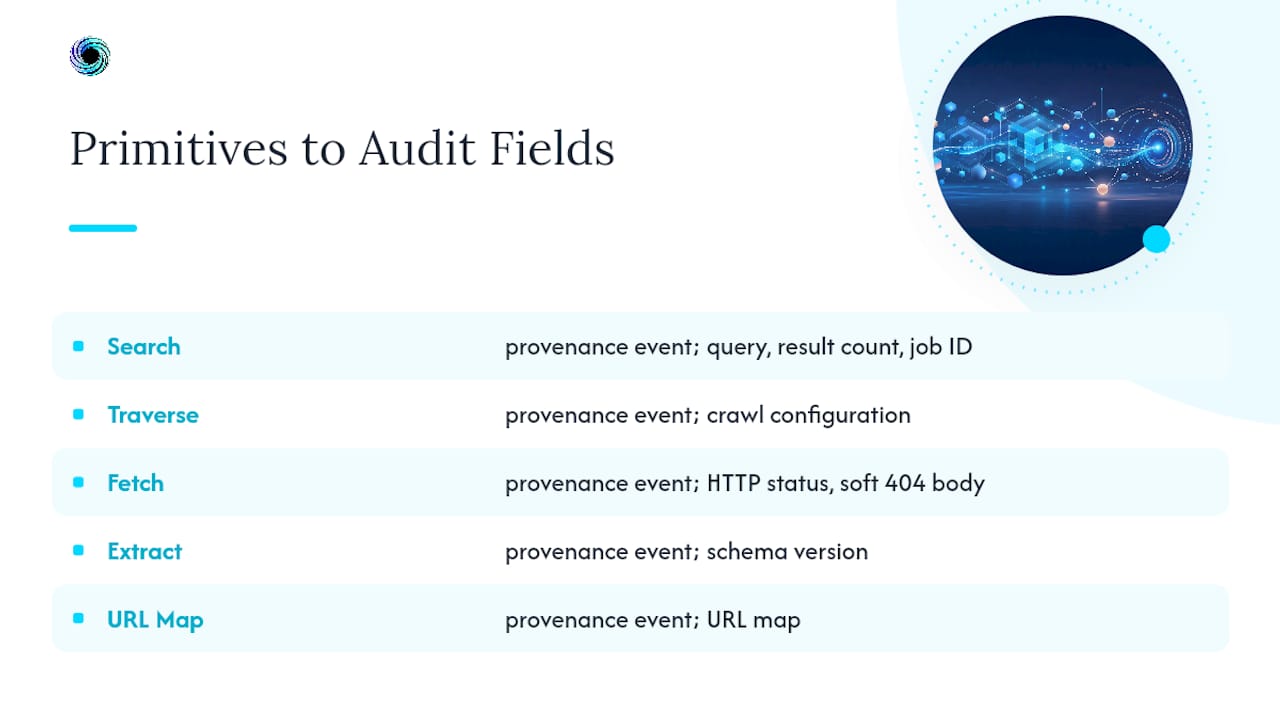
A Search call should log the query, result count, and job ID. A Traverse (crawl) operation should emit job_id and crawl_job_version so you can tell which crawl configuration produced a given page. A Fetch should log source_url, status_code, and response_headers, because a 200 response with a soft 404 body is a common silent failure that only shows up in provenance data. An Extract call should record parser_version and extract_schema_id, so a downstream consumer can trace a malformed field back to a specific schema version rather than guessing.

Failure modes deserve their own event types, not silent drops. A fetch timeout, a parse failure, or a partial extract should each produce an outcome of failure or partial with a specific error code, not an absent log entry. Capture this provenance at the point of web entry, inject traceId via thread-local or MDC context so it propagates automatically, and stream structured JSON to your centralized sink rather than writing ad hoc text. That single discipline, capturing provenance at the edge instead of reconstructing it after the fact, is what separates a traceable web-data pipeline from one that just happens to work most of the time.
What I've Learned Reviewing Web-Data Audit Pipelines
The most common failure I see isn't missing logs, it's logs that exist but can't answer a specific question fast enough when it matters. Teams log everything and index nothing, or they conflate debug output with audit evidence and discover the gap during an actual incident, not a drill. The fix is almost always structural: separate the two log types from day one, enforce a closed schema, and test retrieval before you need it, not after.
Capturing Provenance Without Building It Yourself
If you're scraping or fetching web data as part of an audit-grade pipeline, the provenance fields discussed above (job_id, source_url, status_code, parser_version) are exactly what Gyrence's five primitives are built to surface by default. Every call to Search, Traverse, Fetch, Extract, or Map returns a typed, discriminated-union response, which means failure modes like timeouts and partial extracts show up as structured outcomes your audit pipeline can log directly, instead of exceptions you have to reverse-engineer into an event schema.
That matters because most scraping tools bury provenance metadata or drop it entirely on failure, leaving you to reconstruct what happened from partial data. Gyrence attaches request-level metadata and deterministic job IDs to every operation, so the traceId and job_id correlation described earlier in this article comes built-in rather than bolted on. If you're designing an audit trail for scraped or fetched web data, check the Gyrence documentation to see how the primitives map to your schema, or start with a call through the Gyrence console to see the response shape firsthand.
Sources
- NIST Computer Security Resource Center — Glossary: audit trail
- HHS — HIPAA Security Rule Guidance
- JSONic — JSON audit trail: schema, immutability & GDPR design
FAQ
Can you give me an example of an audit trail?
A simple example is a JSON event recording a fetch: an eventId, actorId, action: "fetch", the target URL, an ISO 8601 timestamp, and an outcome of success or failure. See the copy-pasteable examples earlier in this article for full JSON templates.
What are the required fields in a compliant audit log entry?
At minimum: a unique event ID, a pseudonymized actor identifier, the action taken, the affected resource, a UTC timestamp, request context like IP and user agent, and a hash linking the event to the prior one for tamper evidence.
What does a website audit trail look like in practice?
It typically combines HTTP access log lines with structured JSON events for mutations, correlated by a shared requestId or traceId so a full session can be reconstructed in one query.
How long should audit trails be retained?
Retention windows depend on which standard applies. Regulated data under HIPAA or PCI DSS typically demands longer, stricter retention than general operational logging, and legal holds can extend retention indefinitely regardless of policy.
Does Gyrence capture audit-ready provenance automatically?
Gyrence's typed responses include request-level metadata like job IDs, status codes, and parser versions for every Search, Traverse, Fetch, Extract, and Map call, which maps directly onto the fields an audit-grade web-data trail requires.