
TL;DR:
- Gyrence offers a site crawler API optimized for small AI teams with predictable pricing, typed failure modes, and LLM-friendly outputs. It enables fast prototypes and reliable integration with minimal engineering effort, making it ideal for building agent or RAG workflows. Small teams should prioritize managed APIs like Gyrence to save time, ensure output quality, and maintain control over costs.
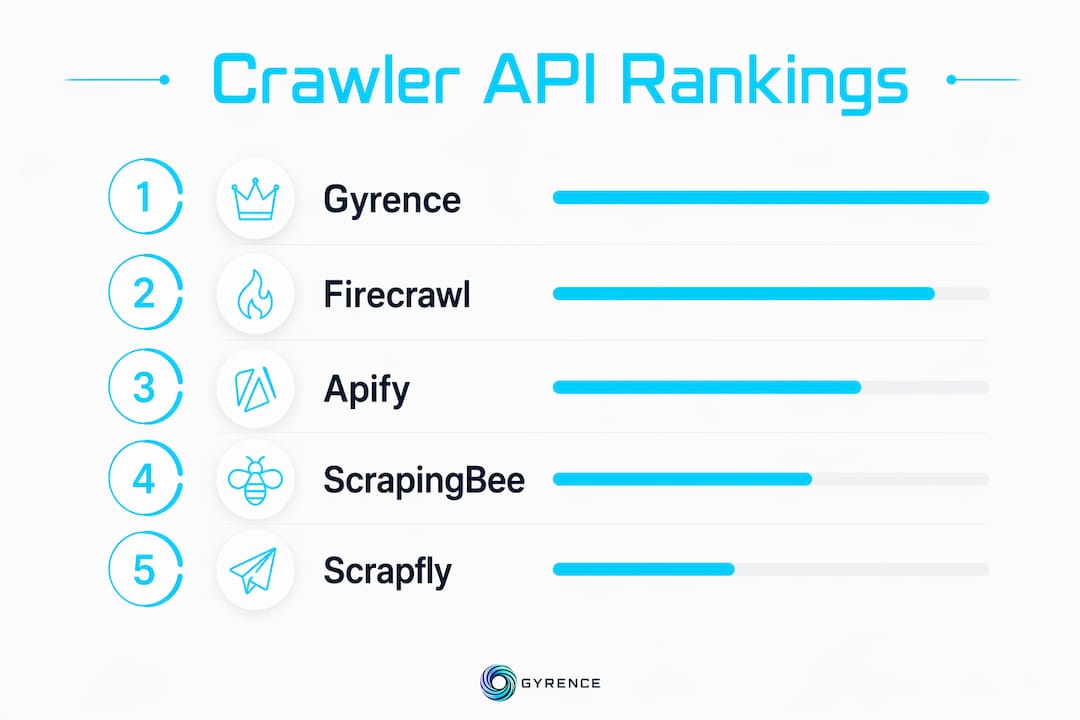
Gyrence is the best site crawler API for small software and AI teams because it delivers LLM-ready outputs, typed failure modes, and predictable credit-based pricing with no surprise overages. For a small team building an agent pipeline or RAG ingestion workflow, that combination cuts integration time and keeps the billing model honest.
Quick runner-ups worth knowing:
- Firecrawl — Markdown-first, low cost, fast to integrate for standard URL-driven extraction
- Apify — Best when you need scheduled jobs or marketplace Actors for niche targets
- ScrapingBee — Predictable entry-level tiers with headless rendering, good for small teams that want simple billing
- Scrapfly — Developer-focused cost controls, worth a look for cost-conscious teams
- Diffbot — Strong semantic extraction across many domains when output quality matters more than price
TL;DR for a quick POC: Start with Gyrence for its MCP endpoint and typed failure responses, which prove fit for an LLM pipeline in under an hour. If your budget is the primary constraint, Firecrawl's free tier gets you to a working prototype cheapest.
Table of Contents
- Which site crawler APIs should small teams compare first?
- Per-tool reviews: what actually matters for small teams
- How we evaluated these crawler APIs
- How should a small team choose a crawler API?
- Crawler API vs. scraping API vs. browser automation: which output do you need?
- Why Gyrence is the recommended pick for small teams
- What does customer support look like across these APIs?
- How reliable are these APIs in production?
- What makes API documentation worth using?
- Security and data privacy when using crawler APIs
- Key Takeaways
- The case for starting managed and building later
- Gyrence trial: start a POC in under an hour
- Useful sources and next steps
- FAQ
Which site crawler APIs should small teams compare first?
| Tool | Best for | Pricing model | LLM/agent-ready | Anti-bot capability | Integration | Free tier |
|---|---|---|---|---|---|---|
| Gyrence | AI agents, RAG pipelines | Credit-based, spending caps | Markdown + schema JSON, MCP endpoint | Yes | SDKs, MCP, webhooks | Yes |
| Firecrawl | Markdown-first URL extraction | Metered, low entry cost | Markdown-first | Moderate | REST, SDKs | Yes |
| Apify | Scheduled jobs, long-tail targets | Actor-based metered | JSON/HTML, some Markdown | Good via Crawlee | SDKs, webhooks | Yes |
| ScrapingBee | Simple headless rendering | Predictable tiers | HTML/JSON | Moderate | REST | Yes |
| Scrapfly | Cost-conscious small teams | Credit-based, predictable | JSON, HTML | Good | REST, SDKs | Yes |
| Diffbot | Semantic structured extraction | Subscription tiers | Structured JSON | Moderate | REST | Limited |
| Bright Data | Enterprise-scale scraping | Volume-based, enterprise SLAs | JSON/HTML | Excellent | SDKs, proxies | Trial |
| Crawl4AI | Custom AI pipelines (open-source) | Free / self-hosted | Markdown, JSON | DIY | Python library | Free |
| ScraperAPI | Fast startup integration | Metered per request | HTML/JSON | Good | REST | Yes |
| Oxylabs | Broad data collection at scale | Volume-based | JSON/HTML | Excellent | REST, SDKs | Trial |
| Zyte | Managed crawlers, enterprise support | Subscription + metered | JSON/HTML | Excellent | SDKs | Trial |
Per-tool reviews: what actually matters for small teams
Gyrence
Gyrence exposes five composable API primitives: Search (query-driven web search), Traverse/Gyre (site-wide crawl from a seed URL), Fetch (single-page fetch normalized to Markdown), Extract (LLM-powered schema-guided JSON extraction), and Map (domain URL graph via sitemap). Every call returns a typed, discriminated-union response that includes the failure cases, so your agent can branch on error type rather than parsing an opaque 200 with an empty body.

Pricing is credit-based with workspace-level spending caps. You set a hard ceiling before you run a job, so the bill cannot drift. The hosted MCP endpoint means you can wire Gyrence into a LangChain or custom agent in minutes without writing a proxy layer. For a small team building a RAG pipeline or a scheduled catalog crawl, that combination of predictable cost and structured output is a practical differentiator.
Firecrawl
Firecrawl is a Markdown-first crawling API built for teams that want to feed pages directly into an LLM without a normalization step. It handles URL-driven extraction cleanly and the free tier is generous enough to validate a POC. The main limitation is anti-bot coverage: heavily protected targets often require additional configuration or fail silently. Pricing is metered per request, with easy pages cheaper than JS-rendered ones.

Pros: Fast integration, clean Markdown output. Cons: Weaker on anti-bot pages, error typing is less structured than Gyrence. Best for teams with standard, publicly accessible targets.
Apify
Apify's marketplace Actors cover hundreds of niche targets out of the box, from e-commerce product pages to social platforms. Scheduling is first-class. The underlying Crawlee library gives you fine-grained proxy and retry control if you want to go deeper. The tradeoff is complexity: the Actor model adds cognitive overhead for a team that just wants a clean REST call.
Pros: Long-tail target coverage, scheduling, strong proxy options. Cons: Steeper learning curve, cost can be unpredictable on high-concurrency jobs. Best for teams with diverse, niche scraping targets.
ScrapingBee
ScrapingBee wraps headless Chrome rendering behind a simple REST API with predictable tier pricing. It is one of the easiest APIs to get running in an afternoon. Output is HTML or JSON; it does not produce Markdown natively, so LLM pipelines need a normalization step. Good for small teams that need occasional JS rendering without managing browser infrastructure.
Scrapfly
Scrapfly emphasizes cost controls and developer tooling. Credit-based billing with clear per-request costs makes it a reasonable choice for teams watching monthly spend. Anti-bot coverage is solid. It lacks a native MCP endpoint or Markdown-first output, so agent integration requires more glue code than Gyrence.
Diffbot
Diffbot's semantic extraction models have been trained across millions of domains, producing structured JSON that is genuinely high quality for product pages, articles, and knowledge-graph entities. The subscription pricing is higher than most alternatives, but for teams where extraction accuracy matters more than raw cost, it earns its place. Not a fit for teams that need Markdown output or MCP integration.
Other tools in the field
Bright Data and Oxylabs are the right choice when you need geo-diverse residential proxies at enterprise scale. Both carry enterprise SLAs and pricing to match. Zyte (formerly Scrapinghub) offers mature managed crawlers with strong SDK support. None of these three are cost-optimized for a small team's POC budget.
ScraperAPI is the fastest path from zero to working scrape for a solo developer: one API key, one endpoint, retries handled. Output is HTML; LLM normalization is your problem. ScrapingDog and ScrapingAnt occupy a similar tier, with ScrapingAnt adding headless rendering tiers for JS-heavy pages.
Crawl4AI is open-source and designed for AI pipelines, producing Markdown and JSON. It is free to self-host, which makes it attractive for teams with engineering bandwidth and a preference for owning their stack. ScrapeGraphAI takes a similar angle, targeting ML/AI data pipelines with structured outputs.
SerpApi is purpose-built for SERP data. If your use case is search-engine result extraction rather than general crawling, it is the specialist pick. Jina AI Reader converts URLs to clean Markdown via a simple GET request, useful as a lightweight fetch layer in agent pipelines.
Browserless and Browserbase provide hosted headless browser execution for teams that need direct Playwright or Puppeteer control in the cloud. Crawlbase bundles proxy and scraping API services. Olostep focuses on anti-bot bypass with regional coverage.
For teams that want to own their entire crawling stack, Scrapy (Python framework), Colly (Go framework), Katana (Go-based fast crawler), and Apache Nutch (distributed open-source crawler) are the standard open-source options. Playwright and Puppeteer handle browser automation. Crawlee wraps both behind a unified Node.js API. StormCrawler targets distributed, high-throughput crawls on Apache Storm. CRW and Scrape.do / Decodo (Smartproxy) round out the mid-market managed API space, with Decodo being the Smartproxy-branded product for teams transitioning from API to proxy-first stacks. Context.dev is frequently recommended for agent-first workflows that need clean Markdown and quick integration.
How we evaluated these crawler APIs
The shortlist above was built against criteria that reflect what actually breaks in production for small teams, not what looks good in a vendor's marketing deck.
Evaluation dimensions:
- Output shape and LLM readiness: Does the API return clean Markdown or schema-guided JSON without a normalization step? Markdown-first outputs reduce downstream processing for RAG and agent pipelines.
- Pricing predictability: Is cost per call transparent before you run a job? Credit-based models with spending caps beat open-ended metered billing for small teams managing a fixed budget.
- Failure mode typing: Does the API return typed errors (rate-limited, bot-blocked, timeout, parse failure) or opaque 200s with empty bodies? Typed failures let agents branch correctly.
- Anti-bot and JS rendering: Tested against a sample set of publicly accessible JS-heavy and bot-protected pages to assess pass rate and error transparency.
- SDK and integration quality: Availability of SDKs, MCP endpoints, LangChain connectors, and webhook support. Docs were evaluated for completeness and example coverage.
- Trial and POC experience: Whether a free tier or trial credits exist and whether they are sufficient to validate a real use case in 48–72 hours.
POC testing checklist (reuse this when trialing a vendor):
- Send 20 URLs: 5 static HTML, 5 JS-rendered, 5 bot-protected, 5 paginated
- Record success rate, error types returned, and latency per category
- Confirm output shape matches your pipeline's expected format (Markdown, JSON, HTML)
- Test spending cap or budget limit behavior before it hits zero
- Verify webhook or polling behavior under a simulated agent loop
Per the expert consensus on stack re-evaluation, revisit your vendor choice every six months. Anti-bot techniques and AI parsing capabilities shift fast enough that the best pick today may not be the best pick at your next planning cycle.
How should a small team choose a crawler API?
The decision is straightforward for teams with fewer than three crawler engineers or fewer than 50 targets: use a managed API. The engineering time saved on proxy rotation, retry logic, and browser management almost always outweighs the per-request cost premium.
Concrete criteria to weight:
- Output shape first. If your pipeline consumes Markdown, pick a Markdown-first API. Converting HTML to Markdown in your own code is a tax you pay on every call.
- Pricing predictability. Metered billing with no cap is a budget risk. Prefer credit-based models or APIs that let you set a hard spending limit.
- Error model. An API that returns a typed
bot_blockedortimeouterror is worth more than one that returns a 200 with an empty string. Your agent needs to know why a fetch failed. - Integration time. How long to a working
curlcall? Under 15 minutes is the bar for a small team's POC. - Observability. Does the API expose per-request logs, retry counts, and error breakdowns in a dashboard or via webhook?
Vendor questions to ask during trial:
- How are errors typed in the response schema?
- What is the retry policy for bot-blocked pages, and does a retry consume credits?
- Can you bring your own proxy pool?
- How does overage work if you exceed a plan limit mid-month?
- Is there a hard spending cap, or does billing continue past the plan ceiling?
Red flags during POC:
- Opaque 200 responses with empty or malformed bodies on failed fetches
- No trial data or credit allocation sufficient to test more than 10 URLs
- Per-request pricing that varies by undocumented factors
- Docs that describe features not yet in the API
Pro Tip: Run a 48–72 hour POC against your actual target URL set, not a toy example. Pick 20 URLs that represent the hardest 20% of your real workload. If the API handles those, it handles the rest. Track typed error rate, not just success rate, because a 95% success rate with opaque failures is worse than an 85% rate with typed ones your agent can handle.
For a structured evaluation framework, the web data API evaluation checklist covers the full vendor audit in a reusable format.
Crawler API vs. scraping API vs. browser automation: which output do you need?
These three categories overlap in marketing copy but differ in what they actually return and what they cost.
Crawler API (e.g., Gyrence Traverse/Gyre, Firecrawl, Apify): starts from a seed URL and follows links across a site, returning a batch of pages. Output is typically Markdown or structured JSON per page. Best for: indexing a full site catalog, building a knowledge base, or feeding a RAG pipeline with broad coverage.
Scraping API (e.g., ScraperAPI, ScrapingBee, Scrapfly): takes a single URL and returns the rendered page content. Output is HTML, JSON, or Markdown depending on the vendor. Best for: high-volume, single-page extraction where you control the URL list and need rendering or proxy rotation handled for you.
Browser automation (e.g., Browserless, Browserbase, Playwright, Puppeteer): gives you direct control of a headless browser session. Output is whatever you extract via selectors or scripts. Best for: interactive pages, multi-step flows (login, pagination, form submission), or targets that detect and block non-browser traffic at the session level.
For LLM agent pipelines, the practical hierarchy is:
- Prefer Markdown output from a crawler or scraping API for text-heavy pages. It feeds directly into a context window without preprocessing.
- Use schema-guided JSON extraction (like Gyrence's Extract primitive) when you need structured fields rather than raw text.
- Fall back to browser automation only when the target requires session state or interaction that a scraping API cannot replicate.
Connecting a scraping API to an AI agent is straightforward when the API returns typed responses: the agent reads the discriminated union, branches on success or error type, and retries or escalates accordingly. Polling vs. webhook: for batch crawls, webhooks reduce agent complexity; for single-page fetches in a synchronous agent loop, polling a job ID is simpler. For structured JSON extraction from messy HTML, schema-guided APIs outperform regex-based post-processing by a wide margin.
Why Gyrence is the recommended pick for small teams
Gyrence's five primitives map directly to the jobs a small AI team actually runs in production. Search handles query-driven discovery without requiring a seed URL. Traverse (Gyre) crawls a site outward from a starting URL, following internal links up to a configurable depth. Fetch retrieves and normalizes a single page to clean Markdown. Extract runs LLM-powered, schema-guided JSON extraction against a page or batch. Map builds a domain's URL graph from its sitemap, useful for scoping a crawl before running it.
Two production examples show how these compose:
LLM RAG pipeline: Call Map to scope the target domain, Traverse to crawl the relevant subtree, then Extract with a schema to pull structured fields into your vector store. Typed failure responses mean your ingestion pipeline can skip bot-blocked pages and log them separately rather than silently dropping data. Implementation time for a small team: roughly one afternoon to a working prototype.
Scheduled catalog crawl: Use Traverse on a product catalog URL with a depth limit, set a spending cap to bound the job cost, and configure a webhook to fire when the crawl completes. The WebDoppler monitoring layer can alert on page changes between runs. No separate infrastructure to manage.
Gyrence's site traversal API documentation covers the Gyre primitive in depth, including depth controls and URL filtering patterns.
Pro Tip: During your POC, set a spending cap at 10–20% of your expected monthly budget and run your hardest 20 URLs first. If the cap is hit before the set completes, you have a cost-per-target estimate before committing to a full crawl. Adjust the cap and retry rather than discovering the cost after a full run.
What does customer support look like across these APIs?
Support quality splits cleanly by tier. Enterprise providers like Bright Data, Oxylabs, and Zyte offer dedicated account managers, SLA-backed response times, and onboarding calls. For a small team, that level of support comes with pricing to match.
Mid-market APIs like ScrapingBee, Scrapfly, and ScraperAPI rely on documentation, community forums, and email support. Response times vary. The practical test during a POC is to submit a support ticket with a specific technical question and measure time to a useful answer, not an auto-response.
Gyrence's developer-focused positioning means its docs and error messages are written for engineers, not account managers. Typed failure responses reduce the need to open a support ticket in the first place: if the API tells you a fetch failed with bot_blocked, you know what to do next without asking.
How reliable are these APIs in production?
Uptime and reliability data for most scraping APIs is not publicly audited by an independent third party. Vendor-published uptime figures should be treated as marketing claims until you have your own production data.
What you can measure during a POC: success rate by page type, error type distribution, and latency percentiles (p50, p95). A vendor with a 95% success rate and typed errors is more reliable in practice than one with a 98% claimed uptime and opaque failures, because your pipeline can handle known error types programmatically.
For production workloads, webhook-based job completion notifications reduce the blast radius of a partial outage: your pipeline retries the failed batch rather than blocking on a hung request. Spending caps prevent a reliability incident from becoming a billing incident.
What makes API documentation worth using?
The gap between good and bad API docs is not word count. It is whether the docs show you what a failed response looks like, not just a successful one.
Scrapy's official documentation is the benchmark for open-source crawler docs: structured, versioned, and example-heavy. Colly's docs are concise and Go-idiomatic. For managed APIs, the bar is higher: you need error schema documentation, rate limit behavior, retry semantics, and SDK quickstarts in at least Python and Node.js.
Red flags in docs: features described without code examples, error codes listed without descriptions, and changelog entries that reference breaking changes with no migration guide. During a POC, the quality of the error reference section predicts how much time you will spend debugging in production.
Security and data privacy when using crawler APIs
Every managed scraping API routes your target URLs through the vendor's infrastructure. That means the vendor sees your target list, request headers, and any credentials you pass. For competitive intelligence workloads, that is a meaningful exposure. Review the vendor's data retention policy before sending sensitive target URLs.
For US-based teams, the relevant considerations are: whether the vendor stores request logs and for how long, whether data is processed in US-based data centers (relevant for certain regulated industries), and whether the vendor's proxy pool uses ethically sourced residential IPs. Bright Data and Oxylabs publish transparency reports on their proxy sourcing. Smaller vendors often do not.
GDPR and CCPA compliance is the vendor's responsibility for data they process on your behalf, but it is your responsibility to ensure the data you collect is legally permissible to collect. Scraping publicly available data is generally permissible under US law, but scraping behind authentication or collecting personal data at scale introduces legal complexity. Consult qualified legal counsel for your specific use case.
Key Takeaways
For small AI and software teams, the best site crawler APIs combine LLM-ready output formats, typed failure modes, and predictable credit-based pricing so your pipeline stays reliable and your bill stays bounded.
| Point | Details |
|---|---|
| Start with a managed API | Teams with fewer than three crawler engineers should use a managed API; the engineering time saved outweighs the per-request cost. |
| Prioritize typed failure modes | An API that returns typed errors (bot_blocked, timeout, parse failure) lets agents branch correctly instead of silently dropping data. |
| Output shape drives selection | Pick Markdown-first for LLM pipelines; use schema-guided JSON extraction when you need structured fields rather than raw text. |
| Set spending caps before you crawl | Credit-based billing with a hard spending cap prevents a runaway job from becoming a surprise invoice. |
| Gyrence for AI agent pipelines | Gyrence's five composable primitives, MCP endpoint, and typed responses make it the practical first choice for small teams building agent or RAG workflows. |
The case for starting managed and building later
The conventional wisdom in developer communities is that you should build your own scraping stack as soon as possible to control costs. That advice is wrong for most small teams, and the math is not close.
A proxy-first DIY stack with Scrapy or Playwright gives you per-unit economics that beat managed APIs at high volume. But "high volume" means tens of millions of pages per month with dedicated engineers maintaining the stack. Below that threshold, the engineering hours spent on proxy rotation, retry logic, browser fingerprinting, and infrastructure monitoring cost more than the API markup. The cost of engineering time is the deciding factor for small teams, not the cost per page.
The smarter path is: start managed, instrument everything, and build your own stack only when you have the volume data to justify it. That data comes from production, not from estimates. A team that ships a working RAG pipeline in a week on Gyrence and then migrates to a custom stack at month six has shipped a product. A team that spends month one building infrastructure has not.
One more thing: re-evaluate your vendor choice every six months. Anti-bot techniques, AI parsing capabilities, and proxy pricing all shift fast enough that the best pick today may be the wrong pick by your next planning cycle.
Gyrence trial: start a POC in under an hour
Gyrence offers a free trial workspace with credits included, covering all five primitives and the hosted MCP endpoint. Set a spending cap before your first job, run a Fetch call against your hardest target URL, and you will know within 15 minutes whether the output shape fits your pipeline.
Sign up at gyrence.com, set your spending cap in the workspace console, and run a sample Traverse or Extract call against your target domain. The Gyrence docs include quickstart examples in Python and Node.js. For teams comparing alternatives before committing, the Crawlbase alternatives guide covers the pricing and output trade-offs in detail.
Useful sources and next steps
Use these to verify claims, run your own benchmarks, and build a POC:
- Gyrence product and docs — primitives reference, error schema, and SDK quickstarts
- Site Traversal API Explained for Developers — deep dive on the Gyre/Traverse primitive
- Web Data API Evaluation Checklist — reusable vendor audit framework
- Connect a Scraping API to an AI Agent — integration guide for LangChain and custom agent frameworks
- Web Scraping APIs vs DIY Scrapers — when to stop building infrastructure
- Best Web Scraping APIs for AI Agents — vendor patterns for Markdown-first and agent-ready outputs
- Scrapy documentation — reference for teams evaluating open-source crawlers
- Apache Nutch — distributed open-source crawler for engineering-owned stacks
- Gainable blog: team workflows and data tooling — practical guidance on integrating crawler outputs into team apps
FAQ
What is the best crawler API for a small AI team?
Gyrence is the strongest fit for small AI teams because it returns typed failure modes, Markdown and schema-guided JSON outputs, and includes a hosted MCP endpoint for direct agent integration with predictable credit-based pricing.
How do crawler APIs charge for usage?
Most APIs charge per successful request, with pricing tiers that vary by page difficulty: static HTML pages cost less than JS-rendered or bot-protected pages. Credit-based models with spending caps give the most predictable billing.
When should a small team use a managed API instead of building its own scraper?
Teams with fewer than three crawler engineers or fewer than 50 targets should use a managed API. The engineering time saved on proxy rotation, retry logic, and browser management typically outweighs the per-request cost premium.
What output format works best for LLM pipelines?
Markdown is the preferred output for LLM context windows because it requires no preprocessing. Use schema-guided JSON extraction when your pipeline needs structured fields. Avoid raw HTML as a primary LLM input; it adds token overhead and noise.
How often should a team re-evaluate its crawler API vendor?
Every six months is the recommended cadence. Anti-bot techniques, AI parsing capabilities, and proxy pricing shift fast enough that the best vendor choice at the start of a project may not be optimal six months into production.