
TL;DR:
- A web research agent is an autonomous system that searches, fetches, extracts, and synthesizes web data without manual input. Building it modularly with dedicated components improves debugging, cost control, and reliability, especially on protected sites. Proper infrastructure, including proxies and fingerprinting, is critical for success and long-term operation.
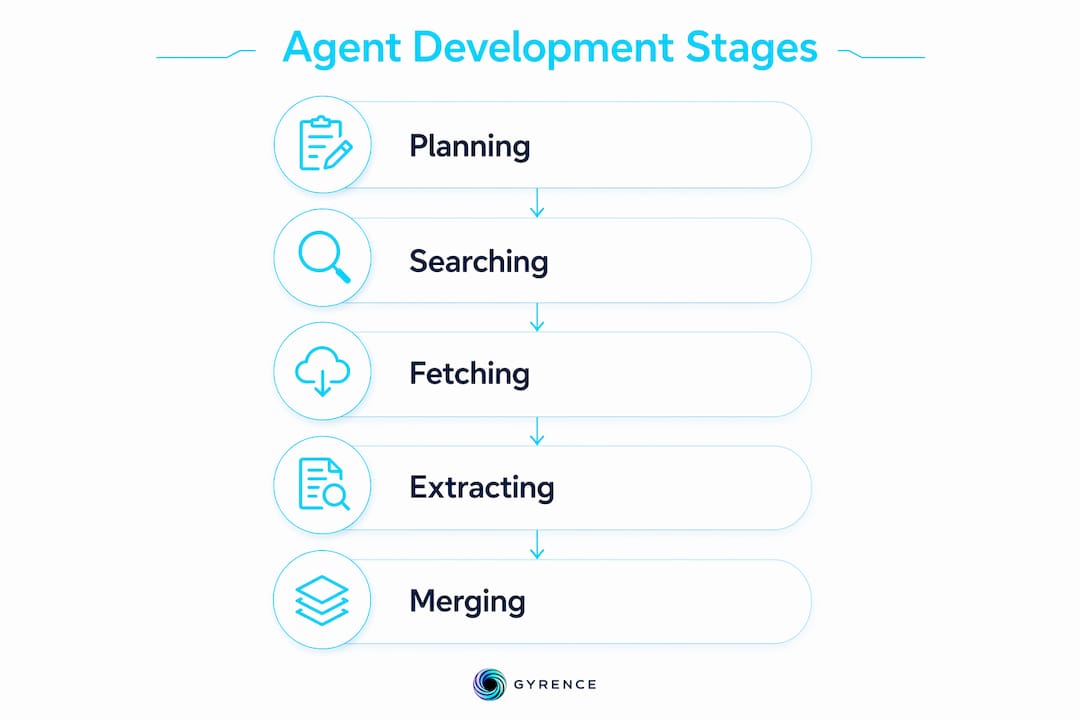
A web research agent is an autonomous system that searches, fetches, and synthesizes web data without manual intervention at each step. The industry term for this class of software is an "agentic scraper" or "LLM-powered research agent," and the distinction matters because it sets the right expectations for infrastructure, cost, and failure modes. To build a web research agent step by step, you need four modular components: a planner, a searcher, an extractor, and a synthesizer. Each component has a defined role, and separating them is what makes the system debuggable, cost-controllable, and reliable at scale.
What are the essential components of a web research agent?
A modular architecture is the foundation of any agent that holds up in production. A well-designed research agent separates concerns so you can swap, test, or reprice each component independently.

The four core components work as follows:
| Component | Responsibility | Typical Tool |
|---|---|---|
| Planner | Decomposes the research goal into targeted queries | Claude Haiku, GPT-4o mini |
| Searcher | Executes web searches and returns URLs | Brave Search, DuckDuckGo API |
| Extractor | Fetches pages, strips noise, returns clean text | httpx, BeautifulSoup, Gyrence Fetch |
| Synthesizer | Extracts facts, deduplicates, and writes the report | Claude Sonnet 3.7 |
Multi-stage workflows with distinct planning, execution, validation, and merger stages optimize cost and performance through component testing and model routing. The practical implication: use a cheap model like Claude Haiku for query generation and reserve Claude Sonnet 3.7 for synthesis. A well-built agent with this architecture produces a 500-word summary from 10–15 sources in under 60 seconds at a cost of $0.05–$0.15. That cost profile is only achievable when components are separated and model routing is intentional.
Caching also belongs at the component level. Cache raw HTML after the extractor runs so you can re-parse without re-fetching. This cuts both cost and block risk on repeat runs.
How to set up infrastructure to minimize blocking
Infrastructure is where most agents fail before they ever reach the synthesis stage. LLMs alone succeed on Cloudflare-protected targets only 26–39% of the time. Managed infrastructure with residential proxies and browser fingerprinting raises that success rate to 91–95%. That gap is not a minor tuning issue. It is the difference between a working agent and a broken one.
The core infrastructure requirements for a reliable agent are:
- Residential proxies: Rotate IPs from real consumer devices. Proxy costs typically run $4–$8 per GB, which is predictable if you cap your request budget upfront.
- Browser fingerprint patching: Patch TLS signatures and HTTP/2 headers to match real browser profiles. Without this, even residential IPs get flagged.
- Headless browser with stealth plugins: Use Playwright or Puppeteer with stealth extensions for JavaScript-heavy pages that require real browser rendering.
- Captcha solving: Budget $0.50–$3.00 per 1,000 requests for captcha solving services on protected targets.
- Rate limiting: Cap requests per domain per minute. Polite crawling keeps you under the radar and respects
robots.txt.
Managed infrastructure with residential proxies reduces block rates on protected e-commerce targets from 61–74% down to under 5%. That is the target you should design toward.
Pro Tip: Set a hard spending cap on proxy GB before each agent run. Runaway crawls on paginated sites can consume 10x your expected data volume in under an hour.
Layout drift is a separate infrastructure problem. Sites redesign without notice, and your selectors break silently. Use schema-driven parsing with JSON schemas instead of CSS or XPath selectors. Schema-driven parsing sustains 70% less breakage during site redesigns compared to selector-based approaches.
Step-by-step guide to implementing each agent stage
Building each stage in sequence gives you a working agent faster than trying to wire everything together at once.
-
Query decomposition. Feed your research goal to the planner. Prompt it to generate 5–10 targeted search queries covering different angles of the topic. Store these as a list for parallel execution.
-
Parallel search execution. Submit all queries to your search API concurrently. Parallel execution of multiple web searches reduces search phase latency by 3–5x without increasing token cost. Use
asyncioin Python withhttpxto fire concurrent requests. Deduplicate URLs before passing them to the extractor. -
Page fetching and cleaning. For each URL, fetch the raw HTML with
httpx. Parse it withBeautifulSoup, strip<script>,<style>, and ad containers, then extract the main content block. Convert to plain text or markdown. -
Content trimming for LLM processing. Cap page content at approximately 4,000 characters before passing it to the extractor LLM. This reduces token costs and improves extraction quality. LLM inference adds 2–8 seconds per page, so trimming also keeps latency manageable.
-
Fact extraction and deduplication. Send each trimmed page to the extractor with a structured prompt: "Extract the key facts relevant to [goal]. Return JSON with fields: fact, source URL, confidence." Deduplicate facts across pages by semantic similarity before synthesis.
-
Report synthesis with approval gates. Pass the deduplicated fact set to Claude Sonnet 3.7 with a report template. For production agents, insert a human approval gate before the final report publishes. This catches hallucinated citations before they reach downstream consumers.
Pro Tip: Log every raw HTML response to object storage before parsing. When your extractor breaks on a site redesign, you can re-parse the cached HTML without re-fetching and without burning proxy budget.
A practical reference for search API selection matters here. Not all search APIs return the same result diversity, and some throttle concurrent requests aggressively.
How to maintain your agent for long-term reliability
Agents degrade silently. A site redesign does not throw a 500 error. It returns a 200 with corrupted data, and your synthesizer confidently reports wrong facts. Layout drift causes silent data corruption, and downstream schema validation is the only reliable way to catch it before it reaches your output.
Ongoing maintenance practices that actually work:
- Schema validation on every extraction: Validate extracted JSON against your defined schema after every run. Flag missing required fields immediately.
- Diff-based auditing: Compare current results against prior runs. Diff-based monitoring filters 90% of false positive alerts caused by normal layout noise.
- Raw HTML caching: Store raw HTML for every fetched page. Re-parse on demand when schemas change without re-fetching.
- Request rate caps: Set a hard ceiling on requests per domain per hour. This protects you from accidental DDoS behavior and keeps block rates low.
- Token budget management: Track token consumption per run. Set alerts when a run exceeds 2x the expected token count. Cost spikes usually signal a broken extractor consuming oversized pages.
- Retry logic with exponential backoff: On search API failures, retry with delays of 1, 2, 4, and 8 seconds before marking a query as failed. Log all failures for post-run review.
The intelligence layer relies on underlying infrastructure to handle crawling, fingerprinting, and request normalization. When that infrastructure drifts, the LLM cannot compensate. Monitoring the infrastructure layer is as important as monitoring the LLM outputs.
Key Takeaways
Building a reliable web research agent requires modular architecture, managed infrastructure, and active monitoring. Infrastructure failure, not LLM quality, is the primary cause of agent breakdown in production.
| Point | Details |
|---|---|
| Modular architecture is non-negotiable | Separate planner, searcher, extractor, and synthesizer components for cost control and debuggability. |
| Infrastructure determines success rate | Managed residential proxies and fingerprinting raise success rates from under 40% to over 91% on protected sites. |
| Parallel search cuts latency | Concurrent search execution reduces search phase time by 3–5x at no extra token cost. |
| Schema validation catches silent failures | JSON schema checks detect field-level data corruption that successful HTTP responses hide. |
| Cost control requires hard caps | Set proxy GB limits and token budgets before each run to prevent runaway infrastructure spend. |
Why infrastructure is still the hardest part of agent development
The honest observation after working with production research agents is this: the LLM is rarely the bottleneck. Claude Sonnet 3.7 synthesizes well. The problem is always the 40 pages the agent tried to fetch before it got there, and how many of those fetches returned garbage or nothing at all.
Most developers underestimate how much of their agent's reliability depends on the proxy layer and fingerprinting stack. They wire up a capable LLM, point it at the web, and then wonder why it hallucinates. The hallucinations are not a model problem. They are a data quality problem caused by blocked or corrupted fetches that the agent treated as valid inputs.
The modular design pattern solves this, but only if you actually separate the infrastructure concerns from the reasoning concerns. I have seen agents where the fetcher and synthesizer were tightly coupled, and every infrastructure failure caused a reasoning failure. Untangling them is painful after the fact. Build the separation in from day one.
The agentic web browsing checklist I return to most often is not about prompting. It is about validating that the infrastructure layer is returning clean, complete data before the LLM ever sees it. Get that right, and the synthesis almost takes care of itself.
— Glen
Gyrence for agent-ready web data
Gyrence is built for exactly this architecture. Its five composable primitives, Search, Traverse, Fetch, Extract, and Map, map directly onto the agent components described here. Every call returns a typed, discriminated-union response that includes failure cases, so your agent reasons about results instead of guessing. Spending caps are built in, so your proxy bill does not surprise you mid-run.
Developers building custom research agents use Gyrence's structured extraction API to skip the infrastructure layer entirely and focus on the reasoning logic. The hosted MCP endpoint connects directly to agent frameworks without custom glue code. If you are ready to build without the infrastructure overhead, the Gyrence console is the starting point.
FAQ
What is a web research agent?
A web research agent is an autonomous system that searches the web, fetches and cleans page content, extracts structured facts, and synthesizes a report without manual intervention at each step.
Why do agents fail on protected websites?
LLMs alone succeed on Cloudflare-protected targets only 26–39% of the time. Managed residential proxies and browser fingerprinting raise that success rate to 91–95%.
How do I reduce token costs in my research agent?
Cap page content at approximately 4,000 characters before passing it to the LLM, and use a cheap model like Claude Haiku for planning tasks. Reserve premium models for synthesis only.
What causes silent data corruption in web agents?
Layout drift causes silent data corruption. A site redesign returns a 200 response with restructured HTML, and the agent extracts wrong or empty fields without throwing an error. Schema validation detects these failures.
How do I build a web research agent step by step without managing proxies myself?
Use a managed web data API like Gyrence that handles proxy rotation, fingerprinting, and structured extraction through a single API call, so you focus on agent logic rather than infrastructure.