
A competitive intelligence data pipeline explained in one sentence: it is the system that turns messy public web pages into typed, provenance-stamped records an AI agent can trust without re-checking. That's the whole job. Not "scraping," not "monitoring," but producing structured output with guarantees attached.
The pipeline carries five responsibilities, in order:
- Discover which URLs matter and when they change
- Fetch the page at the lowest cost tier that still works
- Extract the signal, not the whole document
- Normalize it into a schema-validated record
- Serve it to agents or analysts with provenance intact
Two engineering priorities sit above the rest: cutting tokens before anything touches an LLM, and treating schema-first extraction as essential rather than a nice-to-have.
Key Takeaways
A competitive intelligence data pipeline succeeds when it produces typed, provenance-stamped, low-token records with explicit failure states at every stage boundary.
| Point | Details |
|---|---|
| Reduce tokens before extraction | Converting HTML to markdown or typed JSON cuts per-page token costs by 10 to 50 times versus raw HTML. |
| Escalate fetch tiers deliberately | Use HTTP fetch by default, lightweight rendering for partial JS, and full browser only when verified necessary. |
| Hash for two different jobs | Use a URL hash as the idempotency key and a content hash for change detection and deduplication. |
| Build small, cited context packets | Include source URL, timestamp, content hash, and confidence score in every record served to an agent. |
| Track cost per accepted document | Watch acceptance rate, extraction success rate, and duplicate rate on a live dashboard, not after the fact. |
| Choose a typed API for the pipeline | Gyrence maps Search, Traverse, Fetch, Extract, and Map directly to discovery, acquisition, and normalization stages with explicit failure responses. |
Table of Contents
- Stage-By-Stage Architecture For A Competitive Intelligence Data Pipeline
- When Should A Pipeline Escalate To Full Browser Rendering?
- How Do You Convert Raw Pages Into LLM-Ready Data?
- Why Deduplication And Content Hashing Matter For Storage
- Building Context Packets Agents Can Actually Cite
- What Operational Metrics Actually Reveal Pipeline Health?
- How Gyrence Maps Onto Every Pipeline Stage
- The Part Of This Blueprint Most Teams Get Backward
- A Web Data API Built Around These Same Guarantees
- FAQ
Stage-By-Stage Architecture For A Competitive Intelligence Data Pipeline
A production-grade pipeline organizes work into discrete stages, each with its own inputs, outputs, and failure boundary. This matches the reference architecture most teams converge on independently: source registry → scheduler → URL frontier → acquisition → validation → normalization → storage → retrieval → agent tool. Skip a stage and you push its failure mode downstream, usually into the agent's context window, which is the worst place to discover a broken selector.
Here's the map:
- Source registry tracks every domain and page pattern you care about, with metadata on priority and expected change frequency.
- URL frontier queues candidate URLs, deduplicated against what's already indexed.
- Scheduler decides acquisition mode: scheduled crawls for stable pages, on-demand fetches for time-sensitive queries, or a hybrid of both.
- Acquisition fetches raw content and hands it off with an explicit success/failure status, never a silent empty string.
- Validation, normalization, storage, and retrieval follow in sequence, each rejecting malformed input rather than passing it forward.
Each boundary needs a typed contract. If acquisition can't say clearly whether it succeeded, everything after it inherits that ambiguity.
When Should A Pipeline Escalate To Full Browser Rendering?
Many competitive data collection strategies mistakenly assume every page needs a full browser, which is not the case and can lead to excessive costs.
The correct model is a three-tier escalation, where each tier only fires if the one before it can't do the job:
- Tier 1, HTTP fetch: static HTML, no JavaScript dependency. Cheapest, fastest, use it by default.
- Tier 2, lightweight rendering: pages that need partial JS execution but not full interaction, like lazy-loaded pricing tables.
- Tier 3, full browser: login flows, infinite scroll, or fields verified to only render after client-side execution.
Reserving expensive browser sessions for pages that actually require JS execution keeps both cost and anti-bot exposure down, since browser sessions carry the highest fingerprint risk. Route high-risk domains through rotating proxies and hard spending caps, not through more retries.
Concurrency controls matter just as much as fetch tier. Bound worker pools with a semaphore, back off exponentially on 429s and 503s, and cap retries per URL before flagging for review.
Pro Tip: Treat full browser sessions as a rationed resource with a policy gate, not a fallback you reach for automatically. Every unnecessary browser launch is both a cost line item and a bot-detection signal you didn't need to create.
How Do You Convert Raw Pages Into LLM-Ready Data?
This is where most homegrown pipelines quietly leak money. Feeding raw HTML to an LLM burns tokens on nav bars, footers, cookie banners, and script tags that carry zero competitive signal.
The fix is a three-step reduction: strip noise, isolate the content zone, then convert to either markdown or a targeted JSON schema depending on what you need downstream. Converting cleaned HTML to markdown or typed JSON typically reduces per-page token costs by 10 to 50 times compared with passing raw HTML straight into the prompt.
Which format you pick depends on the use case:
- Typed JSON for price monitors, inventory signals, spec sheets, anything with a fixed shape you'll query repeatedly.
- Content-zone markdown for RAG pipelines, competitor blog summarization, or anything where the agent needs prose context, not fields.
Schema-first extraction, validated against a Pydantic model or JSON Schema, catches malformed output before it ever reaches storage. This is not just a data-quality nicety. It's what makes automated repair flows for malformed LLM output possible at all, since the repair loop needs a schema to repair against.
Building the extraction layer well enough to serve both formats is its own discipline. A dedicated structured JSON extraction guide walks through the schema design choices in more depth than fits here.
Why Deduplication And Content Hashing Matter For Storage
Two hashes do almost all the work of keeping a competitive intelligence data workflow honest: a URL hash and a content hash. Confuse their jobs and you'll either re-index unchanged pages endlessly or silently drop real updates.
- Canonicalize the URL first. Strip tracking parameters, normalize trailing slashes, and resolve redirects before hashing anything.
- Use the URL hash as an idempotency key. It's what lets a retried fetch land on the same record instead of creating a duplicate.
- Use the content hash for change detection. When the content hash matches the last stored version, update freshness metadata instead of re-indexing, which saves both storage and embedding compute.
- Set a retention and versioning policy up front. Competitive intelligence often needs historical comparisons, so don't overwrite the previous version; append it.
- Index with both keyword and vector search. Hybrid retrieval catches exact-match queries (a SKU, a price point) that pure vector search tends to miss.
Skipping the canonicalization step is the single most common bug in pipelines built quickly: the same product page gets three different URL variants and three redundant records.
Building Context Packets Agents Can Actually Cite
An agent doesn't need a page. It needs a bounded packet it can reason over and cite without guessing. Sending a small context packet with provenance and selected passages, instead of raw HTML, reduces hallucination risk measurably, because the agent isn't parsing noise to find the signal.
Build the packet with these fields, every time:
- Source URL and fetch timestamp, so the record is traceable back to origin.
- Content hash, so the agent can flag if the underlying page has since changed.
- The extracted passage or JSON object itself, scoped tightly to the query.
- A confidence score, when extraction involved any inference rather than direct scraping.
Freshness decisions follow a simple rule: use indexed records for anything that doesn't need live verification, and trigger on-demand collection only when the query genuinely requires current state, like a live price check. A hybrid model combining indexed storage with on-demand browser fetches balances cost against responsiveness better than defaulting to either extreme. For citation reliability, cap evidence bundles at a handful of sources per claim. More than that and agents start averaging contradictory signals instead of reasoning through them. Teams wiring this into an agent framework directly will find the mechanics covered in connecting a web scraping API to an AI agent.
What Operational Metrics Actually Reveal Pipeline Health?
A pipeline that runs doesn't mean a pipeline that works. Operational discipline separates the two, and it starts with how you process, not just what you collect.
Run acquisition as a cursor-based incremental loop: track the last-processed ID or timestamp, bound your async workers with a semaphore, and key every write to the URL hash so retries are naturally idempotent. Escalate to human review automatically after a set number of consecutive failures on a domain, rather than letting a broken selector burn through retries silently for days.

QA needs a gold set: a fixed, manually verified sample of pages you re-run against every extraction schema change. Gold-set benchmarking combined with automated validation and JSON repair flows is what catches silent extraction drift before it reaches production data.
Watch these metrics on a dashboard, not in a postmortem:
- Acceptance rate, the share of fetched pages that pass validation
- Extraction success rate, broken out per schema, not pipeline-wide
- Duplicate rate, which flags canonicalization bugs early
- Cost per accepted document, the number that actually tells you if the pipeline is economically sound
These four metrics together reveal exactly where a pipeline leaks value, long before a stakeholder notices missing data. A walkthrough of the common ways teams get this wrong lives in common AI agent scraping mistakes.
How Gyrence Maps Onto Every Pipeline Stage
Gyrence's five primitives correspond almost directly to the stages above, which isn't a coincidence, it's what the primitives were built to cover.
- Search handles discovery, the source registry and frontier problem.
- Traverse (Gyre) walks a domain outward, building the URL graph a scheduler would otherwise assemble by hand.
- Fetch performs the escalation tiers, HTTP first, rendering when required, without you managing proxy pools.
- Extract does schema-guided JSON extraction, LLM-powered, validated against your schema before it returns.
- Map produces sitemap-based URL inventories for coverage checks.
Every call returns a typed, discriminated-union response, meaning failure states are explicit fields, not thrown exceptions or empty strings your code has to guess about. The hosted MCP endpoint plus per-workspace spending caps give agents a bounded action space, which matters more than raw throughput once you're running unattended.
Pro Tip: Check the response type before the payload. A pipeline that can't tell "fetch failed" from "fetch succeeded but found nothing" will eventually feed an agent a false negative it can't recover from.
The Part Of This Blueprint Most Teams Get Backward
Most advice on competitive intelligence pipelines still leads with crawl breadth: more sources, more frequency, bigger indexes. That's backward. The evidence here points the other way. The pipelines that actually hold up in production spend their engineering budget on token reduction and schema enforcement first, breadth second.
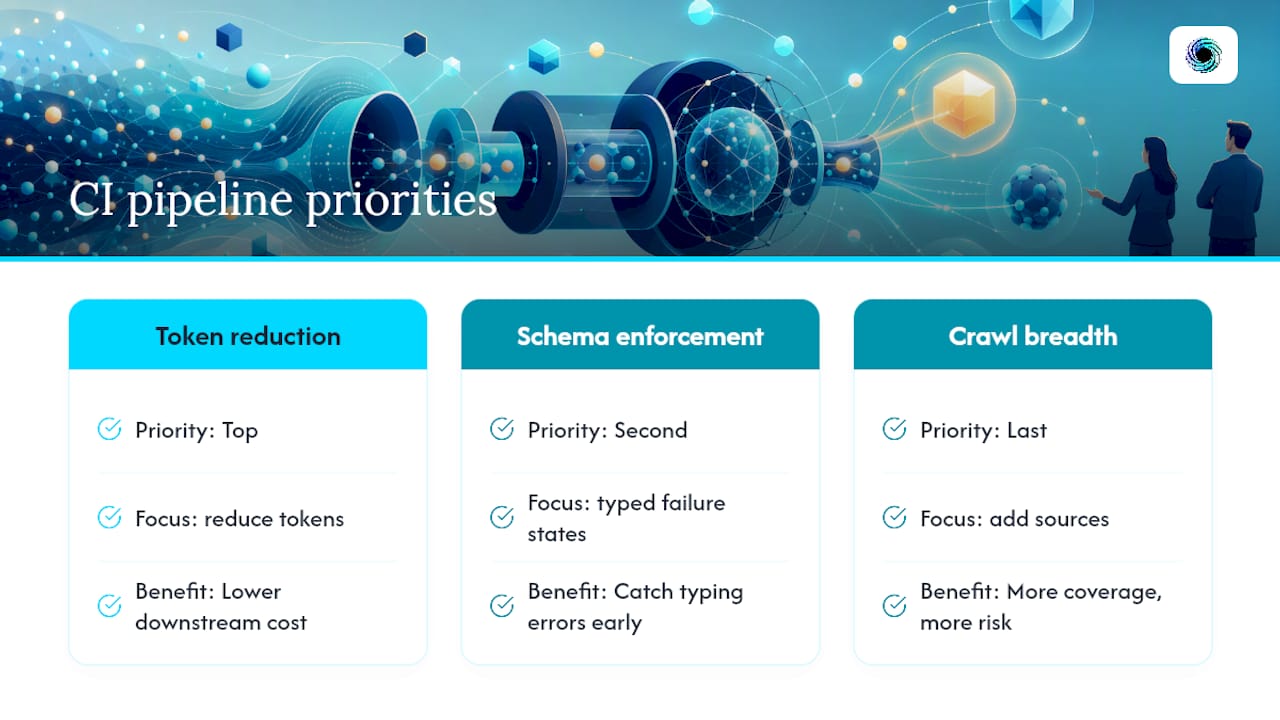
The conventional wisdom undersells failure modes. Teams tolerate a scraper that returns an empty string on failure because it doesn't crash anything, right up until an agent treats that empty string as "no data exists" and reports a competitor discontinued a product they simply couldn't fetch that day. That's not a data problem. It's a typing problem, and it should have been caught at the acquisition boundary, not discovered downstream in a report.
If you're building or rebuilding one of these systems, prioritize in this order: typed failure states first, schema-bound extraction second, breadth of sources last. A pipeline covering fifty competitor domains with honest failure signals beats one covering five hundred that occasionally lies about what it found. The lie is always more expensive than the gap.
— Glen
A Web Data API Built Around These Same Guarantees
Gyrence gives you the pipeline stages above without the maintenance burden of a proxy fleet, a rendering cluster, and a custom extraction validator you're patching every quarter. Every primitive, Search, Traverse, Fetch, Extract, Map, returns typed responses with explicit failure states baked in, and workspace spending caps mean a runaway crawl never turns into a surprise invoice.
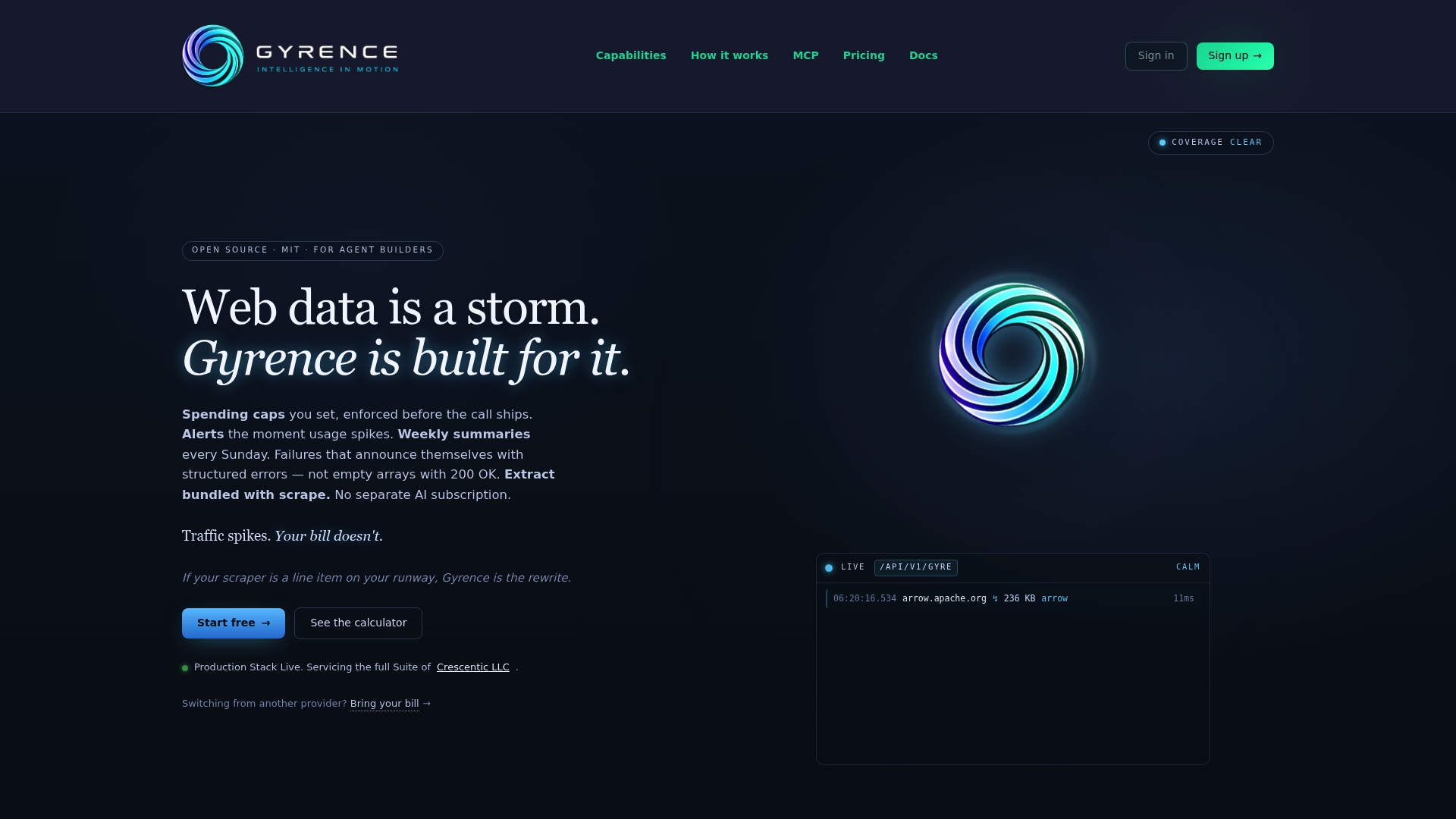
For teams building a competitive intelligence data workflow around an AI agent, the fit is direct: schema-guided Extract calls slot straight into the normalization stage described above, and the hosted MCP endpoint means an agent can call Search or Fetch without you wiring a custom tool. If you're evaluating what a broader CI data strategy looks like end to end, the web data for competitive intelligence guide covers the strategic layer this article's architecture supports.
Start with the Gyrence console and run a Fetch or Extract call against a real competitor page. You'll see the typed response, the provenance fields, and the cost per call before you commit to anything larger.
FAQ
What Is A Competitive Intelligence Data Pipeline?
It's a system that discovers, fetches, extracts, normalizes, and serves web data as typed, provenance-stamped records so AI agents and analysts can trust the output without manual verification.
Why Does Token Reduction Matter So Much In This Pipeline?
Raw HTML wastes tokens on navigation, ads, and scripts that carry no competitive signal, and converting to markdown or typed JSON cuts per-page token costs by 10 to 50 times.
When Should A Pipeline Use Full Browser Rendering Instead Of A Simple Fetch?
Only when a field is verified to render solely through client-side JavaScript execution, since full browser sessions cost more and carry higher bot-detection risk than HTTP fetch or lightweight rendering.
How Does Gyrence Fit Into A Competitive Intelligence Pipeline?
Gyrence's five primitives, Search, Traverse, Fetch, Extract, and Map, map directly onto the discovery, acquisition, and normalization stages, returning typed responses with explicit failure states instead of silent empty results.
What Metrics Show Whether A Pipeline Is Actually Working?
Acceptance rate, extraction success rate, duplicate rate, and cost per accepted document together reveal where a pipeline is leaking value before it shows up in a stakeholder report.