
A reliable competitive monitoring practice delivers early, verifiable signals that route directly to decisions — not a weekly inbox of noise nobody reads. Start this week with three actions: define your competitive set, including several direct rivals and relevant adjacent entities, automate baseline diffs on pricing pages and product changelogs, and commit to one distribution channel with a fixed weekly synthesis cadence.
First 7 days checklist:
- Identify 3–5 direct competitors and 2–3 adjacent players worth watching
- Instrument automated monitoring on pricing pages, product release notes, and job boards for each
- Set up one Slack channel or email digest as the single distribution point
- Schedule a 90-minute weekly synthesis block with a named owner
- Define a relevance threshold: only surface signals that could change a sales conversation, a roadmap decision, or a positioning choice
Pro Tip: Set a relevance threshold before you configure a single alert. If a signal would not change a decision in the next 30 days, it does not belong in the weekly digest. This one filter eliminates the majority of alert fatigue before it starts.
Key Takeaways
A competitive monitoring program delivers measurable business impact only when signals are verified, routed to named owners, and traced to documented actions — not when alert volume is high.
| Point | Details |
|---|---|
| Start narrow, then expand | Begin with 3–7 direct competitors and instrument baseline diffs on pricing pages and product changelogs before adding signal categories. |
| Evidence chain is non-negotiable | Every signal needs a source URL, a before/after diff, a confidence grade, and a recommended action to be usable. |
| Automate diffs, keep synthesis human | Automate baseline change detection; use human judgment for strategic triage and routing. |
| Measure signal-to-action ratio | Track what percentage of surfaced signals trigger a documented action — target above 30%. |
| Assign named owners to every signal | A signal without a named owner and a defined output never closes the action loop. |
Table of Contents
- What competitive monitoring is and why it changes how you compete
- What signals should you actually track?
- How to set up a competitive monitoring program in five steps
- Which tools fit your team's scale and budget?
- How do you keep web data quality high enough to trust?
- What KPIs prove your CI program is working?
- Who owns what, and how often does the team meet?
- What are the ethical and legal limits of competitive monitoring?
- Competitive monitoring setup checklist and starter playbook
- What to do in the next 90 days
- The CI failure modes nobody talks about
- Sources
- FAQ
What competitive monitoring is and why it changes how you compete
Competitive monitoring is the continuous, signal-based practice of detecting changes in your competitive environment and routing those changes to the people who can act on them. It differs from periodic research (a quarterly teardown, an annual win/loss survey) in one critical way: it runs between decisions, not before them.
The business case is direct. Speed to detect a competitor's pricing change, a new feature release, or a messaging shift determines whether your sales team walks into a deal prepared or gets blindsided. Product teams use competitor job postings to infer roadmap direction. Marketing uses messaging diffs to sharpen positioning before a campaign launches. Sales enablement uses review-site sentiment to build objection-handling scripts grounded in real buyer language.
Scanning the periphery for weak signals — adjacent market moves, regulatory filings, executive hires — provides early indicators of strategic shifts that conventional monitoring misses entirely. By the time a competitor's new direction shows up in a press release, the signal was visible in their hiring patterns and docs updates weeks earlier.
The decision loop looks like this: detect a signal → classify its urgency → verify the source → route to the right owner → trigger an action or update. Every step that lacks a named owner or a defined output breaks the loop. Most CI programs fail not at detection but at routing.
What signals should you actually track?
Priority matters here. Monitoring everything is the same as monitoring nothing. Mapping precise signal sources per entity type and building relevance filters is the design choice that separates a usable program from a noisy one.
High-priority signals (instrument these first):
- Pricing and packaging changes. Source: competitor pricing pages, app store listings, public plan comparison pages. Urgency: immediate. A price drop or new tier can shift deal outcomes within days.
- Product releases and changelogs. Source: release notes pages, app store update histories, GitHub public repos, developer docs. Urgency: immediate to 48 hours. New features directly affect your positioning and battlecards.
- Homepage and messaging shifts. Source: homepage, hero copy, tagline, and above-the-fold value proposition. Urgency: strategic. Messaging changes signal repositioning before a campaign launches.
- Paid ad creative and placements. Source: Meta Ad Library, Google Ads Transparency Center, LinkedIn Ad Library. Urgency: strategic. Ad copy reveals which pain points a competitor is testing against your shared audience.
- SEO and keyword movement. Source: keyword ranking tools, SERP monitoring. Urgency: strategic. Sudden ranking gains on your core terms signal content investment or a new SEO push.
- Job postings and hiring patterns. Source: LinkedIn, Indeed, Greenhouse/Lever public boards. Urgency: strategic. A cluster of ML engineer postings signals a product direction; a wave of enterprise sales hires signals a market move.
- Reviews and sentiment. Source: G2, Capterra, Trustpilot, app stores. Urgency: ongoing. Recurring complaints in competitor reviews are your sales objection scripts, written by their customers.
- Funding, partnerships, and M&A. Source: Crunchbase, SEC filings, press releases, LinkedIn announcements. Urgency: strategic. A funding round or partnership changes a competitor's runway and go-to-market capacity.
- Executive moves. Source: LinkedIn, press releases. Urgency: strategic. A new CRO or VP of Product often precedes a strategy shift within 90 days.
- Patent filings and regulatory submissions. Source: USPTO, SEC EDGAR, public regulatory databases. Urgency: long-horizon. Slow-moving but high-signal for technology direction.
Pro Tip: Job posting patterns are one of the most underused signals in competitive monitoring. A competitor hiring three "Enterprise Customer Success Managers" in a single quarter is a more reliable signal of an upmarket move than any press release they will ever publish. Check their open roles weekly.
Signal prioritization comes down to one question: which signals, if missed for two weeks, would cost you a deal or a roadmap decision? Those go in the automated, daily-check tier. Everything else runs weekly or monthly.
How to set up a competitive monitoring program in five steps
A repeatable CI program runs a collect→detect→verify→distribute→act loop, and the design choices that make it reliable are a fixed signal taxonomy, change detection (diffs), a confidence layer, and a citation trail. Here is how to build that in practice.
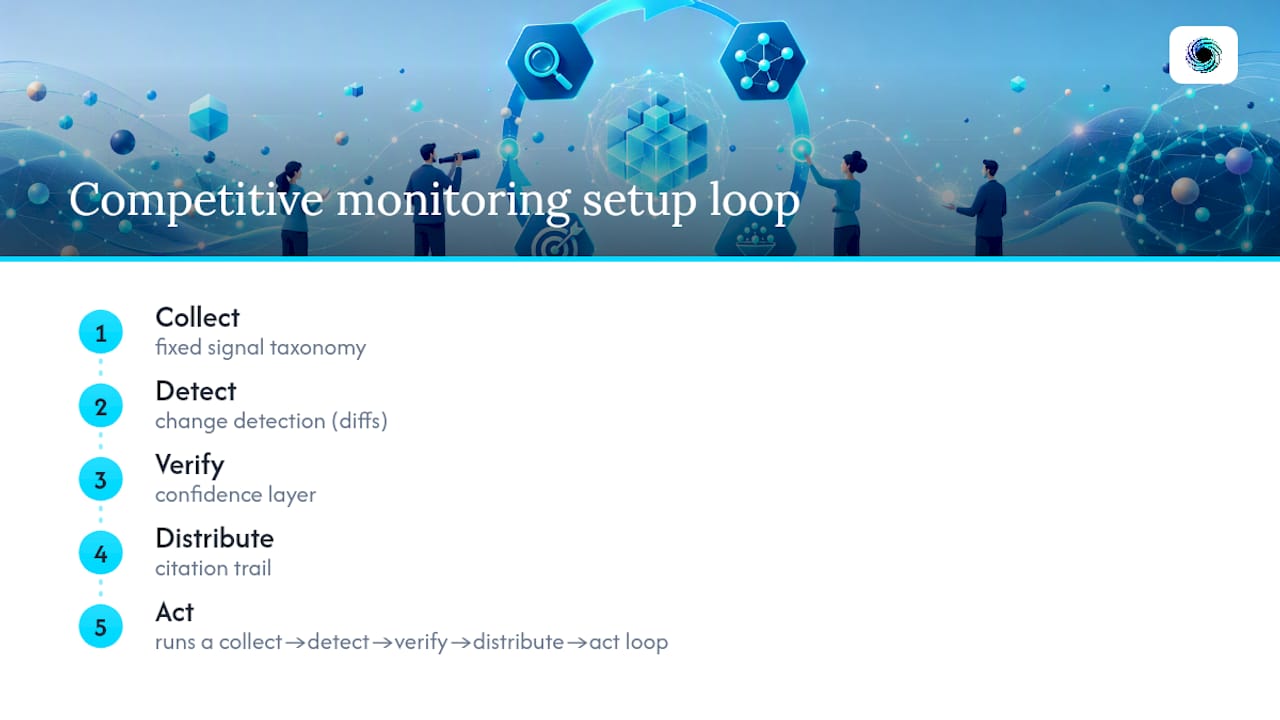
Step 1: Define your competitive universe
Start with a focused group of direct competitors and adjacent entities, including relevant emerging entrants and incumbents. Do not limit the universe to companies you already know. Include relevant regulators, standards bodies, and influential analysts if they shape buyer perception. Review and update this list quarterly.
Step 2: Map signals to sources and owners
For each entity, list the specific URLs and feeds to monitor. Assign an owner for each signal category. Pricing page diffs might belong to product marketing; job posting analysis to product; review sentiment to sales enablement. Ownership without a named person is not ownership.
Step 3: Choose your monitoring method and cadence
Three tiers exist, and most teams should start in the middle:
- Manual: RSS feeds, Google Alerts, weekly spot-checks. Zero infrastructure cost, high labor cost, low coverage.
- Hybrid: Manual synthesis layered on top of automated alerts from a CI platform or web-data API. Best for teams of 2–5 with moderate signal coverage needs.
- Automated: Custom pipelines using site crawl APIs, diff detection, and LLM-assisted classification. High coverage, requires engineering time to build and maintain.
Set a diff-check cadence per signal tier: daily for pricing and product pages, weekly for messaging and job boards, monthly for patents and filings.
Step 4: Build the synthesis layer
Raw diffs are not intelligence. A weekly synthesis digest should include: the signal, the source URL, the before and after state, a confidence classification (confirmed/likely/speculative), the strategic implication, and a recommended action. A three-layer CI model — continuous automated monitoring, AI-assisted synthesis, and human-routed distribution — makes CI consumable and actionable. The synthesis step is where AI earns its place: summarizing diffs and drafting implications, not replacing the human judgment that routes the output.

Step 5: Close the action loop
A signal that reaches a Slack channel and stops there is not intelligence. Map each signal category to a specific output: a battlecard update, a sales talking point, a product backlog item, or an escalation to leadership. Measure signal-to-action ratio, not alert volume. Win/loss analysis feeds back into this loop: deals where competitive signals were used and acted on should be tracked separately to demonstrate program impact.
90-minute weekly workflow for small teams:
- 20 min: Review automated alerts and diffs from the past week
- 20 min: Triage and classify (confirmed, likely, speculative)
- 20 min: Draft the weekly digest with implications and recommended actions
- 15 min: Update battlecards or talking points where signals warrant it
- 15 min: Distribute digest and log actions taken
Pro Tip: Do not try to automate everything in week one. Instrument diffs on three competitor pricing pages and one product changelog page. Run that for two weeks. You will learn more about your signal-to-noise ratio from two weeks of real data than from any planning session.
Which tools fit your team's scale and budget?
Tool selection is a function of three variables: team size, signal coverage requirements, and how much engineering capacity you can dedicate to maintenance. User feedback from CI platform review sites consistently highlights integration, accuracy, and evidence-tracing as the top selection criteria — not feature count.
Manual methods (RSS, Google Alerts, spreadsheets)
Appropriate for solo practitioners or teams just starting out. Google Alerts covers news mentions; RSS covers blog and changelog feeds; spreadsheets track diffs manually. The ceiling is low: coverage is incomplete, diffs require human eyeballs, and there is no evidence chain. Use this tier to validate which signals matter before investing in infrastructure.
Dedicated CI platforms
Purpose-built tools handle alerting, workflow routing, and some synthesis. They reduce manual scraping and surface signals faster than manual methods. Trade-offs: vendor lock-in, variable evidence quality, and pricing that scales with seat count rather than signal volume. Evaluate on evidence-chain completeness (does it give you a source URL and a before/after diff, or just a summary?) and on integration points (Slack, CRM, webhook support).
Web-data APIs and custom infrastructure
For teams with engineering capacity, a site crawler API combined with diff detection and LLM extraction gives the highest signal coverage and evidence quality. You control the cadence, the schema, and the output format. The cost is maintenance: you own the pipeline, the error handling, and the infrastructure. The benefit is that every output is traceable to a source artifact.

When evaluating any tool in this category, use a web-data API evaluation checklist that covers: structured failure modes (does the API surface errors explicitly?), spending caps (can you set a hard cost ceiling?), evidence-chain output (does it return the source URL and raw content alongside the extraction?), and webhook support for real-time routing.
Tool selection checklist:
- Does it return source URLs and before/after diffs, not just summaries?
- Does it integrate with your existing Slack workspace or CRM?
- Can you set spending caps or per-call cost limits?
- Does it surface failure modes explicitly (timeouts, blocked pages, parse errors)?
- Does it support webhook alerts for high-priority signals?
- Does it scale to your competitive universe without per-seat pricing that punishes growth?
Pro Tip: Automate baseline diffs and pricing detection first — these have the highest signal-to-noise ratio and the clearest action mapping. Keep synthesis and strategic triage human-curated. An AI summary without a source link is an assertion, not evidence.
How do you keep web data quality high enough to trust?
The difference between a useful CI program and a noisy one comes down to evidence quality. The standard for high-quality CI is the evidence chain: every signal should include the URL, before state, after state, classification, confidence score, strategic implication, and recommended action. Teams that instrument this standard surface competitive moves weeks earlier than those relying on manual processes.
Common failure modes to design against:
- Centralized hoarding: Intelligence sits in one person's inbox or a shared doc nobody reads. Fix: route outputs to role-specific channels with named owners.
- Alert fatigue: Too many low-relevance signals drown the high-value ones. Fix: set a relevance threshold at the filter layer, not the human layer.
- No change detection: Monitoring a page without diffing it means you see the current state, not the change. Fix: instrument timestamped diffs, not page snapshots.
- Unverifiable AI summaries: An LLM synthesis step that drops the source URL is worse than no synthesis — it creates confident-sounding claims with no evidence trail. Fix: require source links in every output, even when using LLM extraction.
- Stale historical context: A diff without a baseline is meaningless. Fix: store the before state alongside every detected change.
Practical checks for data quality in your ingestion pipeline:
- Every alert includes a timestamped diff (before/after) and the source URL
- Confidence classification is applied at the classification step, not added retroactively
- API responses surface errors explicitly (blocked pages, parse failures, rate limits) rather than returning empty results silently
- LLM extraction outputs are schema-guided and return structured JSON, not free-form prose
For teams building custom pipelines, the web data for competitive intelligence guide covers ingestion patterns, normalization, and how to route raw diffs into an LLM synthesis step while preserving source links. One edge case worth noting: some competitive signals — particularly changes to investor relations pages or regulatory filings — do not show up in a standard HTML diff and require content-type-aware routing to detect reliably.
Pro Tip: Design your ingestion pipeline with predictable failure modes from day one. An API that returns a typed error when a page is blocked or a schema extraction fails is far more useful than one that silently returns an empty result. Silent failures are the most expensive kind — you do not know what you missed.
What KPIs prove your CI program is working?
Measuring alert volume is the wrong metric. A program that fires 200 alerts a week and drives zero battlecard updates is not a CI program — it is a notification service. The metrics that matter connect signal detection to business outcomes.
Operational KPIs:
- Signal-to-action ratio: Of all signals surfaced in a given period, what percentage triggered a documented action (battlecard update, sales talking point, product backlog item)? Target: above 30%.
- Mean time to detect (MTTD): How many days after a competitor makes a change does your team know about it? Automated monitoring should reduce this to under 48 hours for high-priority signals.
- Time to update battlecards: From signal detection to updated battlecard in the hands of sales. Target: under five business days for confirmed signals.
- Alert read/adoption rate: What percentage of distributed digests are opened and acted on? Low adoption signals a distribution or relevance problem, not a monitoring problem.
Business impact metrics:
- Win rate in competitive deals: Track separately from overall win rate. If CI is working, this number should improve over time as reps use updated battlecards.
- Competitive displacement rate: Deals where your team displaced a named competitor. Requires CRM tagging.
- Rep confidence score: A simple 1–5 survey after competitive calls. Tracks whether CI outputs are actually useful in live conversations.
- Time saved per rep per call: Estimated time reps spend researching competitors before calls, before and after CI program implementation.
Dashboard structure:
- Executive layer: Win rate in competitive deals, competitive displacement rate, and program ROI estimate (time saved × rep count × average hourly cost).
- CI team layer: Signal-to-action ratio, MTTD, alert volume by category, and battlecard update frequency.
- Sales enablement layer: Battlecard adoption rate, rep confidence score, and digest open rate.
For attribution, run a simple A/B test on distribution format: send one cohort a Slack card with a one-sentence implication and a link to the full battlecard; send another a CRM notification with the same content embedded. Measure which format drives higher adoption and battlecard usage within 72 hours. The format that wins becomes the standard.
Structured market data types and normalization practices are worth understanding before you build dashboards — the way you normalize signal data upstream determines how cleanly it aggregates in reporting.
Who owns what, and how often does the team meet?
A CI program without named owners degrades into a shared doc nobody updates. The minimum viable team structure for a program covering 5–10 competitors looks like this:
Role matrix:
- CI owner/maintainer: Sets signal taxonomy, manages tool configuration, owns the weekly synthesis. One person, part-time at small scale.
- Signal triage: Reviews raw alerts and classifies them (confirmed/likely/speculative). Can rotate across the team.
- Synthesizer: Drafts the weekly digest and strategic implications. Often the CI owner at small scale.
- Distribution owners: Product marketing owns messaging signals; product owns changelog and hiring signals; sales enablement owns pricing and review signals.
- Battlecard owner: Maintains and versions battlecards. Typically product marketing.
- Escalation path: Define which signal types go directly to leadership (funding rounds, major product launches, executive departures at key competitors).
Recommended cadences:
- Daily: Automated alerts for pricing changes and product releases (high-priority signals only)
- Weekly: Synthesis digest with implications and recommended actions, distributed to all stakeholders
- Monthly: Win/loss review with competitive signal correlation
- Quarterly: Competitive set review — add, remove, or re-tier entities based on deal data
Governance rules that keep the program honest:
- Fixed signal taxonomy: every signal belongs to a defined category with a standard classification rubric
- Confidence grading: confirmed (source-verified, before/after diff), likely (strong indirect evidence), speculative (pattern-based inference)
- Source citation policy: every claim in a digest links to a source artifact — no unlinked assertions
- Access and permission model: raw data access is restricted; synthesized outputs are broadly distributed
Embedding CI into existing workflows reduces adoption friction. Route pricing signals directly into CRM deal records. Attach relevant battlecard updates to call prep templates in your sales engagement platform. Feed product signals into the sprint planning doc the week before planning. The goal is to make CI the path of least resistance, not an extra step.
Pro Tip: Start with one CI owner and a cross-functional steering group that meets monthly. Do not hire a dedicated CI analyst until you have proven the program drives decisions. Scale automation as signal coverage needs grow — not before.
What are the ethical and legal limits of competitive monitoring?
Competitive monitoring operates on public information. The line between legitimate intelligence gathering and legally or reputationally risky behavior is clearer than most teams assume.
Core rules:
- Respect
robots.txtand site terms of service. Automated crawling that violates a site's stated terms creates legal exposure, particularly under the Computer Fraud and Abuse Act (CFAA) in the United States. - Never use credentials you did not create to access competitor systems, dashboards, or internal tools. Unauthorized access is not a gray area.
- Do not publish, redistribute, or act on stolen or leaked data, even if it arrives unsolicited.
- Treat nonpublic filings (draft contracts, internal memos, pre-release documents) as off-limits regardless of how they were obtained.
Public vs. private signals:
Public signals include pricing pages, press releases, job boards, public app stores, ad libraries, patent databases, SEC filings, and review sites. These are legitimate monitoring targets. Private signals — internal Slack messages, private beta access, confidential customer data — are not, regardless of how they were obtained.
When monitoring people (executives, employees), link only to public sources (LinkedIn profiles, published interviews, public conference talks). Limit personal data retention to what is needed for the specific intelligence purpose. Do not build profiles on individuals beyond their public professional role.
Operational controls to reduce legal risk:
- Set rate limits on automated crawls to avoid denial-of-service exposure
- Maintain an audit trail of what was collected, when, and from which URL
- Review
robots.txtfor each monitored domain before instrumenting automated collection - Seek legal counsel before monitoring regulated industries (healthcare, finance) where data handling rules add complexity
- Document your data retention policy and apply it consistently
Competitive monitoring setup checklist and starter playbook
Use this checklist to stand up a monitoring program in 2–4 weeks. Assign an owner to each item before you start.
Operational checklist:
- Define competitive universe including a handful of direct competitors and a bench of adjacent entities. (Week 1, CI owner)
- Map signal categories to source URLs for each entity (Week 1, CI owner + product marketing)
- Select monitoring method: manual, hybrid, or automated (Week 1, CI owner)
- Instrument baseline diffs on pricing pages and product changelogs (Week 1–2, CI owner or engineering)
- Configure job board monitoring for each competitor (Week 2, CI owner)
- Set up one distribution channel (Slack channel or email digest) with named subscribers (Week 2, CI owner)
- Define signal taxonomy and confidence grading rubric (Week 2, CI owner)
- Schedule weekly synthesis block with a named owner (Week 2, CI owner)
- Draft starter battlecard template for top 3 competitors (Week 3, product marketing)
- Run first weekly synthesis and distribute digest (Week 3–4, CI owner)
Starter playbook outline (one-page template):
| Element | Detail |
|---|---|
| Program owner | Named individual, part-time at small scale |
| Signal taxonomy | Pricing, product, messaging, hiring, reviews, funding, executive, regulatory |
| Confidence grades | Confirmed / Likely / Speculative |
| Distribution channel | Single Slack channel or email digest |
| Weekly cadence | 90-minute synthesis block, digest distributed by end of day Friday |
| Escalation rule | Funding rounds and major product launches go to leadership promptly |
| Battlecard update trigger | Confirmed signal in pricing or product category |
| Action log | Shared doc tracking signal → action → outcome |
Dashboard skeleton:
| KPI | How to measure | Cadence |
|---|---|---|
| Signal-to-action ratio | Actions logged / signals surfaced | Weekly |
| Mean time to detect | Days from competitor change to team alert | Weekly |
| Battlecard update frequency | Updates logged per month | Monthly |
| Win rate in competitive deals | CRM competitive deal tag | Monthly |
| Rep confidence score | Post-call survey (1–5 scale) | Monthly |
For teams ready to automate ingestion and diff detection, Gyrence's web data API provides the primitives needed to build a reliable evidence chain: Fetch (page to markdown), Extract (schema-guided JSON), Traverse (site-wide crawl), and WebDoppler monitoring with webhook alerts. Spending caps and typed error responses mean your pipeline budget and failure modes are both predictable from day one.
What to do in the next 90 days
The teams that get value from competitive monitoring fastest share one habit: they start narrow and instrument the evidence chain before they expand coverage.
Immediate next steps:
- Days 1–7 (CI owner): Define the competitive set, map signal sources for a manageable number of top competitors, and instrument automated diffs on pricing pages and product changelogs. Set the relevance threshold.
- Days 8–30 (CI owner + product marketing): Run the first three weekly synthesis cycles. Draft battlecards for the top 3 competitors using confirmed signals. Establish the distribution channel and measure digest adoption.
- Days 31–90 (CI owner + sales enablement + product): Expand signal coverage to job boards, review sites, and ad libraries. Integrate competitive signals into CRM deal records. Run the first win/loss review with competitive signal correlation. Report signal-to-action ratio to leadership.
Evidence quality reminder:
- Every signal in a digest links to a source URL
- Every claim carries a confidence grade
- Every action taken is logged against the signal that triggered it
- No unlinked AI summaries in distributed outputs
The measurement imperative is simple: if you cannot show that a signal led to an action that affected a deal or a product decision, the program is not closing its loop. Fix the routing before you expand the coverage.
The CI failure modes nobody talks about
Most CI programs fail quietly. They do not collapse — they drift. A team instruments monitoring, runs a few weekly digests, and then the synthesis block gets deprioritized, the battlecards go stale, and the Slack channel becomes a feed nobody reads. The program is technically running. It is not actually working.
The three failure modes I see most often: intelligence hoarding (one person synthesizes everything and becomes a bottleneck), noisy channels (no relevance threshold, so every alert trains the team to ignore alerts), and a broken action loop (signals reach the digest but never trigger a documented action). Each one is fixable, and none of them require more tooling.
The corrections are operational, not technical. Fix hoarding by assigning distribution ownership to role-specific stakeholders, not a single CI analyst. Fix noise by setting a relevance threshold at the filter layer — before signals reach humans, not after. Fix the broken action loop by requiring every digest entry to include a recommended action and an owner. If you cannot name an owner for a signal's implication, the signal does not belong in the digest.
The deeper issue is that CI gets treated as a research function when it is actually an operational one. Research produces reports. Operations produces decisions. The cadence, the evidence chain, the routing rules — these are not process overhead. They are what makes the difference between a program that influences strategy and one that generates PDFs.
Pro Tip: Institutionalize CI as an operational habit by tying it to an existing meeting cadence — sprint planning, QBR prep, deal review. A CI digest that arrives the day before a known decision point gets read. One that arrives on a random Tuesday gets archived.
Sources
The sources below were selected for practical, practitioner-focused guidance on building and operating competitive monitoring programs. Each one backs a specific claim in this guide.
- How to Build a Competitive Intelligence Monitoring System — SignoVerse Blog
- Scanning the periphery — Harvard Business Review
FAQ
What is competitive monitoring, and how does it differ from research?
Competitive monitoring is continuous, signal-based detection of changes in your competitive environment — it runs between decisions. Periodic research (quarterly teardowns, annual surveys) captures a snapshot; monitoring captures the change.
How many competitors should you monitor?
Start with 3–7 direct competitors and 5–10 bench entities. Monitoring more than that before you have a working synthesis cadence adds noise faster than it adds signal.
What is the most important signal category to instrument first?
Pricing and product changelog changes have the highest signal-to-action ratio and the most direct impact on deal outcomes. Instrument automated diffs on those pages before expanding to other categories.
How do you avoid alert fatigue in a CI program?
Set a relevance threshold before configuring alerts: only surface signals that could change a sales conversation, a roadmap decision, or a positioning choice within 30 days. Apply this filter at the tool layer, not the human layer.