
Compliance-friendly scraping means engineering a data pipeline that produces audit-ready records, typed failure reporting, PII and content controls, and hard spending caps, not a legal opinion about whether scraping is allowed. The recommended approach is simple: require any scraping API or service you adapt to return structured records with provenance metadata, expose typed errors instead of silent failures, and enforce spending limits before the invoice arrives.
TL;DR:
- Audit trails must include source URL, fetch timestamp, proxy ID, response headers, and extraction schema version to prove data provenance during compliance reviews.
- Typed failure responses like blocked or CAPTCHA states help distinguish between permanent issues and transient errors, reducing wasted retries and budget.
- Building in request caching, request deduplication, and automatic throttling controls can significantly prevent unexpected increases in scraping costs.
- Monitoring success, block rate, latency, null and miss rates, and cost per record allows early detection of schema drift and extraction issues before they impact downstream systems.
- Respectful scraping involves parsing robots.txt, obeying rate limits, handling consent and personal data responsibly, and avoiding IP blocks by responding to target signals instead of masking or evading.
Table of Contents
- What Counts as Compliance-Friendly Scraping in Practice?
- How Do You Monitor Silent Data Failures?
- How Do You Keep Scraping Costs Predictable?
- How Do You Detect Schema Drift Before It Reaches Your Database?
- How Do You Handle a Failed or Drifting Feed?
- Practical API Patterns for Compliance-Friendly Agents
- What Do GDPR, CCPA, and Terms of Service Mean for Your Pipeline?
- Do You Have to Respect Robots.txt?
- How Do You Avoid IP Blocking Without Crossing a Line?
- How Should You Handle Consent and User Data During Extraction?
- What Does Ethical Data Harvesting Actually Look Like?
- Bake Compliance Into the Product, Not the Process
- Get Audit-Ready Scraping Without the Guesswork
- Sources
- FAQ
What Counts as Compliance-Friendly Scraping in Practice?
Security and compliance teams don't ask "is this legal." They ask "can you prove what happened." That distinction defines the whole discipline. A pipeline that returns clean JSON but can't tell you which proxy fetched a record, when, or under what schema version fails a compliance review even if the data itself is accurate.
The minimum bar has five parts, and most production teams skip at least two of them until an incident forces the issue.
- Audit trail: record-level provenance including source URL, fetch timestamp, response headers, resolver or proxy ID, and the extraction version that parsed it.
- Typed failure taxonomy: blocked, CAPTCHA, timeout, parse-miss, and schema-invalid states surfaced as discriminated-union responses, not buried in a generic error string.
- Spending controls: per-workspace caps, per-call cost metadata, and defined throttle or overage rules that trigger automatically.
- PII and content controls: tagging, redaction rules, and content-type-aware routing so personal data doesn't silently flow into a training set or export.
- Schema enforcement: required-field completeness checks, versioned schemas, and a change log every reviewer can read without asking an engineer to explain it.
Miss the audit trail and you can't answer "where did this record come from" during a security review. Miss typed failures and your agent retries a permanent block as if it were a network blip, wasting budget on a request that will never succeed.
How Do You Monitor Silent Data Failures?
HTTP 200 tells you the server responded, not that the response contained anything usable. A page can return a full 200 status and be a CAPTCHA wall, a rate-limit notice, or a redesigned template that no longer matches your selectors. Treating success as passed validation, not HTTP status, is the single biggest shift teams make when they move from a hobby scraper to a production feed.
Five metrics catch almost every real failure before a downstream system notices:
- Success rate per host and per run, measured against validation rules, not status codes.
- Block or CAPTCHA rate, tracked separately from timeouts because the remediation differs.
- P95 latency, since a creeping latency curve often precedes a full block.
- Field null-rate and selector miss rate, which expose template drift long before volume drops.
- Cost per usable record, the metric that turns a quality problem into a finance alert.
Canary checks, hitting a known-good page on a schedule, catch access changes faster than statistical drift detection, because a canary flips the moment a target changes instead of waiting for enough bad records to shift an average. Build alerts around per-host baselines and sustained deviation, not single-minute blips; one slow page is noise, three hours of climbing null-rates is a template change. Every alert payload should name the affected feed, the rule that failed, the observed value, an owner, and the evidence needed to confirm the fix, matching the structure a scraper monitoring checklist recommends for run health, extraction health, and delivery health.
Pro Tip: Label your metrics by feed or spider name, not by page-derived values. A hosted metrics collector will choke on label cardinality if you tag every unique product ID, and you'll lose the alert signal in the noise.
How Do You Keep Scraping Costs Predictable?
Most scraping bills blow up for the same handful of reasons: retries billed as new calls, no caching, no deduplication, and pricing tiers that penalize you for the provider's own failed request. Adding caching and deduplication first is the highest-leverage fix available, because it removes the largest source of wasted spend before you touch anything else.
A working cost governance setup includes:
- Daily, weekly, and monthly spending caps with automated throttles that kick in at threshold, not alerts you read the next morning.
- Aggressive caching and request deduplication, with cache TTLs tiered to how often the underlying data actually changes.
- Pricing models that don't bill you for a blocked or failed call, or that clearly disclose how retries are metered.
- Spend tracked as an operational signal, not just a finance line: bandwidth per usable record and CAPTCHA solves per usable record both spike before a quality incident becomes visible anywhere else.
A sudden jump in cost per record is rarely a pricing change. It's usually a block page or a broken extractor burning credits on unusable output, which is why finance and engineering should watch the same dashboard.
How Do You Detect Schema Drift Before It Reaches Your Database?
Pick a small set of fields your downstream systems cannot tolerate losing, price, availability, a unique identifier, and alert aggressively the moment their null rate or format shifts. Trying to protect every field equally means you protect none of them well.
- Automate schema validation on every run and store the schema version alongside the run manifest, not in a separate document nobody checks.
- Track field-level distribution changes and missing columns as drift signals, not just missing records.
- Quarantine suspect batches and backfill once the fix is verified, rather than deleting bad data and hoping nobody asks where it went.
- Archive raw snapshots and extraction metadata for every run, since a compliance audit will ask for the source page, not just the parsed output.
A runbook approach that defines expected-versus-observed coverage alongside record and schema validation gives reviewers a concrete standard instead of a vague promise that "the data looks fine." Emitting a small run report after every job, a handful of numbers and a pass/fail verdict, is the cheapest monitoring investment that surfaces most drift problems, and it doubles as the audit evidence a security reviewer will eventually ask for.
How Do You Handle a Failed or Drifting Feed?
When a feed fails validation, the sequence matters more than the speed. Skipping triage to patch a selector fast usually creates a second incident on top of the first.
- Triage immediately. Pull the run report, check the error taxonomy, and look for patterns in the proxy pool or selector miss rate.
- Contain the damage. Choose to warn, quarantine the suspect records, pause delivery entirely, or continue under a documented exception if downstream tolerance allows it.
- Fix and re-run. Correct the parser or selector, re-run only the affected window, and re-validate against the same rules that caught the failure.
- Deliver with a manifest. Ship the corrected batch with an incident summary attached, not a silent overwrite of the bad data.
- Document for audit. Record the owner, the evidence reviewed, and any follow-up actions in the incident log.
Defining quarantine policy in advance as an acceptance rule, rather than deciding case by case during an incident, is what separates a documented process from a scramble.
Practical API Patterns for Compliance-Friendly Agents
Agents can't reason about a stack trace. They can reason about a typed response. A discriminated-union API response that returns {status: "blocked"}, {status: "captcha"}, or {status: "parse_miss"} lets an agent branch deterministically instead of guessing whether a retry is worth the cost. This is the pattern Gyrence builds around: every call returns a typed result, including the failure cases, so an agent or a human reviewer can act on the actual state of the request.
Composable primitives make this easier to reason about than one monolithic "scrape everything" endpoint. Gyrence splits the job into five: Search finds relevant pages, Traverse (Gyre) walks a site outward from a starting URL, Fetch cleans a page to markdown, Extract pulls schema-guided structured JSON with an LLM, and Map builds a URL graph from a sitemap. A hosted Model Context Protocol endpoint exposes these same primitives to agents directly, which matters if you're building an agent workflow rather than a one-off script.
Every response should carry provenance and cost metadata alongside the payload, not as an afterthought logged separately. That's what turns a run report into something a reviewer can actually audit: the source, the cost, and the outcome, in the same record.
- Discriminated-union responses replace guesswork with explicit status handling.
- Provenance and per-call cost metadata travel with every payload, not in a separate log.
- Schema-guided extraction means the shape of the output is a contract, not a hope.
- Spending caps and retry policy live at the workspace level, so an agent loop can't runaway a budget overnight.
Pro Tip: If you're building an agent that calls a scraping API in a loop, check the response type before you retry. A "blocked" status and a "timeout" status call for completely different remediation, and retrying a permanent block just burns your cap.
What Do GDPR, CCPA, and Terms of Service Mean for Your Pipeline?
Legal frameworks set the boundary; engineering controls are what let you prove you stayed inside it. GDPR applies when scraped data includes personal information about individuals in the EU, regardless of where your servers sit, and it requires a lawful basis for processing plus the ability to honor deletion and access requests. The CCPA imposes similar obligations for California residents, with its own definitions of what counts as personal information and what counts as a sale of data.
Terms of service sit in a different category. They're contractual, not statutory, and courts have handled scraping-related ToS disputes inconsistently depending on jurisdiction, the nature of the data, and whether access controls were circumvented. None of that is a substitute for reading the specific terms of the sites you target.
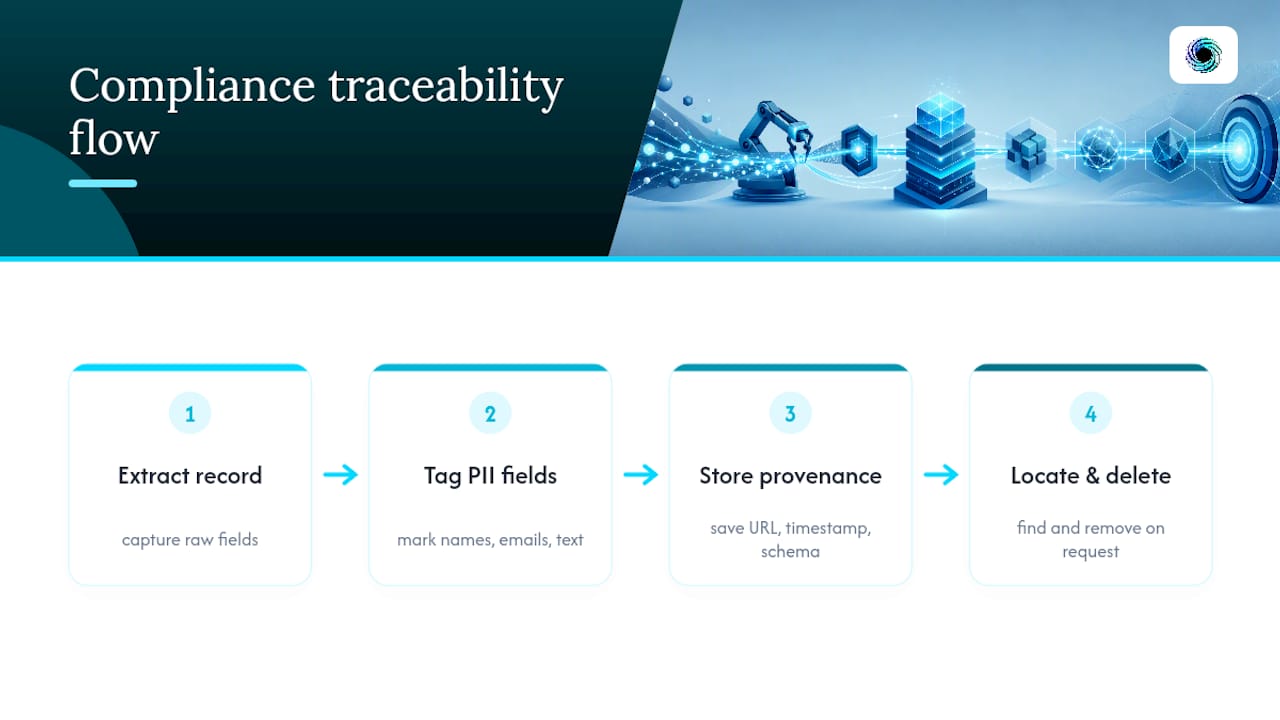
What engineering can control regardless of jurisdiction: tagging any field that might contain personal data at extraction time, so it's identifiable later instead of buried in an unstructured blob. Building a deletion path so a record can be located and removed by source URL or identifier. Keeping a schema version history so you can prove what fields you were collecting at any point in time, which matters if a regulator or auditor asks what changed and when.
Compliance-friendly scraping, in the engineering sense this article uses, doesn't replace a legal review. It gives your legal and security teams something concrete to review instead of a black box.
Do You Have to Respect Robots.txt?
Robots.txt is a voluntary signal, not an access control, but ignoring it is the fastest way to get a compliance reviewer to reject your pipeline on sight. Treat it as the first gate, not an optional check.
A working approach parses robots.txt before the first request to a domain and caches the result rather than re-fetching it on every crawl. Respect Disallow rules at the path level, not just the domain level, since many sites block specific sections (checkout flows, account pages, search result pages) while leaving the rest open. Honor Crawl-delay directives where present, and where absent, set your own conservative default rather than assuming unlimited concurrency is fine.
Site-specific policies go beyond robots.txt. Some sites publish API terms or a dedicated data-use policy that supersedes the general crawl rules. Others rate-limit through response headers like Retry-After, which a compliant crawler should read and obey rather than treating as a suggestion.
Build this into your pipeline as a pre-flight check, not a manual review: a request that violates a Disallow rule should return a typed policy-violation response before it ever reaches the network layer, the same way a blocked or CAPTCHA response gets surfaced. That way your audit trail shows the crawler declined the request, which is a very different record than "the crawler wasn't stopped."
How Do You Avoid IP Blocking Without Crossing a Line?
Getting blocked isn't just an availability problem, it's often the first sign a target considers your traffic hostile, which is exactly the kind of thing a compliance reviewer wants surfaced, not hidden behind an automatic retry.
Rotate proxies to distribute load, not to disguise identity. There's a real difference between spreading requests across a proxy pool to avoid overloading a single origin and rotating IPs specifically to evade a block a site has deliberately placed on your traffic. The first is standard practice; the second usually signals you're ignoring a signal you should be responding to instead.
Rate limit based on the target's own signals. If a site returns 429 responses or a Retry-After header, back off according to that header rather than pushing through with a fresh IP. A rising block rate is data, not an obstacle: it's telling you the current request pattern isn't sustainable, and the fix is usually slowing down or reducing concurrency, not just adding more proxies.
Track block rate as a named metric, not a symptom you notice when a feed goes empty. Document your proxy provider, rotation policy, and rate-limit logic in the same audit trail you use for extraction, so a reviewer can see the full request lifecycle, not just the parsed output.
How Should You Handle Consent and User Data During Extraction?
Consent becomes relevant the moment scraped content includes personal data tied to an identifiable person, comments, reviews, profile pages, or any field a person filled in themselves rather than a business publishing product data.
The practical control isn't asking every website visitor for consent, that's not how scraping works. It's building the pipeline so personal data is identified, minimized, and handled with a defined retention policy from the moment it's extracted. Tag fields likely to contain personal data (names, emails, user-generated text) at extraction time rather than trying to identify them after they're already mixed into a dataset. Apply redaction or hashing where the downstream use case doesn't actually need the raw value, only a stable identifier or an aggregate.
Set a retention policy and enforce it automatically. Data that has no defined expiration tends to accumulate risk without adding value, and a compliance review will ask what your deletion timeline looks like before it asks about your collection method.
Where a data subject access or deletion request applies, the audit trail becomes the mechanism that makes compliance possible. A record that carries its source URL, extraction timestamp, and schema version can be located and removed on request. A record with none of that provenance is nearly impossible to trace back to its origin, which turns a routine deletion request into a manual investigation.
What Does Ethical Data Harvesting Actually Look Like?
Ethical scraping isn't a separate checklist from the technical one, it's the same controls applied with intent rather than as an afterthought bolted on after an incident.
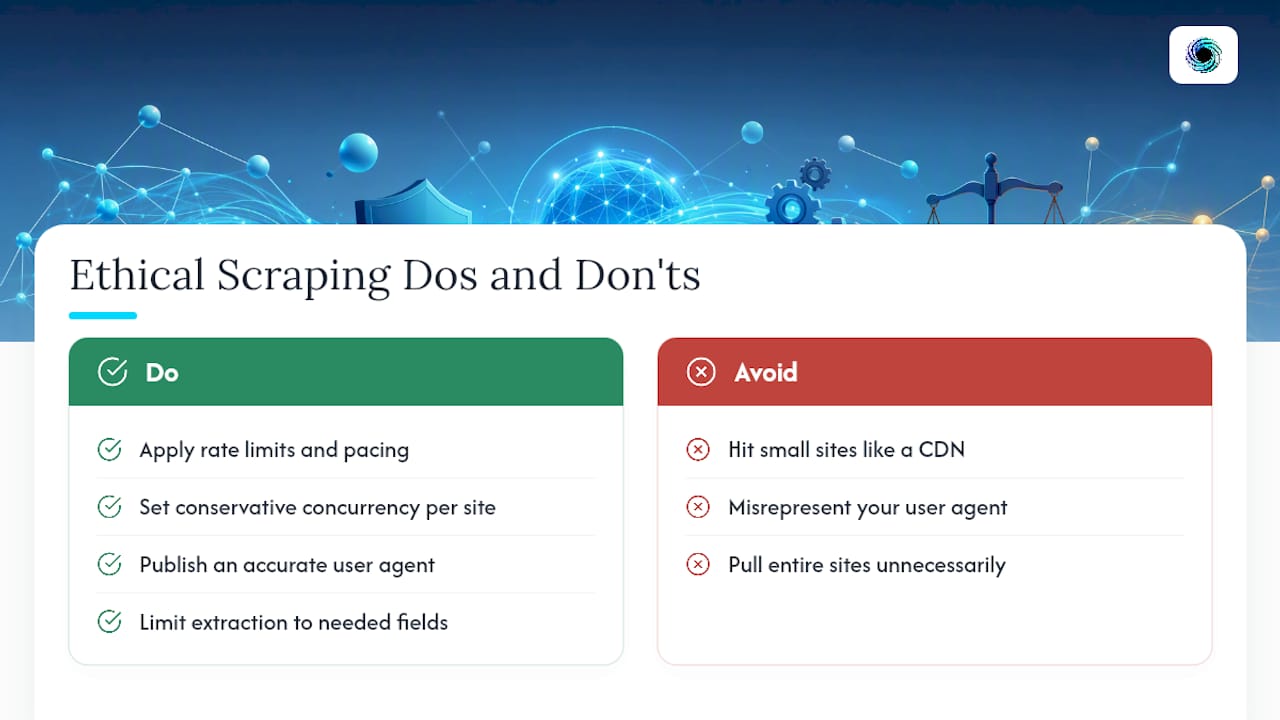
Rate limiting protects the target site's infrastructure, not just your own reputation. A crawler that hits a small site as hard as a CDN backed enterprise domain is externalizing cost onto an operator who has no way to bill you for it. Set concurrency and request pacing based on what a site can reasonably absorb, and treat an unusually generous response time as a hint you have room to be more conservative, not an invitation to increase load.
Transparency in identification matters more than most teams assume. A crawler that misrepresents its user agent to avoid detection is choosing evasion over disclosure, and that choice tends to correlate with other corners getting cut elsewhere in the pipeline. Publishing an accurate user agent and honoring robots.txt costs you very little and signals good faith to any site operator who checks their logs.
Extraction scope should match actual need. Pulling an entire site when you need one data field per page wastes the target's bandwidth and your own budget simultaneously, and it's the kind of decision that looks worse in hindsight during an audit than it did during development. Good practices here overlap directly with ethical web scraping guidance on rate limits, schema, and PII controls: build restraint into the pipeline's defaults, not into a policy document nobody consults during a sprint.
Bake Compliance Into the Product, Not the Process
Compliance-friendly scraping stops being a bottleneck once auditability, typed failures, and spending caps live in the engineering stack itself rather than in a review checklist bolted on afterward. Every control this article describes reduces audit load later. Teams that treat these as product features from the start spend less time reconstructing what happened after something breaks.
— Glen
Get Audit-Ready Scraping Without the Guesswork
Gyrence maps directly onto the checklist above: typed, discriminated-union responses for every call, spending caps at the workspace level, schema-guided extraction with versioned outputs, and provenance metadata attached to every record instead of buried in a log file somewhere.
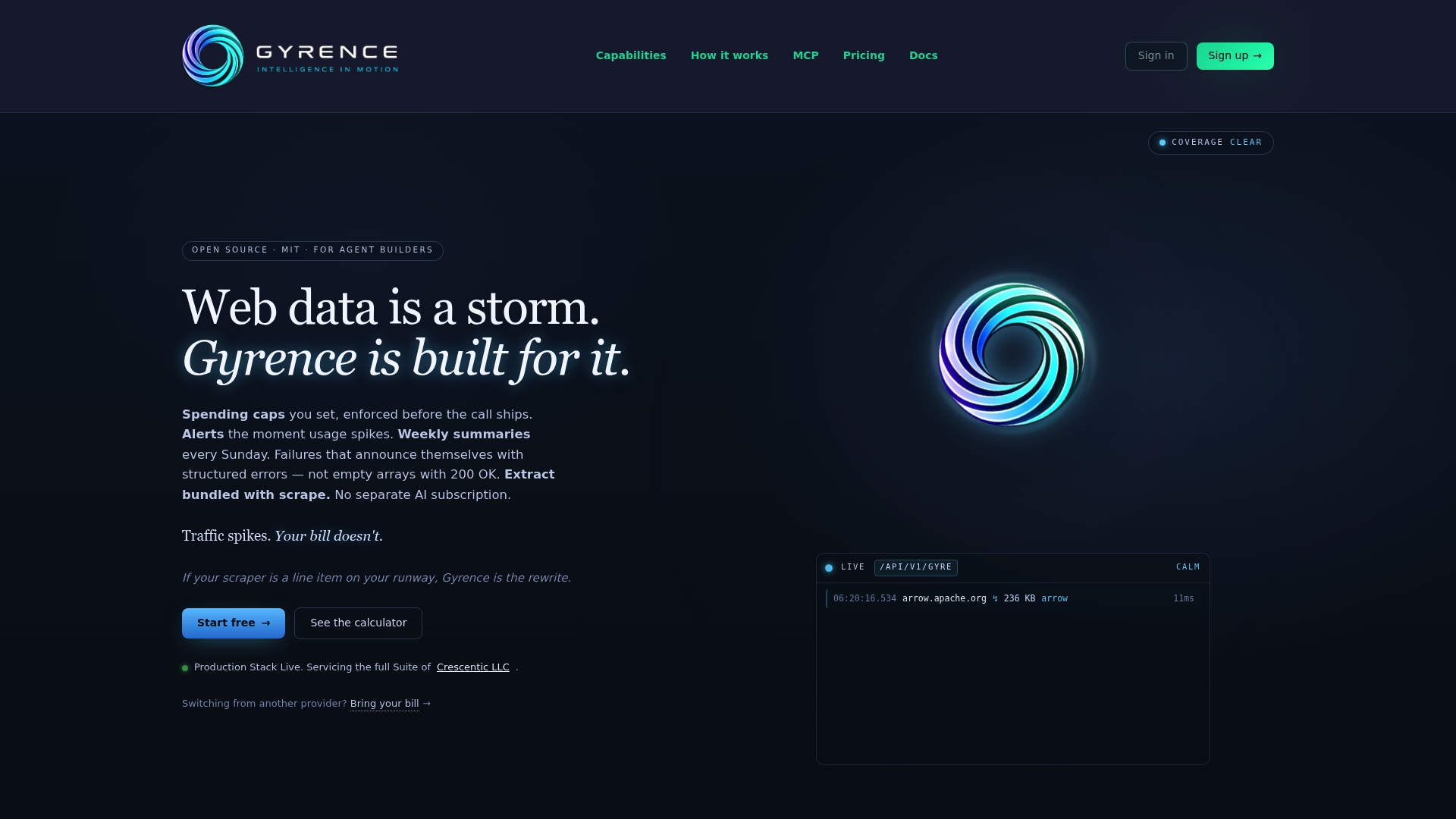
The five primitives, Search, Traverse, Fetch, Extract, and Map, plus the hosted MCP endpoint, give you one API surface that returns audit-ready data whether you're pulling a single page or mapping a domain. For monitoring and drift detection on top of that data, WebDoppler watches your feeds and fires webhook alerts when something changes, closing the loop between extraction and the monitoring practices this article covers. Plans start with a Free tier for testing, and paid plans are available for teams ready to move to production; check the pricing page for details. Check the current plans and usage-based pricing to find the tier that matches your call volume, and take a workspace for a test run before you commit spend to it.
Sources
- Monitoring a Scraping Pipeline: The Metrics That Tell You It's Breaking Before Your Data Does | Shifter Blog
- Monitoring and Alerting for Web Scraping Pipelines
- Cost Control for Web Scraping APIs
- Web Scraping Monitoring: A Runbook for Reliable Data Feeds
- Monitoring and Alerting for Scrapers — Python Web Scraping
FAQ
What Is Compliance-Friendly Scraping in Engineering Terms?
It's a data pipeline built to produce audit-ready records, typed failure reporting, PII controls, and spending caps, not a legal certification. The engineering standard focuses on provenance metadata and structured errors that a compliance or security team can actually review.
What Metrics Should You Monitor to Catch Silent Failures?
Track success rate per host measured against validation rules, block or CAPTCHA rate, field null-rate, selector miss rate, and cost per usable record. Treating HTTP 200 as insufficient proof of success is the core shift that catches problems before they reach a database.
How Do You Keep Scraping Costs Predictable?
Set daily and monthly spending caps with automated throttles, cache aggressively, and deduplicate requests before they hit a billed endpoint. Adding caching and deduplication first typically removes the largest source of wasted spend.
Does Gyrence Handle Typed Failures and Spending Caps?
Yes. Gyrence returns typed, discriminated-union responses for every call, including blocked, CAPTCHA, and parse-miss states, alongside workspace-level spending caps. Current plans and pricing are listed on the Gyrence pricing page.
What Should a Runbook Include for a Failed Data Feed?
A runbook should cover immediate triage using the run report, a containment decision (warn, quarantine, or pause delivery), a correction and re-validation step, and a documented incident summary for audits. Defining quarantine rules in advance keeps that decision consistent during an actual incident.