
To connect a web scraping API to an AI agent, expose a small set of typed HTTP primitives — search, traverse, fetch, extract, and map — that the agent calls by name. Each call returns a discriminated-union response with a status field (success, partial_success, blocked, rate_limited, captcha_required), a short summary, and the cleaned content. The agent reads status first, then decides whether to continue, retry, or halt. That typed contract is what separates a reliable agent from one that silently ingests boilerplate and keeps spending.
For production, route requests through a managed scraping API that handles proxy rotation and JS rendering server-side, convert output to token-efficient Markdown or structured JSON before it touches your vector store, and enforce hard stop conditions — max_requests, max_errors, and budget_left — inside the agent loop. Gyrence implements this pattern directly: five composable primitives, typed failure modes, and per-call cost estimates so your agent knows what it's spending before it commits.
Required components at a glance:
- Agent runtime: LangChain, LlamaIndex, or a custom loop that reads typed API responses
- Secure API client: short-lived or per-agent keys, least-privilege scopes
- Rendering tier: headless browser or managed rendering service for JS-heavy pages
- Cleaner/normalizer: strips boilerplate, outputs Markdown or JSON
- Vector store: Pinecone, Weaviate, Chroma, or equivalent for embedding and retrieval
- Monitoring layer: request logs, response-type histograms, coverage metrics
Pro Tip: Wire stop conditions into the agent runtime before you write a single extraction call. A runaway agent with no budget cap is the most expensive mistake in this stack.
Table of Contents
- How does the integration architecture work between an agent and a scraping API?
- How do you wire auth, primitives, and response handling step by step?
- A minimal working Python example for agent web data extraction
- What are the common failure modes and how do you stop them?
- How do you turn scraped pages into RAG-ready documents?
- What legal, security, and cost controls does your agent need?
- Which tool pattern fits your use case?
- What are the concrete next steps to implement this quickly?
- Key Takeaways
- The part most teams get wrong
- Gyrence gives your agent typed web data from day one
- Useful sources
- FAQ
How does the integration architecture work between an agent and a scraping API?
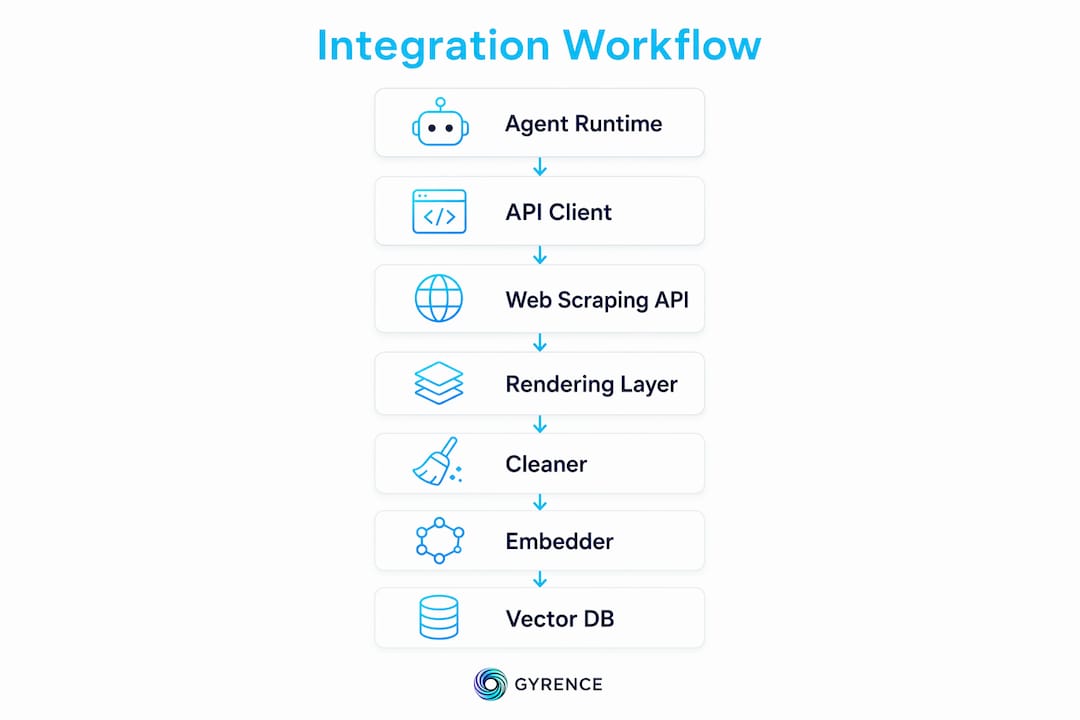
The data flow has six discrete stages, and each one has a failure surface worth designing for.

Agent runtime → API client → Web-scraping API → Rendering layer → Cleaner/Normalizer → Chunker & Embedder → Vector DB. The agent never touches raw HTML. It calls a primitive, receives a typed response, and acts on status. Everything below the API surface — proxy pools, browser fleets, HTML parsing — is the scraping API's problem.
The extraction path itself should follow a tiered cascade: attempt static HTML extraction first, escalate to heuristic density scoring, then JS rendering, then an LLM fallback only when cheaper tiers fail a quality threshold. Routing by cost and quality at each gate keeps your per-page spend predictable. Skipping the cascade and always rendering every page is the fastest way to blow a budget on simple static sites.
Agent-visible primitives and their typed response contract:
search(query)→ ranked URL list withstatus,result_count,cost_estimatetraverse(url, depth)→ discovered child URLs withstatus,links_found,blocked_countfetch(url, render=false|true)→ cleaned Markdown withstatus,content,render_used,cost_estimateextract(url, schema)→ structured JSON matching your schema withstatus,fields_extracted,missing_fieldsmap(start_url)→ domain URL graph withstatus,url_count,sitemap_coverage
Stop conditions belong at the API client layer, not inside the LLM prompt. The client enforces max_requests_per_task, max_errors, and budget_left before forwarding any call. When a threshold trips, the client returns a synthetic budget_exhausted response the agent can read and report — no silent termination, no infinite loop.
For observability, each component should emit: request count and latency (API client), response-type distribution (scraping API), render-tier escalation rate (rendering layer), and document length and deduplication hits (chunker). Those four metrics catch most production failures within the first hour of a new crawl.
Pro Tip: Expose web data primitives to the agent as named tools with strict input/output schemas — not as free-form function calls. Structured tool definitions cut hallucinated parameter combinations significantly.
How do you wire auth, primitives, and response handling step by step?
Authentication is the first thing to get right, and the most commonly skimped on. Use per-agent API keys scoped to the minimum required primitives. For long-running agents, rotate credentials on a schedule and store them in a secret manager — AWS Secrets Manager, HashiCorp Vault, or equivalent — never in environment variables baked into a container image.
Implementation checklist:
- Create a per-agent API key with least-privilege scopes (e.g.,
fetch:read,extract:read— notadmin). - Initialize the API client with the key loaded from a secret store, not from
os.environdirectly in application code. - Register each primitive as a named tool in your agent runtime with a typed input schema and a typed output schema.
- Implement a response parser that reads
statusfirst and branches:success→ process content;partial_success→ log missing fields and continue;blocked/captcha_required→ halt and alert;rate_limited→ apply exponential backoff with jitter;network_error→ retry with idempotency key. - Attach stop-condition counters to the agent session:
requests_made,errors_seen,tokens_consumed,budget_spent. - After each call, check all four counters against configured thresholds before issuing the next request.
- Emit a telemetry event per call: primitive name, URL, status, latency, cost, and session counters.
Designing the typed response object your API should return:
{
  "status": "success" | "partial_success" | "blocked" | "rate_limited"
           | "captcha_required" | "network_error" | "budget_exhausted",
  "summary": "string (≤ 200 chars, human-readable)",
  "content": "string (Markdown) | object (JSON schema match) | null",
  "metadata": { "source_url", "fetch_time", "render_used", "extraction_tier" },
  "error_code": "string | null",
  "retry_after": "integer (seconds) | null",
  "cost_estimate": "float (USD)"
}
The agent reads summary to decide whether the content is worth embedding. It reads cost_estimate to update budget_spent. It reads retry_after to schedule the next attempt. Every field is typed and every failure case is explicit — the agent never has to guess whether an empty content field means "no data" or "something went wrong."
For agent prompts that call these tools, keep the system message short: include one example of a successful response and one example of a blocked response. Agents that have seen both failure shapes in their context make better routing decisions than agents that only see the happy path.
Pro Tip: Push deterministic extraction jobs out of the LLM loop entirely. Use the agent for discovery and script generation, then run the generated extraction scripts offline. The LLM's job is to map the problem — not to parse every page.
A minimal working Python example for agent web data extraction
Three steps to run this: create an API key in the Gyrence console, install the SDK (pip install gyrence), then run the script below.
Setup steps:
- Set
GYRENCE_API_KEYin your secret store and load it at runtime. - Install dependencies:
gyrence,langchain,chromadb(or your preferred vector DB). - Run the script; inspect the vector DB for the ingested document.
- Run the smoke test to confirm expected fields are present.
import os
from gyrence import GyerenceClient
from langchain.text_splitter import RecursiveCharacterTextSplitter
import chromadb

# Load key from environment — never hardcode
client = GyerenceClient(api_key=os.environ["GYRENCE_API_KEY"])

def fetch_and_ingest(url: str, collection) -> dict:
    response = client.fetch(url, render=False)

    # Typed status check — explicit, not optimistic
    if response.status not in ("success", "partial_success"):
        return {"ok": False, "error_code": response.error_code,
                "retry_after": response.retry_after}

    # Clean text is already Markdown — no HTML parsing needed
    text = response.content
    splitter = RecursiveCharacterTextSplitter(chunk_size=800, chunk_overlap=80)
    chunks = splitter.split_text(text)

    # Upsert with provenance metadata
    for i, chunk in enumerate(chunks):
        collection.add(
            documents=[chunk],
            metadatas=[{
                "source_url": response.metadata["source_url"],
                "fetch_time": response.metadata["fetch_time"],
                "render_used": response.metadata["render_used"],
                "chunk_index": i
            }],
            ids=[f"{response.metadata['source_url']}_{i}"]
        )

    return {"ok": True, "chunks_ingested": len(chunks),
            "cost": response.cost_estimate}

# Smoke test: verify required fields exist
def smoke_test(response):
    required = ["status", "content", "metadata", "cost_estimate"]
    missing = [f for f in required if not hasattr(response, f)]
    assert not missing, f"Missing fields: {missing}"
Expected response shape for a successful fetch call:
status:"success"content: cleaned Markdown string, typically 500–4,000 tokens for a standard article pagemetadata.render_used:falsefor static pages,truewhen the rendering tier was invokedcost_estimate: a float in USD representing the per-call charge
For unit tests, stub the client with a fixture that returns a partial_success response with one missing field. Confirm your parser logs the gap and continues rather than crashing. For integration tests, hit a known-stable public URL and assert that status == "success" and len(content) > 100.
Security note: never hardcode secrets. Load GYRENCE_API_KEY from AWS Secrets Manager, Vault, or a .env file excluded from version control. Rotate keys on a schedule for long-running agents.
What are the common failure modes and how do you stop them?
Silent failures are the real threat. An agent that receives a 200 OK containing a login wall or a cookie-consent banner will embed that boilerplate and keep going — spending tokens on garbage. Typed failure responses fix the explicit cases; coverage checks catch the silent ones.
Typed failure modes your API must surface:
blocked/captcha_required: site returned a challenge page; do not embed contentrate_limited: too many requests; readretry_afterand back offnetwork_error: transient connectivity failure; retry with idempotency keypartial_extract: schema fields were found but some are missing; log and decideinvalid_schema: the extraction schema didn't match the page structure; halt and alertbudget_exhausted: session cap reached; stop immediately and report
Beyond typed errors, stop conditions are the primary defense against runaway costs and infinite loops. Hard-code these into every agent session:
max_requests_per_task: absolute ceiling on API calls per taskmax_errors: halt when consecutive errors exceed threshold (e.g., 5)max_total_tokens: stop when embedded token count reaches budgettime_budget: wall-clock limit per taskdata_parity_threshold: halt when successive extractions return delta below a minimum
For backoff, use exponential backoff with jitter: wait = base * 2^attempt + random(0, base). Attach an idempotency key to each request so retries don't double-charge or double-ingest. Add a circuit breaker that opens after three consecutive blocked responses from the same domain — some sites will never yield, and continuing costs money.
Pro Tip: Instrument a parity check that compares the content hash of successive extractions from the same URL. When the delta drops below your threshold, the agent is looping on stale data. Halt it.
How do you turn scraped pages into RAG-ready documents?
Treat scraped pages as an adversarial input: unfiltered HTML routinely injects nav menus, cookie banners, and ad copy into embeddings, degrading retrieval quality. Structured ingestion pipelines that separate discovery, rendering, cleaning, and validation consistently outperform pipelines that dump raw HTML into an embedding model.

Preferred output formats: Markdown for prose-heavy pages, structured JSON for data-dense pages. Both are token-efficient and skip the HTML-to-text conversion step in your pipeline. Managed APIs that return Markdown directly reduce the engineering overhead of building a custom cleaner.
Cleaning steps, in order:
- Strip navigation, footers, sidebars, and ad containers.
- Remove duplicate whitespace and normalize line endings.
- Preserve inline metadata: timestamps, author bylines, canonical URL.
- Validate that content length exceeds a minimum token threshold (e.g., 100 tokens) before proceeding.
Chunking and metadata:
- Chunk size: 500–1,000 tokens with 10–15% overlap to preserve context at boundaries.
- Embed at the chunk level, not the document level.
- Metadata schema per chunk:
source_url,fetch_time,render_required,extraction_tier,content_hash,chunk_index.
Deduplication: compute a SHA-256 hash of the cleaned content before upserting. If the hash already exists in the vector DB, skip the upsert. For frequently updated pages, add a staleness_window (e.g., 24 hours) after which a matching hash triggers a re-fetch to check for updates.
Pseudocode for the full pipeline:
for page in discovered_urls:
    raw = fetch(page)
    if raw.status != "success": continue
    clean = strip_boilerplate(raw.content)
    if token_count(clean) < MIN_TOKENS: continue
    chunks = chunk(clean, size=800, overlap=80)
    for chunk in chunks:
        hash = sha256(chunk.text)
        if not exists_in_db(hash):
            embed_and_upsert(chunk, metadata={...})
Use token-efficient Markdown output from your scraping API to skip the cleaning step for most pages. Quality metrics worth tracking: token coverage ratio (content tokens / total tokens in raw HTML), link density, and entropy score. When coverage drops below your threshold, escalate to the next extraction tier.
What legal, security, and cost controls does your agent need?
This article is general technical guidance, not legal advice. Before scraping any site, confirm its robots.txt directives, terms of service, and applicable U.S. law — the Computer Fraud and Abuse Act and relevant state statutes apply to automated access. When in doubt, consult qualified legal counsel for your specific use case.
Security controls:
- Store API keys in a secret manager; rotate on a schedule for long-running agents.
- Use per-agent keys with least-privilege scopes — a fetch-only agent should not hold admin credentials.
- Redact PII from telemetry logs before they leave your infrastructure.
- Sanitize scraped content before it enters your vector store; malicious pages can inject prompt-injection payloads.
Cost control patterns:
- Request a
cost_estimatefield in every API response; update the agent'sbudget_spentcounter before issuing the next call. - Set a hard spending cap at the API level — not just in agent logic, which can be bypassed by bugs.
- Use dry-run mode for new crawl configurations: simulate the request plan and get a cost estimate before committing.
- Bundle related fetch calls where the API supports batching; per-call overhead adds up at scale.
Managed scraping platforms internalize headless-browser fleets and proxy rotation, trading a per-page cost for zero infrastructure maintenance. That tradeoff favors managed APIs when your team lacks the headcount to operate browser fleets reliably.
Pro Tip: Add a cost_estimate pre-call primitive: before the agent commits to a large traversal, call map(start_url) to get a URL count, multiply by your per-page rate, and let the agent decide whether the task fits the budget.
Which tool pattern fits your use case?
The right choice depends on four variables: throughput requirements, anti-bot exposure, cost sensitivity, and maintenance headcount. No single pattern wins on all four.
Managed scraping APIs (Gyrence, and similar services) handle proxy rotation, browser fingerprinting, and HTML-to-Markdown conversion server-side. Use them when you need high throughput without operating infrastructure. The tradeoff is per-page cost and vendor dependency. For scaling agent fleets in production, managed APIs typically reach operational readiness faster than self-hosted alternatives.
Rendering services / headless browser tiers are the right call when target sites rely on heavy client-side rendering, require session cookies, or use WebSocket-based data loading. Latency is higher and cost per page is higher than static extraction — use them only when the tiered cascade escalates, not as the default path. MCP server patterns can expose browser actions as agent-callable tools, which is useful when you need fine-grained control over browser state.
Open-source frameworks like Scrapy give you full control over crawl logic, data residency, and custom middleware. The maintenance cost is real: you own proxy management, browser fleet operations, and anti-bot evasion. Choose this path when data residency requirements or custom extraction logic make managed APIs impractical.
Hybrid pattern: use an LLM agent for discovery and script generation, then run the generated extraction scripts deterministically off-LLM. The agent maps the site structure and writes the extractor; a deterministic runner executes it at scale. This keeps LLM costs bounded and extraction results reproducible.
Tool-selection checklist:
- Scale: requests per day, pages per crawl, concurrent agents
- Anti-bot exposure: does the target site use Cloudflare, Akamai, or similar?
- Cost sensitivity: per-page budget vs. fixed infrastructure cost
- Legal/terms constraints: does the site's ToS permit automated access?
- Maintenance headcount: do you have engineers to operate a browser fleet?
What are the concrete next steps to implement this quickly?
The core pattern is straightforward: typed primitives, stop conditions, and tiered extraction. Teams that skip the stop conditions first and add them later consistently spend more than teams that wire them in from the start.
Recommended next steps:
- Pick a managed scraping API or stand up a rendering tier — confirm it returns typed discriminated-union responses before writing any agent code.
- Implement the five primitives as named tools in your agent runtime with strict input/output schemas.
- Add stop conditions (
max_requests,max_errors,budget_left,parity_threshold) to the agent session before writing any extraction logic. - Run the minimal working example from this guide against a known-stable URL; confirm
status == "success"and that chunks appear in your vector DB. - Instrument telemetry: request count, response-type distribution, render-tier escalation rate, and cost per task. Review after the first production crawl.
For a deeper walkthrough of the discovery and search primitive layer, the web research agent guide covers the full step-by-step build. For the agent web browsing checklist, see the developer checklist for a pre-launch verification list.
Key Takeaways
Connecting a web scraping API to an AI agent requires typed primitives, hard stop conditions, and a structured ingestion pipeline — teams that skip any one of these three controls reliably encounter runaway costs or degraded retrieval quality.
| Point | Details |
|---|---|
| Typed primitives are non-negotiable | Expose search, traverse, fetch, extract, and map with discriminated-union responses so agents can reason on status, not guess. |
| Stop conditions go in first | Wire max_requests, max_errors, budget_left, and parity_threshold into the agent session before writing extraction logic. |
| Use a tiered extraction cascade | Route static HTML → heuristic density → JS rendering → LLM fallback; escalate only when cheaper tiers fail a quality threshold. |
| RAG ingestion requires structured cleaning | Strip boilerplate, chunk at 500–1,000 tokens with overlap, and deduplicate by content hash before upserting to your vector store. |
| Gyrence implements this pattern | Gyrence provides five typed primitives, per-call cost estimates, spending caps, and structured failure modes for agent-friendly web data access. |
The part most teams get wrong
The typed response contract gets all the attention in architecture discussions, and rightly so. But the failure I see most often isn't a missing status field — it's teams that wire up the happy path perfectly and leave stop conditions as a "we'll add that later" item.
"Later" usually arrives after the first runaway crawl. An agent with no parity check will loop on a paginated site indefinitely, re-embedding the same content with slightly different timestamps. An agent with no error threshold will retry a blocked domain hundreds of times. Neither failure is loud. Both are expensive.
The second common mistake is keeping the LLM in the extraction loop for every page. Discovery and schema generation are genuinely good uses of an LLM. Parsing the 400th product page with a language model is not. The hybrid pattern — agent maps and generates, deterministic runner extracts — is the right architecture for anything beyond a prototype. It's also significantly cheaper at scale.
Gyrence was built around the premise that the failure modes other APIs hide in a 200 OK body are the ones that actually matter. Typed responses and spending caps aren't features bolted on after the fact — they're the design. That's the pattern worth replicating regardless of which API you use.
Gyrence gives your agent typed web data from day one
Your agent needs live web data. What it doesn't need is a scraping bill that scales with every bug in your stop-condition logic.
Gyrence gives you five composable primitives — Search, Traverse, Fetch, Extract, and Map — each returning a typed discriminated-union response with an explicit status, a cost_estimate, and clean Markdown or structured JSON output. Spending caps are enforced at the API level, not just in your agent code. Failure modes are named and typed, not buried in a 200 OK with an empty body.
For teams building production agent pipelines:
- Typed responses with explicit failure codes (
blocked,rate_limited,budget_exhausted) - Per-call cost estimates so agents can make budget-aware decisions
- Hosted MCP endpoint for direct agent integration without custom SDK wiring
- Bundled LLM extraction for schema-driven JSON output
Get started with Gyrence — review the docs, create an API key, and run the minimal example from this guide against a live URL in under 15 minutes.
Useful sources
These are the primary references behind the architecture and implementation guidance in this guide. Each is worth reading in full for additional depth.
- Evaluating Web Scraping APIs for RAG Pipelines (DEV Community) — practical evaluation of managed APIs for RAG ingestion, including Markdown output and SDK examples.
- Engineering LLM-Assisted Web Scraping: From Agentic Discovery to Deterministic Extraction — the hybrid architecture pattern where agents generate extraction scripts that run off-LLM.
- Why Web Data Is the Hardest Problem in RAG Systems (AI Mind) — tiered cascade architecture with quality metrics and routing thresholds.
- Build Scraping Skills for AI Agents: Incremental and Parallel (MindStudio) — stop conditions, request budgets, and safe agent loop design.
- LLMs Applied to Web Scraping and Web Crawling: A Systematic Review (Springer) — academic review of LLM-augmented scraping tools and hybrid pipeline trends from 2021–2025.
- How to Build a RAG System Using Web Scraping APIs (SerpPost) — managed platform economics, proxy rotation, and the cost-per-page tradeoff.
- Scrapy (scrapy.org) — the canonical open-source Python crawling framework; reference for self-hosted crawler architecture.
- Supercharging Enterprise Productivity: Creating and Scaling AI Agents (BRDGIT) — production patterns for scaling agent fleets and telemetry.
- Why MCP Servers Are the Missing Piece for AI Agents (BRDGIT) — MCP server patterns for exposing browser actions as agent-callable tools.
FAQ
How do you connect a web scraping API to an AI agent?
Expose a small set of typed primitives (search, fetch, extract, map) as named tools in your agent runtime. Each call returns a discriminated-union response with a status field the agent reads before processing content.
What stop conditions should every scraping agent enforce?
At minimum: max_requests_per_task, max_errors, budget_left, and a data-parity threshold that halts the agent when successive extractions return no new content.
What output format works best for RAG ingestion from scraped pages?
Markdown is the preferred format: it's token-efficient, strips most HTML noise, and passes directly to a text splitter. Chunk at 500–1,000 tokens with 10–15% overlap and deduplicate by content hash before upserting.
When should an agent use JS rendering instead of static fetch?
Escalate to a rendering tier only when static extraction fails a quality threshold — low token coverage, high link density, or near-zero entropy in the output. Rendering every page by default is significantly more expensive than routing through a tiered cascade.
Does Gyrence support typed failure responses and spending caps?
Yes. Gyrence returns a typed discriminated-union response on every call — including explicit failure codes like blocked, rate_limited, and budget_exhausted — and enforces spending caps at the API level, not just in client code.