
Finding a web scraping API with clear billing, stable extraction, and auditability creates friction for engineering teams and data analysts. Many services hide error modes, require manual proxy management, or tie critical features to expensive enterprise plans. This comparison covers contract terms, extraction style, and billing structure so engineering teams and data analysts can pick a replacement without committing to long contracts.
Table of Contents
Gyrence
At a Glance
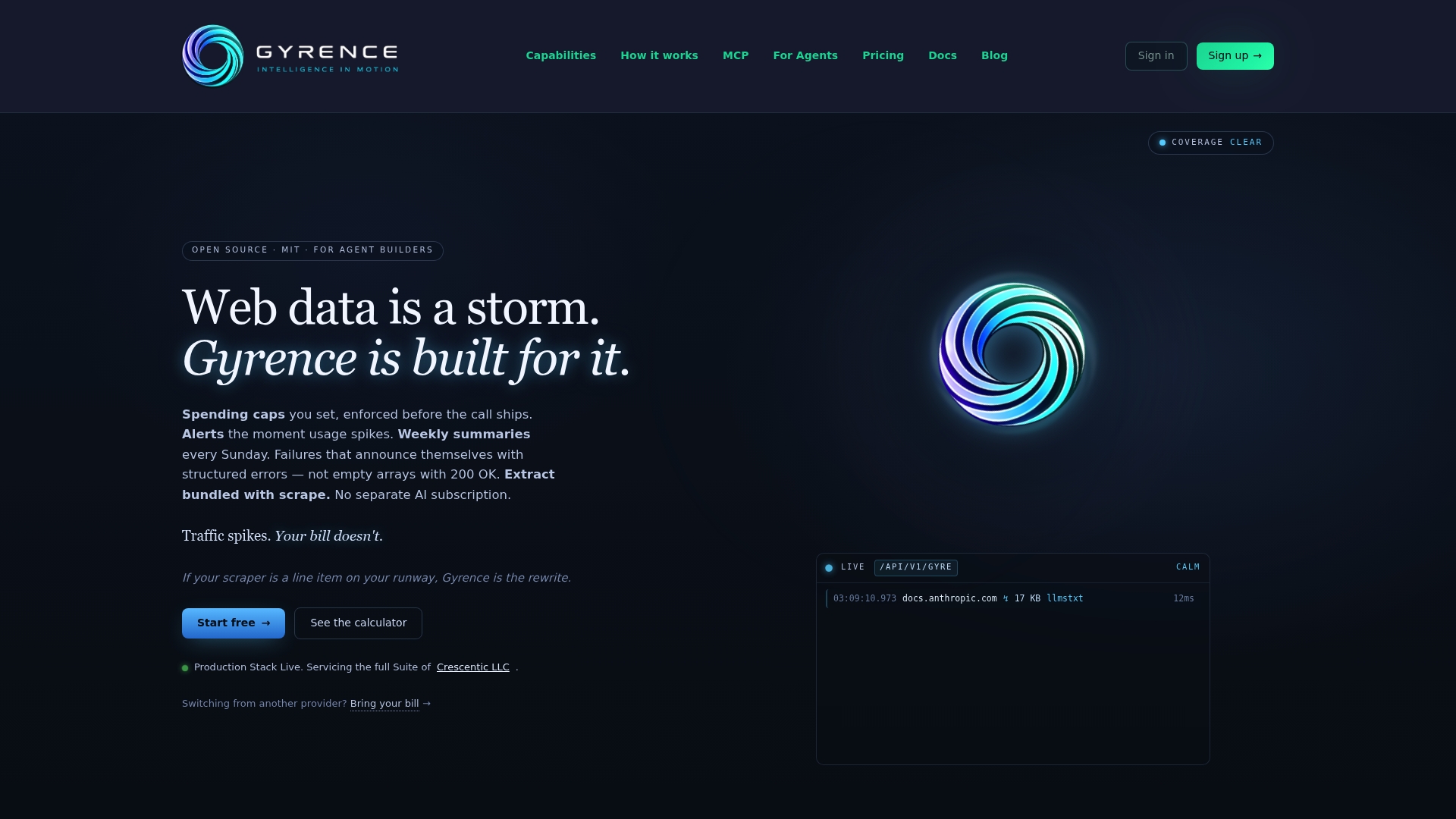
Gyrence exposes five low-level primitives called Search, Gyre, Fetch, Extract, and Map. This primitives approach makes it straightforward to compose tasks for AI agent web access. The design targets predictable billing and clear error reporting for web scraping API workflows.
Core Features
Gyrence provides primitives for searching the web, traversing sites outward from a seed URL, fetching and cleaning pages to markdown, extracting structured JSON with schema guidance, and mapping a domain's URL graph. The platform routes requests by content type and surfaces content signals such as robots.txt directives. Both an OpenAPI and an MCP interface are available, and the vendor advertises parity in billing between those interfaces.
Key Differentiator
Gyrence centers on a primitives based, open source friendly architecture with format aware extraction and explicit error reporting. That design returns predictable, typed responses and exposes failure modes so agents can handle partial results instead of guessing.
Pros
The code friendly architecture provides transparency and lets teams inspect and self host components if needed. The pricing model is flat and credit based, which reduces surprise bills for long running ingestion tasks. Gyrence supports JavaScript rendered pages through a self hosted browser and claims format aware extraction for HTML, iXBRL, and mediawiki content. The presence of MCP and REST APIs helps integrate these primitives into agent frameworks and RAG pipelines.
Cons
- No async job queue, so large traversals require client side orchestration and retry logic.
Who It's For
Teams building autonomous web agents, research agents, or RAG ingestion pipelines that need transparent failure modes and predictable billing will get the most value. Developers who prefer an inspectable, self hosted friendly stack and who can operate a browser for JavaScript rendering will find this fits their workflow. It works well for groups that must reason about partial or failed retrievals.
Unique Value Proposition
Flat, credit based pricing combined with OpenAPI and MCP billing parity reduces surprises when you move from prototyping to production. That pricing, paired with explicit failure reporting and typed responses, lets teams budget ingestion costs and program agents that react to specific failure types instead of retrying blindly.
Real World Use Case
A financial news platform automates monitoring of earnings reports across publishers. Gyrence fetches pages, extracts structured financial facts, and returns typed JSON so downstream pipelines can update dashboards without bespoke scrapers. The result reduces engineering time spent on fragile HTML parsing.
Pricing
Gyrence uses a flat, credit based pricing model with options for free, founders, PAYG, standard, growth, and scale tiers. The vendor states these tiers for different usage profiles and offers overage options for burst traffic.
Website: https://gyrence.com
ScrapeGraphAI
At a Glance
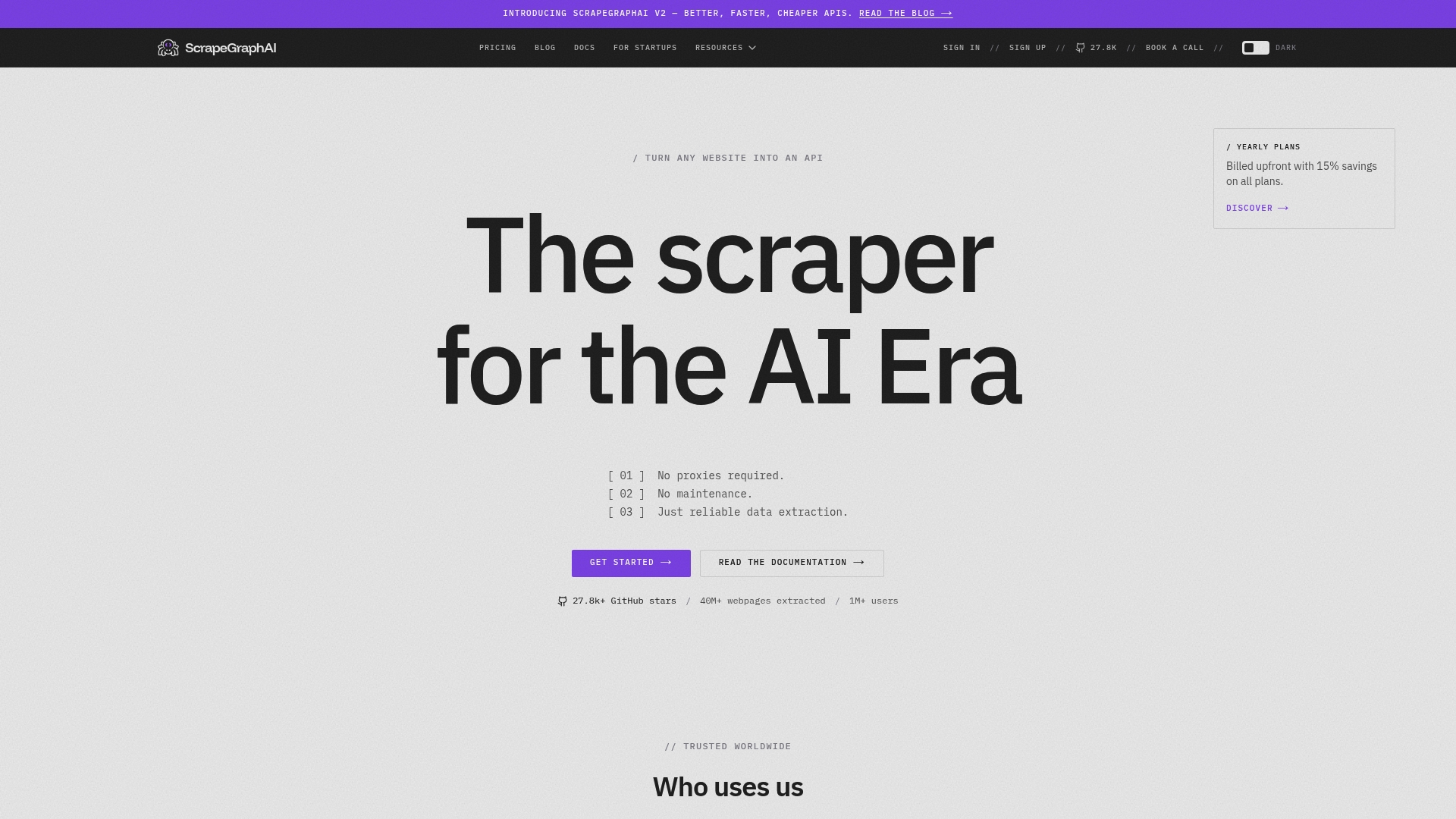
ScrapeGraphAI reports over 40 million webpages extracted and 1 million users. That figure comes from the vendor and appears in its marketing materials. The product emphasizes single-call scraping that returns clean JSON, Markdown, or HTML with AI-driven parsing for dynamic, JavaScript-heavy pages.
Core Features
ScrapeGraphAI combines AI-powered extraction with automatic page rendering to handle dynamic content and client-side frameworks. The API accepts natural language prompts and returns structured output in multiple formats, plus screenshots when needed. According to the company, it maintains SOC 2 Type I compliance, which helps teams that require an audit-ready security posture.
Key Differentiator
The standout capability is prompt-driven scraping that adapts to layout changes without manual selector updates. That approach shifts work from writing brittle parsers to crafting extraction prompts and schemas. Teams embedding web data into agents or pipelines get typed, prompt-first results rather than raw HTML.
Pros
The vendor advertises a rapid setup that often completes with a single API call. That claim shortens onboarding for prototypes and small automation tasks. The service removes the need for proxy fleets and continual selector maintenance, which cuts operational overhead for data teams. SDK coverage for Python, JavaScript, and a CLI plus adapter integrations for LangChain and LlamaIndex speed embedding into ML workflows.
Cons
- May struggle with highly niche or deeply obfuscated sites that demand manual script tuning. One or two sites can require custom scraping logic outside the AI flow.
- Young platform with features still evolving. Buyers that need longterm stability for complex enterprise pipelines should verify feature roadmaps.
- Pricing depends on credits and usage. Heavy continuous scraping may become expensive compared with self-managed crawlers.
When It May Not Fit
If your pipeline requires deterministic, hand-crafted selectors for every page element, this product may not match that workflow. Large scale, continuous enterprise crawls with tight per-call cost targets could find credit-based billing less predictable. Teams that must process highly sensitive or regulated data should validate the platform against their compliance checklist.
Notable Integrations
- Python SDK for embedding extraction into ETL jobs and model training scripts.
- JavaScript SDK and CLI for developer tooling and automation tasks.
- LangChain and LlamaIndex adapters for agent and RAG ingestion workflows.
- Vercel AI and CrewAI connectors for AI-first applications and runtime integration.
Who It's For
Developers, data engineers, and AI teams that prefer low-maintenance extraction and quick iteration cycles. Startups and automation-focused teams that value prompt-driven results will get the fastest wins. Teams building RAG pipelines or ML datasets benefit from the multi-format outputs and SDK support.
Real World Use Case
A startup used ScrapeGraphAI to automate competitor price monitoring across ecommerce sites. They replaced a selector-based scraper with prompt templates and cut maintenance time. The startup fed normalized JSON directly into its pricing model and reduced manual rule updates.
Pricing
The platform starts free with 500 credits and offers a Starter plan from $20/month. Paid tiers scale with credits and custom enterprise billing is available for high-volume contracts. The credits model trades fixed monthly cost for usage-based flexibility.
Website: https://scrapegraphai.com
ScrapingBee
At a Glance
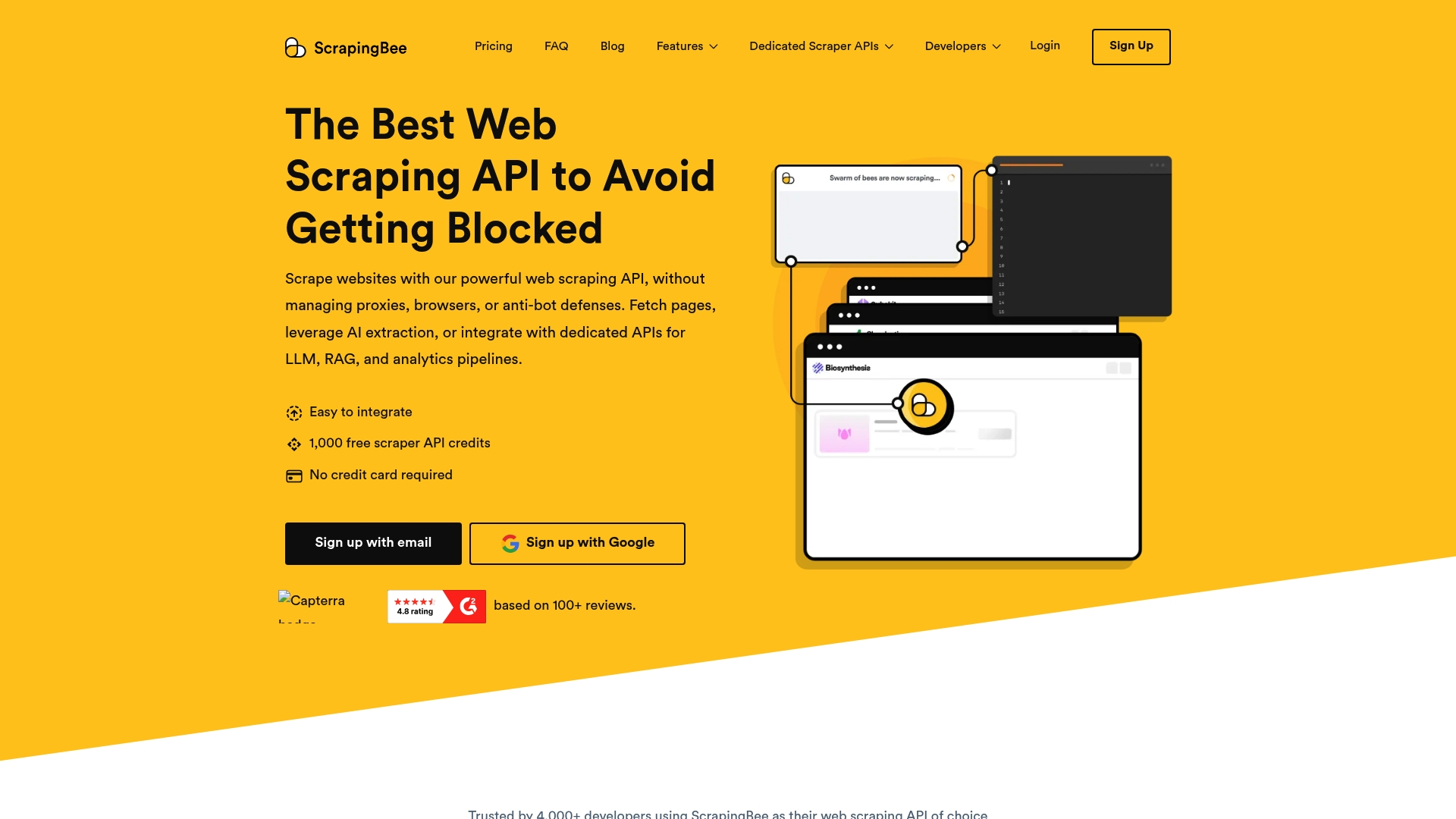
Starts with 1,000 free API credits so teams can test scraping flows without immediate cost. The API combines JavaScript rendering and structured AI extraction for JSON outputs. The vendor advertises compliance with SOC 2 Type 2 and GDPR.
Core Features
Easy integration and a hosted API remove proxy and browser management, while headless Chrome handles JavaScript heavy pages. Automatic proxy rotation includes stealth and geolocation proxies for anti bot evasion, and the service returns AI ready data via JSON or natural language queries. Dedicated endpoints exist for sources like Amazon, Google Search, YouTube, and there is a real time Fast Search API.
Key Differentiator
Built in AI extraction with schema style outputs plus dedicated APIs for major sources reduces engineering glue work. That combination shortens extraction setup for common targets and moves more logic to the API side. Teams get fewer one off scrapers and more predictable parsing.
Pros
ScrapingBee's marketing materials claim it is trusted by thousands of developers. The product groups JavaScript rendering, proxy management, and AI extraction under one API, which reduces operational overhead. Dedicated endpoints for popular platforms and the free credits make initial testing low friction.
Cons
- Response times increase on complex JavaScript heavy pages or sites with strong anti bot measures.
- Costs rise when you need high concurrency or many advanced features.
- Offers limited customization for highly specialized scraping setups that require bespoke session handling.
When It May Not Fit
If you need rapid single page fetches for thousands of concurrent workers, billing can become a constraint. The platform does not target scraping behind custom logins or paywalls unless those are explicitly supported. Teams needing deep session level customization may find the built in controls limiting.
Notable Integrations
Supports common workflow and automation tools used by developer teams. Integrations enable simple routing of results to automation platforms and hosted MCP endpoints. The following connections are listed by the vendor:
- ChatGPT API
- Make
- n8n
- Zapier
- MCP Server
Who It's For
Developers and product teams that want scalable web data collection without running proxy fleets or maintaining headless browsers. It fits teams that prefer API level extraction and ready made connectors for common targets. It also suits groups with compliance needs who want a managed option.
Real World Use Case
A data science team wires ScrapingBee into a price monitoring pipeline to track competitor listings across retail sites. They use dedicated endpoints for Amazon and Fast Search for quick discovery and apply AI extraction rules to normalize product fields. The setup reduces manual parsing work and speeds model training.
Pricing
Plans start at $49/month for 250,000 API credits. Tiers increase with usage and concurrency, and the vendor offers custom plans for larger needs. Free credits let teams validate flows before committing.
Website: https://scrapingbee.com
WebScrapingAPI
At a Glance
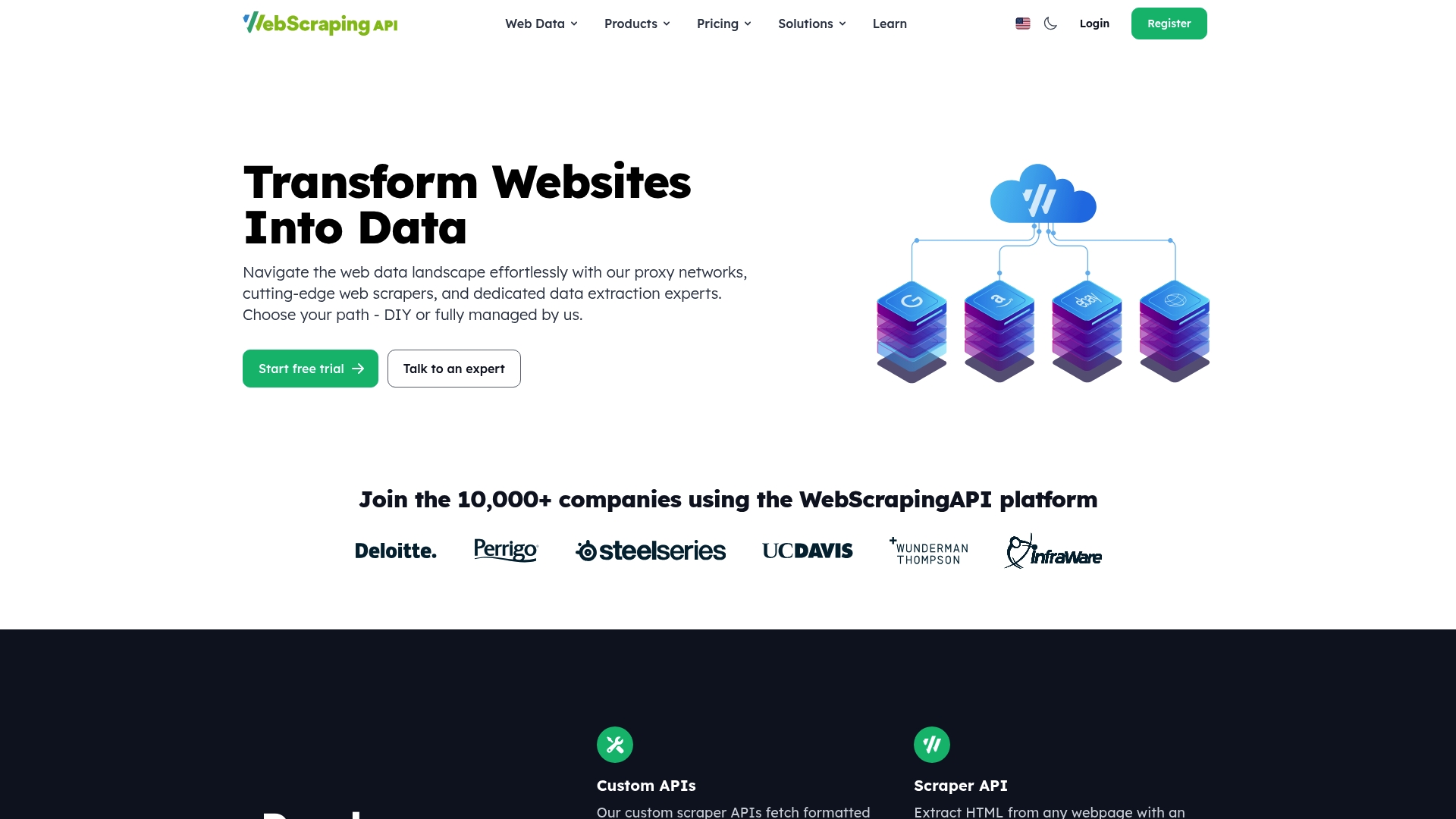
WebScrapingAPI reports being used by over 10,000 companies. It pairs developer APIs with a full proxy stack and optional managed extraction services. That combination targets teams that want scale and operational support for price intelligence and competitor monitoring.
Core Features
WebScrapingAPI provides custom scraper APIs that aim to deliver formatted outputs for downstream processing, and it exposes specialist endpoints for Google SERP, Amazon, social networks, news, real estate listings, and job boards. The platform includes residential and stealth proxy pools to reduce blocking, plus managed extraction services where the vendor handles orchestration and data delivery. It also offers website change monitoring, ad verification tooling, and utilities commonly used in market research and price intelligence.
Key Differentiator
The single most distinguishing element is the dual model: a developer-facing API plus a managed service backed by large proxy networks. That approach suits teams that prefer outsourcing operational complexity to a vendor and need broad site coverage rather than a single typed, agent-ready API response format.
Pros
WebScrapingAPI groups proxies, scraper endpoints, and managed extraction under one roof, which reduces the number of vendors you must coordinate with. The interface and API set reportedly simplify common scraping tasks and speed integration for engineering teams. The vendor claims strong reliability and broad enterprise adoption, and that figure supports the case for tried operational practices and customer support at scale.
Cons
- Pricing can become expensive for enterprise-scale crawling and proxy usage.
- Site content shows occasional 404 pages, which can make documentation or feature discovery harder for new users.
- Public third-party reviews and independent performance benchmarks are sparse, leaving some operational questions unanswered.
When It May Not Fit
Teams that need deterministic, typed extraction responses with explicit failure modes may find this platform less suitable. Projects that require precise agent-ready JSON schemas and embedded LLM extraction guarantees will likely prefer an API that documents typed failure cases. Organizations on tight budgets at very large scale should expect proxy and managed service costs to add up.
Who It's For
Businesses, data analysts, and engineering teams that need reliable site coverage and turnkey extraction support will get the most value. It fits groups that want to combine a scrapable API surface with vendor-run extraction for high-touch use cases. Developers who prefer deep control over typed outputs may want to evaluate alternatives.
Real World Use Case
A retail company automates competitor price tracking by calling targeted product endpoints, rotating requests through residential proxies, and subscribing to managed extraction for complex merchants. The company receives cleaned data for price intelligence dashboards and reduces manual scraping maintenance.
Pricing
Pricing starts at $19/month for the Scraper API, $28/month for the Google SERP API, and $59/month for the Amazon API, with additional charges for proxy bundles and managed services. Enterprise quotes are available and will increase with proxy volume and managed extraction scope.
Website: https://webscrapingapi.com
Comparison of alternatives
The competitors in this comparison serve diverse web scraping needs, yet Gyrence excels in predictable operation and explicit error management.
Transparency vs. Scaling Features
Prompt-Driven Response-Encoding Benefits
Comparing platforms based on their web scraping capabilities allows for tailored decision-making.
| Platform | Key Differentiator | Best For | Pricing | Notable Limitation |
|---|---|---|---|---|
| Gyrence | Primitives-based design for structured JSON output | Autonomous agents | Price not published | Requires client-side orchestration for large traversals |
| ScrapeGraphAI | Prompt-driven adaptable scraping | Startups | From $20/month | Struggles with niche or obfuscated sites |
| ScrapingBee | Pre-integrated AI tools for structured outputs | Developers | From $49/month | Limited customization for session-specific scraping |
| WebScrapingAPI | Combined APIs and managed scraping services | Businesses | From $19/month | Sparse public benchmarks for operational transparency |
How to address unreliable billing and hidden failures in crawlbase.com alternatives
Crawlbase.com alternatives often fall short when it comes to predictable pricing and clear handling of scraping errors. Teams building AI agents or RAG ingestion pipelines need a solution that offers transparent, typed failure modes and spending caps to avoid surprise bills. Gyrence delivers this with an honest-by-design web scraping API centered on five composable primitives that produce structured, agent-ready data.
Gyrence combines typed, discriminated-union responses with bundled LLM extraction and an MCP endpoint for flexible integration. Developers can search, traverse, fetch, extract, and map with explicit error reporting so their agents do not guess at partial results. This approach makes Gyrence a strong alternative for developers prioritizing reliable billing and precise structured data extraction.
Explore Gyrence's homepage to see how predictable-pricing scraping API capabilities and typed failure modes reduce uncertainty. Check the documentation and console today to start managing your web data extraction costs confidently.
FAQ
What are the key features of Gyrence for web scraping?
Gyrence provides primitives for searching, fetching, and extracting data while ensuring predictable billing and clear error reporting. The platform offers a code-friendly architecture with format-aware extraction for HTML and mediawiki content, allowing teams to inspect and host components if needed.
How does Gyrence compare to ScrapeGraphAI in terms of usability?
ScrapeGraphAI excels with rapid single-call scraping and AI-driven extraction, making it very user-friendly for dynamic content. Gyrence, on the other hand, is designed for teams needing detailed failure reporting and a more transparent pricing model, which suits projects that require handling partial retrievals.
What unique pricing model does Gyrence offer?
Gyrence uses a flat, credit-based pricing model that aims to reduce unexpected costs for long-running ingestion tasks. This pricing structure allows teams to budget more effectively for their scraping needs, especially when moving from prototype to production.
Can I use Gyrence for JavaScript-heavy pages?
Yes, Gyrence supports JavaScript rendered pages through a self-hosted browser, integrating into workflows that require dynamic content extraction. This capability ensures you can scrape complex sites without sacrificing the quality of your output.
Which teams benefit the most from using Gyrence?
Teams building autonomous web agents or research agents that require predictable billing and failure modes will find Gyrence especially valuable. Developers looking for a self-hosted solution with transparency and control over their scraping processes should consider using Gyrence.