
What are the top Crawleo.dev alternatives?
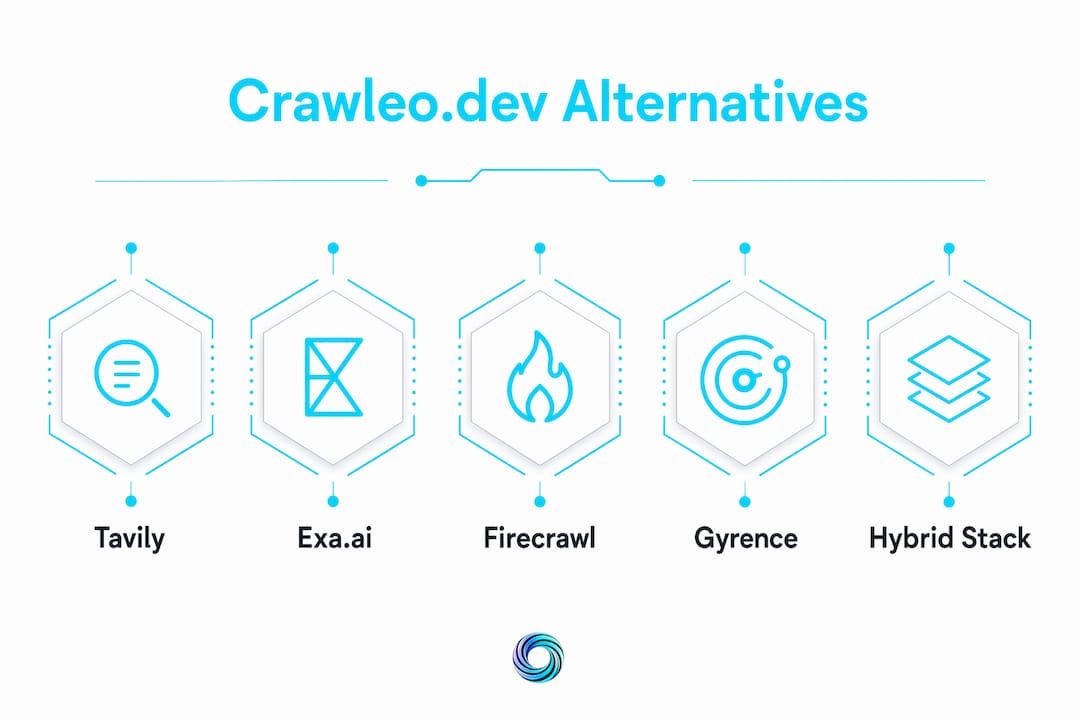
The three strongest Crawleo.dev alternatives in 2026 are Tavily, Exa.ai, and Firecrawl. Each solves a different slice of the web data problem: Tavily prioritizes source-verified search with guardrails, Exa.ai leads on semantic relevance for LLM connectivity, and Firecrawl delivers clean, LLM-ready markdown extraction as a managed service. Choosing between them depends on whether your pipeline needs discovery, extraction, or both.
| Tool | Pricing model | Core capability | Pros | Cons | Ideal use case |
|---|---|---|---|---|---|
| Tavily | Free tier + paid credits | Source-first semantic search | Guardrails, citation quality | Limited crawling depth | RAG pipelines, fact-grounded agents |
| Exa.ai | Free tier + paid credits | Semantic-first web search | High information density, LLM-native | Not a full crawler | Deep research, multi-hop agents |
| Firecrawl | Free tier + paid per page | Crawl + markdown extraction | Easy setup, clean output | Limited proxy rotation | Content extraction, AI ingestion |
Key differentiators at a glance:
- Discovery vs. extraction: Tavily and Exa.ai are search APIs for AI; Firecrawl is an extraction API. Most production stacks need both.
- Managed vs. self-hosted: All three are managed cloud services, which trades infrastructure overhead for per-call cost.
- Failure transparency: None of the three expose typed, discriminated-union failure metadata by default, which matters when you're building self-healing agent pipelines.
Table of Contents
- How do Tavily, Exa.ai, and Firecrawl compare in depth?
- How do you choose the right Crawleo.dev alternative?
- What are AI engineers actually prioritizing in web data APIs in 2026?
- Key Takeaways
- The gap between API specs and production reality
- Gyrence gives you the failure modes other APIs hide
- FAQ
How do Tavily, Exa.ai, and Firecrawl compare in depth?
Tavily
Tavily positions itself as a source-first search API built for LLM agents. It returns ranked results with citations and relevance scores, and its guardrail layer filters out low-quality or promotional content before results reach your model. The free tier covers monthly queries; paid plans scale by credit volume, though exact 2026 tier pricing is not publicly listed.
Pros: Strong citation quality, built-in content filtering, straightforward REST integration, good fit for retrieval-augmented generation (RAG) workflows where source trustworthiness matters.
Cons: Not designed for deep site crawling or structured field extraction. If your agent needs to pull a specific JSON schema from a target page, Tavily alone won't get you there.
Ideal for: Fact-grounded agents, research assistants, and any pipeline where hallucination reduction is the primary concern.
Exa.ai
Exa.ai takes a semantic-first search approach, ranking results by information density and citation relevance rather than consumer engagement signals like clicks or ad spend. That distinction is what makes it genuinely useful for LLM pipelines: the results it surfaces tend to be denser, more citable, and less polluted by SEO-optimized filler. It offers a free tier for low-volume testing and paid tiers that scale with query volume.

Pros: Best-in-class semantic relevance for LLM queries, neural search index purpose-built for AI agents, strong developer experience with clean SDK access.
Cons: Like Tavily, it is a search API, not a crawler. It won't traverse a site, extract structured fields, or return markdown from an arbitrary URL on demand.
Ideal for: Multi-hop research agents, deep-research pipelines, and any workflow where the quality of discovered sources directly affects downstream model output.
Firecrawl
Firecrawl handles crawling, scraping, and clean content formatting as a managed service. You point it at a URL, and it returns LLM-ready markdown. Setup is low-friction: the official MCP server installs via npm, and the API surface is straightforward. It offers a free tier with markdown output, and paid plans priced per page crawled, suited for moderate-volume use cases.
Pros: Excellent extraction quality, the easiest managed setup of any crawler in this category, good MCP support, and output that drops cleanly into most LLM ingestion pipelines.
Cons: Proxy rotation is limited compared to self-hosted alternatives. Proxy flexibility matters at scale: Firecrawl handles some IP management in the cloud, but it lacks the full rotation, sticky sessions, and geo-targeting that self-hosted frameworks provide. Per-page pricing also adds up quickly at high volume.
Ideal for: Teams that want clean content extraction without managing infrastructure, moderate-volume AI ingestion pipelines, and projects where time-to-integration beats long-term cost optimization.
How do you choose the right Crawleo.dev alternative?
Picking the right tool comes down to five criteria, and the order you weight them should reflect your actual pipeline architecture.
1. API reliability and data freshness Managed APIs like Tavily and Exa.ai maintain their own indexes and crawl schedules, so freshness depends on their update cadence, not yours. Firecrawl fetches on demand, so the content is as fresh as the live page. For agents that need real-time data, on-demand fetching wins.
2. Ease of integration
All three offer REST APIs and SDKs. Firecrawl's npm-installable MCP server is the fastest path to an agent-ready setup. Tavily and Exa.ai both support standard REST and provide LangChain connectors, which matters if your stack already uses LangChain or a similar orchestration layer.
3. Scalability and proxy management At high crawl volumes, proxy rotation and geo-targeting become critical. Firecrawl's cloud handles basic IP management but lacks full rotation control. If you need sticky sessions or residential proxies at scale, a self-hosted framework gives you that control at the cost of operational overhead.
4. Failure mode transparency
This is the criterion most developers underweight until something breaks in production. APIs that emit explicit failure metadata — HTTP error details, timeout reasons, block detection signals — let your agent implement self-healing logic: retry with a different user agent, fall back to a cached version, or escalate to a browser-level fetch. Generic 500 errors give your agent nothing to reason about.
5. Pricing predictability Per-page and per-query pricing models can produce wildly variable monthly bills when crawl depth or query volume spikes. Before committing to any managed API, map your expected monthly call volume against the published tier structure and identify where the cost curve steepens.
Managed vs. self-hosted trade-off: Managed APIs abstract infrastructure complexity but carry higher sustained per-call costs. Self-hosted frameworks offer long-term cost savings and full customization, but require your team to manage browser infrastructure, proxy rotation, and anti-bot handling. For most teams shipping their first production agent, a managed API is the right starting point. Revisit the decision at scale.
Pro Tip: Before you commit to any provider, run a structured API evaluation checklist against your actual use cases. Test failure responses explicitly, not just happy-path calls. A provider that returns a typed error on a blocked page is worth more than one that silently returns empty content.
What are AI engineers actually prioritizing in web data APIs in 2026?
The dominant pattern in 2026 AI engineering is the hybrid stack: a semantic search API for discovery paired with a lean, AI-optimized scraper for structured extraction. The two tool categories solve different problems, and combining them is now standard practice for production RAG and agentic workflows.
Why does this matter for hallucination rates? AI-native search APIs rank by information density and citation relevance, not by consumer engagement metrics like ad clicks. That shift means the documents your retrieval layer surfaces are more likely to contain the actual answer, which reduces the gap the LLM has to fill with inference. Fewer gaps, fewer hallucinations.
A realistic 2026 production stack looks like this:
- Discovery layer: Exa.ai or Tavily for semantic search and source ranking
- Extraction layer: Firecrawl or a self-hosted crawler for structured content pull
- Retrieval layer: A vector store or hybrid search index
- LLM on top: GPT-4, Claude, or an open-weight model
The third trend worth tracking is explicit failure mode metadata. APIs that surface structured error signals enable agents to implement retry logic, fallback fetch strategies, and escalation paths without human intervention. This is the difference between a pipeline that degrades gracefully and one that silently drops data. For teams building autonomous web agents, this capability is no longer optional.
Key Takeaways
The most reliable 2026 web data stack combines a semantic search API for discovery with a structured extraction API for content pull, and both layers need explicit failure metadata to support self-healing agent logic.
| Point | Details |
|---|---|
| Discovery vs. extraction | Tavily and Exa.ai handle search; Firecrawl handles extraction. Most pipelines need both. |
| Failure metadata matters | APIs with typed error responses let agents retry intelligently rather than fail silently. |
| Managed vs. self-hosted | Managed APIs reduce setup time; self-hosted frameworks cut long-term per-call costs at scale. |
| Pricing transparency | Map your expected call volume against tier pricing before committing to avoid bill surprises. |
| Gyrence as an alternative | Gyrence offers five composable primitives, spending caps, and typed failure responses built for AI agent pipelines. |
The gap between API specs and production reality
The spec sheet for any web data API looks clean. The production reality is messier. Pages block, timeouts cascade, and the content you get back is often not what the documentation implied you'd receive.
What most crawleo.dev alternatives don't advertise is how they behave when things go wrong. Tavily and Exa.ai are search APIs, so their failure modes are relatively contained: a query returns fewer results, or a source is unavailable. Firecrawl's failure surface is wider because it's doing live fetches, and its limited proxy rotation means you'll hit blocks more often at scale than the documentation suggests.
The managed-vs-self-hosted debate is also more nuanced than it appears. Managed APIs are not just "easier." They're also a bet that the vendor's infrastructure decisions align with your reliability requirements. When a managed API's upstream changes its anti-bot fingerprinting, your pipeline breaks and you wait for the vendor to patch it. A self-hosted framework breaks the same way, but you control the fix timeline.
The hybrid stack trend is real and worth taking seriously, but it introduces its own coordination overhead. Two APIs means two billing relationships, two failure surfaces, and two integration points to maintain. That's a reasonable trade for most teams, but it's worth designing the seams between discovery and extraction carefully. Scalable AI development practices increasingly treat the API layer as infrastructure, not tooling, which means the same reliability and observability standards apply.
The developers who get the most out of these tools are the ones who test failure paths before they test happy paths. Run a blocked URL through your chosen API. Run a timeout scenario. Check what comes back. If the answer is an opaque error code, build your retry logic accordingly.
Gyrence gives you the failure modes other APIs hide
If you've read this far, you know the real differentiator in web data APIs isn't the happy-path output. It's what happens when a page blocks, a fetch times out, or a schema doesn't match. Gyrence is built around that reality.
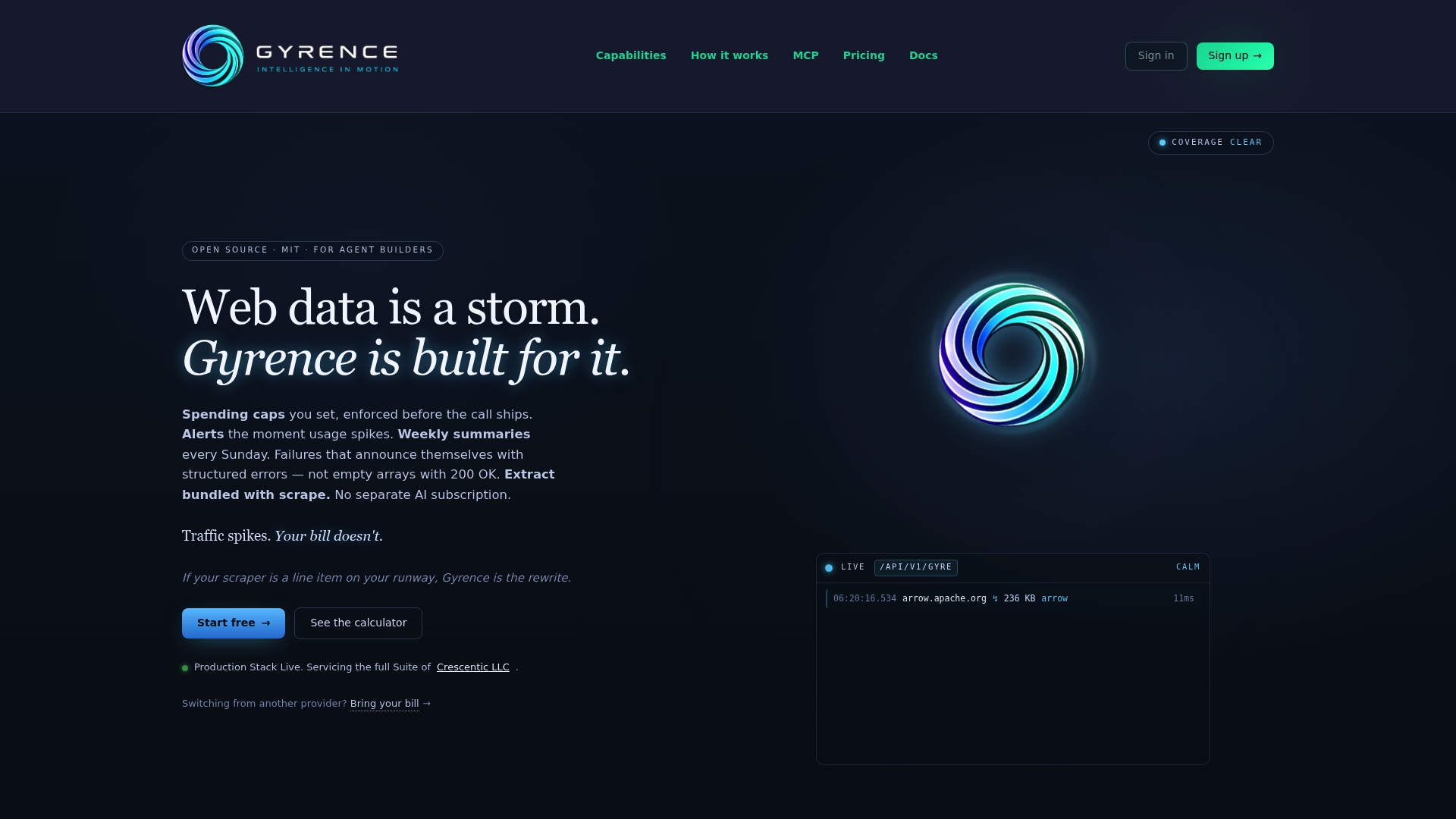
Gyrence exposes five composable primitives: Search, Traverse, Fetch, Extract, and Map. Every call returns a typed, discriminated-union response that includes the failure cases, so your agent can reason about what went wrong and act on it. Spending caps mean your bill won't spike when a crawl job runs longer than expected. Bundled LLM extraction handles structured JSON from web pages without a separate extraction service. And the hosted MCP endpoint connects directly to agent frameworks without custom glue code.
Where Tavily and Exa.ai stop at discovery, and Firecrawl stops at extraction, Gyrence covers the full pipeline in a single API with predictable pricing. Try it at gyrence.com and run your first failure-mode test before you commit.
FAQ
What is the best Crawleo.dev alternative for RAG pipelines?
Tavily and Exa.ai are the strongest choices for RAG pipelines because they rank results by information density and citation relevance rather than consumer engagement signals, which directly reduces hallucination rates in LLM outputs.
Does Firecrawl offer a free tier?
Yes. Firecrawl offers a free tier with markdown output, making it practical to test extraction quality before committing to a paid plan.
When should I use a self-hosted crawler instead of a managed API?
Self-hosted frameworks offer long-term cost savings and full proxy control, but require your team to manage browser infrastructure and anti-bot handling. Managed APIs are the better starting point for most teams; revisit at high volume.
Does Gyrence expose failure mode metadata?
Yes. Every Gyrence API call returns a typed, discriminated-union response that includes structured failure cases, so agents can implement intelligent retry and fallback logic rather than handling generic errors.
What is a hybrid web data stack?
A hybrid stack combines a semantic search API for discovery with a structured extraction API for content pull. As of 2026, this is the standard architecture for production RAG and agentic AI workflows.