
TL;DR:
- Domain URL graph analysis maps website URLs as nodes and hyperlinks as directed edges to improve crawling and data extraction. It reveals site structure, content clusters, and crawl efficiency, guiding optimization strategies. Gyrence's Map primitive simplifies graph generation from one API call, enabling faster, more accurate domain mapping without complex crawler setup.
What is domain URL graph analysis and why does it matter?
Domain URL graph analysis maps every URL on a site as a node and every hyperlink between them as a directed edge, producing a graph you can query, measure, and act on. The technique is the foundation of domain URL mapping for scraping pipelines, crawl scheduling, and structural audits.
Key things this analysis reveals:
- Domain structure explained: which pages are hubs, which are orphans, and where navigation dead-ends exist
- URL relationships: how content clusters form and which paths a crawler must traverse to reach deep pages
- Crawl efficiency: which entry points yield the most reachable URLs per request
- Data extraction accuracy: whether your scraper is missing whole subgraphs due to poor seed selection
Research on website graph construction confirms that well-defined thematic structures produce higher modularity and clustering coefficients, making them faster to crawl and easier to extract from. Sites without that structure force crawlers to waste budget on redundant or unreachable paths.
How to build and analyze a domain URL graph
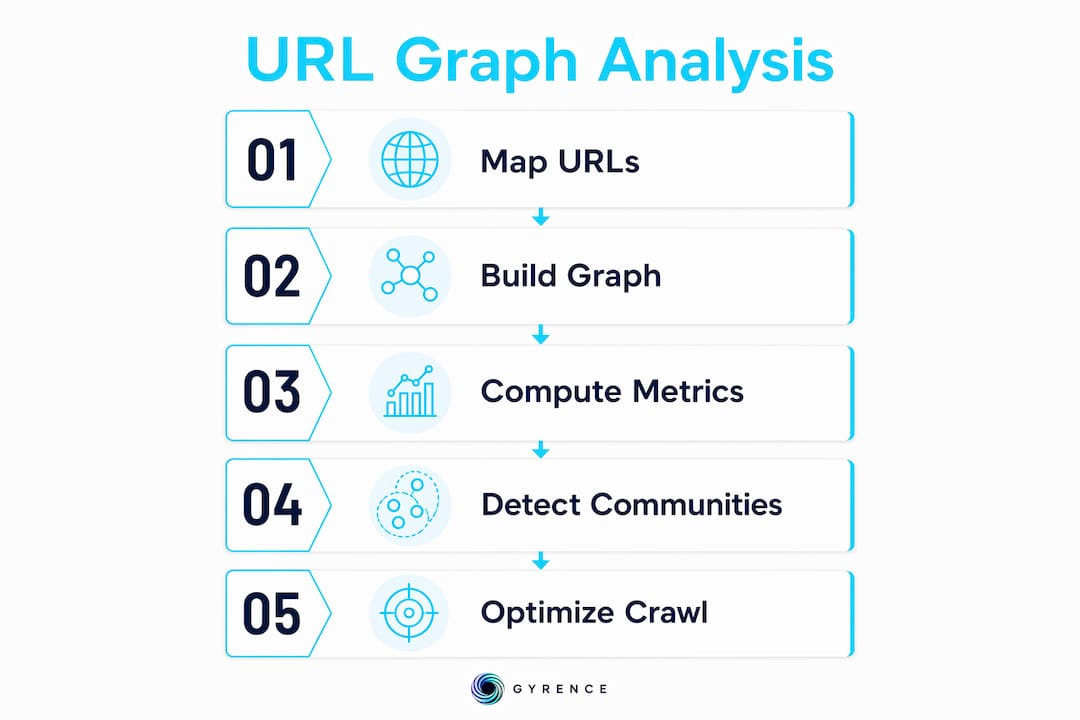
Construction workflow
- Seed collection: parse
sitemap.xml,robots.txt, and any exposed API endpoints to gather initial URLs. - Breadth-first traversal: follow outbound links layer by layer, recording each source-destination pair as a directed edge. Python libraries
requests,BeautifulSoup4, andnetworkxcover this end to end. - URL normalization: strip tracking parameters, resolve redirects, and canonicalize schemes to collapse synonymous URLs into single nodes.
- Graph storage: represent the result as an adjacency list or matrix, depending on whether you need fast neighbor lookup or dense linear-algebra operations.
- Metric computation: calculate diameter, density, clustering coefficient, and modularity using
networkxor a graph database like Neo4j.
Analysis methods
- Breadth-first vs. focused crawling: breadth-first gives full coverage; semantic graph-based focused crawling targets topic-relevant subgraphs and outperforms standard crawlers by more than 19% on relevant page acquisition rate, average relevance, and acquisition speed.
- PageRank and hub scoring: identify which URLs propagate the most link equity and deserve priority in your crawl queue.
- Community detection: algorithms like Louvain partition the graph into thematic clusters, exposing content silos that may need separate crawl strategies.
Pro Tip: Combine breadth-first traversal for initial graph construction with semantic priority ranking for subsequent focused passes. You get full structural coverage on the first run and topic-accurate extraction on every run after that.

Key use cases where domain graph analysis pays off
Visualizing URL relationships is not an academic exercise. Here is where it directly improves production pipelines:
- Crawl schedule optimization: graph influence research shows that an update in one page raises the probability of updates in neighboring nodes, letting you front-load revisits to high-churn clusters rather than polling every URL at a flat interval.
- Seed selection: graph-based seed selection at web scale consistently increases page discovery and reduces the proportion of low-value pages in the crawl corpus.
- Structural audits: high diameter values flag deep, poorly linked content that search engines and scrapers alike will underindex.
- Duplicate detection: near-duplicate content from mirroring and URL synonymy inflated one 30-million-page corpus studied by Broder et al. to 29% similar pages; graph-level deduplication catches this before it pollutes your dataset.
- Dynamic content navigation: mapping JavaScript-rendered routes as graph edges lets you build targeted fetch sequences instead of blind full-page renders.
- Resource allocation: density metrics show which site sections are tightly interlinked and which are sparse, so you can allocate crawl budget proportionally.
Challenges in domain URL graph analysis and how to handle them
Practitioners consistently report that the hardest part is not extraction. It is keeping the graph accurate and clean over time.
- URL synonymy and mirroring: query strings, session tokens, and CDN mirrors create multiple nodes for the same resource. Normalization and ETag/Last-Modified prioritization reduce this duplication and improve graph fidelity.
- Dynamic URLs: single-page applications generate URLs at runtime that never appear in sitemaps. Combine sitemap parsing with API exploration and AI-based deep-link heuristics to surface them.
- Noisy graph clustering: Union-Find fails at web scale because a single weak edge can merge two unrelated clusters into one giant component. Weighted graph clustering tolerates contradictory evidence by letting the algorithm decline a merge when internal cluster density outweighs the bridging edge.
- Adversarial and incomplete content: dynamic user behavior, adversarial interference, and distribution shifts erode graph reliability. Robust graph learning addresses this through data-level preprocessing and model-level adaptation.
- Provenance and quality tracking: the knowledge graph construction lifecycle requires explicit quality measures and provenance records at every step. Without them, downstream consumers cannot trust the graph's lineage.
- Crawl politeness vs. freshness: aggressive revisit schedules violate server politeness policies. Space requests using a multiple of the last observed response time, as the Mercator crawler design demonstrated.
How AI and APIs are advancing domain URL graph analysis
The shift from hand-tuned heuristics to learned models is the most consequential change in this space right now.
- AI deep-link heuristics: modern crawlers combine sitemap analysis, link traversal, API probing, and machine-learned URL scoring to discover pages that static rules miss entirely.
- Reinforcement learning for crawl scheduling: graph-structured crawling formalizes the correlation between neighboring page updates and uses a reinforcement learning agent to allocate crawl budget where freshness gain is highest. The latent Bernoulli process model underlying this approach is provably effective on real web data.
- LLM-assisted knowledge engineering: large language models now handle the transition from supervised extraction pipelines to scalable knowledge graph construction from unstructured web content, improving consistency and reducing manual annotation overhead.
- Temporal link graphs: systems like URLBank replace manual seed curation with label-free controllers that infer optimal seeds from temporal crawl telemetry, achieving higher coverage and earlier discovery under identical request budgets.
- Composable API primitives: Gyrence's Map primitive generates a domain's URL graph from a single API call, returning typed nodes and edges your pipeline can query immediately without building a custom crawler.
Statistic callout: The SG-GA focused crawler, which combines semantic graph disambiguation with genetic algorithm weighting, exceeds 19% improvement over standard focused crawlers across relevant page count, acquisition rate, and average relevance.
Tools commonly used for domain URL graph analysis
| Tool / Library | Primary role |
|---|---|
networkx (Python) | Graph construction, metric computation, community detection |
BeautifulSoup4 + requests | HTML parsing and link extraction during crawl |
| Neo4j | Persistent graph storage with Cypher query support |
| Apache Spark (GraphX) | Distributed graph processing at web scale |
| Scrapy | Production crawl framework with middleware hooks for graph logging |
| Gephi | Visual graph exploration and layout rendering |
| Gyrence Map API | One-call domain URL graph generation with typed, structured output |
For structured JSON extraction layered on top of graph traversal, pairing networkx with a fetch-and-extract API removes the boilerplate of managing HTTP sessions, redirect chains, and JavaScript rendering separately. AI-assisted prioritization, as explored in ranked hypothesis approaches, applies directly to crawl queue ordering when you treat each candidate URL as a hypothesis about where fresh content lives.
Case studies: domain graph analysis in practice
E-commerce catalog auditing: a data team mapped a retailer's product URLs as a graph and found a cluster of 4,000 product pages with no inbound internal links. These pages were invisible to both the site's search and external crawlers. Reconnecting them through category pages increased crawl coverage measurably on the next scheduled run.
News freshness optimization: a media monitoring pipeline applied graph-structured crawling to a network of news sites. By modeling update correlations between connected pages, the crawler front-loaded revisits to pages neighboring recently updated articles, reducing average content staleness without increasing total request volume.
Knowledge graph construction from web documents: an enterprise team used LLM-assisted extraction to build a domain-scoped knowledge graph from unstructured product documentation. Provenance tracking at each pipeline stage, following the KG construction lifecycle standard, let downstream consumers audit exactly which source URL contributed each graph triple.
Seed selection at scale: URLBank's shadow A/B evaluation across many sites showed that temporal link graph signals, fed into a greedy marginal-gain objective, consistently outperformed manual seed curation on coverage, efficiency, and discovery latency under identical politeness budgets.
Metrics that tell you whether your URL graph is working
Tracking the right numbers separates a graph that looks complete from one that actually is.
- Diameter: the longest shortest path between any two nodes. High diameter means deep pages require many hops and are likely underindexed.
- Density: ratio of actual edges to possible edges. Low density on a large site signals sparse internal linking.
- Clustering coefficient: how tightly a node's neighbors link to each other. Higher values correlate with well-defined thematic structures and faster focused crawls.
- Modularity: strength of community partitioning. High modularity confirms that content silos are real and can be crawled independently.
- Coverage rate: percentage of known URLs successfully fetched per crawl cycle. Drops here flag politeness violations or dynamic URL generation outpacing discovery.
- Duplicate node ratio: proportion of nodes that normalize to an existing canonical URL. Sustained high ratios indicate a normalization gap in your pipeline. Consult web data quality standards for benchmarks.
- Edge freshness: age of the most recent successful fetch per edge. Stale edges in high-churn clusters are the first signal that your revisit schedule needs retuning.
Key Takeaways
Domain URL graph analysis turns a site's link structure into a queryable data model that directly improves crawl efficiency, data quality, and extraction accuracy.
| Point | Details |
|---|---|
| Graph construction basics | Map URLs as nodes and hyperlinks as directed edges, then compute diameter, density, and clustering coefficient. |
| Semantic crawling gains | Focused crawlers using semantic graph prioritization exceed standard crawlers by more than 19% on relevant page acquisition. |
| Normalization is non-negotiable | ETag and Last-Modified signals reduce URL duplication and improve graph fidelity at scale. |
| Weighted clustering over Union-Find | At web scale, weighted graph clustering prevents giant incorrect clusters that Union-Find cannot avoid with noisy edges. |
| Gyrence Map primitive | Gyrence generates a typed domain URL graph from a single API call, removing the need for a custom crawler build. |
Gyrence maps your domain graph so you don't have to build one
Web data is a storm. Most teams spend weeks writing crawlers before they extract a single useful record. Gyrence cuts that to one API call.
The Map primitive traverses a domain outward from your seed URL and returns a fully typed URL graph with nodes, edges, and structured metadata. Every response is a discriminated union, including failure cases, so your agent knows exactly what it got and why. Spending caps mean your bill matches your budget, not your crawler's ambition. No surprise overages, no opaque failure modes, no guessing whether a 404 is a real dead link or a transient error.
Pair Map with Extract to pull structured JSON from any node in the graph, or use Traverse to walk a specific subgraph depth-first. The Gyrence docs cover every primitive with typed request and response schemas. Start mapping your first domain at gyrence.com/app.
FAQ
What is domain URL graph analysis?
Domain URL graph analysis represents a website's URLs as nodes and its hyperlinks as directed edges, forming a graph you can measure and query to understand site structure, crawl coverage, and data extraction paths.
Which graph metrics matter most for crawl optimization?
Clustering coefficient and modularity are the strongest indicators of thematic structure quality. High values on both mean your focused crawler can target content clusters efficiently without wasting budget on unrelated pages.
How does URL normalization affect graph accuracy?
Without normalization, query strings, session tokens, and mirrors create duplicate nodes for the same resource, inflating graph size and skewing metrics. Prioritizing URLs with ETag and Last-Modified headers reduces this duplication.
How does reinforcement learning improve crawl scheduling?
Graph-structured crawling models update correlations between neighboring pages. A reinforcement learning agent uses those correlations to front-load revisits where freshness gain is highest, reducing staleness without increasing total request volume.
How does Gyrence support domain URL graph analysis?
Gyrence's Map primitive generates a typed domain URL graph from a single API call, returning structured nodes and edges your pipeline can query immediately, with spending caps and explicit failure modes built in.