
TL;DR:
- Domain URL mapping organizes a domain's URLs to ensure crawlers and AI agents discover only relevant pages. It helps build site inventories, improve AI data quality, monitor competitors, and create knowledge bases efficiently. Regular updates and adaptive methods like metadata-annotated maps enhance accuracy for evolving sites.
Domain URL mapping is the practice of structuring a domain's URL graph so that crawlers, AI agents, and extraction pipelines discover, filter, and process only the pages that matter. The industry term for this practice is URL graph mapping, though developers commonly call it domain URL mapping. The core domain url mapping use cases span site inventories, RAG ingestion pipelines, competitor monitoring, and knowledge base construction. Each use case depends on the same foundational idea: mapping acts as a quality gate, normalizing and cleaning the URL inventory before extraction so pipelines never flood with garbage pages.
1. Building structured site inventories for audits and migrations

Mapping a domain's URL structure is the fastest way to build a complete site inventory. AI understands content types like blog posts, product pages, and documentation during crawling, which enables automated classification without manual tagging. That classification directly supports content migration projects and SEO audits, where knowing which URL belongs to which content type is the first requirement.
For a large e-commerce site with tens of thousands of product pages, a URL map separates /products/, /blog/, /support/, and /account/ paths before a single extraction call runs. The result is a typed inventory your team can query, filter, and hand off to a CMS migration script. Mapping reduces manual auditing effort by automating URL discovery and classification through crawling, which means analysts spend time on decisions rather than spreadsheet cleanup.
- Crawl the root domain and record every discovered URL with its path depth and content type.
- Group URLs by path prefix (
/docs/,/pricing/,/blog/) to identify content zones. - Flag orphaned pages, duplicate slugs, and redirect chains during the mapping pass.
- Export the inventory as structured JSON for downstream migration or audit tools.
Pro Tip: Run your mapping pass with a depth limit of 3–4 levels first. Most content-heavy pages live within that range, and you avoid crawling infinite pagination or filter query strings on the first pass.
2. Selective crawling for RAG ingestion pipelines
Retrieval-Augmented Generation systems fail when they ingest noise. Selective path crawling mapped during discovery enables AI agents to ingest only content-heavy pages, improving embedding quality while lowering token usage. That is the single most important benefit of URL mapping for AI data teams.
By June 2026 standards, agents filter out structural utility nodes like account or cart pages, focusing on articles, documents, and product descriptions. A URL map defines those inclusion and exclusion rules before the crawler starts. The map becomes the contract between your data pipeline and the web source.
"Mapping acts as the quality gate. By normalizing and cleaning the URL inventory before extraction, we avoid flooding ingestion with garbage pages." — lead developers on RAG ingestion
The table below shows a practical inclusion and exclusion pattern for a documentation site RAG pipeline.
| URL Pattern | Action | Reason |
|---|---|---|
/docs/* | Include | Primary content for embeddings |
/blog/* | Include | High-value long-form content |
/login, /signup | Exclude | No content value |
/cart, /checkout | Exclude | Transactional, not informational |
?page=, ?sort= | Exclude | Duplicate or thin content |
Successful RAG systems depend heavily on structured URL mapping to eliminate redundant or irrelevant page ingestion that would degrade AI embeddings. Getting this filter layer right before extraction is cheaper than cleaning embeddings after the fact.
3. Automated competitor and market monitoring
Competitor monitoring at scale requires precision. Domain URL mapping helps automate competitor monitoring by targeting relevant pages for price tracking or feature updates, rather than re-crawling an entire domain on every run. Mapping filters URLs precisely to monitor product pages and auto-flag changes. That specificity is what makes scheduled monitoring practical rather than expensive.
A typical URL mapping strategy for competitor monitoring looks like this:
- Define a target URL pattern set:
/pricing/,/features/,/product/*. - Exclude blog posts, press releases, and legal pages from the monitored set.
- Store the mapped URL list with timestamps and content hashes.
- On each monitoring run, fetch only the mapped URLs and diff the content hashes.
- Trigger alerts when a hash changes, indicating a pricing update or feature addition.
This approach keeps your crawl footprint small and your signal-to-noise ratio high. For more detail on applying this to specific competitor domains, the competitor domain mapping guide covers pattern-based inclusion and exclusion in depth.
4. Knowledge base creation and large-scale data aggregation
Building an AI knowledge base from documentation sites, forums, and directories requires organizing crawling across large URL spaces. Mapped URLs allow AI to index and categorize content for RAG systems effectively, which means the mapping step directly determines the quality of the knowledge base output.
The practical workflow starts with mapping the domain's URL graph to identify content zones. Each zone gets a content type label: reference docs, tutorials, community threads, or API specs. The crawler then processes each zone with extraction rules tuned to that content type. The output feeds a structured JSON dataset that slots directly into a vector store or search index.
Pro Tip: When aggregating across multiple documentation sites, normalize URL structures to a common schema before combining datasets. Inconsistent path conventions create duplicate embeddings that degrade retrieval accuracy.
For a deeper look at how structured web data feeds RAG pipelines, the RAG developer's guide covers URL normalization and cleaning in detail.
5. Comparing URL mapping methods for different project needs
Different domain URL mapping methods vary in scope, from regex pattern filtering to rich graph structures with metadata. The right method depends on your project's complexity, team size, and how often the target domain changes.
| Method | Best for | Tradeoff |
|---|---|---|
| Regex pattern filtering | Simple, stable domains | Fast to set up, brittle on structural changes |
| Explicit graph maps | Complex sites with many content types | Full control, higher maintenance cost |
| Metadata-annotated maps | AI agent pipelines needing typed data | Best integration with LLM extraction, requires schema design |
| Sitemap-driven mapping | Sites with well-maintained XML sitemaps | Low effort, depends on sitemap accuracy |
Graph-based maps offer detailed control but require more complex upkeep than simple pattern-based filtering. For most scraping projects, regex filtering handles the first 80% of the work. Graph structures with metadata annotation become worth the investment when you need typed, discriminated-union responses from your extraction layer, which is exactly what agent navigation mapping covers for AI-driven workflows.
Key takeaways
Domain URL mapping is the quality gate that determines whether your extraction pipeline produces usable data or noise. Without a defined URL map, every downstream step, from embedding to monitoring to migration, inherits the cost of that missing structure.
| Point | Details |
|---|---|
| Mapping is a quality gate | Define inclusion and exclusion rules before crawling to prevent garbage data from entering pipelines. |
| RAG pipelines need selective crawling | Filter utility pages like login and cart URLs to improve embedding quality and reduce token waste. |
| Competitor monitoring requires precision | Map only target URL patterns to keep crawl footprint small and change detection accurate. |
| Method choice affects maintainability | Regex filtering suits stable sites; graph maps with metadata suit complex AI agent workflows. |
| Inventory mapping saves audit time | Automated URL classification by content type replaces manual spreadsheet work for migrations and SEO audits. |
What I've learned from mapping domains at scale
The biggest mistake I see data teams make is treating URL mapping as a one-time setup task. Domains change. New path structures appear, old ones redirect, and pagination patterns shift after CMS upgrades. A map that was accurate in january is often wrong by april. The teams that get the most out of their scraping infrastructure treat the URL map as a living artifact, not a config file they set and forget.
The second thing I'd push back on is the instinct to map everything before starting. Iterative mapping, where you start with a shallow crawl, validate the content types you find, and then deepen selectively, produces better results than trying to define the perfect map upfront. The domain always surprises you. Build the map in passes, not in one shot.
The trend I'm watching in 2026 is the shift toward metadata-annotated maps that carry content type signals directly into the extraction layer. When your URL map tells the extractor "this is a product page" before the fetch even runs, you get tighter JSON schemas and fewer hallucinated fields from LLM extraction. That integration between mapping and extraction is where the real efficiency gains are showing up.
— Glen
Gyrence's Map primitive for structured data pipelines
Gyrence builds the Map primitive directly into its web data API, so developers can generate a typed URL graph for any domain without writing a custom crawler. The Gyrence platform returns every discovered URL with content type signals, depth metadata, and structured failure modes, so your pipeline knows exactly what it got and what it missed.
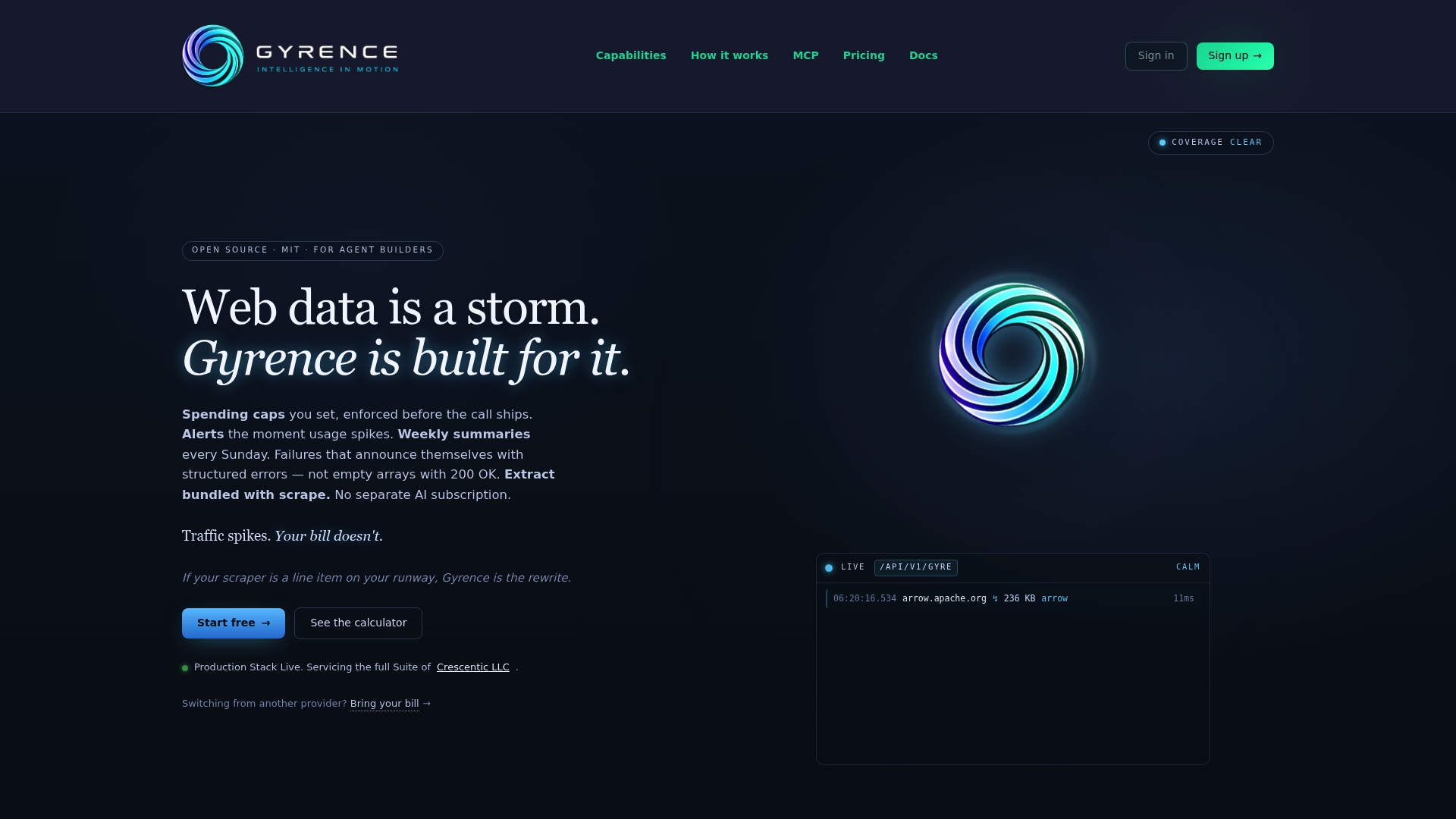
Every Map call returns a discriminated-union response, which means your agent can branch on success, partial results, or access failures without guessing. Spending caps and bundled LLM extraction mean your bill reflects actual usage, not runaway crawl loops. For teams building RAG pipelines, competitor monitors, or site inventory tools, Gyrence gives you the structured extraction benefits without the infrastructure overhead.
FAQ
What is domain URL mapping used for?
Domain URL mapping defines which URLs a crawler should visit, exclude, or prioritize during data extraction. It acts as an instruction set for automated agents to discover and process relevant content without excessive noise.
How does URL mapping improve RAG ingestion?
URL mapping filters out utility and duplicate pages before extraction, so only content-heavy pages enter the embedding pipeline. This improves embedding quality and reduces token consumption in retrieval-augmented generation systems.
What is the difference between regex filtering and graph-based URL mapping?
Regex filtering applies pattern rules to include or exclude URLs and works well for stable, simple domains. Graph-based mapping models the full URL structure with metadata, offering more control for complex sites but requiring more maintenance.
How often should a domain URL map be updated?
Domain URL maps should be refreshed whenever the target site undergoes structural changes, such as CMS migrations, new content sections, or URL restructuring. For actively monitored sites, a monthly validation pass is a practical baseline.
Can URL mapping work across multiple domains?
Yes. Multi-domain mapping applies the same inclusion and exclusion logic across several domains, normalizing URL structures into a common schema before aggregation. This approach is standard for knowledge base construction and large-scale data aggregation projects.