
Ethical web scraping means collecting only public data for a documented purpose, minimizing what you take, protecting any personal information you touch, and respecting the signals a publisher sends through robots.txt, rate limits, and terms of service. The single habit that separates careful teams from reckless ones: check for a documented API before you write a single line of scraping code. If one exists, use it.
TL;DR:
- Using documented APIs instead of HTML scraping significantly reduces legal and technical risks while improving pipeline stability and cost-efficiency.
- Implementing rate limits, exponential backoff, and request caching is essential to maintaining access and avoiding server blocks or bans.
- Collect only publicly available data needed for the purpose and avoid personal information unless absolutely necessary, with proper encryption and short retention periods.
- Maintaining detailed logs of requests, responses, and backoff events provides a strong audit trail helpful in legal or dispute situations.
- Opting for managed web data APIs can streamline operation, provide error handling, and save engineering time compared to manual, ad-hoc scraping.
Table of Contents
- What Are the Core Principles of Ethical Web Scraping?
- How Do You Build Rate Limits and Backoff Into a Scraper?
- Does Scraping Public Data Violate the CFAA?
- How Should You Handle Personal Data You Scrape?
- What Operational Controls Make a Scraper Defensible?
- When Should You Request API Access Instead of Scraping?
- Can a Managed Web Data API Replace Manual Scraping?
- What Do Practitioners Get Wrong About Ethical Scraping?
- Ready to Move Past Manual Scraper Maintenance?
- Where Can You Read the Primary Sources?
- Sources
- FAQ
What Are the Core Principles of Ethical Web Scraping?
Before anyone on your team opens a terminal, get agreement on the ground rules. These aren't legal advice. They're operational guardrails that keep your project defensible.
- Public data only. Never bypass a login wall or paywall to reach content. If a human needs credentials to see it, your scraper doesn't get a pass either.
- API-first, always. Check for a documented feed or API before touching HTML. Practitioner guidance from Apify's best-practices review treats API-first extraction as the highest-impact rule for long-lived pipelines. It's cheaper, more stable, and far less likely to draw a cease-and-desist.
- Purpose limitation. Collect only the fields your stated use case actually requires. If you're tracking prices, you don't need author bios and comment threads along with them.
- Honor publisher signals. Robots.txt isn't legally binding in most jurisdictions, but treating it as a preference signal, alongside meta tags and ToS language, is standard practice under the IETF's draft on automated collection.
- Identify yourself. A descriptive User-Agent string and a contact email cost you nothing and buy enormous goodwill if a site operator notices unusual traffic.
- Document everything. Write down your collection purpose, retention timeline, and minimization rules before the first request goes out, not after someone asks.
These principles from UCSB's ethics and legality guide boil down to one idea: least privilege. Take the smallest slice of data that does the job, and be ready to explain why you took it.
How Do You Build Rate Limits and Backoff Into a Scraper?
Politeness at the code level isn't optional; it's what keeps your access alive. Here's the sequence experienced teams follow:
- Set a global rate limit before you write extraction logic. Distributed scrapers running on multiple nodes need a shared coordinator, not per-node sleep timers. Ad-hoc delays on separate machines routinely stack into accidental request bursts against the same host.
- Respond to 429 and 503 as instructions, not errors. When a server returns either code, that's the site telling you to slow down. Treat it as a signal, back off, and resume gradually.
- Apply jittered exponential backoff. Add randomized delay increments after each failure instead of retrying on a fixed clock. This is standard developer practice for avoiding synchronized retry storms across concurrent workers, per rate-limit strategy notes on GitHub.
- Cache and use conditional requests. ETag and If-Modified-Since headers let you skip re-downloading unchanged pages, cutting load on the target server and your own bill.
- Build selector fallbacks and validate the schema. Layout changes are inevitable. Libraries like Pydantic (Python) or Zod (TypeScript) catch malformed extractions before bad data reaches your pipeline instead of silently corrupting it.
- Source proxies ethically. Residential proxy networks built on consent-based panels differ sharply from ones built on compromised devices; know which kind you're paying for.
- Use headless browsers sparingly. Reserve tools like Playwright for pages that genuinely require JavaScript rendering, then fall back to lightweight HTTP requests for everything else. A headless browser scraping guide covers this handoff pattern in detail.
- Monitor for drift. Automated alerts on parsing failures catch layout changes within hours instead of days.
Pro Tip: Log every backoff event with the response code that triggered it. Six months from now, that log is the difference between "we adjusted automatically" and "we don't actually know how our scraper behaves under load."
Does Scraping Public Data Violate the CFAA?
The Ninth Circuit's ruling in hiQ Labs v. LinkedIn held that scraping publicly available web pages generally does not count as "without authorization" under the Computer Fraud and Abuse Act. That's a meaningful limit on criminal exposure, but it is not blanket immunity, and the court's opinion leaves plenty of factual nuance for cases involving access restrictions or technical barriers.
Three separate risk categories deserve separate attention:
- Criminal unauthorized-access risk (CFAA). Reduced for public pages after hiQ, but not eliminated where a site erects technical barriers you circumvent.
- Contractual risk (Terms of Service). A ToS violation is a civil contract claim, independent of CFAA exposure. Courts have enforced these against scrapers even when the underlying data was public.
- Copyright risk. Reproducing substantial copyrighted content, rather than extracting factual data points, can trigger DMCA claims separate from any access theory.
The EFF's analysis of the ruling frames it accurately: a real win for scraping public data, paired with a caution that contract terms and blocking mechanisms remain live legal theories. Mitigate all three by documenting your purpose in writing, keeping detailed logs, and preferring licensed API access for any target where volume or data value is high. A deeper breakdown of these legal axes lives in this scraping legality checklist if your team needs to brief legal counsel.
How Should You Handle Personal Data You Scrape?
Public availability doesn't mean personal data is fair game for unlimited use. Even data a site displays openly, names, emails, phone numbers, still carries privacy obligations once you collect it into your own systems.
- Minimize fields at collection time. If your use case doesn't need an email address, don't extract it in the first place, even if it's sitting right there on the page.
- Detect and quarantine PII automatically. An automated classifier that flags emails, IDs, and phone numbers, then routes them to a quarantine queue requiring human approval, prevents mass accidental retention, according to ethical data collection guidance from WebScrapingHQ.
- Encrypt in transit and at rest. Pair encryption with role-based access controls so only people who need the data can see it.
- Set short retention windows with automated deletion. Data you don't need in 90 days shouldn't still be sitting in a warehouse a year later.
GDPR and CCPA both apply retention and subject-rights obligations to personal data regardless of whether you scraped it from a public page or received it directly. If a European or California resident asks what data you hold on them, "we found it publicly" isn't a defense against a deletion request.
What Operational Controls Make a Scraper Defensible?
Logging is your best evidence in a dispute, and it's cheap to build in from day one with AI compliance assistance for business.
- Log every request. Timestamp, target URL, source IP, a unique query ID, and the parser version that processed it. The IETF's collection best-practices draft recommends retaining these logs for a documented window to support later audits.
- Monitor success and failure rates. Alert when 4xx or 5xx responses spike, that's often the first sign a publisher has changed something or flagged your traffic.
- Pilot before you scale. Run a small batch, stress-test your rate limits against real response times, and validate your extraction schema before pointing the scraper at the full target list.
- Define graceful failure rules in advance. When layout drift or a publisher complaint hits, know whether your policy is to stop, slow down, or route to human review, before it happens under pressure.
Pro Tip: Store your query logs separately from your extracted data. If a publisher ever challenges your collection, a clean audit trail of what you requested and when is worth more than any legal argument about intent.
When Should You Request API Access Instead of Scraping?
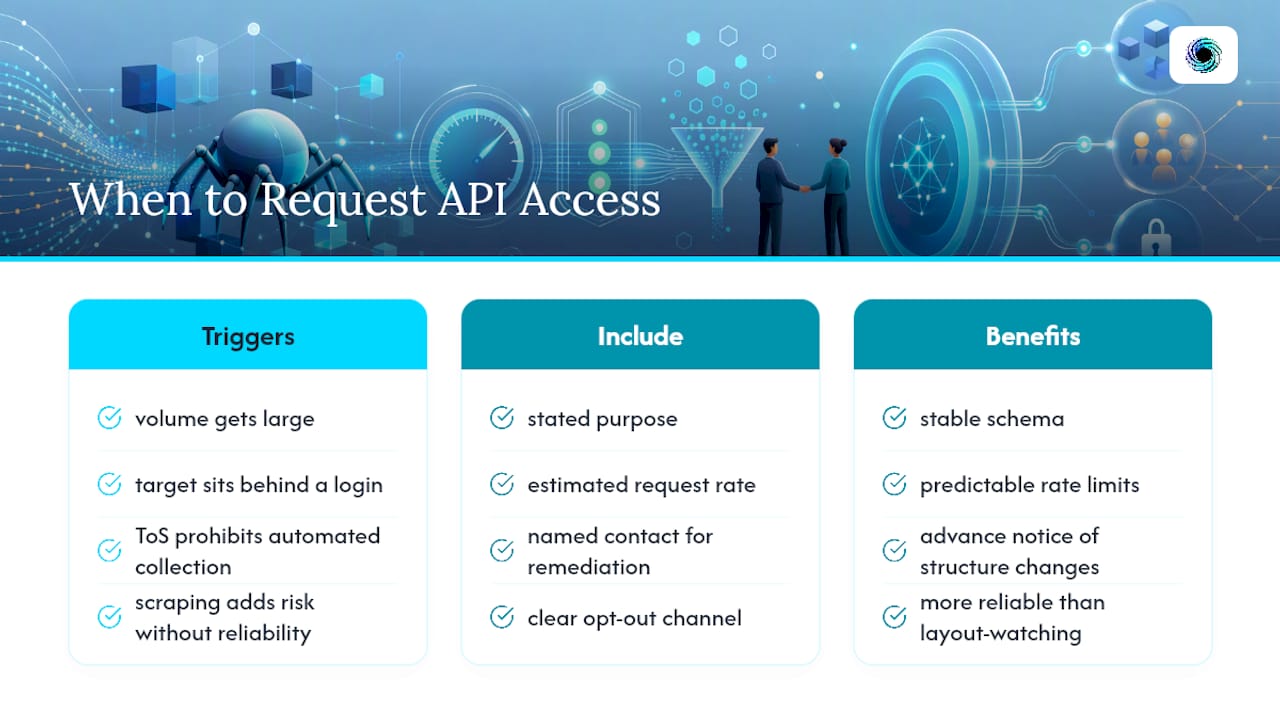
Escalate to a permission request when volume gets large, when the target sits behind a login, or when the ToS explicitly prohibits automated collection. At that point, scraping around the restriction just adds risk without adding reliability.
A solid request includes your stated purpose, an estimated request rate, a named contact for remediation issues, and a clear opt-out channel the publisher can use if they change their mind. Negotiated access usually pays for itself: you get a stable schema, predictable rate limits, and advance notice when the site's structure changes, none of which a scraper watching for layout drift can promise.
Can a Managed Web Data API Replace Manual Scraping?
Every control covered above, rate limiting, schema validation, failure logging, PII handling, can be built by hand, or centralized in infrastructure designed to enforce them automatically. That's the operational case for a managed web-data API.
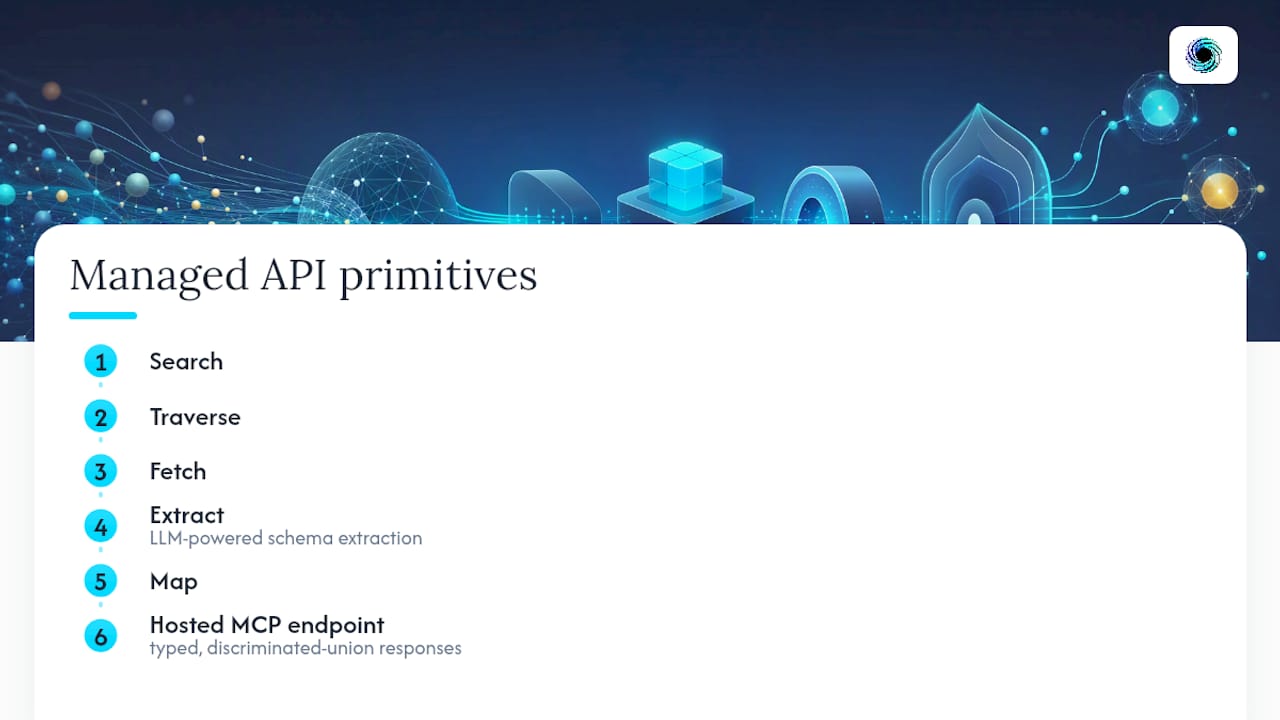
Gyrence is built around that idea: five composable primitives, Search, Traverse, Fetch, Extract, and Map, plus a hosted MCP endpoint, all returning typed, discriminated-union responses instead of silent failures. Extraction runs through bundled LLM-powered schema extraction, so a layout change doesn't quietly corrupt your data; it surfaces as a structured failure you can react to. Spending caps keep a runaway crawl from turning into a surprise invoice, which matters more than most teams realize until it happens once.
What Do Practitioners Get Wrong About Ethical Scraping?
Stealth evasion (rotating fingerprints to dodge detection) is a last resort, not a strategy, and treating it as one raises legal exposure over time rather than lowering it. Favor API or licensed access whenever scale matters. Log everything: a clear audit trail defends you better than any argument about intent. Least-privilege collection isn't caution for its own sake. It's the fastest way to explain your rationale if anyone ever asks.
— Glen
Ready to Move Past Manual Scraper Maintenance?
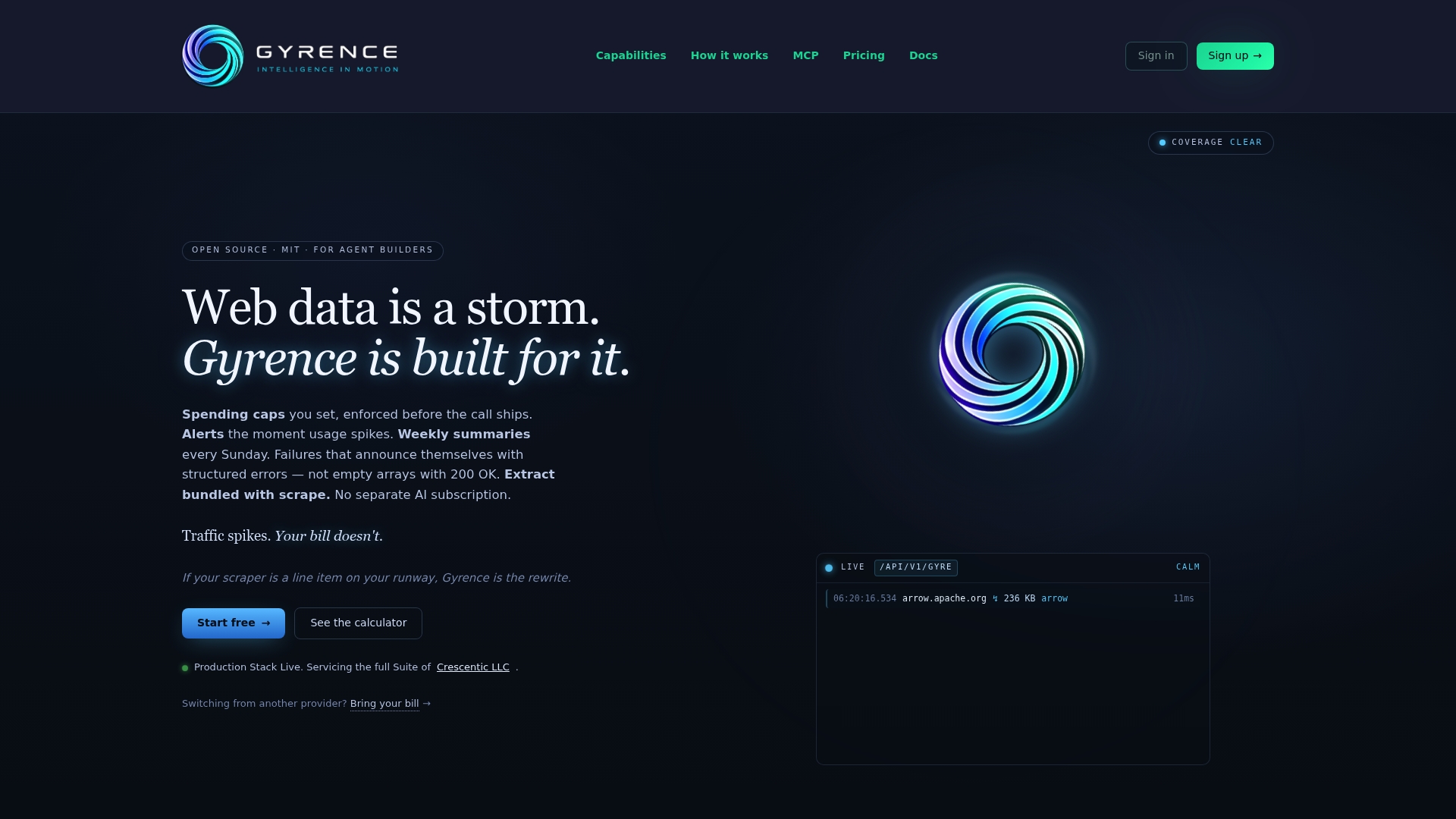
Teams that outgrow ad-hoc scripts usually hit the same wall: every layout change breaks a selector, and every fix eats an engineering afternoon that should have gone to the product. Gyrence replaces that cycle with typed, error-surfacing responses across Search, Traverse, Fetch, Extract, and Map, so a broken page returns a structured failure your agent can act on instead of a silent bad record.
For teams running continuous collection, WebDoppler adds drift detection and webhook alerts when a target site changes shape, closing the monitoring gap most in-house scrapers never build. If you're evaluating the cost side, the Standard plan runs $75 per month, with Growth and Scale tiers available as volume grows, all on predictable, capped credit usage instead of an open-ended bill. Check the pricing page and run a real workload against it before you commit engineering time to another custom scraper.
Where Can You Read the Primary Sources?
- hiQ Labs, Inc. v. LinkedIn Corp. (9th Cir. opinion), the foundational CFAA ruling on public-page scraping.
- IETF draft: Technical best practices for automated collection of public web data, the closest thing to an industry standard.
- Ethics & Legality of Webscraping (UCSB), a practitioner-oriented ethics primer.
- EFF coverage of hiQ v. LinkedIn, accessible legal context beyond the raw opinion.
Sources
- hiQ Labs, Inc. v. LinkedIn Corp. (9th Cir. opinion)
- IETF draft: Technical best practices for automated collection of public web data
- Ethics & Legality of Webscraping (UCSB)
- Web Scraping Best Practices 2026 (Apify)
FAQ
Is It Ethical to Scrape Websites?
Scraping public data for a documented, minimized purpose while respecting rate limits and publisher signals is widely considered ethical; scraping behind logins, ignoring blocking signals, or harvesting personal data without safeguards is not.
Can You Be Sued for Web Scraping?
Yes. Even where the hiQ v. LinkedIn ruling limits criminal CFAA exposure for public-page scraping, a site operator can still bring a civil claim for breach of Terms of Service or copyright infringement if you reproduce protected content.
What Is the Etiquette for Web Scraping?
Check for an API first, honor robots.txt and rate limits, identify your scraper with a real User-Agent and contact email, and take only the data fields your stated purpose actually requires.
Why Is Web Scraping Controversial?
It sits at the intersection of open-data ideals and site owners' control over their infrastructure and content; aggressive, unthrottled, or privacy-careless scraping damages that balance and invites the legal and technical countermeasures that shut down access for everyone.
Does Gyrence Handle Rate Limiting and Failure Reporting Automatically?
Yes. Gyrence's typed, discriminated-union responses surface failure modes like rate limits and layout drift directly, instead of hiding them behind generic errors, and spending caps keep collection costs predictable.