
TL;DR:
- A tiered extraction cascade with typed context packets and trust signals is essential for reliable live web grounding in LLM systems. Proper component setup, latency awareness, and observability practices prevent silent retrieval failures from degrading answer quality. Implementing strict metadata, coverage checks, and fallback routing ensures source fidelity and cost control in production pipelines.
The production pattern that works: a tiered extraction cascade feeding typed context packets into your RAG or agent gateway, with SLIs that catch silent failures before they reach users. Build this or your LLM will confidently hallucinate yesterday's facts.
Minimal components to ship first:
- Search + Fetch: resolve queries to live URLs before prompt assembly
- Extraction tiers: heuristic → density scoring → JS render → LLM fallback
- Dedupe + chunking: MinHash pass before embedding; semantic-boundary splits at 256–512 tokens
- Embedding + vector store: with centroid drift monitoring post-ingest
- Context packet schema:
contentHash,source_url,fetched_at,extraction_tier,verbatim_coverage - Numeric verification + citation plumbing: reject answers whose numbers are absent from retrieved context
Two non-negotiable trust signals: verbatim coverage checks on every extracted block, and contentHash-based provenance so any answer can be replayed against its exact source snapshot.
Table of Contents
- How does the tiered cascade architecture work for live web grounding?
- Extraction best practices for source-faithful, auditable text
- How do you prevent embedding-space collapse from web-derived chunks?
- What fields should every context packet include?
- How should you route requests and enforce spending caps per tier?
- Production implementation checklist
- Key Takeaways
- Why observability-first engineering is the only honest approach
- Gyrence covers the pipeline components you'd otherwise build yourself
- Useful sources and further reading
- FAQ
How does the tiered cascade architecture work for live web grounding?
The flow runs in one direction: query → search API → fetch → cascade routing → context packet assembly → LLM gateway → numeric verify → citations. Salesforce's Prompt Builder demonstrates this pattern at enterprise scale, inserting live external content into the resolved prompt and linking every snippet back to its original source.
Each URL enters the cascade at Tier 1 and escalates only when the cheaper tier fails quality thresholds.
| Tier | Method | Latency | Relative cost | Accuracy |
|---|---|---|---|---|
| 1 | Static fetch + heuristics | 50–200 ms | Baseline | Moderate |
| 2 | Density/block scoring + reconstruction | 100–400 ms | 2–5× | Good |
| 3 | Headless browser render | 1–4 s | 10–30× | High |
| 4 | LLM extraction fallback | 2–8 s | 1,000–50,000× | Highest |
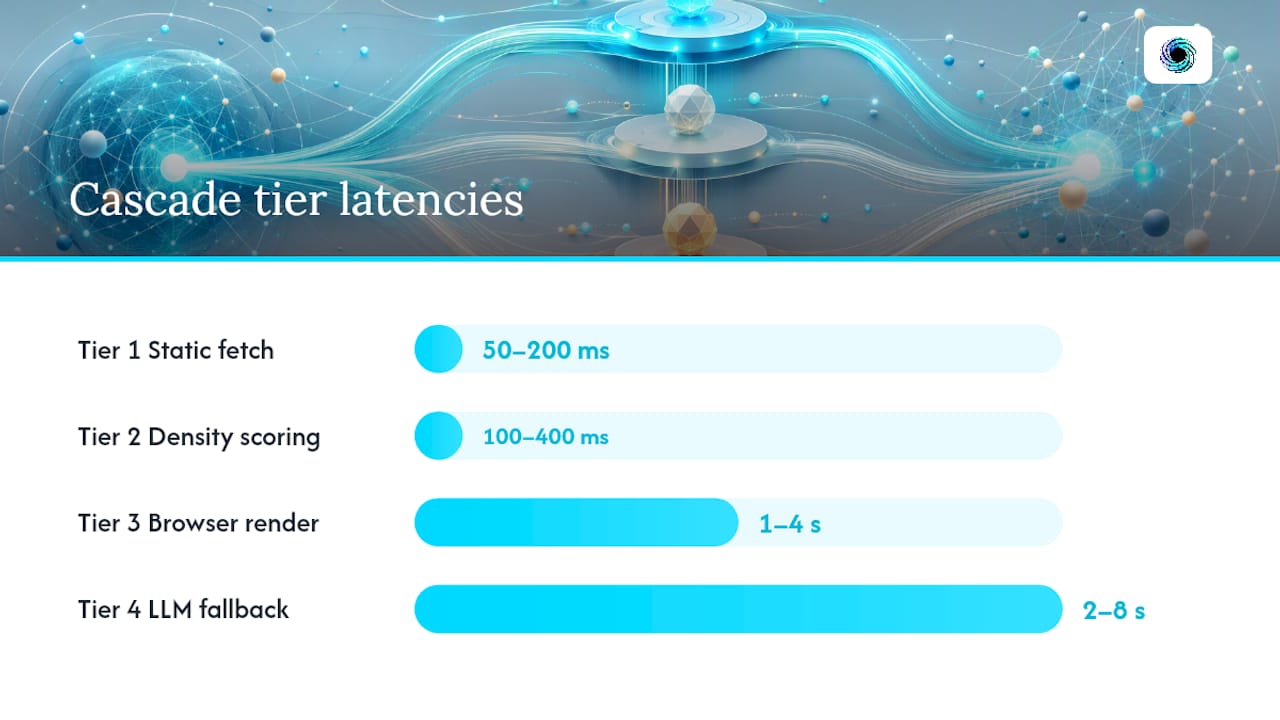
Routing decisions use feature signals: content-density score below threshold, JS-detection flags in response headers, or an EXTRACTION_FAILED token from the previous tier. Spending caps intervene at Tier 3 and Tier 4 — if a per-workspace budget is exhausted, the pipeline falls back to static RAG rather than running uncapped LLM calls.
Measured stage medians show search API alone adds 500 ms–5.5 s, fetch adds ~2.6 s, and extraction adds 100–300 ms. Stacked, that's 3.5–9 seconds of overhead before the LLM sees a single token. Design the cascade with those numbers in mind, not as an afterthought.
Extraction best practices for source-faithful, auditable text
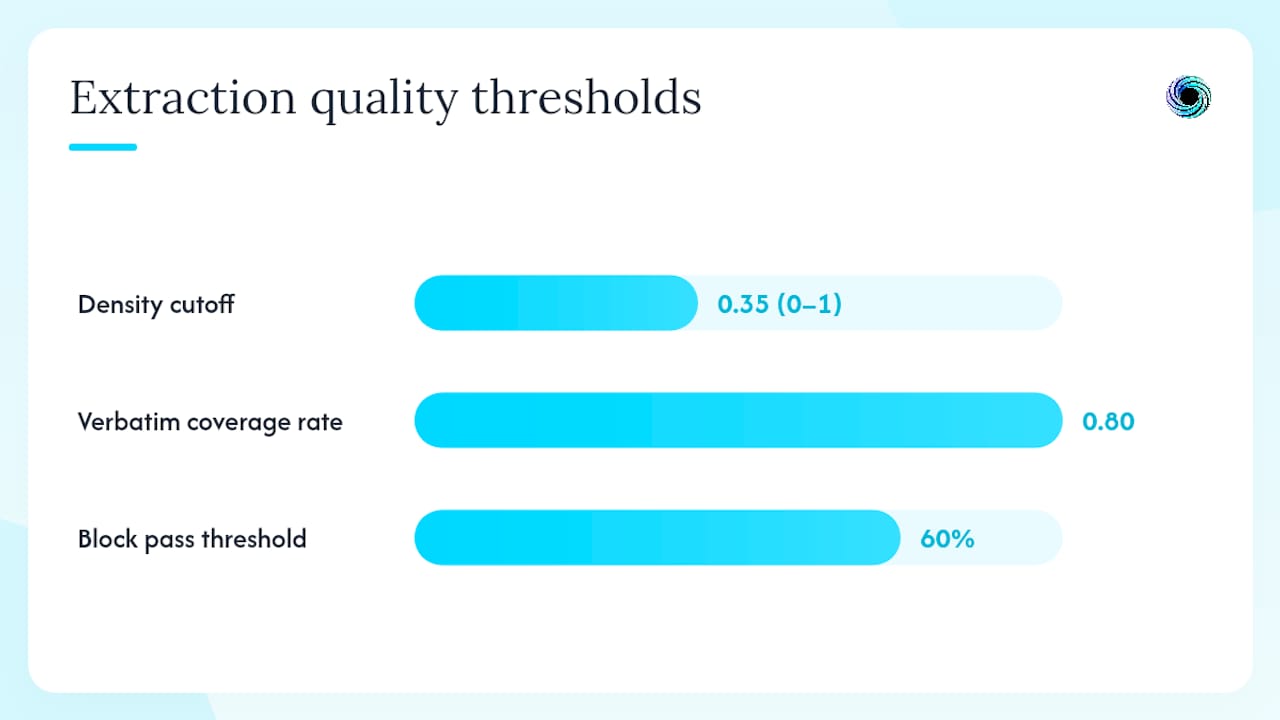
Heuristic extraction — boilerplate stripping, density scoring, whitespace normalization — handles the majority of clean article pages. It suffices when the density score clears your threshold (a common cutoff is 0.35 on a 0–1 scale) and the extracted token count falls within the expected distribution for that content type. Escalate to rendering or LLM extraction when those signals fail.
For LLM extraction prompts, the instructions matter more than the model:
- Grounding Enterprise AI with Live Web Retrieval and Verifiable Citations
- Why web data is the hardest problem in RAG systems
- AI web context pipeline: turn messy pages into reliable agent inputs
- Live Web Grounding in Production: Why Calling a Search API Is Only the Beginning
- How to Ground LLMs with Real Time Web Data
- How to build production web-to-RAG pipelines
- Grounded LLM (reference implementation)
Post-extraction, run three checks on every block:
- Verbatim coverage rate: ratio of extracted tokens that appear verbatim in the raw HTML; flag blocks below 0.80
- Token-count distribution check: compare extracted length against the expected range for the URL's content type; outliers signal boilerplate leakage or truncation
- Block-level coverage threshold: if fewer than 60% of content blocks pass the density cutoff, route the URL to the next tier
Failure handling is not optional. A pipeline that swallows
EXTRACTION_FAILEDand passes an empty string to the embedder will silently collapse retrieval quality. Route failures to a human-review queue or a logged dead-letter store. Never embed an empty or near-empty extraction result.
Pro Tip: Store the raw HTML alongside the extraction output for at least 72 hours. When a coverage regression surfaces in your SLIs, you need the original page to replay the extraction and isolate whether the failure was a site change or a pipeline bug.
How do you prevent embedding-space collapse from web-derived chunks?
Boilerplate injected before embedding causes embedding-space collapse: repeated structural chrome across pages pulls embeddings toward a common centroid, destroying the discriminative geometry retrieval depends on. The fix runs in three stages.
Chunking rules:
- Split at semantic boundaries (paragraph breaks, heading transitions) rather than fixed character counts
- Target 256–512 tokens per chunk; preserve the nearest heading and any structured metadata (date, author, URL) as chunk-level fields
- Never split mid-sentence; a sentence that straddles a chunk boundary loses coherence in both halves
Pre-embedding deduplication must run before the embedder sees anything. A MinHash or SimHash bloom-filter pass flags near-duplicate chunks across URLs. Embedding duplicates wastes index capacity and, worse, inflates the centroid toward the duplicated content type.
Monitoring signals for embedding-space drift:
- Centroid shift greater than a defined threshold between index builds indicates boilerplate leakage or a new high-volume source dominating the corpus
- Decreased variance across the embedding space signals collapse; healthy indexes show wide spread
- React by rebuilding the affected index partition, pruning boilerplate clusters, and tightening the density-score cutoff upstream
Operationally, prefer incremental reindexing for routine freshness updates and full rebuilds only after structural pipeline changes. Retain contentHash fingerprints so you can replay any chunk against its original source for audit or regression testing. Hybrid queries that combine dense retrieval with metadata filters (date range, extraction_tier, language) outperform pure vector search on time-sensitive web content.
What fields should every context packet include?
The context packet is the minimal unit of trust for agent inputs. It is not a blob of page text — it is a typed, fielded record that makes the answer replayable and the source auditable.
Minimum required fields:
| Field | Purpose |
|---|---|
contentHash | Change detection, dedupe, replay |
source_url | Citation and provenance |
fetched_at | Freshness gating and display |
extraction_tier | Cost attribution and quality signal |
verbatim_coverage | Faithfulness score for the block |
chunk_id | Retrieval traceability |
language | Routing and filtering |
A minimal packet in JSON looks like:
{
  "contentHash": "sha256:a3f...",
  "source_url": "https://example.com/article",
  "fetched_at": "2026-05-01T14:22:00Z",
  "extraction_tier": 2,
  "verbatim_coverage": 0.91,
  "chunk_id": "doc_42_chunk_3",
  "language": "en"
}
The contentHash field does three jobs: it detects when a source page changes between fetches, it deduplicates chunks before embedding, and it makes any generated answer replayable against the exact snapshot the LLM saw. The response audit record ties these packets together: prompt version, selected context IDs, and citation URLs all live in the same audit row. Production web-to-RAG pipelines that skip this metadata lose the ability to refresh, dedupe, and filter at retrieval time.
How should you route requests and enforce spending caps per tier?
Routing is a policy, not a guess. Define thresholds explicitly and enforce them in code.
- Tier 1 → Tier 2 escalation: density score below 0.35, or extracted token count outside the expected range for the content type
- Tier 2 → Tier 3 escalation: JS-detection flag in response headers, or
EXTRACTION_UNCERTAINreturned by the density scorer - Tier 3 → Tier 4 escalation: render timeout exceeded, or verbatim coverage below 0.60 after render
- Tier 4 cap: hard per-request spending cap; if hit, return
EXTRACTION_FAILEDand fall back to static RAG
Spending cap behaviors to implement:
- Per-request caps prevent a single runaway URL from consuming disproportionate budget
- Per-workspace monthly caps trigger a circuit breaker that routes all Tier 3/4 traffic to Tier 1/2 until the budget resets
- Slow or failed providers trip a circuit breaker after N consecutive failures; traffic reroutes to an alternate fetch endpoint
Track Tier Distribution Rate (what proportion of URLs resolved at each tier) weekly. A drift toward Tier 3/4 signals either site changes or threshold miscalibration — both require action. For queries containing keywords like "today," "latest," or explicit numeric data requests, force a Search-First call regardless of cache state.
Production implementation checklist
- Define your seed URL discovery strategy (sitemap crawl, search API, or domain Traverse)
- Implement Tier 1 static fetch with heuristic extraction and density scoring
- Add Tier 2 block reconstruction with a configurable density-score threshold
- Add Tier 3 headless render with a timeout and JS-detection routing flag
- Add Tier 4 LLM extraction with verbatim-only prompt constraints and
EXTRACTION_FAILED/EXTRACTION_UNCERTAINtokens - Run MinHash deduplication before any chunk reaches the embedder
- Roll out the context packet schema with all required fields including
contentHash - Instrument VCR, TDR, EDR, centroid drift, and context relevance SLIs with alert thresholds
- Build a labeled eval set (50–100 pairs) and schedule weekly context-relevance runs
- Configure per-request and per-workspace spending caps with circuit breakers
- Write and test the incident playbook (check VCR → EDR → centroid drift → TDR)
- Canary on read-only queries; run shadow traffic for Tier 3/4 before full enablement
- Enable staged rollout per workspace with kill switches for each tier
Sample tests to run before promoting to production: an extraction-coverage unit test that asserts VCR ≥ 0.80 on a fixture set; an embedding-centroid regression test that fails if drift exceeds threshold between two index builds; an end-to-end citation replay test that reconstructs an answer from stored context packets; and a load test that verifies circuit breakers trip correctly under Tier 3/4 cap exhaustion.
Key Takeaways
Grounded LLM responses from live web data require a tiered extraction cascade, typed context packets with contentHash provenance, and instrumented SLIs — skipping any one of these produces silent retrieval degradation that the LLM surface will not reveal.
| Point | Details |
|---|---|
| Tiered cascade is mandatory | Route each URL to the cheapest tier that clears quality thresholds; LLM extraction costs 1,000–50,000× more than heuristics. |
| Verbatim extraction checks | Assert VCR ≥ 0.80 per block; surface EXTRACTION_FAILED tokens rather than embedding empty results. |
| Dedupe before embedding | Run MinHash before the embedder to prevent embedding-space collapse from repeated boilerplate. |
| Instrument SLIs from day one | Track VCR, TDR, EDR, and centroid drift; alert thresholds catch silent failures before users notice. |
| Gyrence as implementation path | Gyrence's Search, Fetch, Extract, and Traverse primitives map directly to this pipeline with typed failures and spending caps built in. |
Why observability-first engineering is the only honest approach
The most common mistake teams make is treating web ingestion as a solved I/O problem. It is not. Web pages are engineered for rendering, not semantic retrieval, and the failure modes are almost always silent. A pipeline that ingests boilerplate, skips deduplication, and emits no coverage metrics will appear to work in staging and degrade slowly in production — with no alarm until users start reporting wrong answers.
The teams that avoid large outages treat live web grounding as distributed systems engineering from the start. They define SLIs before they write extraction code. They store contentHash on day one, not as a retrofit. They build the labeled eval set when the pipeline is small enough that 50 examples cover the query space.
Common mistakes worth naming directly:
- Embedding before deduplication (collapses the index)
- Swallowing
EXTRACTION_FAILEDtokens (silently degrades retrieval) - Skipping
fetched_atmetadata (makes freshness ungovernable) - Treating Tier 4 LLM extraction as the default (costs spiral without spending caps)
- Building no eval set (means you cannot detect regression until users report it)
The structured web data for RAG guide covers normalization and chunking in depth for teams building this from scratch.
Gyrence covers the pipeline components you'd otherwise build yourself
Gyrence's five primitives map directly to this architecture: Search resolves queries to live URLs, Fetch cleans pages to markdown, Extract runs schema-guided LLM extraction with typed failure responses, Traverse (Gyre) crawls a domain outward from a seed URL, and Map builds the URL graph. Every call returns a discriminated-union response that includes the failure case, so your agent reasons about results rather than guessing at empty strings.
Spending caps are workspace-level and per-request, circuit breakers are built in, and the hosted MCP endpoint means you can connect an agent without writing a custom integration layer. The extraction tier handles EXTRACTION_FAILED and EXTRACTION_UNCERTAIN as first-class return types, not exceptions. That removes the most common source of silent pipeline degradation before it reaches your embedder.
Start with the Gyrence docs to map your pipeline components to the API primitives, or open the console to run a live extraction against a URL you already know is hard.
Useful sources and further reading
The sources below back the architecture and implementation guidance in this article:
- Grounding Enterprise AI with Live Web Retrieval and Verifiable Citations — Salesforce engineering post on inserting live web content into prompt resolution and building citation traceability.
- AI web context pipeline: turn messy pages into reliable agent inputs — Typed context packet schema, provenance fields, and the argument for small, testable packets over text blobs.
- Live Web Grounding in Production — Latency stage decomposition with measured medians; prefetching and semantic caching patterns.
- How to Ground LLMs with Real Time Web Data — Search-First, Tool Use, and Agentic Loop patterns with latency/cost/complexity tradeoffs.
- How to build production web-to-RAG pipelines — End-to-end workflow with required metadata fields for citations, refresh, and deduplication.
FAQ
What is the minimum viable context packet schema for grounded LLM responses?
At minimum, store contentHash, source_url, fetched_at, extraction_tier, verbatim_coverage, and chunk_id. These six fields support change detection, citation display, deduplication, and answer replayability.
How do you detect silent retrieval degradation in a live web grounding pipeline?
Track Verbatim Coverage Rate and Extraction Failure Rate on a rolling window. A VCR drop below 0.75 or an EDR above 5% typically signals extraction-layer failure before answer quality visibly degrades.
When should you use LLM extraction instead of heuristic extraction?
Use LLM extraction only as a last-resort fallback after heuristic and render tiers fail. LLM extraction is 1,000–50,000× more expensive than heuristics and should be gated by a per-request spending cap.
How does Gyrence handle extraction failures in a production pipeline?
Gyrence returns typed, discriminated-union responses that include EXTRACTION_FAILED and EXTRACTION_UNCERTAIN as first-class values, so agents can branch on failure rather than embedding empty or partial results.
Which grounding pattern is best for conversational AI applications?
Tool Use (function calling) balances cost and freshness for most conversational apps. Search-First is simpler but more expensive per query; the Agentic Loop suits multi-step research tasks where a single retrieval pass is insufficient.