
TL;DR:
- Mapping a competitor's domain URL structure involves analyzing their URLs to uncover content strategy and site hierarchy. It combines traffic data, crawl reports, and discovery files to create a comprehensive, repeatable process. This approach reveals where competitors focus their authority and identifies content gaps for strategic targeting.
Mapping a competitor domain URL structure is the process of extracting, grouping, and analyzing their URLs to decode content strategy, site taxonomy, and topical authority. For developers and analysts, this is not a curiosity exercise. It is a repeatable intelligence method that reveals where a competitor has invested editorial resources, how their crawl budget is allocated, and which content clusters they are defending. The industry term for this practice is domain architecture comparison or competitive URL analysis, and it combines SEO tooling, pattern normalization, and internal link graph analysis into a structured workflow.
What tools and data do you need to map competitor URLs?
Three data sources form the foundation of any domain structure analysis: a traffic-filtered URL export, a crawl report, and the site's discovery files.

For traffic-filtered exports, SEO platforms that surface organic keyword data let you pull URLs with meaningful traffic. The Google site: operator is a fast, free starting point. Running site: queries grouped by core keyword reveals 4–8 distinct content pillars for mid-market sites in under 20 minutes. That speed matters when you are profiling multiple competitors in a single sprint.
Crawl tools give you the internal link graph, which is the data layer that traffic exports miss. You need both to do this correctly.
Discovery files are the third layer most analysts skip. Files like sitemap.xml, robots.txt, llms.txt, and ai.txt define the domain's declared structure. Missing these files causes negative trust signals for both AI agents and search engine crawlers. Including them in your mapping pass prevents blind spots in your URL inventory.
| Data source | What it reveals | Priority |
|---|---|---|
| Traffic-filtered URL export | High-value pages and primary keywords | High |
| Crawl report | Internal link graph and orphan pages | High |
sitemap.xml | Declared URL inventory | High |
robots.txt / llms.txt | Crawl directives and AI access rules | Medium |
| Redirect map | URL chains and equity flow | Medium |
How do you extract and cluster competitor URLs into topical pillars?
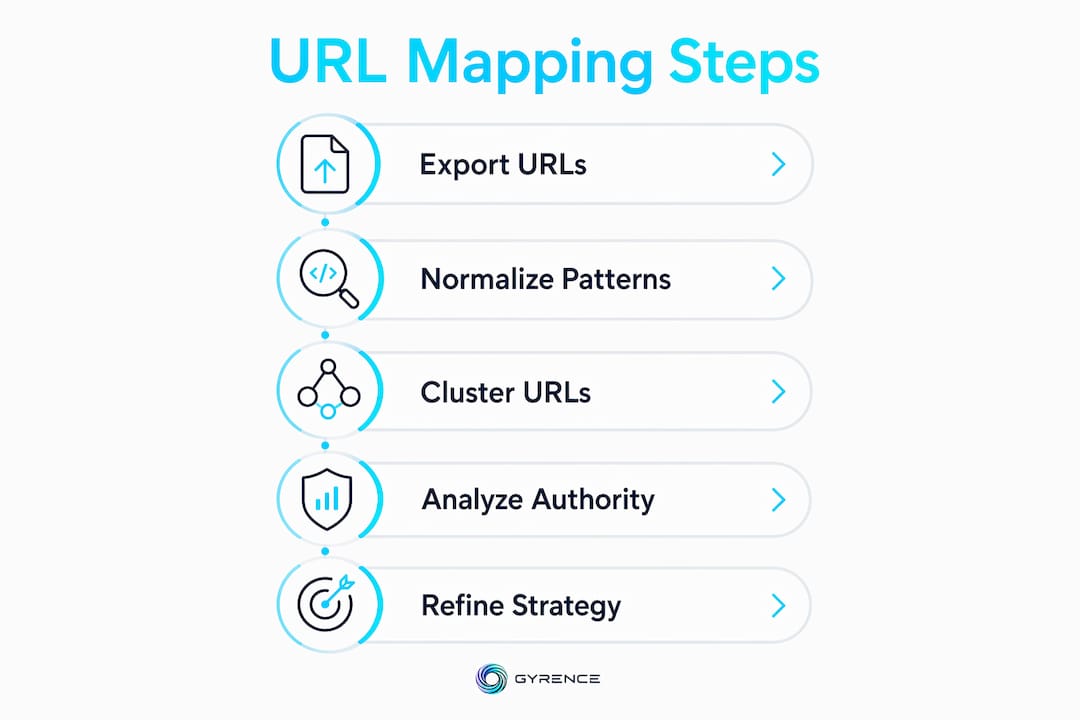
This is a four-step process. Each step builds on the previous one, and skipping any step produces an incomplete picture.
-
Export traffic-qualified URLs. Pull URLs with more than 50 visits per month alongside their primary organic keywords. Filtering to this threshold removes thin pages and rank one-offs that would distort your cluster analysis. You want signal, not noise.
-
Group by folder path and slug pattern. Segment URLs by their first and second path segments. A URL like
/blog/seo/keyword-research-toolsbelongs to the/blog/seo/cluster. Repeated slug tokens across a folder confirm a deliberate content theme, not accidental overlap. -
Cross-reference clusters with internal link anchors. Internal link anchor text is the most reliable signal of a site's true topical pillar. A page that receives repeated anchors like "keyword research guide" from across the site is a pillar page, regardless of its folder depth. This step separates real authority hubs from pages that just happen to share a folder.
-
Apply tiered verification. A tiered approach is the standard for large datasets: the top 1–3% of high-authority pages require manual review, while 70–80% of URLs can be processed automatically using pattern rules. Manual review for top-tier pages catches edge cases that regex patterns miss.
Pro Tip: Normalize URL patterns before clustering. Replace variable segments with placeholders, so /compare/tool-a-vs-tool-b becomes /compare/{var}-vs-{var}. This exposes programmatic SEO templates that would otherwise look like hundreds of unrelated pages.
For a deeper look at how URL graphs support agent navigation, the domain URL map guide covers advanced pattern decoding strategies.
How do you interpret URL mapping results for SEO strategy?
A completed URL cluster map tells you three things: where the competitor has concentrated authority, how their site hierarchy is organized, and where your content gaps are largest.
Concentrated authority shows up as multiple URLs ranking on the same topic cluster. A domain's taxonomy determines crawler prioritization, distinguishing primary hubs from utility pages. Misalignment between URL structure and internal linking leads to wasted crawl budget and weaker rankings. When you see a competitor with 40 URLs under /guides/ all linking back to one root page, that is a deliberate authority-building pattern worth replicating or countering.
Programmatic SEO signals appear in URL templates. Patterns like /compare/{product}-vs-{product} or /best-{category}-tools indicate dataset-driven content at scale. Spotting these templates tells you the competitor is not writing individual posts. They are running a content program.
To prioritize your own content gaps, rank the competitor's clusters by URL count and estimated link equity. The clusters with the most URLs and the strongest internal linking are the ones they are defending hardest. Those are your highest-value targets.
- Look for clusters where the competitor has 10+ URLs but you have zero coverage.
- Flag pillar pages identified by repeated anchor text across the site.
- Note URL templates that suggest programmatic content you could replicate with your own data.
- Check whether their top clusters align with high-volume keywords you are currently ignoring.
What are the most common pitfalls when mapping competitor URL structures?
The biggest mistake is trusting folder paths without validating internal links. A competitor might have /resources/ as a top-level folder, but if no other page links to it with consistent anchors, it is not a real pillar. Folder depth is a hint, not a verdict.
Dynamic URLs are the second common failure point. Tracking parameters like utm_source fragment your URL inventory if you do not strip them before clustering. The fix is normalization at the data layer, not just blocking parameters in robots.txt. Cache-key normalization handles this more reliably than exclusion rules alone.
Redirect chains are silent equity killers. A 301 that points to another 301 before reaching the final destination loses link equity at each hop. Proper redirect maps include URL pairs, status codes, and priority tiers to prevent chains and preserve equity during any restructuring.
Orphan pages are the third trap. Pages with no internal links pointing to them will not appear in a crawl-based analysis. You need to cross-reference your crawl output against the sitemap to surface them. Orphan pages often hold historical content that a competitor has quietly deprioritized.
Pro Tip: Run your URL normalization script before clustering, not after. Cleaning the data upstream saves hours of manual deduplication downstream.
For technical details on handling unstructured HTML and dynamic parameters, the guide on why agents fail on HTML covers the normalization edge cases in depth.
Key Takeaways
Mapping a competitor's domain URL structure requires traffic-filtered exports, internal link graph analysis, and pattern normalization working together. No single data source is sufficient on its own.
| Point | Details |
|---|---|
| Start with traffic-filtered URLs | Export only URLs above 50 visits/month to remove noise from your cluster analysis. |
| Validate clusters with anchor text | Internal link anchors confirm true pillar pages more reliably than folder paths alone. |
| Normalize before clustering | Strip tracking parameters and replace variable segments with placeholders before grouping URLs. |
| Apply tiered verification | Automate 70–80% of URL mapping and reserve manual review for the top 1–3% of authority pages. |
| Include discovery files | Sitemap.xml, robots.txt, and llms.txt complete the URL inventory and prevent crawl blind spots. |
URL mapping is more art than most analysts admit
I have run this process on domains ranging from 500 URLs to well over 200,000. The consistent lesson is that the data never speaks for itself. You can export, cluster, and normalize perfectly and still misread the map if you skip the internal link validation step. Folder paths are the competitor's intended structure. Anchor text patterns are their actual structure. Those two things diverge more often than you would expect, especially on older domains that have been reorganized multiple times.
The other thing I have noticed is that programmatic URL templates are becoming the most important signal to catch early. A competitor running /compare/{a}-vs-{b} at scale is not competing on editorial quality. They are competing on data coverage. Recognizing that pattern changes how you respond. You do not write better comparison posts. You build a better dataset.
Scaling this work across large domains without automation is not realistic. The tiered verification model, where automation handles the bulk and humans review the top tier, is the only approach that holds up past 10,000 URLs. Getting that balance right is where most teams underinvest.
— Glen
Gyrence makes domain-scale URL mapping repeatable
Gyrence's Map primitive traverses a domain outward from a starting URL and returns a typed URL graph, structured for direct use in clustering pipelines or agent workflows. No custom crawl scripts. No guessing at failure modes.
Every Gyrence API call returns a discriminated-union response that includes the failure cases, so your pipeline knows exactly what it got and what it missed. Spending caps mean your web data infrastructure costs stay predictable, even when you are mapping a competitor with 50,000 URLs. Pair the Map primitive with Extract to pull structured JSON from any page in the graph, and you have a full competitive URL analysis pipeline in a single API contract. See the web map tools guide for implementation patterns.
FAQ
What is competitor domain URL structure mapping?
Competitor domain URL structure mapping is the process of extracting and grouping a site's URLs by folder path, slug pattern, and internal link signals to decode its content strategy and site hierarchy.
How many URLs do you need before automation makes sense?
Automation becomes necessary above roughly a few thousand URLs. A tiered approach, where pattern rules handle the bulk and manual review covers the top authority pages, is the standard method for large datasets.
Why is internal link anchor text more reliable than folder paths?
Anchor text across a site reflects how the competitor actually treats a page, not just where they filed it. Folder paths show intended structure; anchor patterns show actual editorial priority.
What discovery files should I include in a URL mapping pass?
Include sitemap.xml, robots.txt, llms.txt, and ai.txt. Missing these files creates blind spots in your URL inventory and sends negative trust signals to crawlers and AI agents.
How do I identify programmatic SEO from URL patterns?
Normalize URLs by replacing variable segments with placeholders. Patterns like /compare/{var}-vs-{var} appearing at scale confirm a programmatic content strategy built on templated data rather than individual editorial decisions.