
The practical way to add web search to a LangChain agent is to wrap a discovery API as a Tool, fetch full pages, convert the results to LLM-friendly markdown or structured JSON, and orchestrate retrieval through agent tool calls or Deep Agents. Watch two failure modes from day one: repeated fetches that burn tokens, and agents that loop on the same query without making progress. Install the LangChain packages, pick a discovery provider, and start there.
TL;DR:
- Pre-crawl frequently queried domains into an owned index to significantly reduce token costs and avoid repetitive search and fetch loops.
- Use scraper-first providers for large, repeated queries and reserve SERP-only providers for exploratory searches where volume and cost matter.
- Clean HTML pages by stripping navigation, ads, and scripts, then truncate aggressively to preserve document hierarchy and avoid overwhelming the model.
- Implement guardrails such as tracking visited URLs and setting limits on tool calls and session spending to prevent runaway loops and unpredictable costs.
- Opt for structured JSON output when possible, as it balances detail and cost while enabling precise information extraction and reasoning.
Table of Contents
- Setting Up LangChain for Web Search
- How Do LangChain's Web Search Tools Work?
- Choosing a Search Provider and Wiring It as a Tool
- Fetch and Clean: Turning Pages Into Markdown or JSON
- Orchestrating Multi-Step Agent Research
- Mapping Gyrence's Primitives to This Pipeline
- What Actually Works in Production
- Try Gyrence for Faster Web Search Integration
- Primary Sources and Further Reading
- Sources
- FAQ
Setting Up LangChain for Web Search
You need four things before you write a single tool: a discovery provider, a fetch layer, an HTML cleaner, and (optionally) a vector store for long documents. LangChain itself does not scrape the web. It orchestrates calls to whatever provider or fetch library you wire in.
For Python projects, install langchain, langchain-community, and httpx for HTTP fetches. If you need JavaScript rendering, add playwright (or puppeteer in Node projects) alongside beautifulsoup4 or cheerio for parsing. Plain httpx requests handle the majority of static pages faster and cheaper. Reach for a headless browser only when a page requires JavaScript execution to render content, since Playwright adds real latency and memory overhead per page.
Setup checklist:
- Store API keys for your search provider and any embedding model in environment variables or a secrets manager, never in code.
- Set conservative timeouts (5 to 10 seconds per fetch) and respect provider rate limits from the start.
- Add a vector store like FAISS or Chroma only when you're summarizing large documents across sessions; skip it for single-turn lookups.
- Review LangChain's tool integrations index to see which search tools return page content versus snippets only.
How Do LangChain's Web Search Tools Work?
LangChain tools follow a simple contract: the model decides to call a tool, LangChain executes it with structured arguments, and the tool's output goes back into the model's context as an observation. That's the entire loop. The WebBrowser tool is the clearest example. It accepts a URL and an optional extraction instruction, then returns either a summary or the specific detail the agent asked for.
You get two usage modes:
- Standalone invocation. You call
webbrowser.run("https://example.com, summarize the pricing section")directly in your code, outside of any agent loop. Useful for testing, batch jobs, or deterministic pipelines. - In-agent tool calling. You bind the tool to a chat model with
.bind_tools(), and the model decides when and how to invoke it based on the conversation. The model generates the arguments; LangChain executes and returns results.
The shape of what the tool returns matters more than most developers expect. A full document gives the model everything it needs in one shot but costs more tokens. A snippet is cheap but often missing the specific fact the agent needs, forcing a second fetch. Structured JSON, produced by a schema-guided extraction step, is usually the best middle ground for agents that need to reason over specific fields rather than free text.
Choosing a Search Provider and Wiring It as a Tool
Three provider shapes dominate practice, and each has a different cost profile. A SERP-only provider returns titles, URLs, and short snippets. It's cheap per call but forces your agent into a discover-then-fetch loop for anything beyond a quick fact check. A scraper-first provider returns full cleaned page content directly from the search call, cutting out a round trip. An owned index (your own pre-crawled dataset) is the fastest and cheapest option for domains you query repeatedly, but it requires upfront crawling and maintenance.
Wrapping any of these as a LangChain Tool follows the same shape:
- Define the tool's input schema (query string, optional
max_results, optional domain filter). - Call the provider with a hard timeout and a retry limit of one or two attempts.
- Normalize the response into a consistent shape (title, URL, content, timestamp) regardless of provider.
- Return that structure to the model as the tool's output.
Pro Tip: If your agent repeatedly queries the same handful of domains, pre-crawl them into an owned index. Practitioner analysis on agent token costs shows that returning pre-cleaned documents instead of running iterative SERP-then-fetch loops cuts token spend dramatically for repeat queries.
Fetch and Clean: Turning Pages Into Markdown or JSON
Raw HTML is expensive and noisy for an LLM. Fetch politely: send a real user agent, honor robots.txt where it applies, set a timeout around 8 seconds, and cap page size before you parse anything. A page that takes 20 seconds to load is rarely worth the wait in an agent loop.
Cleaning has a fixed job: strip navigation, ads, and boilerplate footers, collapse repeated whitespace, and preserve heading structure so the model can still follow document hierarchy. Truncate aggressively past a reasonable length rather than passing an entire 40,000 word article into context.
- Strip
<nav>,<footer>, and<script>tags before converting to markdown. - Preserve
<h1>through<h3>tags as markdown headings so the model retains document structure. - Truncate to the first 3,000 to 5,000 tokens unless the task explicitly needs the full document.
- Attach the source URL, fetch timestamp, and an extraction confidence flag to every result.
For structured output, pair a prompt with a JSON schema (or a Zod schema in TypeScript projects) so the extraction step returns typed fields instead of loose text.
Pro Tip: Always carry provenance metadata through your pipeline. When an agent cites a fact three tool calls later, you want the original URL and timestamp still attached, not lost in a string concatenation.
Orchestrating Multi-Step Agent Research
Complex research queries rarely resolve in one search call. LangChain's Deep Agents pattern handles this by delegating subtasks to subagents, each with an isolated context window, then merging their findings. This keeps one noisy research thread from polluting another's context, and it's the pattern shown in LangChain's own deep research agent guide.
Decide between parallel and sequential retrieval with a short checklist:
- Are the subqueries independent of each other? Run them in parallel.
- Does query two depend on an answer from query one? Run sequentially.
- Is the topic broad enough to need three or more angles? Split across subagents.
A typical refinement loop looks like: rewrite the query for specificity, search, fetch the top result, extract the relevant field, then decide if another pass is needed. The 2026 academic survey of LLM-based search agents documents hybrid parallel-and-sequential structures as the common production pattern for exactly this kind of multi-hop research.
Loop prevention needs explicit guardrails, not hope:
- Track visited URLs in a set and reject repeat fetches within the same run.
- Cap total tool calls per task (10 to 15 is a reasonable ceiling for most research agents).
- Return typed failure responses (timeout, no results, blocked) instead of empty strings, so the agent can branch on the actual failure instead of guessing.
- Set a hard spending cap per session to stop runaway loops before they hit your bill.
Mapping Gyrence's Primitives to This Pipeline
Gyrence's five primitives map directly onto the pipeline described above: Search handles discovery, Fetch retrieves and normalizes a single page to markdown, Extract runs schema-guided extraction with an LLM, Traverse (Gyre) crawls a site outward from a starting URL, and Map returns a domain's URL graph from its sitemap.
- Every call returns a typed, discriminated-union response, including failure cases, so your agent branches on explicit error types instead of parsing exception strings.
- Spending caps and predictable cost management help control costs to avoid surprise invoices in case of runaway agent loops.
- The hosted MCP endpoint lets you connect these primitives directly to an agent framework without writing custom tool wrappers.
A basic integration sketch: call Search for discovery, pass the top result's URL to Fetch for clean markdown, then call Extract with a JSON schema if you need structured fields, and feed the typed response straight into your agent's tool output.
What Actually Works in Production
Start with scraper-first retrieval or an owned index for deep, repeated queries. Reserve SERP-only discovery for genuinely exploratory searches where you don't yet know which domain has the answer. Measure token cost per task, latency per fetch, and extraction fidelity before you scale any of this to production traffic. The wiring sketches above are a starting point, not a finished system. Test them against your own workload before you trust the numbers.
— Glen
Try Gyrence for Faster Web Search Integration
Building the discover-fetch-clean pipeline from scratch means stitching together a search provider, a fetch layer, an HTML cleaner, and your own error handling. Gyrence collapses that into a single API call: Search for discovery, Fetch for clean markdown, Extract for schema-guided JSON, all with typed failure responses and spending caps built in.
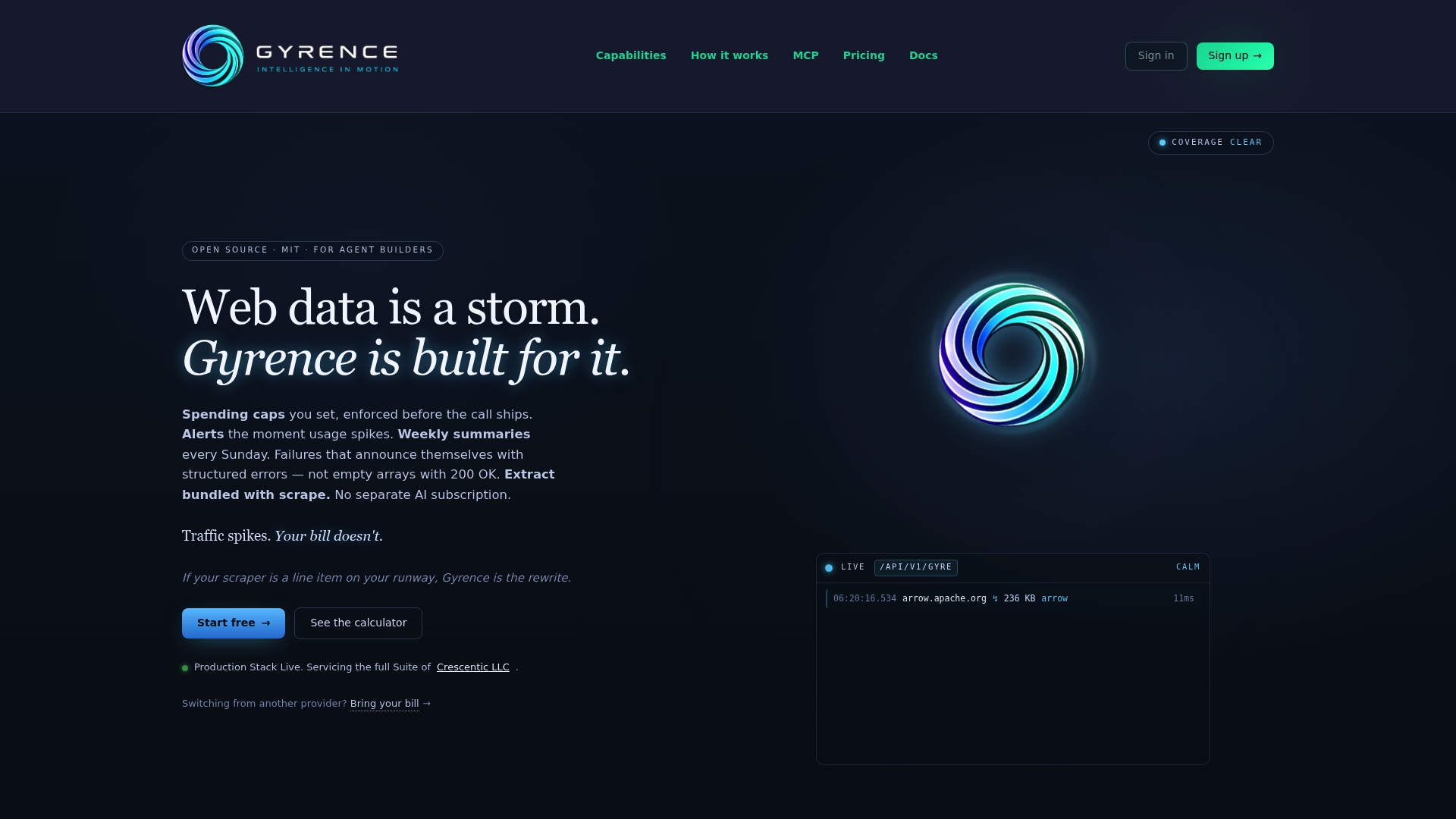
That last part matters more than it sounds. A runaway agent loop against a raw scraper can rack up unpredictable costs overnight. With Gyrence, your spending cap stops it before it becomes a surprise invoice. If you want to see how the primitives fit your own agent, visit the Gyrence landing page and walk through a live example in the docs.
Primary Sources and Further Reading
- Web browser integration and tool integrations index, LangChain docs
- A survey of LLM-based search agents, ACL 2026
- Build a deep research agent, LangChain docs
- Building a web search tool with LangChain, step-by-step guide
Sources
- Web browser integration - Docs by LangChain
- Tool integrations - Docs by LangChain
- Agents need a new kind of web search — Daily Dose of DS
- Build a deep research agent - Docs by LangChain
FAQ
What tools are available in LangChain for web search?
LangChain ships tool integrations like WebBrowser for page visits and extraction, plus a broader tool integrations index listing search providers that return snippets, page content, or both, depending on the provider.
What is a website search agent?
A website search agent is an LLM-driven system that decides when to search, fetches and reads page content, then reasons over the results to answer a question, often using subagents for multi-step research tasks.
Which chat models does LangChain support for tool calling?
LangChain supports tool calling across most major chat model providers through its unified .bind_tools() interface, letting the same tool wiring work regardless of which underlying model you choose.
How does LangGraph use tool calls?
LangGraph represents each tool call as a node in a graph, routing the model's decision to invoke a tool through explicit edges, which makes multi-step agent loops easier to inspect and debug than a single linear chain.
Should I use snippets or full pages for agent web search?
Full cleaned pages or structured JSON generally beat snippets for agent reliability, since agents avoid the extra round trip a snippet-only result often forces, though snippets stay cheaper for simple lookups.