
The Model Context Protocol (MCP) is an open, capability-based JSON-RPC protocol that lets LLM hosts discover and call external Resources, Tools, and Prompts, so models access live data and execute actions without a bespoke connector for every integration. MCP servers expose their capabilities through a discovery step, which means a host built once against the spec works against any compliant server. The immediate payoff: faster integrations, consistent runtime discovery, and fewer one-off API clients to maintain.
TL;DR:
- MCP allows for quick, standardized discovery of external resources, tools, and prompts, reducing the need for custom connectors and streamlining integration.
- Clients should cache
server/discoverresponses to avoid unnecessary round trips, as capability sets typically do not change during a session.- Implementing proper security measures like TLS, token rotation, and least-privilege tool design is crucial for reliable and safe production MCP deployments.
- Using HTTP+SSE facilitates remote and streaming use cases, while stdio is suitable for local development and rapid iteration.
- Gyrence offers a hosted MCP endpoint that handles security, discovery, and typed responses, allowing teams to deploy MCP without building their own server.
Table of Contents
- How MCP Structures Hosts, Clients, and Servers
- What Are Resources, Tools, and Prompts in MCP?
- Which Transport Should You Use: Stdio or HTTP+SSE?
- How Do You Implement an MCP Client Step by Step?
- What Security Mistakes Break MCP Integrations in Production?
- How Gyrence Maps Its Primitives to MCP
- Is MCP Worth Adopting Now, or Still Too Early?
- Get a Hosted MCP Endpoint Without Building Your Own Server
- Where to Read the MCP Spec and SDK Docs
- Sources
- FAQ
How MCP Structures Hosts, Clients, and Servers
MCP splits responsibility across three roles, and getting the boundaries right determines whether your integration scales past a demo. The host is the application the user actually talks to. It runs the client lifecycle, handles user consent, manages authorization, and aggregates context pulled from multiple servers into one coherent conversation. The client maintains a 1:1 connection to a single server and attaches a _meta object to every outbound request, carrying protocol version and capability flags. The server exposes a focused slice of functionality (a database, a file system, a web-data pipeline) and must implement server/discover so the client knows what exists before it tries to call anything.
Connections follow a fixed lifecycle:
- The client sends
initialize, declaring its protocol version and capabilities. - The server responds, then the client calls
server/discoverto enumerate available Resources, Tools, and Prompts. - The client sends
initializedonce discovery completes and it's ready to operate. - Both sides exchange typed requests and responses for the life of the session.
- Either side can terminate the connection, and a well-built host handles that gracefully rather than assuming the server is always there.
MCP is stateless at the request level: each call carries its own _meta, so servers don't need to track session state across requests to know what a client can handle. That design choice makes horizontal scaling of servers far simpler than protocols that lean on sticky sessions.
What Are Resources, Tools, and Prompts in MCP?
MCP servers expose functionality through three primary primitives, and each one solves a distinct problem. Confusing them is the fastest way to design a server that hosts can't reason about.
- Resources are addressable data, identified by URI. A client calls
resources/listto enumerate what's available andresources/getto pull one. Servers can push updates for resources that change frequently, or simply let clients poll, depending on how volatile the underlying data is. - Tools are callable functions with defined argument schemas. Clients call
tools/listto see signatures, thentools/callwith validated arguments. A tool should be idempotent where possible and return a typed result, including an explicit failure shape, so the model can reason about what went wrong instead of guessing from a stack trace. - Prompts are reusable templates a server offers, discoverable through
prompts/listand retrieved throughprompts/get. Hosts can render them directly or splice them into a larger conversation context.
Discovery drives everything downstream: a tool the server never advertises during server/discover simply doesn't exist to the client, no matter how well it's implemented on the backend.
Pro Tip: Design your tools/call return shapes as discriminated unions from day one. Retrofitting typed error codes after a host has already shipped against loose JSON is far more painful than doing it up front.
Which Transport Should You Use: Stdio or HTTP+SSE?
MCP's data layer runs on JSON-RPC 2.0, which gives you three message types to work with: requests (expecting a result), notifications (fire-and-forget), and errors, each carrying a standard code and message so failures are machine-readable rather than a raw exception string.
Transport choice is a separate decision from the message format:
- Stdio works well for local development. It's the fastest way to iterate on a server without standing up networking infrastructure.
- HTTP+SSE handles remote deployments and streaming. Server-sent events let a server push notifications, like a resource update or a long-running tool's progress, without the client polling.
- Authentication typically means bearer tokens or OAuth at the transport layer. The host is responsible for enforcing authorization decisions; the server simply respects the constraints it's handed.
Many teams start on stdio for speed, then move to HTTP+SSE once they need remote access or multiple concurrent clients, which is also the point where auth hardening has to happen.
How Do You Implement an MCP Client Step by Step?
A working MCP integration follows the same handful of steps regardless of language or SDK. Here's the sequence, with the payload shapes that trip people up.
- Send
initialize. The client declares its protocol version and capabilities inside_meta. The server responds with its own version and capability set, so both sides agree on what's supported before anything else happens. - Call
server/discoverand cache the response. This returns the full list of Resources, Tools, and Prompts the server exposes. Cache it. Re-fetching on every request wastes a round trip and most capability sets don't change mid-session. - Call
tools/list, parse the signatures, thentools/callwith typed arguments. Validate arguments client-side against the schema before sending; a server should reject malformed calls with a structured error, not a silent failure. - Open subscriptions where relevant.
subscriptions/listenlets a server push notifications for things like resource changes or a tool that requires additional input mid-call (anInputRequiredResultelicitation). Handle that as a first-class flow, not an edge case bolted on later. - Handle errors using standard JSON-RPC error codes, and shut down connections gracefully rather than letting a dropped transport cascade into unhandled promise rejections in the host.
Pro Tip: Log every _meta block you send and receive during development. Half of MCP integration bugs trace back to a capability the client assumed was present but the server never actually advertised.
What Security Mistakes Break MCP Integrations in Production?
Most production failures trace back to a handful of repeatable mistakes, and they're the same ones showing up across the ecosystem regardless of language or SDK.
- Enforce least privilege. Don't expose a raw database connection or an entire third-party API as a single tool. Narrow, precise tool functions that map to exact operations let a model reason about what it's calling and let you audit what it did.
- Implement
server/discovercorrectly and cache it. A missing or incomplete discovery response is a top cause of integration failures, because the host simply never learns a capability exists. - Harden the transport before you ship. TLS everywhere, token rotation, per-connection scopes, rate limits, and explicit consent flows. Treat an MCP server as a first-class backend service, not a script you happened to wire up to JSON-RPC.
- Instrument everything. Trace
_metafields, log every tool call with its arguments and result shape, and track failure rates per tool so you catch a broken integration before your users do.
Pro Tip: Run a monthly audit of exactly which tools your MCP server advertises versus which ones actually get called. Unused tool surface is unused attack surface.
How Gyrence Maps Its Primitives to MCP
Gyrence's five composable primitives, Search, Traverse, Fetch, Extract, and Map, translate cleanly onto MCP's primitive model. Extract, for instance, works as both an MCP Resource (the schema-guided output) and a callable Tool (the extraction call itself), which lets an agent discover it once and invoke it repeatedly with different schemas.
- The hosted MCP endpoint skips the work of building and maintaining your own server implementation.
- Every response is a typed, discriminated union, including the failure modes, so agents don't have to guess why a call failed.
- Spending caps and predictable cost-per-call mean an agent can hammer
tools/callwithout a surprise invoice at the end of the month.
For a deeper look at how these primitives map onto agent-facing interfaces generally, see this developer's guide to AI agent web data primitives.
Is MCP Worth Adopting Now, or Still Too Early?
MCP earns its keep by cutting the integration tax: build one server, and every compliant host can use it. Teams evaluating it should prioritize discovery correctness and least-privilege tool design over feature count. Prototype on stdio, then harden transport and auth before production. Watch SDK maturity and server registries as your adoption signal.
— Glen
Get a Hosted MCP Endpoint Without Building Your Own Server
Building and hardening an MCP server from scratch means owning discovery caching, transport security, token rotation, and typed error handling yourself, on top of whatever data pipeline sits behind it. Gyrence gives you that server already built: Search, Traverse, Fetch, Extract, and Map are exposed as MCP-compatible primitives behind a hosted MCP endpoint, with spending caps and typed failure responses so an agent calling tools/call in a loop never turns into a surprise invoice.
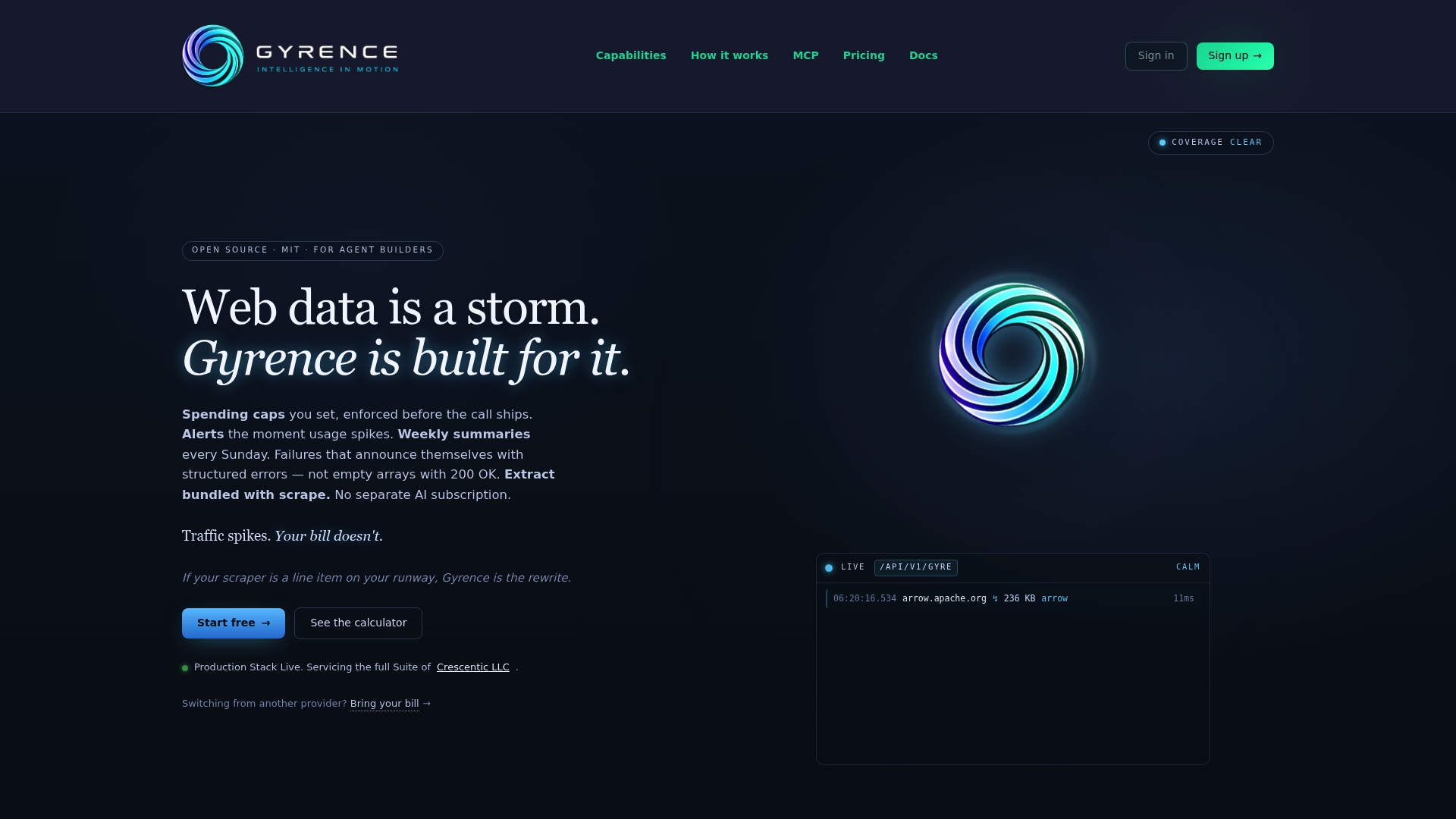
If you're evaluating MCP for a web-data agent, connect a sample client to Gyrence's endpoint and run server/discover against it directly. The documentation walks through initialization, discovery, and tool calls end to end, and the console lets you start on a free tier before committing to a plan.
Where to Read the MCP Spec and SDK Docs
- MCP specification: core protocol reference.
- Architecture overview: transports and message flow.
- Anthropic's announcement: origin and ecosystem intent.
Sources
- modelcontextprotocol/modelcontextprotocol: specification (2026-07-28)
- Introducing the Model Context Protocol
- Model Context Protocol — architecture overview
- OpenAI MCP docs
FAQ
What Is MCP vs API?
A REST API defines endpoints for one specific service; MCP is a discovery layer sitting on top of the concept, letting a client enumerate what any compliant server offers through server/discover rather than reading fixed documentation for each integration.
Does ChatGPT Use MCP?
OpenAI has published MCP guidance covering capability discovery and least-privilege tool design, and support for connecting MCP servers has been rolling out across major LLM hosts, Anthropic's Claude among them.
What Is MCP vs RAG?
RAG (retrieval-augmented generation) is a technique for injecting retrieved text into a prompt; MCP is a protocol for connecting a host to live external systems, so a server built with MCP could power a RAG pipeline, but the two solve different layers of the problem.
What Is MCP for AI Agents?
For an agent, MCP is the standardized way to discover and call external Tools and Resources at runtime, which means the agent doesn't need a custom connector hardcoded for every data source or action it might need. Gyrence's hosted MCP endpoint is one example built specifically for agents pulling structured web data.
What's the Difference Between MCP and LangChain?
LangChain is an application framework for chaining LLM calls, memory, and tools inside your own code; MCP is a wire protocol that standardizes how any host, LangChain-based or not, discovers and calls external servers, so the two are complementary rather than competing.