
A discriminator names the property whose value tells a client, or a code generator, which schema in a oneOf, anyOf, or allOf set actually applies to a given payload. Instead of testing a JSON object against every candidate schema, tooling reads one field and jumps straight to the right type.
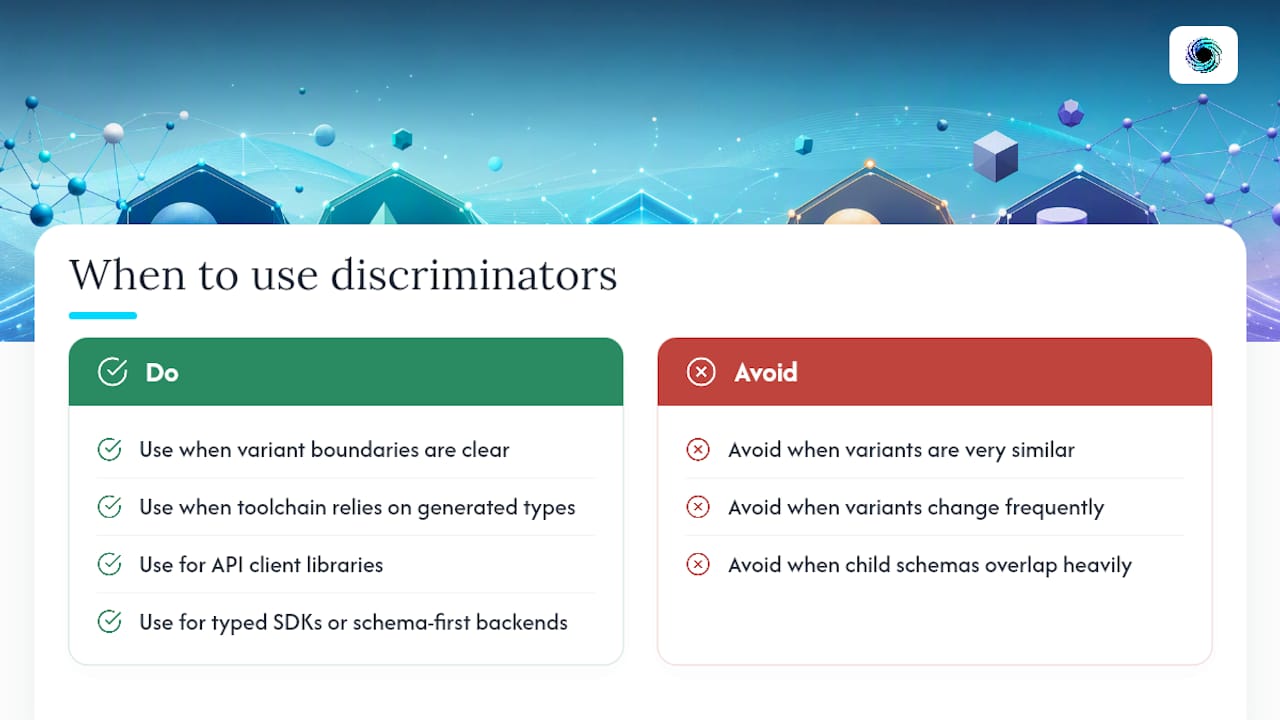
That matters most in two situations: your API returns mutually exclusive subtypes (a Cat or a Dog, never both), or you want to skip exhaustive validation and generate clean, typed models. Skip discriminators when you have two or three variants that barely change, or when overlapping fields make "mutually exclusive" a stretch.
- Discriminator selects a concrete schema from a composed set
- Works with
oneOf,anyOf, andallOf - Primary payoff: faster codegen, typed clients, fewer runtime surprises
Key Takeaways
A discriminator works because it turns "guess which schema this JSON matches" into "read one field and know," which is the difference codegen tools and client libraries depend on.
| Point | Details |
|---|---|
| Definition | A discriminator names the property that selects a concrete schema from a oneOf, anyOf, or allOf set. |
| Required property | The discriminated property must exist and be required in every candidate schema. |
| Mapping choice | Explicit mapping avoids the case-sensitivity and rename bugs that implicit matching causes. |
| Schema placement | Use named $ref components; inline schemas are invisible to discriminator mapping. |
| First-party example | Gyrence returns typed, discriminated-union responses across its API primitives, including error cases. |
Table of Contents
- What Is an OpenAPI Discriminator, Officially?
- Choosing Between oneOf, anyOf, and allOf
- How to Define a Discriminator: Syntax and Example
- Best Practices for Maintainable Discriminators
- Common Mistakes That Break Discriminator Behavior
- Why Discriminators Improve Code Generation
- Advanced Discriminator Patterns and Edge Cases
- A First-Party Example: Discriminated Responses at Gyrence
- Try Gyrence for Typed, Discriminated API Responses
- Sources
- FAQ
What Is an OpenAPI Discriminator, Officially?
The OpenAPI Specification v3.2.0 allows discriminator only alongside oneOf, anyOf, or allOf, and it must sit at the same schema level as that composition keyword. You cannot bury it inside a nested object and expect a validator to find it.
The spec and Swagger's own inheritance and polymorphism guide agree on a hard constraint: the property named by propertyName must exist, and typically must be required, in every candidate schema. Miss that on even one variant and tooling behavior gets inconsistent fast.
The discriminator is a hint, not a validation rule on its own. A payload can technically validate against a
oneOfset without any discriminator present. What the discriminator buys you is speed and clarity: tools stop guessing and start selecting.
propertyNamepoints to the field that carries the type signal- That field must appear in every schema under the
oneOf/anyOf/allOfblock - Mapping can be implicit (schema name equals property value) or explicit (a
mappingobject you control)
Implicit mapping is the default and the most fragile option. Explicit mapping, which Redocly's discriminator guide recommends as the safer path, lets you decouple the string value from your component schema's actual name.
Choosing Between oneOf, anyOf, and allOf
Your composition keyword choice changes how the discriminator behaves, and picking wrong causes headaches downstream in generated clients.
- oneOf: use it when a payload matches exactly one variant. This is the cleanest pairing. The discriminator reads one field, picks one schema, done. Most polymorphic API responses (payment methods, event types, notification channels) fit this shape.
- anyOf: use it only when an object might legitimately satisfy more than one schema at once, such as overlapping trait sets without a unique identifying field. A Redocly analysis of oneOf versus anyOf notes that
anyOfis necessary precisely when schemas share properties without a clean discriminant, but that ambiguity makes discriminator behavior harder to reason about. - allOf: this is the inheritance pattern. A base schema carries
discriminatorand shared fields; each child schema usesallOfto pull in the base and add its own fields. OpenAPI's polymorphism handling confirms discriminator pairs naturally with this composition for base-and-child modeling.
Pro Tip: Default to oneOf for anything you'd describe as "it's either A or B." Reach for anyOf only when you've tried to force mutual exclusivity and the domain genuinely won't allow it.
How to Define a Discriminator: Syntax and Example
Place discriminator at the same level as oneOf or allOf, never nested inside a child schema. Every candidate schema needs the discriminated property, and it needs to exist as a named component, because inline schemas are invisible to discriminator mapping.
Explicit mapping connects a string value to a $ref target, so you're not relying on your schema's component name matching the payload string exactly, which is the failure mode explicit mapping exists to prevent, per Redocly's guidance.
components:
  schemas:
    FetchedResource:
      type: object
      required: [resourceType]
      properties:
        resourceType:
          type: string
      discriminator:
        propertyName: resourceType
        mapping:
          article: '#/components/schemas/Article'
          product: '#/components/schemas/Product'
    Article:
      allOf:
        - $ref: '#/components/schemas/FetchedResource'
        - type: object
          properties:
            resourceType:
              type: string
              const: article
            headline:
              type: string
    Product:
      allOf:
        - $ref: '#/components/schemas/FetchedResource'
        - type: object
          properties:
            resourceType:
              type: string
              const: product
            price:
              type: number
| Element | Requirement |
|---|---|
propertyName location | Same schema level as oneOf/allOf |
| Discriminated property | Present and required in every child schema |
| Mapping style | Explicit mapping preferred over implicit name matching |
| Child schema form | Named component with $ref, never inline |
- Never leave a candidate schema anonymous or inline
- Always declare the discriminated property with
const(OAS 3.1+) or a single enum value on children
Best Practices for Maintainable Discriminators
A discriminator you set up once and never touch again is the goal. A few habits get you there.
- Define
discriminatoron the base schema, and make the discriminated propertyrequiredon every child so nothing silently falls through validation. - Use explicit
mappingrather than implicit name-based matching. Case sensitivity bugs and schema renames are the two most common reasons implicit mapping breaks in production, according to Redocly's field notes on the discriminator object. - Constrain the discriminated property to a
constvalue or a single-item enum on each child schema. This makes the API self-describing and lets a reader understand structure just from the schema files, an approach echoed in community discussion on the OpenAPI Specification repository. - Keep the variant count manageable. Nested discriminators, where one variant itself branches into sub-variants, are technically supported but add real maintenance cost.
Pro Tip: Run a schema-diff check in CI whenever a discriminator mapping value changes. A renamed mapping key is a breaking change for every client that switches on that string, even though the YAML file still validates fine on its own.
Common Mistakes That Break Discriminator Behavior
Most discriminator bugs trace back to the same handful of setup errors, and Redocly's documented list of common mistakes covers the majority of them.
- Case sensitivity on implicit mapping. If your payload sends
"Article"but your schema component is namedarticle, implicit matching fails silently in some tools. Fix: switch to explicitmapping. - Discriminator declared at the wrong schema level. Putting
discriminatorinside a child schema instead of beside the composition keyword means tools won't find it. Fix: move it up to sit alongsideoneOf/anyOf/allOf. - Inline, anonymous child schemas. If a candidate schema isn't a named component behind a
$ref, mapping has nothing to point to. Fix: extract it intocomponents/schemasand reference it. - Non-string or optional discriminated properties. The property should be a string type and marked
requiredin each child. Fix: add it to therequiredarray and confirm the type.
Why Discriminators Improve Code Generation
The technical justification for a discriminator isn't validation. A JSON payload can pass oneOf validation with no discriminator at all. The real payoff shows up in generated code.
- Generators can produce typed subclasses (a Java
Article extends FetchedResource, a TypeScript discriminated union, a Go type switch) instead of forcing consumer code to probe fields manually. - Validators can skip checking a payload against every variant in the set, since the discriminator field already narrows the candidate to one, a performance and ergonomics tradeoff documented in the OpenAPI Specification's own discussion of discriminators.
- Client code switches on one field (
if resourceType == "article") rather than chainingtry/catchblocks across every possible shape.
Discriminators are technically redundant for validation but not for developer experience. The gap between "this JSON is valid" and "this JSON is a typed
Articleobject I can work with immediately" is exactly what a discriminator closes.
Some generators go further: they simply ignore anyOf/oneOf blocks without a discriminator present, according to Redocly's visual reference on the discriminator object, which makes adding one a compatibility fix as much as a convenience.
Advanced Discriminator Patterns and Edge Cases
Larger specs eventually run into three recurring complications.
- Nested discriminators. A variant that itself branches into sub-variants is technically valid, but readability drops fast. Document the nesting explicitly, or flatten the hierarchy if two levels of discriminator start feeling unmanageable.
- External
$reftargets in mapping. You can map a discriminator value to a schema hosted at a remote URL. It works, but only as reliably as that URL stays stable. Pin versions and avoid remote references for anything under active development. - Validation edge cases. If a payload's discriminator value has no matching entry in
mapping, validation should fail rather than fall back to a guess. Tooling isn't fully consistent here: some validators are strict, others are permissive, so test against the exact toolchain your pipeline uses.
Pro Tip: Before you add a second layer of nested discriminators, ask whether a flatter oneOf list with more variants at a single level would be easier for both humans and generators to reason about. It usually is.
A First-Party Example: Discriminated Responses at Gyrence
Gyrence's Extract primitive returns structured data from a page, but "structured data" can mean a parsed article, a JSON-LD block, or an extraction failure. A discriminator makes that distinction explicit in the schema instead of leaving consumer code to guess from field presence.

FetchedResource:
  discriminator:
    propertyName: kind
    mapping:
      article: '#/components/schemas/Article'
      structured_data: '#/components/schemas/StructuredData'
  oneOf:
    - $ref: '#/components/schemas/Article'
    - $ref: '#/components/schemas/StructuredData'
Each variant carries kind as a const value, article or structured_data, so a client's switch statement resolves in one step.
Typed, error-surfacing responses only work if the type is unambiguous. A discriminated union means a failed extraction, an article, and a structured data block are three distinct, inspectable shapes, not three flavors of the same loosely typed object.
Every Gyrence API response follows this pattern, including failure cases, which is what lets agent code branch on outcome instead of parsing exceptions after the fact. Details on the response shapes for each primitive live in the Gyrence docs.
When the Complexity Is Worth It
Discriminators earn their keep when variant boundaries are genuinely clear and your toolchain leans hard on generated types, an API client library, a strongly typed SDK, a schema-first backend. They cost more than they return when you have two similar variants that change often, or when child schemas overlap so much that "mutually exclusive" is a stretch. If you do add one, put a schema-validation check in CI so a renamed mapping value fails a build instead of a production client.
Try Gyrence for Typed, Discriminated API Responses
Every response Gyrence returns from Search, Traverse, Fetch, Extract, or Map is a typed, discriminated union, including failures, so your code branches on a field instead of guessing from a stack trace. That's the practical version of everything above: a base schema, explicit mapping, and child schemas your generator can turn into real types.
If you're building an agent or a data pipeline that needs to reason about web data programmatically, the Gyrence docs walk through the actual response schemas, including the discriminated variants for each primitive. Pair that with a look at structured JSON extraction from the web if you're modeling extraction pipelines specifically. Start a trial from the Gyrence console and inspect a live response to see the discriminator pattern in practice before you commit it to your own spec.
Sources
- OpenAPI Specification v3.2.0
- Inheritance and Polymorphism
- How to use the OpenAPI discriminator
- How does OpenAPI handle polymorphism?
FAQ
What Does a Discriminator Do in OpenAPI?
It names a property whose value tells a client or code generator which schema in a oneOf, anyOf, or allOf set applies to a given payload, avoiding exhaustive validation against every variant.
Is a Discriminator Required for Polymorphism to Work?
No. A payload can validate against a oneOf set without one; the discriminator adds developer experience and codegen benefits rather than validation logic itself.
What's the Difference Between Explicit and Implicit Mapping?
Implicit mapping assumes the property's string value matches a schema's component name exactly, while explicit mapping lets you map arbitrary string values to specific $ref targets, avoiding case-sensitivity and rename issues.
Can I Use a Discriminator With Inline Schemas?
No. Inline, anonymous schemas are ignored by discriminator mapping. Every candidate schema needs to be a named component referenced with $ref.
Does Gyrence Use Discriminated Responses?
Yes. Gyrence's API returns typed, discriminated-union responses across its Search, Traverse, Fetch, Extract, and Map primitives, including structured failure cases, documented in the Gyrence docs.