
Choosing a web data extraction API that handles agent workflows and modern web formats without uncontrolled costs or reliability gaps is time-consuming and risky. Many APIs hide error modes, restrict integration, or complicate usage accounting, leading to unpredictable bills and troubleshooting dead ends. This comparison ranks pricing, integration options, and output transparency so developers and data teams can judge which alternative fits before switching platforms.
Table of Contents
Gyrence
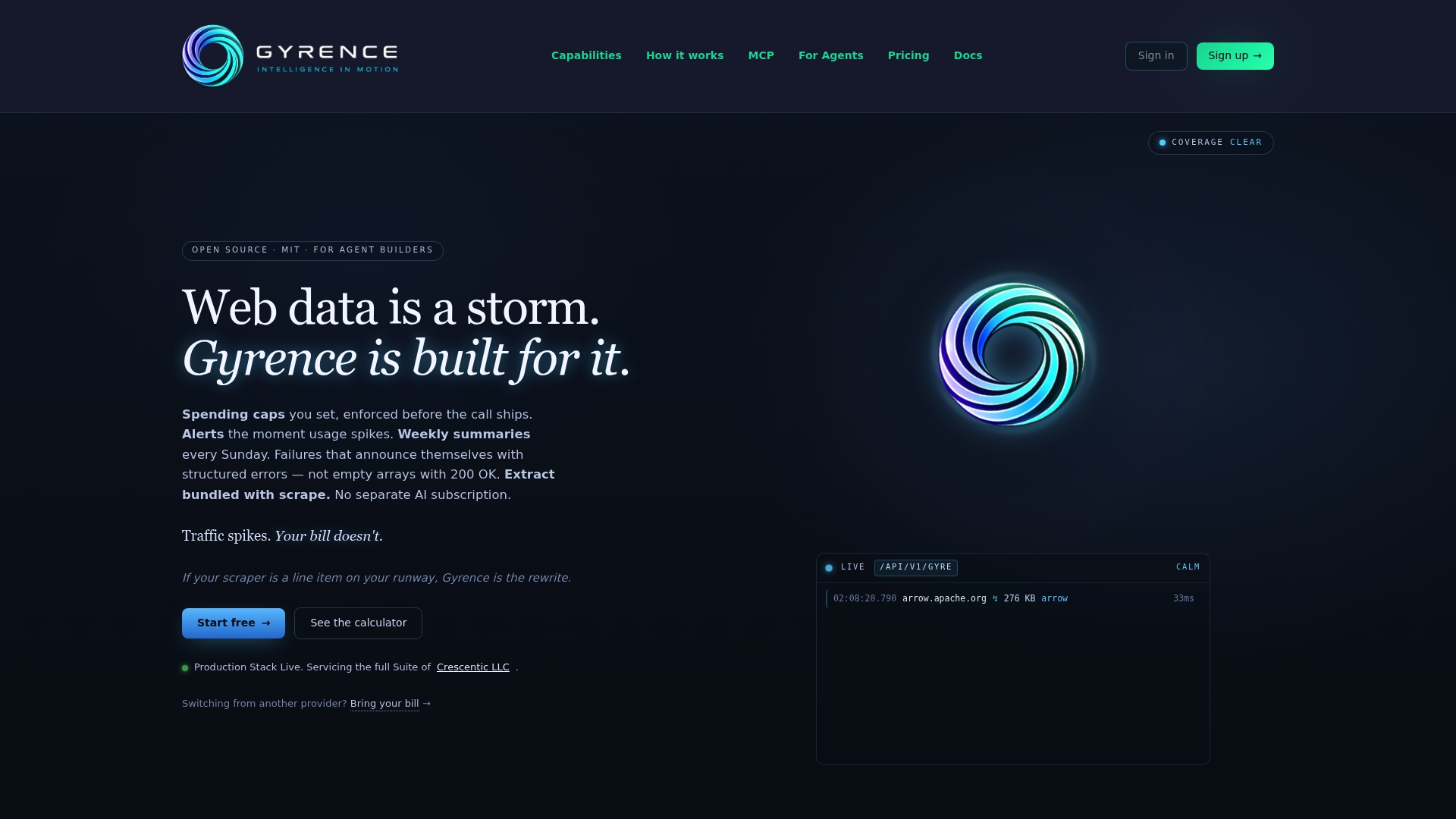
At a Glance
Five composable primitives power the API: Search, Fetch, and Extract anchor the workflow. Gyrence is self-hosted friendly and includes a built-in MCP server for agent integration. The platform emphasizes transparent usage accounting, so teams can control spending and inspect failure modes.
Core Features
Gyrence exposes five primitives that map to common retrieval tasks and agent actions. The product ships a hosted MCP server and supports REST calls, allowing direct agent connections or standard HTTP integration. The stack runs a self-hosted browser fleet for JavaScript pages, extracts structured data from HTML, iXBRL, MediaWiki, PDFs, and Office docs, and provides WebDoppler webhook alerts for content change monitoring.
Key Differentiator
Gyrence returns typed, discriminated responses that include explicit failure modes instead of opaque errors. That design, paired with a curative, governed source catalog and format-aware extraction, makes it easier for agents and data teams to reason about trust and provenance. The model focuses on predictable costs and accountable pipelines for long-running agent workloads.
Pros
The architecture is open source friendly and exposes clear primitives so teams can compose functionality without guessing internal behavior. Flexible integration comes via both MCP and standard REST, which fits agent frameworks and traditional pipelines. Format-aware extraction covers a broad set of content types, and the self-hosted browser fleet helps with JavaScript-rendered pages. Usage and credit tracking give teams visibility into spending, reducing surprise bills when running large crawls or frequent monitoring. WebDoppler's webhook alerts pair change detection with optional AI extraction for targeted updates.
Cons
- Does not bypass advanced enterprise bot protections such as Akamai Bot Manager. This means highly protected enterprise portals may require partner arrangements or separate access strategies.
Who It's For
Developers building web crawling and data extraction pipelines for AI and automation will get the most value. Teams needing agent-ready, typed outputs and explicit failure modes can integrate Gyrence into RAG ingestion flows and autonomous agent stacks. Data teams that need predictable billing and governance will appreciate the usage controls and source catalog.
Unique Value Proposition
Every API call returns a typed response that includes the failure case, so downstream agents can programmatically decide next steps. That predictable failure signaling, combined with credit-based spending controls, reduces surprise bills and simplifies error handling in autonomous workflows. The MCP endpoint lets agents connect without bespoke SDKs while REST keeps integration lightweight.
Real World Use Case
A financial news platform runs scheduled gyres from seed sites, fetches pages, and extracts headlines and facts into typed JSON. WebDoppler triggers webhooks on changes and the platform runs selective re-extraction with LLM-assisted schemas. Predictable credit usage keeps analytics costs stable as traffic and extraction volume vary.
Pricing
Gyrence uses flat, credit-based pricing across multiple tiers. Plans include Free, Founders (verification only), Pay-As-You-Go, Standard, Growth, and Scale. Pricing ranges from $0 up to $549/month depending on tier and usage needs.
Website: https://gyrence.com
Firecrawl
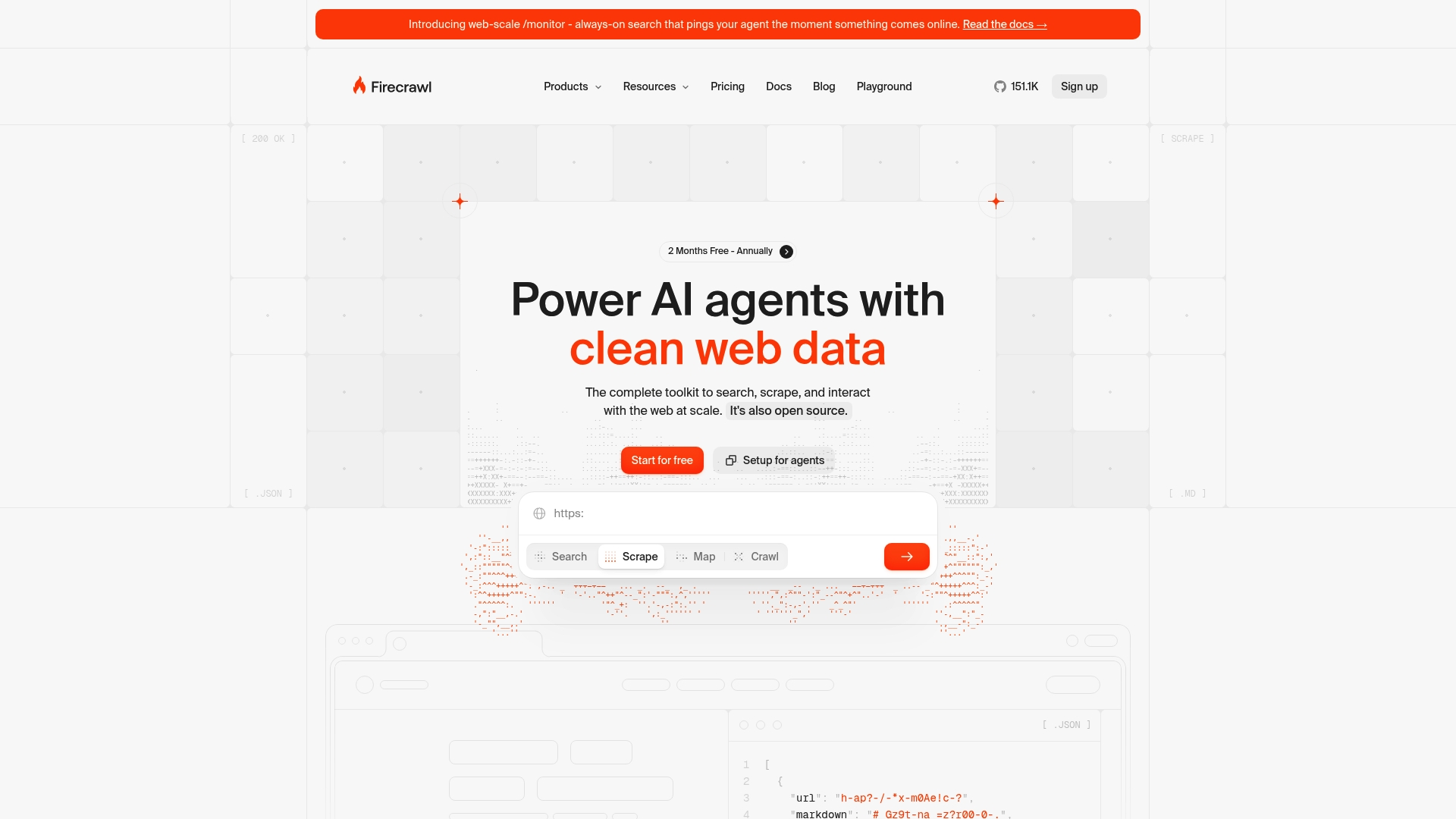
At a Glance
Optimizes token usage while rendering JavaScript heavy websites at scale. Firecrawl pairs open source code and SDKs so teams can inspect and extend crawlers. That mix suits AI systems that need clean, structured web content for live queries.
Core Features
search, scrape, and interact features convert raw pages into markdown, JSON, screenshots, and typed output for direct model consumption. The tool renders JavaScript and supports programmatic clicking, navigation, and autonomous agents that gather data from multi page flows. SDKs for several languages let teams connect retrieval and extraction into AI pipelines.
Key Differentiator
Open source infrastructure is the primary differentiator. The visible crawling logic lets teams adjust renderers and extraction to handle complex site behaviors. The codebase and SDKs emphasize AI integration and token conscious extraction for heavy JavaScript sites.
Pros
Converts dynamic, script heavy pages into structured outputs that reduce cleanup work for downstream models. Supports large scale crawling with attention to token efficiency, which lowers token overhead during wide crawls and many small fetches. Being open source brings transparency, community contributed fixes, and the ability to fork or patch renderers for niche site behaviors. Integrates with AI agents for live interaction, enabling workflows that click, fill forms, and extract updated content on demand.
Cons
- Limited third party reviews compared with larger commercial vendors, which makes independent reliability signals sparse.
- Potential long term cost scalability concerns for heavy continuous crawling, especially when running many render sessions.
- Relies on API infrastructure that can experience outages or latency during peak loads.
When It May Not Fit
If audited vendor reviews and a turnkey enterprise SLA are must have items, Firecrawl may not fit. Teams needing minimal setup will find integration and tuning take longer for complex workflows. If published uptime guarantees are mandatory, a fully managed vendor with explicit SLAs may be preferable.
Who It's For
AI developers and data scientists building web enabled intelligence and automation tools will get the most value. Teams that require JavaScript rendering, agent interaction, and token conscious extraction align with its capabilities. Engineering groups that want to inspect or modify crawling behavior will benefit particularly from the open source model.
Real World Use Case
A company scrapes product details and reviews from thousands of ecommerce listings to feed a recommendation engine. Firecrawl renders pages, clicks through pagination, extracts reviews as structured JSON, and trims irrelevant text for LLM ingestion. The company refreshes the dataset regularly using automated agents to keep recommendations current.
Pricing
Pricing is not applicable for Firecrawl because the project is presented as informational and open source. Teams should plan for hosting, rendering resource costs, and operational expenses when deploying at scale. Commercial or hosted options are not detailed on the project site.
Website: https://firecrawl.dev
Apify
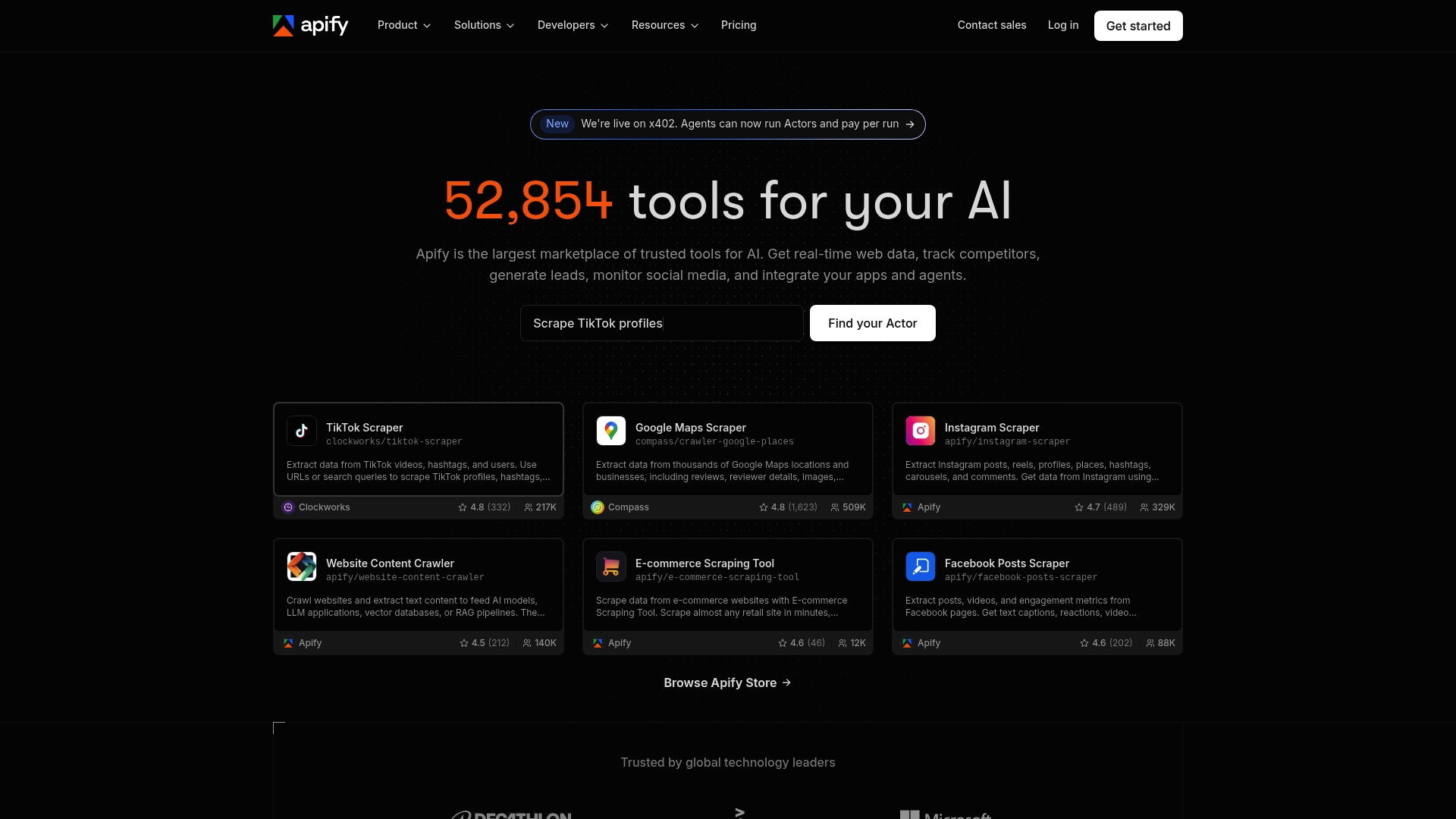
At a Glance
Apify's marketing materials describe it as the largest marketplace of trusted web scraping and automation tools. It offers a wide catalog of ready to run Actors for common scraping and automation tasks. The platform pairs those Actors with a serverless runtime and scaling controls for production workloads.
Core Features
Apify bundles a library of prebuilt Actors with a serverless platform for running and scheduling web tasks. The project includes an open source crawling library called Crawlee, developer SDKs, and monitoring so you can run crawls at scale. Integrations and webhooks let results flow into spreadsheets, messaging, CI, or downstream pipelines.
Key Differentiator
That marketplace claim highlights Apify's focus on reusable automation components. Teams can assemble workflows from published Actors instead of writing every spider from scratch. For organizations that require audited deployments, Apify pairs those components with enterprise security and compliance controls.
Pros
A large catalog of ready to run Actors reduces development time for common scrapes and automations. The serverless runtime scales automatically and handles retries and monitoring for long runs. Crawlee gives developers a familiar open source toolkit to customize crawlers and maintain code in repositories. Native integrations with webhooks, Slack, Google Sheets, and Zapier make it easy to push results into existing pipelines.
Cons
-
Steep learning curve for advanced features and actor orchestration, which raises onboarding time for junior engineers.
-
Pricing based on credits and usage can be unpredictable for high volume crawls. This may complicate monthly budgeting.
-
Customer support response times are sometimes slow, which affects time sensitive incidents.
-
Limited control over crawl depth in certain Actors and some debugging steps require digging into logs.
When It May Not Fit
If you need predictable per page pricing for massive crawl volumes, Apify's credit model may not be ideal. Teams without scraping expertise will spend time learning actor conventions and the platform runtime. Organizations requiring fine grained crawl control or an embedded SDK in a private cloud might find the marketplace model constraining.
Notable Integrations
Apify connects to APIs and webhooks and lists direct integrations with Slack, Google Sheets, GitHub, and Zapier. The platform also supports MCP connectors and common cloud services for storage and orchestration. These connectors help move extracted JSON into BI, ETL, or alerting systems.
Who It's For
Developers and data teams that prefer building from reusable components and need a managed runtime for production crawls. Enterprises that require security controls and vendor support for large scale scraping will find the platform aligned with their needs. Teams focused on rapid prototyping of crawlers will benefit from the Actor marketplace.
Real World Use Case
A large e commerce company runs Apify Actors to monitor competitor prices hourly across multiple markets. The Actors fetch product pages, normalize prices, and post updates to an internal pricing service. That pipeline lets the company apply automated pricing rules based on near real time signals.
Pricing
Apify offers a free tier for testing and prototyping. Paid plans start at $29/month for a Starter plan. There is a Scale tier at $199/month and custom enterprise options for high volume or compliance needs.
Website: https://apify.com
Comparison of alternatives
When comparing web data extraction platforms, each alternative presents a unique combination of advantages tailored to distinct use cases.
Scalability and platform extensibility
Gyrence's support for multiple output types paired with curated source catalog management places authority over content quality in developers' hands. Conversely, Firecrawl offers the additional flexibility of being an open-source platform. This allows teams to adapt the framework for distinct workflows, particularly for unique or unsupported web environments. However, Gyrence ensures implementation robustness while Firecrawl emphasizes freedom of configuration. Apify offers pre-built Actors enabling rapid project initiation, which proves advantageous for time-constrained projects or users with limited technical resources for development.
Integration simplicity and system governance
The direct accessibility of Gyrence's MCP protocol eases embedding the platform into agent-centered architectures without relying on specific SDKs, a feature not highlighted for its alternatives. Firecrawl pursues integration by offering modular open-source accessibility, encouraging custom extensions to functional capabilities. Meanwhile, Apify uses a standardized API to run and orchestrate features across a serverless environment, streamlining deployment operations. Each platform prioritizes integration differently, leading to varying complexity during initial deployment.
Best fit
- Teams requiring alerts on content changes should explore Gyrence for its WebDoppler feature.
- Organizations emphasizing extensible, open-source solutions can grow efficiently with Firecrawl.
- Teams desiring a library of ready-to-deploy actors for rapid prototyping will benefit from Apify.
- Developers seeking proprietary data governance and transparency in operational costs gain immediate value from Gyrence’s structured usage accounting.
Our pick
For those prioritizing transparent failure signaling alongside governance over extraction pipeline accountability, Gyrence represents the most balanced choice. However, teams valuing open-source accessibility or preconfigured workflows may prefer Firecrawl or Apify, respectively.
The following table provides a concise comparison of three alternatives for advanced web data extraction APIs based on their features and characteristics.
| Product | Key Use Case | Differentiator | Pricing | Limitation |
|---|---|---|---|---|
| Gyrence | Self-hosted, developer oriented | Typed, discriminated responses with governed source catalog | $0–$549/month | Does not bypass advanced enterprise bot protections |
| Firecrawl | Open source crawling with JavaScript rendering | Open source infrastructure for inspection and fine-tuning | Price not published | Limited third-party reviews and no enterprise SLA |
| Apify | Prebuilt Actor integration for scraping and automations | Marketplace for reusable automation components | From $0–$199/month | Steep learning curve for advanced Actor orchestration |
What Challenges Do OpenWebNinja.com Alternatives Need to Solve?
Many developers and data teams confront unpredictable pricing, unclear failure modes, and limited control when selecting a web scraping API. Gyrence addresses these issues with five composable primitives for web data tasks, delivering typed, precise structured outputs that simplify error handling in autonomous AI agent workflows. Its hosted MCP endpoint and spending caps eliminate billing surprises common with other providers.
Gyrence turns complex web data into reliable, LLM-friendly JSON or markdown by supporting web search, site crawling, fetching, and extraction through a single API. This combination suits developers building AI agent web data pipelines who demand transparency and governance.
See how Gyrence meets your needs and evaluate its features in detailed documentation. Your next step is controlled spending and explicit failure signals in your web data ingestion with Gyrence.
FAQ
What features make Gyrence suitable for data extraction tasks?
Gyrence excels in providing typed, discriminated responses that include explicit failure modes. This capability ensures clearer communication in data extraction processes, allowing teams to make informed decisions when handling errors. Users should consider integrating Gyrence for reliable web data extraction projects.
How does Gyrence compare to Firecrawl in terms of JavaScript rendering?
Firecrawl shines with its open source infrastructure, which allows teams to adjust crawling logic to handle complex site behaviors. Gyrence, on the other hand, focuses on predictable costs and offers typed outputs, making it a better choice for users who prioritize clear, accountable usage in web data extraction.
What pricing options does Gyrence provide?
Gyrence offers a tiered, credit-based pricing model that ranges from $0 to $549 per month, depending on the chosen plan and usage requirements. This model helps users predict and control their data extraction costs effectively, accommodating various project scales.
Can Gyrence help with monitoring content changes on web pages?
Yes, Gyrence includes WebDoppler webhook alerts that enable teams to monitor content changes seamlessly. This feature is useful for users who need real-time updates and precise data extraction aligned with evolving web content.
What is unique about Gyrence's approach to error reporting?
Gyrence provides explicit failure modes instead of opaque errors, allowing teams to handle failures programmatically. This feature enhances the reliability of data extraction workflows, making it easier for teams to manage and troubleshoot issues.