
TL;DR:
- Programmatic web research automates the entire research process, from query decomposition to report synthesis. It uses modular pipelines, schema validation, and source caching to ensure reliable, scalable, and traceable results. Proper separation of search, fetch, and extraction phases improves maintainability and data quality in automated workflows.
Programmatic web research is defined as an automated, modular pipeline that decomposes complex queries into sub-questions, searches multiple web sources via APIs, fetches and cleans page content, extracts structured data with LLM-based schema validation, and synthesizes a verified report. The industry term for the extraction layer is "programmatic extraction," and it forms the backbone of this methodology. Unlike manual research or simple scraping scripts, this approach treats every stage as a typed, composable unit. Tools like Claude and GPT-4o handle constrained schema extraction, while search APIs handle discovery. The result is a repeatable, auditable process that scales from a single developer to a full data team.
What is programmatic web research, and how does it work?
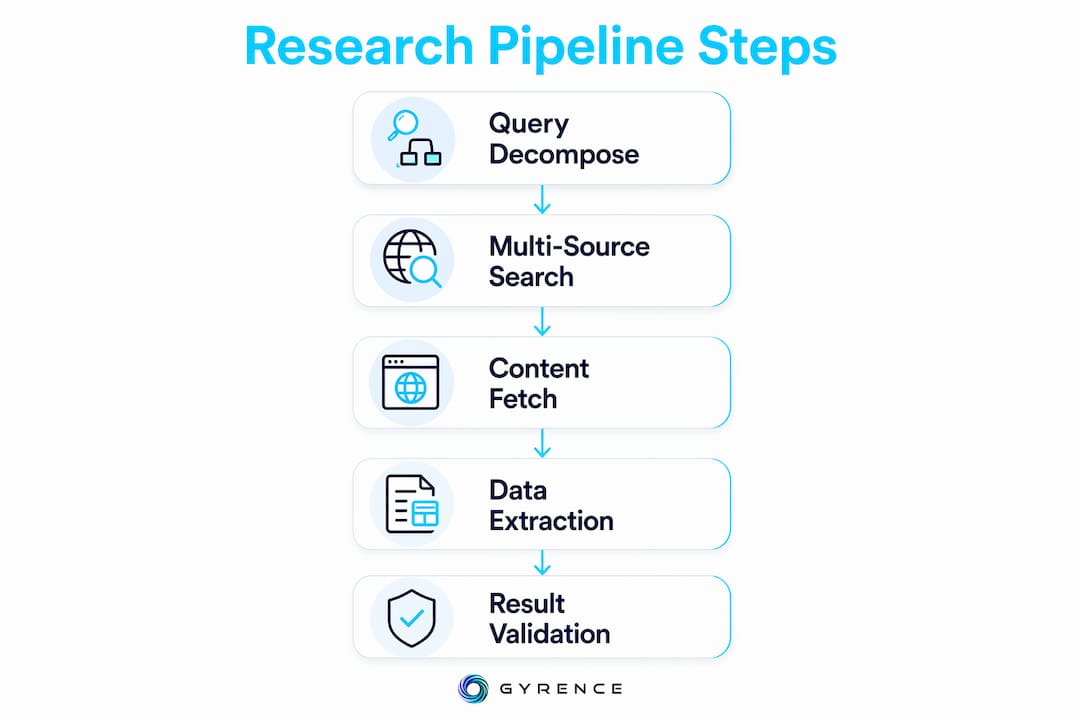
Programmatic web research is the systematic automation of the full research cycle: query decomposition, multi-source discovery, content retrieval, structured extraction, and synthesis. Each stage is a discrete module with defined inputs and outputs. That modularity is what separates it from ad hoc scraping.
The workflow starts with query decomposition. A single research question breaks into 2–5 sub-questions, each targeting a different angle of the topic. This prevents surface-level summaries and forces the pipeline to gather evidence from multiple perspectives. Each sub-question maps to a distinct search query.
Discovery comes next. Search APIs like Brave Search API or SerpApi return ranked URLs for each sub-question. The pipeline records every source URL at this stage. That source recording is what enables contradiction detection and traceability later in synthesis.
Fetching follows discovery. The pipeline retrieves page content using an escalation strategy: plain HTTP requests first, then structured data harvesting from JSON-LD, then headless browser rendering only when the page requires runtime JavaScript evaluation. This escalation ladder keeps cost and latency low for the majority of pages.
Extraction converts raw HTML or markdown into structured JSON. LLMs like Claude apply a schema contract to the cleaned content and return typed fields or a validation error. Synthesis then aggregates claims across sources, flags contradictions, and generates the final report.
Pro Tip: Separate your fetching layer from your extraction layer in code. A single function that fetches and extracts is hard to test, hard to swap, and impossible to cache. Keep them as distinct modules with typed interfaces.
What practical tools and technologies enable programmatic web research?
The tool stack for programmatic web research divides cleanly into four categories: search, fetch, extract, and orchestrate.

For search, Brave Search API and SerpApi both return structured SERP results with source URLs. They are the correct tools for the discovery phase. Do not use an LLM to generate URLs from memory. That path leads to hallucinated sources and unverifiable claims.
For fetching, the right choice depends on the target page. Static pages need only an HTTP client. Pages with JSON-LD embedded in the HTML yield structured data without any rendering. JavaScript-heavy pages require Playwright or Puppeteer. Libraries like Silkweb take this further: they cache LLM-synthesized selectors keyed by DOM structure, so the LLM runs once per page template and subsequent requests cost nothing.
| Extraction method | Advantages | Limitations | Best for |
|---|---|---|---|
| Direct API call | Typed, reliable, low latency | Requires API access | First-party or partner data |
| Browser scraping | Handles dynamic JS content | High cost, fragile selectors | JS-rendered pages only |
| LLM extraction | Schema-aware, fail-loud | Higher per-call cost | Unstructured or variable HTML |
For extraction, Claude and GPT-4o both support schema-constrained output. The key is to pass a JSON Schema or Pydantic model alongside the content. The LLM either returns a valid object or raises a validation error. That fail-loud behavior is what makes LLM extraction more reliable than CSS selectors in production.
For orchestration, workflow engines like LangGraph and Mastra manage task concurrency, retry logic, and state across pipeline stages. They let you run multiple sub-question branches in parallel, which is how modular pipelines achieve a cost per report in the $0.20–$0.40 range.
Pro Tip: Cache aggressively at the fetch layer. Store cleaned markdown by URL and content hash. Re-extraction from cache costs nothing. Re-fetching from the web costs time, money, and rate-limit budget.
How do you ensure data quality in a programmatic research pipeline?
Data quality in programmatic pipelines fails in one specific way: silently. A CSS selector breaks after a site redesign, the pipeline keeps running, and corrupted records accumulate in your dataset before anyone notices. Schema validation is the fix.
Schema validation using Pydantic, Zod, or JSON Schema turns your data contract into an enforced gate. Every extracted record either matches the schema or triggers an immediate error. That error can route to a re-extraction attempt, a fallback model, or a human review queue. None of those outcomes are silent.
The following practices define a reliable pipeline:
- Validate at extraction time. Never write unvalidated records to your store. A schema mismatch caught at extraction is cheap. One caught downstream in a model training run is expensive.
- Separate discovery from retrieval. Keeping search and fetch as distinct phases preserves source URLs and lets you swap search providers without touching the fetch layer.
- Log every source URL with a timestamp. Contradiction detection and provenance tracking both require knowing exactly where and when each claim came from.
- Set re-extraction triggers. When a schema validation fails three consecutive times on the same URL, flag it for human review rather than retrying indefinitely.
- Remove boilerplate before extraction. Navigation menus, cookie banners, and footer links inflate token counts and confuse LLM extractors. Clean to markdown first.
Pro Tip: Build your schema contracts before you write a single line of fetching code. The schema defines what you need. Everything else is just plumbing to get it.
What are the key use cases for programmatic web research?
Programmatic extraction enables automated AI training data pipelines by converting raw web content into clean, validated datasets. That is the highest-leverage application for most data teams, but it is far from the only one.
Research pipelines support scheduled refresh cadences ranging from 30 minutes to weekly. Parallel task execution means a fresh structured dataset can be ready in 2–5 minutes. That speed makes programmatic research viable for time-sensitive applications like price monitoring and news aggregation, not just batch jobs.
Common project types that benefit directly from this methodology:
- AI training dataset generation. Automated collection, cleaning, and validation of domain-specific web content at scale.
- Competitive intelligence. Scheduled monitoring of product pages, pricing, and feature announcements with structured output for dashboards.
- Market analysis. Multi-source aggregation of industry data with contradiction detection and source provenance.
- Lead generation. Structured extraction of contact and firmographic data from directories and public profiles.
- RAG pipeline ingestion. Converting web sources to structured web data for RAG with clean markdown and metadata for retrieval-augmented generation systems.
Export formats typically include CSV and Parquet for downstream models, plus JSON for API consumers. Incremental update support means pipelines can append new records rather than re-processing entire datasets on each run.
Key Takeaways
Programmatic web research requires modular pipeline design, schema-enforced extraction, and strict separation of discovery and retrieval phases to produce reliable, auditable structured data at scale.
| Point | Details |
|---|---|
| Decompose queries first | Break every research question into 2–5 sub-questions before any search or fetch begins. |
| Use an escalation ladder for fetching | Start with HTTP, add JSON-LD harvesting, and reserve headless browsers for JS-only pages. |
| Enforce schema validation | Use Pydantic, Zod, or JSON Schema as a hard gate; never write unvalidated records to storage. |
| Separate discovery from retrieval | Keep search APIs and fetch clients as distinct modules to preserve traceability and enable model swaps. |
| Cache at the fetch layer | Store cleaned markdown by URL hash to eliminate redundant LLM calls on unchanged content. |
Why modular design is the only design worth building
The biggest mistake I see developers make is building a monolithic research script: one function that searches, fetches, extracts, and writes to a database. It works on the first run. By the third site redesign or second model upgrade, it is unmaintainable.
Modular design is not an architectural preference. It is a production requirement. When your extraction schema changes, you should be able to swap the extraction module without touching the fetch layer. When Brave Search API changes a response field, that fix should live in one place. The web research pipeline best practices that hold up in production all share this property: each stage is independently testable and replaceable.
The other pattern I advocate for without reservation is fail-loud extraction. Silent failures are the most expensive bugs in data pipelines because they compound. A schema mismatch that writes null values to your training dataset does not throw an error. It degrades your model quietly over weeks. Fail-loud systems surface the problem at the moment it occurs. That is the only acceptable behavior in a production pipeline.
The future of this space is self-healing pipelines: systems that detect schema drift, trigger re-extraction with updated prompts, and log every intervention for audit. That future is closer than most teams realize, and the teams building toward it now are the ones who will not be scrambling to fix corrupted datasets later.
— Glen
Gyrence and programmatic web research pipelines
Gyrence connects directly to the programmatic research workflow through its hosted MCP endpoint, which integrates with Claude, Cursor, and agent frameworks like LangGraph and Mastra. Its five composable primitives, Search, Traverse, Fetch, Extract, and Map, map cleanly onto the pipeline stages covered in this article. Every call returns a typed, discriminated-union response that includes failure cases, so your agent knows exactly what happened at each stage. Spending caps prevent runaway costs during parallel execution. Structured failure modes replace silent errors with typed signals your pipeline can act on.
Developers building AI agent web data pipelines can connect Gyrence via MCP in minutes and start issuing structured research tasks directly from Claude or any compatible agent framework.
FAQ
What is programmatic web research?
Programmatic web research is an automated pipeline that decomposes queries, searches multiple sources via APIs, fetches and cleans content, extracts structured data using LLM-based schema validation, and synthesizes a verified report. It is the automated equivalent of a manual research workflow, built for repeatability and scale.
How does query decomposition improve research quality?
Breaking a research question into 2–5 sub-questions forces the pipeline to gather evidence from multiple angles, which prevents shallow summaries and enables contradiction detection during synthesis.
Why use schema validation in extraction pipelines?
Schema validation using tools like Pydantic or Zod catches malformed records at extraction time, before they corrupt downstream datasets or AI training runs. It converts silent failures into typed errors that trigger automated retries or human review.
When should a pipeline use headless browser rendering?
Reserve headless browser rendering for pages that require runtime JavaScript evaluation. For static pages and pages with embedded JSON-LD, plain HTTP requests and structured data harvesting are faster and cheaper.
What is the difference between web searching and web fetching?
Web searching is the discovery phase: a search API returns ranked URLs for a query. Web fetching is the retrieval phase: a compliant HTTP client or browser retrieves the actual page content. Keeping these phases separate preserves source traceability and lets you swap tools in either layer independently.