
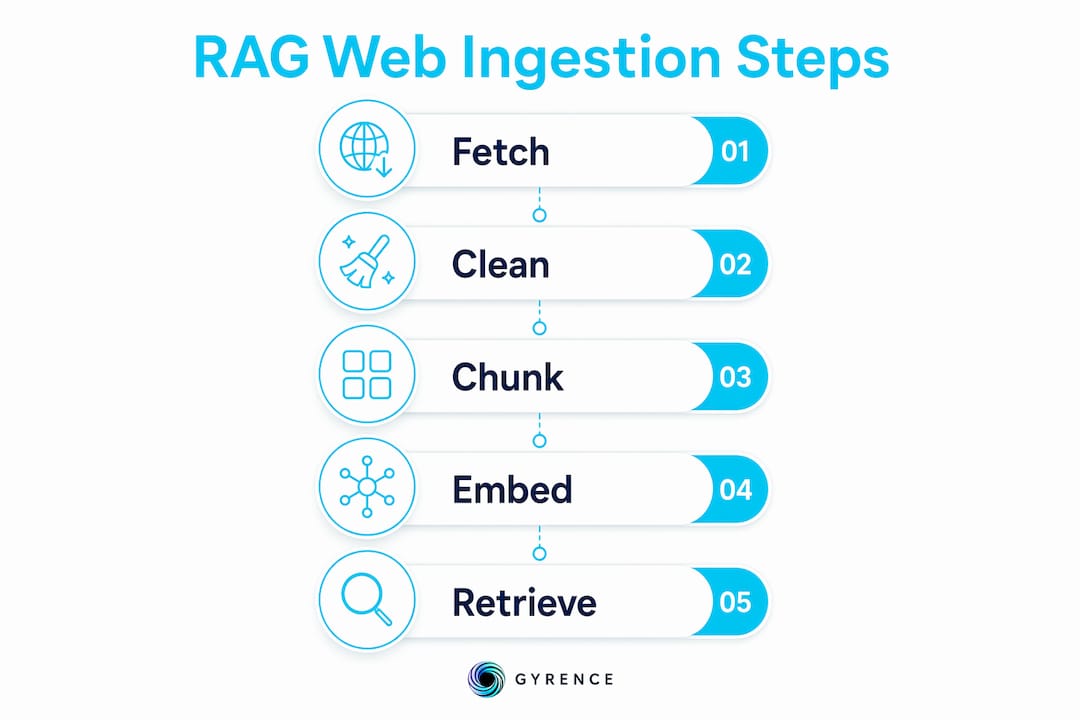
RAG web ingestion is the process of programmatically discovering, fetching, normalizing, chunking, embedding, and indexing live web content so an LLM can cite fresh public sources instead of hallucinating from stale training data. Use live web ingestion when your answers depend on recency or public provenance. Stick with a static corpus when your data is internal, controlled, and doesn't change.
The pipeline primitives every implementation touches:
- Search / Discovery — query rewrite + SERP or sitemap traversal
- Fetch — polite HTTP or headless render with
robots.txtcompliance - Extract — DOM-level cleaning to markdown, stripping boilerplate
- Chunk — structure-aware splits with metadata attached
- Embed — batch vectorization with content hash gating
- Retrieve — hybrid lexical + vector search, reranked to top 3–5
Gyrence covers all six as composable API primitives (Search, Traverse, Fetch, Extract, Map) with a hosted MCP endpoint and per-job spending caps.
Table of Contents
- What does "web ingestion for RAG" actually mean?
- What are the end-to-end pipeline steps?
- What failure modes silently wreck retrieval quality?
- What should you implement first to ship a safe web-RAG feed?
- How do you keep costs predictable at scale?
- What does the API flow look like in practice?
- How do you measure whether the pipeline is healthy?
- What are the U.S. legal and compliance requirements?
- Key Takeaways
- The part most teams get wrong
- Gyrence covers the full pipeline with predictable costs
- Useful sources
- FAQ
What does "web ingestion for RAG" actually mean?
Web RAG is a live-web variant of retrieval-augmented generation: at query time, the pipeline searches the open web, fetches and normalizes pages, and selects passages to ground the LLM's answer with citations. The core goals are recency (answers reflect today's web), provenance (every claim traces to a URL), auditability (fetch timestamps and canonical URLs travel with every chunk), and reduced hallucination through source grounding.
Three modes exist and they are not interchangeable:
- Pre-indexed RAG — a static corpus built offline; fast retrieval, stale content
- Web RAG — live fetch per query; fresh, but higher latency and cost
- Browsing agents — interactive, multi-step navigation; highest fidelity, highest cost
Pro Tip: Treat the web as a delivery format (DOM + JavaScript), not a document store. Preserve url, fetch_timestamp, canonical, content_hash, and language alongside every text chunk from the first fetch. Retrofitting metadata later is expensive and often incomplete.
What are the end-to-end pipeline steps?
A disciplined web RAG pipeline treats retrieval like a research loop: search for candidates, fetch and normalize, embed and rerank, then generate with strict citation checking. Here are the required stages:
- Query analysis — rewrite the user query into search-friendly terms; detect language and intent
- Search / discovery — call a search API for agents or parse sitemaps/RSS feeds
- Polite fetch — respect
robots.txt, crawl-delay, andUser-Agentheaders - Render decision — HTTP first; escalate to headless only on JS-detection or low density score
- DOM extraction — strip navigation, ads, cookie banners; output clean markdown
- Normalize — converting HTML to LLM-friendly markdown reduces token overhead and preserves structural boundaries
- Semantic chunking — split on headings; preserve tables and code blocks as atomic units
- Embed + metadata store — batch vectors with
url,canonical,fetch_timestamp,content_hash - Hybrid retrieval — lexical + vector fusion (K≈20), then cross-encoder rerank to top 3–5
- Grounded generation — prompt with cited passages; run post-hoc quote checks
Required metadata per chunk: url, title, canonical, publish_date, fetch_timestamp, content_hash, language, content_type. Without these, filtering by recency or region is impossible and citation accuracy collapses.
| Stage | Typical primitive / behavior | Cost / latency tradeoff |
|---|---|---|
| Search | SERP API or sitemap parse | Low cost; limited to indexed pages |
| HTTP fetch | Static GET + readability parse | Fast, cheap; fails on JS-heavy pages |
| Headless render | Playwright / Puppeteer | 5–10× slower and costlier than HTTP |
| LLM extraction | Prompt-based JSON extraction | Highest cost; use as last resort |
| Embedding | Batch API call | Cost scales with token count |

Pro Tip: Implement a tiered extraction cascade: static fetch → density gate → JS render gate → LLM fallback. Each gate only fires when the previous stage returns insufficient content, keeping the median cost at the HTTP tier.
What failure modes silently wreck retrieval quality?
Web pages are engineered for browser rendering, not semantic retrieval. Treating a raw HTML response as a document introduces representation pollution that degrades accuracy in ways that don't surface until users complain. The most damaging failure modes:
- DOM boilerplate pollution — navigation, footers, and cookie banners can exceed 80% of an HTML response's token count, poisoning the embedding space
- JS-shell fetches — HTTP returns a near-empty
<div id="app">with no content; embeddings encode noise - Pagination duplicates —
/page/1through/page/Nproduce near-identical chunks that collapse retrieval diversity - Incorrect canonical handling —
?utm_source=variants andwwwvs. non-wwwURLs index the same content multiple times - Missing metadata — chunks without
fetch_timestamporcanonicalcannot be filtered for freshness - Stale content served as current — cached pages returned without a freshness check mislead the LLM
- Mid-table chunking — splitting a table row across chunk boundaries makes both chunks unreadable
- PII leakage — user-generated content on public pages may contain emails, SSNs, or health data
Pro Tip: Run MinHash or locality-sensitive hashing (LSH) on chunk text before generating any embeddings. Near-duplicate detection at this stage is cheaper and more effective than trying to deduplicate in vector space after the fact. Track duplicate-chunk ratio as a standing SLI.
What should you implement first to ship a safe web-RAG feed?
Crawling and ingestion are distinct operations — conflating them is how teams end up with a corpus full of silent failures. A minimum viable pipeline, in order:
- Seed discovery via sitemaps, RSS, or a search API
- Polite fetch with
robots.txtcompliance and crawl-delay - Readability-style main-content extraction → markdown normalization
- Structure-aware chunking (split on headings; preserve tables and code blocks)
- Embed with full metadata; store in a vector DB with hybrid retrieval baseline
| Task | Timeline | Impact |
|---|---|---|
| Fetch + readability extraction | Day 1 | Removes boilerplate; unblocks chunking |
| Canonical URL normalization | Day 1–2 | Eliminates duplicate indexing |
| MinHash pre-embed dedupe | Day 2–3 | Prevents embedding-space collapse |
| TTL-based refresh scheduling | Week 1 | Controls freshness and re-embed cost |
| Embedding centroid drift monitor | Week 2–4 | Detects silent corpus degradation |
Pro Tip: Assign TTLs by domain volatility: news sources at 6–24 hours, documentation sites at 7–30 days. Gate re-embedding on content hash changes so unchanged pages never burn embedding API budget.
How do you keep costs predictable at scale?
The tiered cascade pattern — static extract → density scoring → render-on-demand — produces predictable spending because the expensive headless tier only fires when the cheap tier fails. Pair it with these controls:
- Extraction hash gating — skip re-embed when
content_hashmatches the stored value - Per-domain TTLs — schedule refreshes by volatility, not by a flat cron
- Concurrency limits — cap parallel requests per domain to avoid 429s and bans
- Exponential backoff on 429s — treat rate-limit responses as a signal, not an error
- Batch embedding windows — accumulate chunks and call the embedding API in batches to reduce per-call overhead
- Circuit breakers per stage — if headless render costs exceed a budget threshold, halt and alert
Expose a per-job spending cap and structured failure modes so cost behavior is debuggable, not opaque. When a stage fails, the response should tell you why (403, 429, JS-required, empty-body) so the agent can route around it rather than silently retrying.
Pro Tip: A hosted MCP endpoint with explicit spend caps turns cost management from a runtime surprise into a configuration parameter. Set the cap, run the job, inspect the typed failure responses. Your bill doesn't guess.
What does the API flow look like in practice?
The goal: a pipeline that returns agent-ready, cited chunks with full provenance metadata at every handoff.
# 1. Search / discovery
results = search_api(query=rewritten_query, max_results=10)
# returns: [{url, title, snippet, canonical}]

# 2. Fetch + render decision
for result in results:
    page = fetch(url=result.canonical, mode="http")
    if page.status == "js_required" or page.density_score < 0.15:
        page = fetch(url=result.canonical, mode="headless")
    if page.status in ["403", "429", "empty"]:
        log_failure(result.url, page.status)
        continue  # typed failure — skip, don't crash

# 3. Normalize to markdown
md = to_markdown(page.html)  # preserves headings, tables, code blocks

# 4. Structure-aware chunking
chunks = chunk(md,
    max_tokens=400,
    overlap=0.15,          # ~10–20% overlap
    preserve=["table","code","list"])

# 5. Dedupe before embedding
chunks = minhash_dedupe(chunks, threshold=0.85)

# 6. Embed with metadata
vectors = embed_batch([c.text for c in chunks])
for chunk, vec in zip(chunks, vectors):
    store(vector=vec, metadata={
        "url": result.url,
        "canonical": result.canonical,
        "fetch_timestamp": page.fetched_at,
        "content_hash": chunk.hash,
        "title": result.title,
        "language": page.language
    })

# 7. Hybrid retrieve + rerank
candidates = hybrid_search(query_vec, query_text, k=20)
top_chunks  = cross_encoder_rerank(candidates, query=user_query, top_n=5)
Chunking heuristics: 200–400 tokens per chunk, 10–20% overlap, tables and code blocks treated as atomic units. Retry policy: exponential backoff starting at 1 second, max 3 retries, then log a typed failure and continue.
Pro Tip: Before calling the embedding API, normalize canonical URLs (https://, strip tracking params, resolve redirects) and check content_hash against your store. If the hash matches, skip the embed call entirely. This single gate can cut embedding costs by a large fraction on incremental crawls.
How do you measure whether the pipeline is healthy?
A production rollout must monitor corpus health, not just job success. Silent ingestion failures require corpus-level SLIs keyed to content metrics, not just HTTP status codes. Recommended SLIs:
- Duplicate-chunk ratio — target below 5%; spikes indicate canonical or pagination failures
- Density-gate failure rate — fraction of fetches below the content-density threshold; high rates signal JS-shell problems
- JS-shell detection rate — pages returning near-empty bodies after HTTP fetch
- Embedding centroid drift — weekly cosine distance between corpus centroid snapshots; drift signals topic shift or boilerplate infiltration
- Time-to-first-fetch — latency from query to first retrieved chunk; regression indicates crawl or render bottlenecks
- Citation verification pass rate — fraction of generated quotes that match the source chunk verbatim
- Top-k provenance coverage — fraction of retrieved chunks with complete metadata fields
Run synthetic golden queries weekly: a fixed set of questions with known expected source URLs. If the correct source drops out of the top 5, the alert fires before users notice. Quote-check success rate below 90% is a signal to audit chunking boundaries and markdown normalization.
What are the U.S. legal and compliance requirements?
This is a checklist for engineering teams, not legal advice. Confirm specifics with qualified counsel for high-risk sources.
robots.txtcompliance — parse and respectDisallowrules andCrawl-delaydirectives before every crawl run- Polite
User-Agent— identify your crawler honestly; spoofing a browser UA to bypass blocks creates legal exposure - Terms of service review — heavy reuse or redistribution of scraped content may violate site ToS; review before indexing at scale
- Copyright caution — storing and serving verbatim passages from copyrighted sources carries risk; consult counsel for any corpus that republishes substantial excerpts
- PII detection and redaction — user-generated content on public pages may contain names, emails, or health data; run a PII classifier before storing embeddings or serving chunks
Pro Tip: Flag and drop any chunk where a PII classifier returns a positive signal before it reaches the vector store. Storing PII in embeddings is harder to audit and remediate than storing it in plain text.
Key Takeaways
A production-grade RAG web ingestion pipeline requires DOM-level cleaning, canonical deduplication, metadata-rich chunking, and corpus-level SLIs to deliver fresh, citable answers without runaway costs.
| Point | Details |
|---|---|
| Clean before you chunk | Strip DOM boilerplate first; navigation and ads can exceed 80% of raw HTML token counts. |
| Metadata is non-negotiable | Store url, canonical, fetch_timestamp, and content_hash with every chunk for provenance and freshness filtering. |
| Dedupe before embedding | Run MinHash/LSH on chunk text before vectorizing to prevent embedding-space collapse. |
| TTLs and hash gating control cost | Assign refresh TTLs by domain volatility and skip re-embedding when the content hash is unchanged. |
| Gyrence as pipeline primitives | Gyrence's Search, Fetch, Extract, Traverse, and Map cover every stage with typed failure modes and per-job spending caps. |
The part most teams get wrong
The most common mistake isn't a bad algorithm. It's skipping the cleaning step and feeding raw HTML directly into a chunker. Navigation menus, cookie consent text, and footer links end up as chunks. The embedding model dutifully vectorizes them. Then retrieval returns "Accept all cookies" as a top-5 result for a technical query. This happens in production, repeatedly, at teams that should know better.
The second mistake is treating ingestion as a one-time ETL job. Web content changes. Canonical URLs shift. Pages get deleted. A corpus without TTLs and hash-based reembed gating drifts silently until the LLM starts citing 404s. Monitoring corpus health — duplicate ratio, centroid drift, provenance coverage — is the operational discipline that separates a demo from a production system.
The build-vs-buy question is real but often framed wrong. Teams ask "should we build our own scraper?" when the real question is "which stages are commodity and which are differentiated?" Fetch, render, and markdown normalization are commodity. Your chunking strategy, metadata schema, and retrieval architecture are where differentiation lives. Buying the primitive layer and owning the retrieval layer is usually the right split.
Gyrence covers the full pipeline with predictable costs
If you've read this far, you know the pipeline has seven distinct failure surfaces. Gyrence is built around that reality. Its five primitives map directly: Search for discovery, Fetch for polite HTTP and headless retrieval, Extract for structured JSON or markdown output, Traverse for outward site crawls, and Map for domain URL graphs. Every call returns a typed, discriminated-union response that includes the failure case — 403, 429, JS-required, empty-body — so your agent routes around problems instead of silently retrying into a budget hole.
The hosted MCP endpoint ships with per-job spending caps. Set the budget, run the job, inspect the typed responses. No surprise invoices. Gyrence also bundles LLM extraction, so the fallback tier in your cascade doesn't require a separate vendor contract. Start with the Gyrence API and have a working fetch-to-markdown pipeline running in under an hour.
Pro Tip: Evaluate any primitive provider with a 48-hour golden-query test: run a fixed set of queries, measure citation success rate and duplicate-chunk ratio. A provider that hides failure modes will look fine on day one and break on day three.
Useful sources
- Web RAG: How AI Agents Use the Web to Find Answers — core pipeline architecture and hybrid retrieval guidance
- Why Web Data is the Hardest Problem in RAG Systems — boilerplate/DOM extraction analysis and token-distribution evidence
- Building a RAG Data Feed: The Ingestion Problems Nobody Warns You About — operational post-mortem on silent ingestion failures and SLI design
- How to build production web-to-RAG pipelines — tiered extraction cascade, chunking heuristics, and TTL strategies
- Fetch Web Pages to Markdown for LLM: 2026 Developer Guide — normalization steps and markdown structure preservation
FAQ
What is RAG web ingestion?
RAG web ingestion is the process of fetching, cleaning, chunking, and embedding live web content so an LLM can retrieve and cite it at query time. It differs from static RAG in that the corpus is built from the open web and refreshed on a schedule.
How large should chunks be for web RAG?
Target 200–400 tokens per chunk with 10–20% overlap. Preserve tables, code blocks, and lists as atomic units rather than splitting them at token boundaries.
How do you handle JavaScript-heavy pages during ingestion?
Use a tiered cascade: attempt a static HTTP fetch first, score the response for content density, and escalate to headless rendering only when the density score falls below your threshold or a JS-shell is detected. This keeps the median fetch cost at the HTTP tier.
What metadata should every chunk carry?
At minimum: url, canonical, fetch_timestamp, content_hash, title, language, and content_type. Without canonical and content_hash, deduplication and freshness filtering are unreliable.
How does Gyrence fit into a web ingestion pipeline?
Gyrence provides five composable primitives — Search, Fetch, Extract, Traverse, and Map — that cover every stage from discovery to structured output. Its typed failure responses and per-job spending caps make cost behavior explicit and debuggable rather than a runtime surprise.