
A rate limit throttles how fast a client hits your API, usually measured in seconds or minutes, to stop bursts from crushing your infrastructure. A quota caps how much a client can consume over a long window, usually a day or a billing cycle, to enforce a contract or pricing tier. Pick a rate limit when you're protecting capacity right now. Pick a quota when you're protecting revenue over time. Most production APIs need both, layered together.
TL;DR:
- Rate limits are enforced at the gateway or edge to prevent immediate overload during short bursts, typically using tokens or sliding window counters.
- Quotas track an overall consumption over days or months, often tied to billing plans, and require global counters for accurate enforcement.
- Combining short-term rate limits with long-term quotas helps protect infrastructure while ensuring customers stay within their paid usage levels.
- Proper scoping of limits—per IP, API key, or endpoint—is crucial to avoid unnecessarily blocking legitimate traffic or allowing abuse.
- Keeping clients informed through headers and dashboards reduces support issues and allows proactive self-regulation before hitting caps.
Table of Contents
- Rate Limits vs Quotas: What Is a Rate Limit?
- Rate Limits vs Quotas: What Is a Quota?
- Quota vs Limit Comparison: The Differences That Matter
- Rate Limiting Strategies: Token Bucket, Leaky Bucket, and Sliding Windows
- How to Set Quotas: Scoping Rate Limits Without Punishing Real Users
- Operational Best Practices for Rate Limits and Quotas
- Implementation Pitfalls in Distributed Systems
- When to Use Rate Limits, Quotas, or Both
- A Practical Example: Predictable Spending Caps Instead of Opaque Quota Enforcement
- What Rate Limits and Quotas Get Wrong in Most Architecture Docs
- An Adjacent Approach: Predictable Per-Call Pricing Instead of Consumption Tiers
- Sources
- FAQ
Rate Limits vs Quotas: What Is a Rate Limit?
A rate limit is a short-window throttle: N requests per second, per minute, or per hour, enforced to keep your backend from falling over. It's a traffic-shaping tool, not a billing tool. When a client exceeds it, you reject or delay the request, then let them try again once the window resets.
Rate limits earn their keep in a few recurring scenarios:
- Protecting a database-backed endpoint from a client polling too aggressively
- Absorbing bursty frontend traffic during a product launch or a cron job gone wrong
- Capping token throughput on LLM-backed routes, where a single request can cost far more compute than a normal API call
The standard signal for a rejected request is an HTTP 429 Too Many Requests response, paired with a Retry-After header telling the client exactly when to come back. Azure's API Management docs walk through this pattern using token-bucket and sliding-window counters enforced at the gateway, which is where most teams should implement rate limits first: gateway, load balancer, or edge, before the request ever reaches application code.
Rate Limits vs Quotas: What Is a Quota?
A quota tracks cumulative consumption over a long window, typically a day, a month, or a full billing cycle. It answers a different question than a rate limit. A rate limit asks "how fast is this client going right now?" A quota asks "how much has this client used this month, and is that within what they paid for?"
Quotas do the heavy lifting in monetization. They map directly onto pricing tiers and partner contracts, which is why vendor guides consistently frame them as billing infrastructure, not traffic control. Common enforcement patterns include:
- Hard block: requests fail once the quota is exhausted, full stop
- Soft overage: requests keep succeeding past the cap, then get reconciled on the next invoice
- Automatic downgrade: the account drops to a lower tier's feature set until the cycle resets
- Metered billing: every unit consumed past the included allowance gets billed incrementally
Tyk's documentation notes that request quotas are operationally heavier than rate limits precisely because they're tied to billing accuracy across every node handling that customer's traffic.
Quota vs Limit Comparison: The Differences That Matter
Here's the compressed version, for the moments you just need to check your assumptions:
- Time window and intent. Rate limits operate in seconds to minutes and exist to smooth bursts. Quotas operate in days to months and exist to enforce a contract or plan.
- Where enforcement happens. Rate limits are commonly enforced at the gateway or edge with per-region or per-node counters. Quotas usually need a global counter, often backed by a shared store, because the number has to be accurate across your entire fleet.
- Client experience and signaling. A rate limit rejection is transient: retry in a few seconds and you're fine. A quota rejection is structural: the client needs to upgrade, wait for the next cycle, or pay for overage. The
RateLimit-Limit,RateLimit-Remaining, andRateLimit-Resetheaders proposed in the IETF draft are built for the first case; quota status is more often surfaced through account dashboards or billing webhooks.
Confusing the two in your API design is the single most common source of angry support tickets. A client hitting a rate limit expects to retry in seconds. A client hitting a quota wall and getting a generic 429 has no idea whether retrying will ever work.
Rate Limiting Strategies: Token Bucket, Leaky Bucket, and Sliding Windows
Token bucket is the default for a reason. Each client gets a bucket that holds a fixed number of tokens, refilled at a steady rate. Every request consumes a token; if the bucket's empty, the request waits or fails. It naturally allows short bursts (a full bucket) while enforcing a long-run average rate, which is why Microsoft's own throttling samples build on it for gateway-level enforcement.
Leaky bucket is the stricter cousin: requests queue up and drain at a constant rate, with no burst allowance at all. It suits systems where a steady, predictable output rate matters more than client convenience, like a downstream service with a hard throughput ceiling. Sliding window counters split the difference, tracking requests across a rolling time frame instead of fixed buckets, which avoids the classic edge-of-window burst problem where two allowed bursts land back to back.
Combining short-term limits with long-term quotas takes layering:
- Enforce a token-bucket rate limit at the gateway for burst protection
- Track a separate cumulative counter, reset monthly, for the quota
- Weight requests by actual cost, not raw count, so a cheap read costs 1 unit and an expensive export costs 20, a pattern practitioner guides increasingly recommend for CPU and I/O heavy endpoints
Pro Tip: Size your token bucket's burst capacity to your worst legitimate traffic pattern, not your average. A mobile app reconnecting after a network drop can fire a dozen requests in one second, and that's normal behavior, not abuse.
How to Set Quotas: Scoping Rate Limits Without Punishing Real Users
Scope determines whether your rate limiting protects the system or just annoys legitimate traffic. A single global counter is too blunt. A counter per individual request path is too granular to manage. The workable pattern layers several scopes at once.

Start with a modest per-IP safeguard, loose enough to avoid blocking users behind a shared NAT or corporate proxy. Layer a stronger per-API-key or per-account limit on top, since that's your reliable identity signal, one that survives IP rotation and VPN switching. Add per-route limits for your most expensive endpoints, an export or a bulk search, regardless of who's calling them. For partner integrations, add a per-tenant limit that caps one partner's traffic from starving everyone else on a shared resource.
A few scoping rules that hold up in practice:
- Treat API keys, not IPs, as your primary identity for limiting; IPs shift constantly behind CDNs and mobile carriers
- Watch for leaked keys causing anomalous spikes and build in automatic key rotation as a response, not just a manual fix
- Apply global rate limits as a last-resort circuit breaker, separate from per-key limits, to protect the whole system during a coordinated overload
- Reserve per-route limits for endpoints with real cost asymmetry, like exports, bulk operations, or anything hitting a third-party service
Axway's breakdown of throttling architecture makes the same point from the infrastructure side: rate counters often live per-gateway instance, while quota counters need to be global, which is exactly why the two controls tend to live in different parts of your stack.
Operational Best Practices for Rate Limits and Quotas
Getting the algorithm right matters less than getting the operational surface right. Clients need to know where they stand, and your team needs to know before something breaks, not after.
On the client-facing side:
- Publish
RateLimit-Limit,RateLimit-Remaining, andRateLimit-Resetheaders on every response, not just rejected ones, so clients can self-regulate before hitting the wall - Return a clear 429 with a
Retry-Aftervalue and a link to your rate-limiting docs, not a bare error code - Document quota status separately, ideally through a dashboard or webhook, since quota exhaustion isn't something a client can retry their way out of
Statistic Callout: Warning thresholds are standard practice in mature API programs, with alerts commonly triggered at certain high levels of quota consumption so customers get advance notice before they hit a hard wall.(https://codelit.io/blog/api-throttling-quota-management).
On the monitoring side, track hit rates on your rate limiters as a leading indicator of either abuse or an undersized bucket. On the client SDK side, build exponential backoff with jitter into any official client library, and support idempotency keys so retried requests don't double-charge or double-write. On the billing side, decide upfront whether a tier upgrade takes effect immediately or on the next cycle, and whether overage is billed automatically or throttled progressively. Soft overage handling, where a customer gets a grace window before being cut off, tends to generate far fewer angry tickets than a hard cutoff the moment they cross the line.
Implementation Pitfalls in Distributed Systems
Per-node counters are the most common bug in distributed rate limiting. If each of your ten application servers keeps its own local counter, a client can effectively get ten times their intended limit just by getting load-balanced across nodes. The fix is a hybrid: local counters for fast rejection, backed by a shared store like Redis for the authoritative global count, reconciled frequently enough to stay accurate without adding latency to every request.
A few more traps worth watching for:
- Exact accuracy costs latency; approximate counting (with brief eventual consistency) is usually fine for rate limits but rarely acceptable for billing-linked quotas
- Mid-cycle tier changes create race conditions. If a customer upgrades mid-month, decide explicitly whether their new limit applies retroactively to the current cycle or only going forward
- Load-test your limiter under realistic concurrency, not just sequential requests, since race conditions in counter increments only show up under real parallel load
When to Use Rate Limits, Quotas, or Both
The decision usually comes down to one question: are you protecting capacity, or are you protecting revenue?
- Use a rate limit alone when your concern is infrastructure stability, an internal API, an unmetered free tool, or any endpoint where abuse means downtime rather than lost revenue.
- Use a quota alone when the endpoint is cheap to serve but the business model depends on tiered access, like a data export limited by contract rather than by server load.
- Use both for any monetized public API. A short-term rate limit stops bursts from taking down the service in the moment; a long-term quota enforces what the customer actually paid for. This combination shows up across most production API platforms precisely because neither control substitutes for the other.
A Practical Example: Predictable Spending Caps Instead of Opaque Quota Enforcement
Traditional quota enforcement often surprises customers: a hard cutoff, a confusing overage bill, or a downgrade nobody saw coming. This approach uses spending caps and predictable per-call pricing as the quota-style control instead of a consumption tier buried in fine print.
A few structural details worth noting:
- Each API call returns a typed, discriminated-union response, including failure cases, so an agent hitting a limit gets a structured signal instead of an ambiguous error
- Spending caps function like a quota the customer sets themselves, rather than one imposed after the fact
- Predictable per-call cost removes the guessing game that comes with opaque, usage-tiered billing
What Rate Limits and Quotas Get Wrong in Most Architecture Docs
Most guides treat rate limits and quotas as a checkbox: pick an algorithm, ship it, move on. That undersells how much the choice depends on instrumentation you probably don't have yet. You can't size a token bucket correctly until you've watched real burst patterns for a few weeks, and you can't set a fair quota tier until you know what normal usage actually looks like for your customer base.
For most APIs, the right default is a short-term rate limit paired with a long-term quota, sized conservatively at launch and revised often. The algorithm matters less than the dashboard you build to watch it. Teams that treat rate limiting as a one-time architecture decision, instead of a setting they revisit monthly, end up with limits that either choke legitimate traffic or let abuse through unnoticed.
— Glen
An Adjacent Approach: Predictable Per-Call Pricing Instead of Consumption Tiers
If the quota discussion above left you thinking about your own API's billing exposure, there's a version of this problem you can sidestep entirely on the consumption side. Classic quota enforcement, hard caps, soft overage, tier downgrades, all assumes you're willing to build and maintain that machinery yourself.
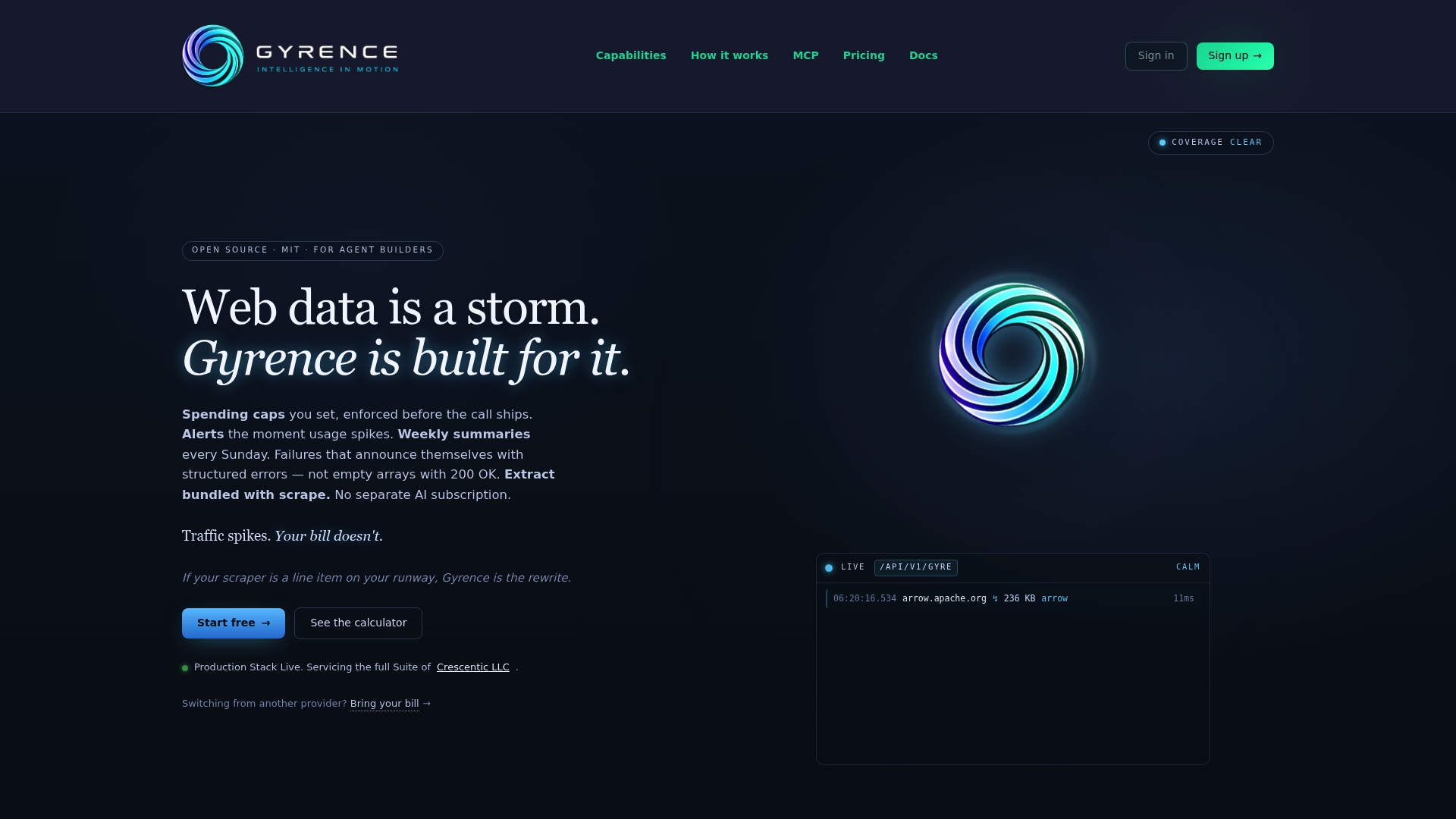
Another approach for teams pulling web data into agents or pipelines uses spending caps and predictable cost-per-call instead of a metered quota you have to reverse-engineer from an invoice. Every call returns a typed response, including the failure cases, so you know exactly what happened and what it cost before the bill ever surprises you. If unpredictable scraping costs are the actual problem you're solving for, not just rate limiting theory, check the Gyrence pricing page to see how the spending caps work, or start directly at Gyrence to test a call against your own use case.
Sources
For implementation details straight from the source, the IETF rate limit headers draft defines the header format most gateways now follow. Microsoft's API Management throttling sample shows token-bucket enforcement in practice, and Tyk's request quota documentation covers the billing-integration side in more depth. For a real-world example of contract-style usage constraints, StudioFlare's terms of service illustrates how quota language shows up outside pure API docs.
- API Management sample: flexible throttling - Microsoft Learn
- Best Practices for API Rate Limits and Quotas with Moesif to Avoid Angry Customers
- Request quotas — Tyk documentation
- API Rate Limiting, Throttling, API Quota & API Bursts Defined - Axway blog
FAQ
Can you give me an example of a rate limiter?
A token-bucket limiter capping a client at a fixed number of requests per minute is a common example: the bucket holds tokens, refills gradually, and any request beyond the available tokens gets a 429 response with a Retry-After header.
What is a quota limit?
A quota limit is a cap on total consumption over a long window, like a set number of API calls per month, tied to a customer's pricing tier or contract rather than to moment-to-moment traffic speed.
What does rate limit mean?
A rate limit restricts how many requests a client can make within a short time window, typically seconds or minutes, to prevent bursts from overwhelming backend infrastructure.
What is a quota example?
A SaaS API that includes a set number of requests per month on its standard plan, then bills a small amount per additional request past that threshold, is a straightforward quota example tied directly to billing.
Should a new API start with rate limits or quotas?
Start with a rate limit to protect infrastructure immediately, since it's simpler to implement and ships value on day one; add a quota once you have pricing tiers or contracts that need enforcing.