
Regex wins for deterministic, well-structured fields (invoice numbers, dates, IDs) because it's fast, cheap, and predictable. LLMs win for semantic or fuzzy fields where meaning matters more than pattern (extracting "sentiment" or "the reason for a return" from free text).
TL;DR:
- Regex excels at extracting fixed-format information like dates, IDs, and codes because it is fast, precise, and has minimal maintenance needs unless source formats change.
- LLMs are better suited for semantic fields requiring understanding or when source documents are highly variable, but they come with higher costs, slower response times, and more unpredictable failures.
- Combining both approaches in a hybrid pipeline—using regex first and routing only unmatched or semantic fields to an LLM—optimizes speed, cost, and accuracy for large-scale data extraction.
- Regular expressions deeply suffer from pattern rot and require ongoing pattern audits, while LLM pipelines demand prompt version control and output monitoring to prevent hallucinations and drift.
- Starting with regex for deterministic fields and escalating to an LLM only when necessary leads to more maintainable, transparent, and cost-effective extraction systems.
Table of Contents
- Regex vs LLM: A Side-by-Side Comparison
- How Much Faster Is Regex Than an LLM in Practice?
- Which Method Fails More Often, and How?
- What Does Regex or an LLM Actually Cost Over a Year?
- Building a Hybrid Pipeline That Uses Both
- Common Regex and LLM Mistakes That Break Pipelines
- How Do You Choose Between Regex and an LLM for a Task?
- Who's Behind This Guidance, and How Does It Apply in Production?
- Where Extraction Tooling Is Headed
- Gyrence: Built for the Hybrid Pipeline You Just Read About
- Sources
- FAQ
Regex vs LLM: A Side-by-Side Comparison
Regex and large language models solve overlapping problems with opposite philosophies. Regex matches character patterns you define in advance. An LLM reads content the way a person would, inferring structure it was never explicitly told about. Neither is "better" in the abstract. Each wins on a different axis.
Latency and cost separate them fastest. A compiled regex pattern runs in microseconds to low milliseconds, with no external call and no per-request fee. An LLM extraction call involves a network round trip, model inference, and a bill tied to input and output tokens. On workloads with millions of rows, that gap compounds into real infrastructure decisions.
Precision versus recall is the second dividing line. Regex is precise when you know exactly what "correct" looks like. A phone number, a SKU, a ZIP code. It has no opinion about context and won't guess. An LLM tends to have better recall on fields that vary in wording, order, or formatting, because it's reasoning about meaning, not matching characters.
Maintenance is where regex quietly loses ground over time. A pattern built for one invoice template breaks the day a vendor changes their PDF layout. LLM pipelines don't break the same way, but they drift: model updates change output shape, and prompts need versioning and monitoring just like code.
| Dimension | Regex | LLM |
|---|---|---|
| Speed | Microseconds to milliseconds | Seconds per call, often 1 to 3+ |
| Cost per call | Effectively zero (compute only) | Billed per token or inference |
| Best fit | Fixed-format fields (dates, IDs, emails) | Context-dependent or unstructured fields |
| Failure mode | Silent miss or "no match" | Hallucinated or inconsistent output |
| Maintenance burden | Pattern rot as source formats change | Prompt drift, model version changes |
- Use regex first for anything with a fixed, documented format.
- Use an LLM when the field's meaning matters more than its shape.
- Expect to maintain both differently: regex needs pattern audits, LLM pipelines need output monitoring.
How Much Faster Is Regex Than an LLM in Practice?
The gap is not close. A comparative study extracting BI-RADS scores from radiological reports found regex completed the task in 0.06 seconds versus 1,687.20 seconds for an LLM-based approach on the same dataset. That's a difference of roughly 28,120 times.
That number isn't a fluke of one narrow benchmark. It reflects a structural truth: regex is a compiled pattern match against text you already have in memory. An LLM call involves sending text to a model, waiting for token-by-token generation, and parsing a response. Even a fast model measured in low single-digit seconds per call loses badly to a regex engine measured in microseconds, once you multiply by volume.
Cost follows the same curve. Regex execution is a rounding error on your compute bill. LLM extraction is billed per token, in and out, and that adds up fast across millions of documents. A few practical levers matter here:
- Batching multiple extraction requests into one prompt cuts per-call overhead, though it raises the risk of one bad document poisoning a batch's output.
- Caching identical or near-identical inputs avoids paying twice for the same extraction, which matters more than most teams expect on repeat-crawl workloads.
- Local or smaller models reduce per-call latency and cost, trading some accuracy for throughput, and work well when your schema is narrow.
- Cheap prefilters using regex before an expensive LLM call let you skip inference entirely on rows regex already handles with confidence.
That last pattern deserves its own callout, because it's the one most teams skip until their bill forces the conversation. Run regex first on every document. Route only the misses, or the fields regex can't touch, to the LLM. You get regex's speed on the bulk of the workload and the LLM's flexibility only where you actually need it. Async queueing helps too: don't block a user-facing request on an LLM call when you can process it in the background and notify on completion. The Python re module's documented behavior around match, search, and fullmatch also matters here. Choosing the wrong function can silently return partial matches that look correct but aren't, which costs you debugging time that erodes regex's speed advantage.
Which Method Fails More Often, and How?
Both methods fail, but they fail differently, and that difference should shape how you test them.
Regex fails silently and specifically. When a pattern doesn't match, you get no match, an empty string, or a "value not found" result. There's rarely ambiguity about what happened, but there's also no partial credit. The BI-RADS extraction study found regex tended to return "unclear" more often than the LLM approach, which is the honest failure mode: the pattern didn't match, so it says so, rather than guessing.
LLMs fail confidently and unpredictably. A model can return a well-formatted, plausible-looking answer that is simply wrong, a behavior generally described as hallucination. The same study observed LLMs favoring common output classes, a sign of bias toward frequent answers over correct ones when the model is uncertain. That's a harder failure to catch, because the output looks fine until you check it against ground truth.
Testing strategy has to match the failure mode:
- For regex, build unit tests against synthetic edge cases: empty fields, unexpected whitespace, unicode characters, multiple matches in one string.
- For regex, maintain a small library of "known bad" inputs that previously broke a pattern, and rerun them on every change.
- For LLMs, build a stratified ground-truth sample that covers rare classes, not just common ones, so you catch the bias toward frequent answers.
- For LLMs, set confidence thresholds and route low-confidence outputs to human review instead of trusting every response equally.
- For both, log every extraction failure with enough context to reproduce it, not just a boolean success flag.
Human-in-the-loop review isn't a sign your pipeline is unfinished. It's the calibration step that catches the failure mode automated tests miss, especially for fields where "close enough" output is worse than no output at all.
What Does Regex or an LLM Actually Cost Over a Year?
Raw runtime numbers tell you almost nothing about what a pipeline actually costs to run for a year. Engineer time is the number that usually dominates.
Regex pipelines accumulate cost through pattern rot. A pattern written against one document format works until the source changes, and it will change: a vendor updates a template, a government form gets a new field, a website redesigns its HTML. Every change means someone has to notice the failure, diagnose which pattern broke, and rewrite it. Practitioner guidance on hybrid extraction frames this directly: the primary bottleneck for regex pipelines is maintenance, not execution speed.

LLM pipelines accumulate cost through operational overhead. Model providers deprecate or update versions, which can shift output formatting even when your prompt hasn't changed. Prompts themselves need version control, the same as code, because a small wording change can shift accuracy in ways that are hard to predict without a regression test suite. Add monitoring for output drift and occasional bias toward common answers, and the cost center moves from "engineer writes a pattern" to "engineer maintains infrastructure."
A rough checklist for estimating which side of that line your workload sits on:
- Count how many source formats feed the pipeline today, and how often they've changed in the past year.
- Estimate engineer-hours spent per month fixing broken patterns versus hours spent tuning prompts or reviewing flagged outputs.
- Price out inference cost per thousand documents at your actual volume, not a demo-scale estimate.
- Check whether your schema is stable enough that a regex pattern written today still works in six months.
Pro Tip: Track pattern-fix frequency in your issue tracker with a dedicated label. Six months of that data tells you more about true regex maintenance cost than any benchmark ever will.
Building a Hybrid Pipeline That Uses Both
The most durable extraction architectures don't pick a side. They route.
- Run a deterministic pass first. Apply regex to every document for the fields you can define precisely: dates, IDs, currency amounts, fixed-format codes. This handles the majority of well-structured content at near-zero cost.
- Fall back to the LLM only on misses. When regex returns no match, or when a field is inherently semantic (a product description's category, the sentiment of a review), send just that portion to an LLM rather than the whole document.
- Use regex as an anchor for LLM extraction. A coarse pattern can locate the relevant block of text (a table, a section header, a paragraph boundary) and hand only that chunk to the model with a schema it needs to fill. This cuts token cost and reduces the model's chance of drifting off-topic.
- Add timeouts and retry logic around every LLM call. A hung request shouldn't silently corrupt downstream data. Fail loudly, retry once with backoff, and if it still fails, flag the row for review instead of writing a null value that looks like a valid result.
- Signal failure types distinctly. A regex miss, an LLM timeout, and an LLM low-confidence output are three different problems. Collapsing them into one generic "extraction failed" bucket makes debugging far harder than it needs to be.
This isn't a compromise between two weaker options. It's the architecture that shows up repeatedly in production, because it matches engineering effort to the actual difficulty of each field. Guidance on hybrid extraction patterns makes the same case: frame the choice as maintenance versus inference cost, not raw accuracy, and route accordingly.
Common Regex and LLM Mistakes That Break Pipelines
The bugs that break extraction pipelines are almost always avoidable, and almost always repeated across teams that haven't hit them yet.
Greedy quantifiers overconsume text. By default, Python's *, +, and ? quantifiers are greedy, meaning they'll match as much as possible before backtracking. A pattern like <.*> intended to match one HTML tag will instead swallow everything from the first < to the last > in the string. The fix is often as simple as adding a ?: <.*?> makes the quantifier non-greedy, matching the shortest possible string instead, a behavior documented directly in the Python regex HOWTO.
Catastrophic backtracking can hang a process. Nested quantifiers on ambiguous patterns can cause the regex engine to try exponentially many combinations before failing. This isn't a theoretical risk. It's how a regex-based service goes from fast to unresponsive on one malformed input. Refactor ambiguous nested groups, anchor patterns explicitly, and test against adversarial inputs designed to trigger worst-case behavior.
- Prefer explicit delimiters to broad wildcards whenever the surrounding text has a predictable boundary.
- Test every pattern against empty strings, very long strings, and strings with repeated delimiters.
- Version prompts the same way you version code, with a changelog and rollback path.
- Give an LLM negative examples, not just positive ones, so it knows what a wrong answer looks like.
Pro Tip: Add an automated schema check after every LLM extraction call. If the model returns a field type or shape that doesn't match your schema, reject and retry before the bad data ever reaches storage.
How Do You Choose Between Regex and an LLM for a Task?
Run this checklist before writing a single line of extraction code.
- Is the field deterministic and well-specified? If the format is fixed and documented (an order number, a date in a known format), regex is faster, cheaper, and easier to test. Start there.
- Does the task require semantic understanding, or does the layout vary widely? If you're extracting meaning rather than matching a shape, or if source documents come from dozens of inconsistent templates, an LLM or a hybrid approach will cover more cases with less pattern-writing.
- Build a quick regex prototype and a small validation set before reaching for a model. Run it against 50 to 100 real examples. If coverage gaps persist after reasonable pattern iteration, that's your signal to escalate the uncovered fields to an LLM rather than rewriting the whole pipeline around one.
The order matters. Teams that start with an LLM for everything often discover, months later, that half their fields were deterministic all along and they've been paying inference cost for something a five-line pattern could have handled. Teams that start with regex and expand only where it demonstrably fails tend to end up with leaner, cheaper, more explainable systems. For a deeper look at where deterministic rules outperform model-based extraction, the breakdown in structured financial data extraction walks through the same decision logic applied to a specific data domain.
Who's Behind This Guidance, and How Does It Apply in Production?
Glen writes on web data infrastructure and extraction architecture for Gyrence, focusing on the practical engineering trade-offs teams hit when building pipelines that scale past a demo. The guidance above reflects patterns that show up repeatedly across regex and LLM extraction work, not abstract theory.
Gyrence builds toward the same routing-first philosophy described throughout this piece. Its composable primitives, Search, Traverse, Fetch, Extract, and Map, let a pipeline apply deterministic fetching and structure detection first, then hand only the ambiguous parts to schema-guided LLM extraction.
A few things matter more in production than in a benchmark:
- Typed, discriminated-union responses mean a failure looks different from a success at the type level, so your code can't accidentally treat a miss as valid data.
- Predictable failure modes across both deterministic and LLM-based steps cut debugging time, because you're not guessing whether a null result means "not found" or "the call errored."
- Spending caps on LLM-backed extraction calls prevent a runaway prompt loop or a bad batch from turning into a surprise bill.
Anyone building this kind of pipeline from scratch should look at how typed errors shape a six-stage extraction pipeline before writing the first regex pattern, since the failure handling matters as much as the extraction logic itself.
Where Extraction Tooling Is Headed
Regex versus LLM was never going to have a permanent winner, and the more interesting question is where the tooling goes next. Expect routing to become a default architectural pattern rather than a clever workaround, as more frameworks bake in "try deterministic, fall back to model" logic out of the box. Smaller, cheaper local models will keep eating into the cost argument for LLM extraction, narrowing the latency gap that currently favors regex on high-volume workloads.
The bigger shift will come from operational maturity, not model accuracy. Teams that treat prompt versioning, failure logging, and confidence thresholds as seriously as they treat regex unit tests will out-execute teams chasing marginal accuracy gains on a benchmark leaderboard.
— Glen
Gyrence: Built for the Hybrid Pipeline You Just Read About
This API provides deterministic and semantic pieces of this pipeline, so you're not stitching together a regex library, a scraper, and a separate LLM client to get structured data out of the web. Fetching and mapping handle the deterministic side: pulling clean markdown and mapping a site's URL graph without writing a single pattern. Semantic extraction is handled using schema-guided LLM extraction for the fields that regex can't reliably touch.
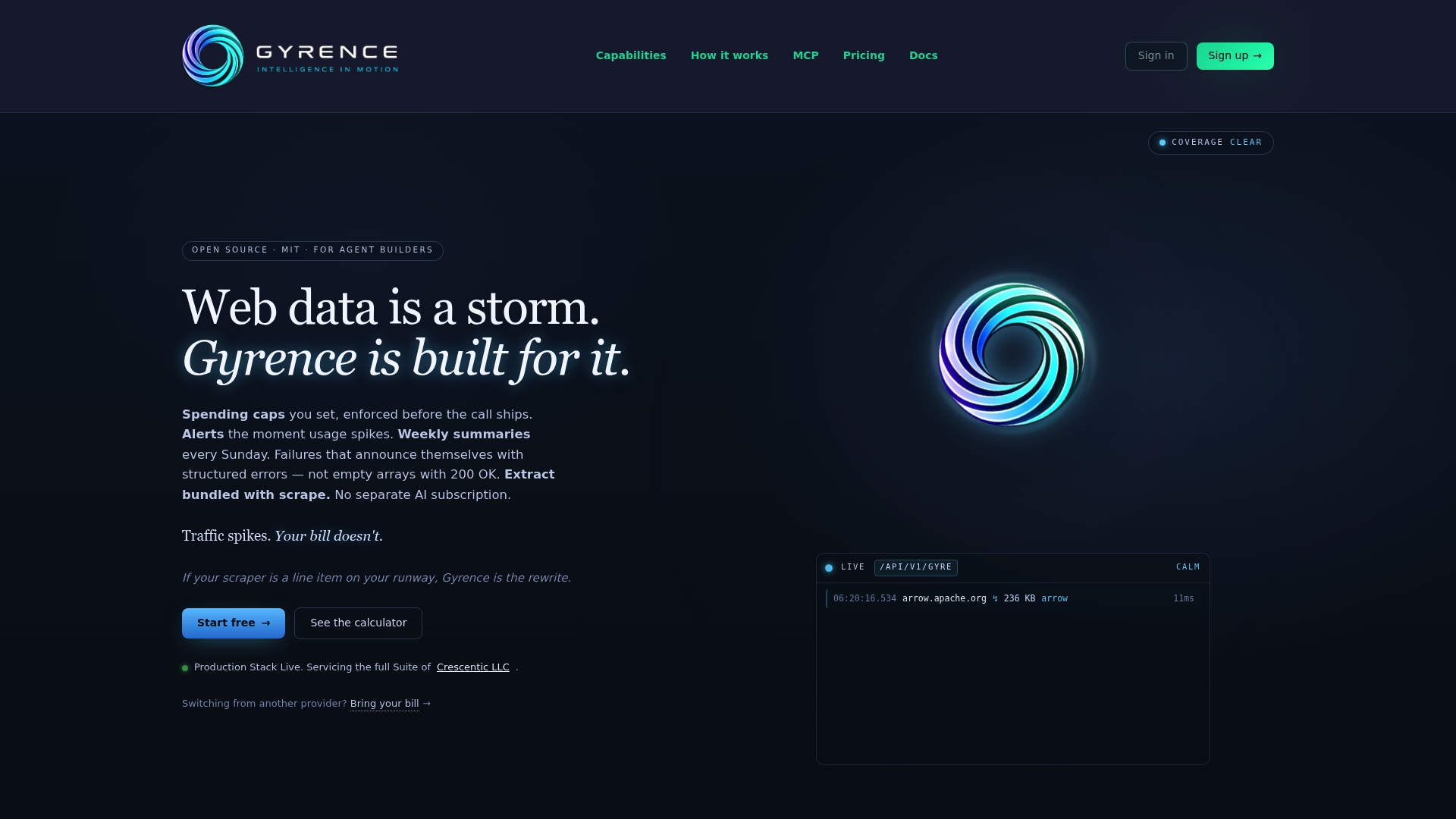
Calls return typed, discriminated-union responses, including failure cases, allowing clear differentiation between success and failure. Spending caps help to prevent unexpected costs from large batch operations. If you're building the routing architecture described above, start with the Gyrence console and check the developer docs for the Extract and Fetch primitives to see how the schema-guided extraction maps to your own pipeline.
Sources
- A comparative performance analysis of regular expressions and a large language model-based approach to extract the BI-RADS score from radiological reports
- Hybrid extraction: LLMs, local models, and regex — practitioner guidance
- re — Regular expression operations — Python standard library documentation
FAQ
Is Python Regex Greedy by Default?
Yes. Quantifiers like *, +, and ? are greedy by default in Python, matching as much text as possible before backtracking. Append a ? to make a quantifier non-greedy, as documented in the Python regex HOWTO.
What Is Regex, Exactly?
Regex, short for regular expression, is a formal notation for matching character patterns in text, originally developed by Stephen Cole Kleene in the 1950s and now built into nearly every programming language for tasks like validation and search.
Is an LLM Always More Accurate Than Regex?
No. Regex is more accurate on strictly formatted fields because it either matches exactly or doesn't match at all. LLMs tend to have better recall on context-dependent or loosely formatted fields, but they can hallucinate or favor common answer classes when uncertain.
Can Gyrence Handle Both Regex-Style and LLM-Based Extraction?
Gyrence's Extract primitive uses schema-guided LLM extraction for semantic fields, while Fetch and Map handle the deterministic retrieval and structure side of a pipeline, matching the hybrid routing pattern described throughout this guide.
How Do I Decide Between Regex and an LLM for a New Extraction Task?
Start with a quick regex prototype against a small validation set. If the field is fixed-format, regex alone usually suffices; if coverage gaps persist after iteration, route only those gaps to an LLM instead of rebuilding the whole pipeline.