
TL;DR:
- A site traversal API automates URL discovery, page fetching, and data extraction with specialized primitives. Developers should choose Map, Crawl, or Scrape based on their task to optimize efficiency and reduce costs. Using a Map API before crawling improves control, avoids unnecessary fetches, and enhances pipeline reliability.
A site traversal API is a programmatic interface that automates the discovery, fetching, and extraction of web pages from a target domain with precise control over scope, depth, and output format. Developers and data scientists use these APIs to replace fragile, hand-rolled crawlers with typed, structured pipelines. With site traversal API explained clearly, you can pick the right tool for each job, avoid common architectural mistakes, and build data pipelines that don't collapse under real-world conditions. The three core API categories — Mapping, Crawling, and Scraping — each solve a different problem, and confusing them costs time and money.

What is a site traversal API and how does it work?
A site traversal API is defined as a specialized interface that programmatically navigates a website's link graph to discover URLs, fetch page content, or extract structured data. The term "site traversal" is a descriptive label used in developer communities. The recognized industry vocabulary breaks this into three distinct primitives: Map, Crawl, and Scrape. Understanding which primitive fits your task is the foundation of any efficient web data pipeline.
Industry standards classify three key API categories — Mapping, Crawling, and Scraping — each suited for distinct web data extraction scenarios. That classification matters because each category has different cost profiles, latency characteristics, and failure modes. Treating them as interchangeable is the most common mistake developers make when building web data pipelines.
What are the main types of site traversal APIs and how do they differ?
The three API types operate at different layers of the data pipeline. Each one answers a different question about a target site.
Mapping APIs discover URLs without fetching page content. They return a site inventory: a list of URLs found within a domain, often derived from sitemaps or shallow link extraction. Using a Map API first before selective scraping enhances control, reduces data noise, and saves query costs in indexing workflows. This makes Map the right starting point when you need to audit a site's structure or build a URL list before committing to full content fetches.
Crawling APIs recursively follow links across a site to fetch multiple pages. They are designed for unknown page sets where you don't know in advance which URLs contain the data you need. The crawler fetches a seed URL, extracts outbound links, and enqueues unseen URLs for subsequent fetches.
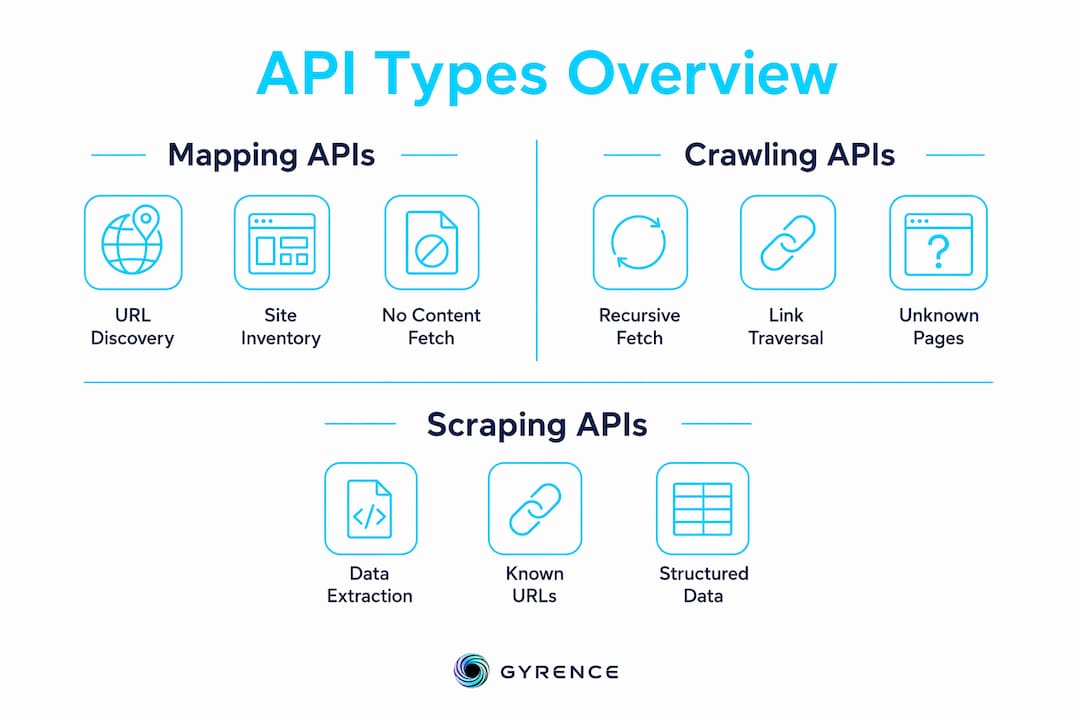
Scraping APIs extract structured data from specific, known URLs. You supply the URL; the API returns clean content, often as markdown or structured JSON. Using a Crawl API for single known URLs is inefficient. Scrape APIs are faster, cheaper, and more accurate for targeted page fetches.
| API type | Primary action | Input | Output |
|---|---|---|---|
| Map | URL discovery | Seed URL or domain | URL inventory list |
| Crawl | Recursive link following | Seed URL + depth/scope | Fetched page content at scale |
| Scrape | Structured data extraction | Known specific URL(s) | Structured JSON or markdown |
How does recursive crawling work, and what are its technical challenges?
Recursive crawling follows a tight loop: fetch a page, extract all outbound links, filter for in-scope URLs, deduplicate against already-visited URLs, and enqueue the remainder. The component managing this queue is called the frontier queue. It enforces politeness per host, handles priority scheduling, and runs deduplication at scale.
Frontier queue implementations use Bloom filters to deduplicate billions of URLs in web-scale crawlers. A Bloom filter is a probabilistic data structure that checks set membership in constant time with minimal memory. That efficiency is what makes large-scale crawling tractable without exhausting RAM.
Breadth-first search (BFS) traversal is the standard strategy for web crawling because it improves coverage and avoids getting trapped in deep pagination or spider traps compared to depth-first search (DFS). Spider traps are URL patterns that generate infinite unique URLs, such as calendar pages with endlessly incrementing date parameters. BFS surfaces the most important pages first and limits exposure to these traps.
URL normalization — including stripping tracking parameters and sorting query strings — prevents URL explosion and redundant crawling. Without normalization, a single page with ten tracking parameter variants gets fetched ten times. That wastes compute, inflates cost, and corrupts your visited-URL set.
Pro Tip: Set a hard depth limit and a strict includePaths scope on every crawl job. An unconstrained crawler will follow external links, pagination traps, and session tokens until it exhausts your budget or hits a rate limit.
The table below maps the core data structures in a recursive crawler to their responsibilities:
| Component | Responsibility | Key technique |
|---|---|---|
| Frontier queue | Schedules and deduplicates URLs | Bloom filter, priority queue |
| Politeness layer | Rate limits requests per host | Per-host delay, robots.txt |
| URL normalizer | Canonicalizes URLs before enqueue | Strip params, sort query strings |
| Visited set | Tracks fetched URLs | Bloom filter or hash set |
How should developers architect their site traversal pipelines?
Effective site traversal pipelines separate crawl logic from scrape logic to isolate failure modes and enable modular upgrades. This is the single most important architectural decision you will make. When discovery and extraction share the same process, a rendering failure in extraction blocks URL discovery for the entire pipeline.
A clean pipeline follows this sequence:
- Map the target domain to get a URL inventory.
- Filter the inventory by path patterns, content type, or priority score.
- Crawl the filtered set if the page count is large or the structure is unknown.
- Scrape specific URLs to extract structured data.
Industry experts emphasize modular transport layers beneath crawling and scraping to improve resilience against blocking, retries, and geographic routing. Transport abstraction means your proxy rotation, retry logic, and header management live in one place. You can upgrade them without touching your extraction logic.
Recursive crawlers at scale use distributed systems with stateless workers and messaging tiers such as Kafka to scale discovery and extraction independently. Stateless workers mean any worker can pick up any URL from the queue. That makes horizontal scaling straightforward and failure recovery fast.
Additional architectural best practices:
- Keep extraction schemas versioned and separate from crawl configuration.
- Log every failure with a typed error code, not a generic exception string.
- Apply
robots.txtcompliance and server-side politeness per host to avoid blocks. - Store raw fetched content before extraction so you can re-extract without re-crawling.
Pro Tip: Treat your crawl layer as a data producer and your scrape layer as a data consumer. Connect them with a message queue. This lets you replay failed extractions without re-fetching pages.
When and why should you use site traversal APIs?
The right API depends on what you know about the target site before you start.
Use a Map API when you need a site inventory before committing to content fetches. Link audits, sitemap validation, and pre-crawl scoping all fit here. You get URL lists fast, with no content fetching cost. For domain URL mapping use cases, this is the lowest-cost entry point into any site's structure.
Use a Crawl API for broad site ingestion where the page set is unknown. Content migration, broad data collection for RAG pipelines, and site-wide monitoring all require crawling. Set depth and includePaths parameters to bound the job and prevent runaway costs.
Use a Scrape API for known URLs where you need structured output. Product pages, job listings, and news articles with predictable URLs are ideal scrape targets. For structured JSON extraction from specific pages, a scrape call is always cheaper and faster than a crawl call.
A hybrid workflow combining all three looks like this:
- Call Map on the target domain to get all URLs.
- Filter URLs by path pattern (e.g.,
/products/). - Batch-scrape the filtered list for structured product data.
- Schedule a weekly crawl to catch new URLs the map missed.
This pattern gives you maximum control with minimum redundant fetching.
Key Takeaways
A site traversal API works best when Map, Crawl, and Scrape primitives are used for their intended purposes within a modular, decoupled pipeline.
| Point | Details |
|---|---|
| Three distinct API types | Map discovers URLs, Crawl fetches recursively, Scrape extracts from known URLs. |
| BFS over DFS | Breadth-first search improves coverage and reduces spider trap exposure in recursive crawlers. |
| Decouple discovery and extraction | Separating crawl and scrape logic isolates failures and enables independent scaling. |
| Normalize URLs early | Strip tracking parameters before enqueuing to prevent redundant fetches and state explosion. |
| Match API to task | Using a Crawl API for known single URLs wastes budget; Scrape APIs are faster and cheaper for that job. |
The architectural mistake I keep seeing in traversal pipelines
Most pipeline failures I've observed don't come from bad scraping logic. They come from treating the three API types as a single tool. Developers reach for a Crawl API because it sounds like it does everything, then wonder why their costs are unpredictable and their output is noisy.
The fix is almost always the same: add a Map step at the front. Knowing your URL inventory before you crawl lets you filter aggressively, set tight scope bounds, and avoid fetching pages you don't need. That one change typically cuts crawl volume by more than half on any site with a clear URL structure.
The second pattern I'd warn against is coupling your transport layer to your extraction logic. When your proxy rotation lives inside your scraper, a proxy failure takes down extraction. When they're separate, a proxy failure is just a transport retry. The single API web data access model works precisely because it enforces this separation by design.
URL normalization is the unglamorous detail that breaks pipelines when ignored. Tracking parameters, session tokens, and UTM strings create thousands of phantom unique URLs. A crawler without normalization will loop on them indefinitely. Implement canonicalization before your first enqueue, not as an afterthought.
— Glen
Gyrence gives you all five primitives in one API
Gyrence is built around the exact architecture this article describes: Map, Traverse, Fetch, Extract, and Scrape as separate, composable primitives. You call the right tool for each job without building the separation yourself.
Every Gyrence call returns a typed, discriminated-union response that includes failure cases, so your pipeline knows what happened instead of guessing. Spending caps mean your crawl budget is bounded by design, not by hope. If you're building a web data pipeline for AI agents or structured data extraction, explore Gyrence's platform to see how the primitives map to your workflow. The docs at gyrence.com/docs cover each endpoint with typed schemas and real failure examples.
FAQ
What is a site traversal API?
A site traversal API is a programmatic interface that automates URL discovery, page fetching, and structured data extraction within a target domain. It typically exposes Map, Crawl, and Scrape primitives for different stages of a web data pipeline.
How does a crawl API differ from a scrape API?
A Crawl API recursively follows links to fetch multiple unknown pages from a site. A Scrape API extracts structured data from specific, known URLs. Using a Crawl API for single known URLs increases cost and latency unnecessarily.
What is BFS and why does it matter for crawling?
Breadth-first search (BFS) is a traversal strategy that fetches pages level by level from the seed URL outward. It improves site coverage and reduces the risk of getting trapped in infinite URL loops compared to depth-first search.
How do I prevent a crawler from running out of control?
Set a hard depth limit, restrict scope with includePaths parameters, and apply URL normalization before enqueuing. Politeness rules per host prevent rate-limit blocks and keep the target server healthy.
When should I use a Map API instead of a Crawl API?
Use a Map API when you need a URL inventory before fetching content. It is faster and cheaper than crawling because it skips content retrieval. Map first, then scrape only the URLs that match your target criteria.