
TL;DR:
- Reliable site traversal starts with using category trees or sitemaps to gather product URLs before extraction. JSON-LD structured data should be prioritized over DOM traversal because it survives site redesigns and provides detailed variant information. Gyrence's platform enhances catalog tracking through typed failure modes, proxy rotation, and incremental refreshes that focus on volatile data.
Reliable site traverse for product catalog tracking starts with three non-negotiable decisions: where you begin, how you detect the end of pagination, and how you model product variants. Start from category trees or product sitemaps rather than guessing URLs — e-commerce platforms expose structured sitemap.xml listings that give you a complete product URL inventory before you write a single extraction rule. From there, the best practices are:
- Parse
schema.org/ProductJSON-LD blocks first; fall back to DOM selectors only when no structured data exists - Detect pagination end by the absence of new product IDs, never by a fixed page count
- Model every variant as its own SKU record — collapsing sizes, colors, or bundles into one row hides price and availability signals
- Use rotating residential proxies with per-request IP rotation to capture localized pricing and avoid throttling
- Respect
robots.txtand site terms of service; document your crawl policy - Run incremental refreshes on a split schedule: volatile fields (price, stock) more frequently than static ones (descriptions, images)
- Use an API that returns typed, discriminated-union responses so your pipeline knows exactly what failed and why
Table of Contents
- How to implement site traversal for product catalog tracking
- Why JSON-LD outperforms DOM traversal for catalog data
- How Gyrence handles robust catalog traversal
- Expert tips for developers building catalog tracking pipelines
- Gyrence gives your catalog pipeline a predictable foundation
- Key Takeaways
- FAQ
How to implement site traversal for product catalog tracking
The crawl-then-scrape pattern is the right mental model. Crawling discovers URLs; scraping extracts structured records from those URLs. For catalog work, you almost always do both in sequence.
Breadth-first crawl focused on category trees and sitemaps. Pull sitemap.xml or walk category navigation to collect product URLs methodically. This avoids the blind-spot problem of depth-first traversal, which can exhaust one branch while missing entire product categories.
Pagination type identification matters. Numbered pages, "load more" buttons, and infinite scroll each require a different strategy:
- Numbered pages: increment the page parameter and stop when the response returns no new product IDs
- "Load more" / infinite scroll: inspect network calls in your browser's developer tools to find the underlying JSON API endpoint — calling it directly is faster and more stable than simulating UI interactions
- Cursor-based pagination: track the cursor token returned in each response
Build traversal logic tolerant to structure changes. Brittle CSS selectors tied to layout classes break on every redesign. Anchoring extraction to schema.org/Product data or stable API endpoints insulates your pipeline from cosmetic site changes.
Validate responses at the boundary. Check item counts per page against expected ranges. A page returning zero items mid-catalog is a silent failure, not a clean end. Log it, retry it, and flag it for review rather than treating it as the catalog's natural terminus.

Respecting robots.txt is both a legal and operational requirement. Automated API clients can parse disallowed paths before queuing URLs, keeping your crawl inside permitted territory.
Why JSON-LD outperforms DOM traversal for catalog data
DOM traversal is the path of most resistance. A selector like div.product-card:nth-child(3) > span.price is a bet that the site's HTML structure will never change. It will. Layout redesigns, A/B tests, and framework migrations all break it silently.
Schema.org/Product JSON-LD blocks are a different contract. They exist specifically to communicate structured product data to machines, so they survive redesigns that gut the visible HTML. The typical fields you get:
name,sku,brandoffers.price,offers.priceCurrency,offers.availabilityoffersas an array for multi-variant productsimage,description,aggregateRating
The offers array is where variant tracking lives. Each offer carries its own price, availability, and often a variant-specific SKU. Collapsing that array into a single product record means you lose the signal that a size-M shirt is out of stock while size-L is $5 cheaper. Model each offer as a child record keyed by SKU.
Pro Tip: Always attempt JSON-LD extraction first. If the <script type="application/ld+json"> block is absent or malformed, fall back to DOM selectors — but log the fallback so you know which sites are costing you maintenance time.
Structured extraction also aids catalog data analysis downstream. When every record arrives in a consistent schema, normalization and deduplication are configuration, not code you rewrite per site.
The maintenance math is straightforward: a JSON-LD parser you write once handles hundreds of sites; a DOM selector set requires a patch every time any one of those sites ships a redesign.
How Gyrence handles robust catalog traversal
Gyrence is built around five composable primitives: Search, Traverse, Fetch, Extract, and Map. For product catalog work, the relevant sequence is usually Traverse → Extract, with Map used to audit a domain's URL graph before you commit to a full crawl.
Key platform behaviors that matter for catalog tracking:
- Structured failure modes. Every API call returns a typed, discriminated-union response that includes the failure cases. Your pipeline can branch on
result.type === "blocked"orresult.type === "truncated"rather than guessing why a page came back empty. - Transparent per-byte pricing with spending caps. You set a cap; Gyrence's pricing doesn't run past it. No surprise invoices after a crawl that hit more pages than expected.
- Rotating proxies and sticky sessions. Rotating IPs prevent throttling; sticky sessions let you hold a regional identity long enough to capture localized pricing and availability for a given market.
- Bundled LLM extraction. When JSON-LD is absent and DOM selectors are too fragile, you can pass a prompt or schema to the Extract primitive and get structured JSON back without building a separate parsing layer.
- Hosted MCP endpoint. AI agents connect directly via the Model Context Protocol, which means catalog tracking workflows can run inside agent pipelines without custom crawler maintenance.
- Built-in deduplication and incremental update support. The Traverse primitive handles URL deduplication automatically. You configure which fields to re-fetch on each run rather than re-crawling the full catalog every time.
Gyrence also enforces robots.txt compliance at the API level, so you are not relying on your own code to catch disallowed paths. That matters when you are running catalog tracking across dozens of domains with different crawl policies.
Expert tips for developers building catalog tracking pipelines
These are the decisions that separate a pipeline that runs reliably for months from one that needs constant patching.
Start scoped, not broad. Target category paths or product sitemaps first. A broad crawl from the homepage wastes credits on navigation pages, blog posts, and support articles that carry no product data.
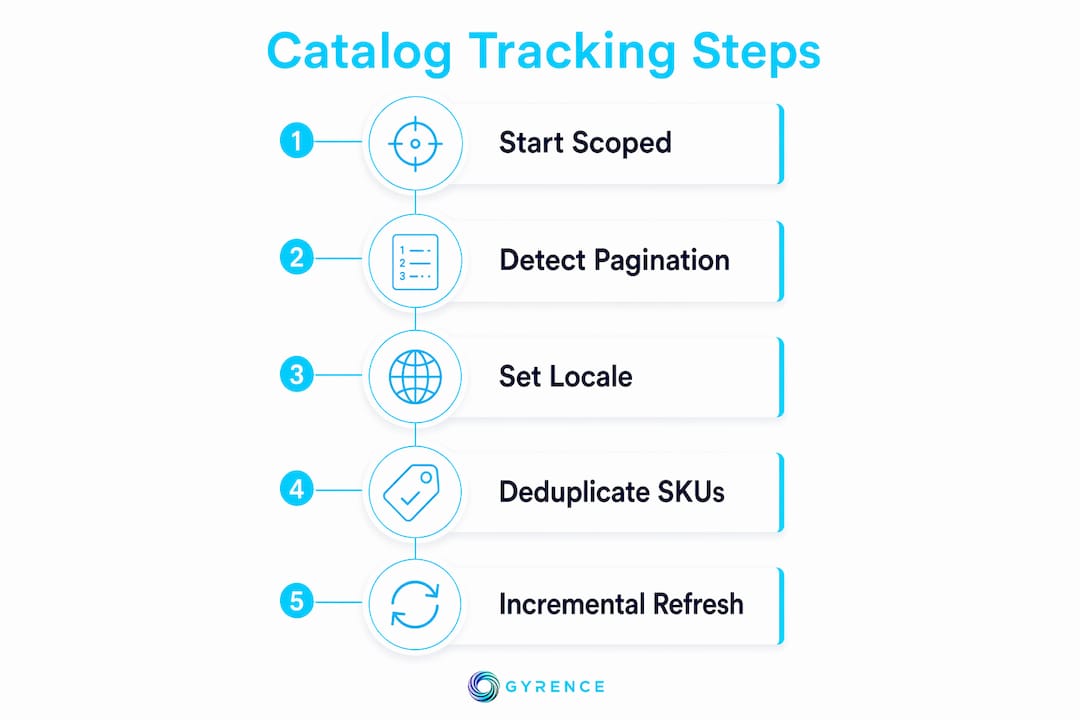
Detect pagination end correctly. Silent truncation is the most common catalog tracking failure. Stop pagination when no new product IDs appear in the response, not when you hit page 50 or page 100.
Set locale in proxy parameters. A US residential IP returns US pricing; a UK IP returns GBP pricing. If your catalog tracks multiple markets, parameterize the proxy locale per market segment rather than mixing results.
Deduplicate by SKU, not product name. Product names change in promotions and A/B tests. SKUs don't. Key every variant record to its SKU.
Split your refresh schedule. Price and stock change daily or hourly on active catalogs. Descriptions and images rarely change. Running a full re-crawl for every field wastes bandwidth and increases your blocking risk. Schedule volatile fields on a short cycle; static fields on a weekly or monthly one.
Pro Tip: Open your browser's Network tab, filter by XHR/Fetch, and trigger a "load more" or scroll event on the target site. The paginated JSON endpoint usually appears immediately — calling it directly bypasses JavaScript rendering entirely and cuts your per-page cost.
Validate and normalize on ingest. Apply a schema (JSON Schema or Pydantic model) to every extracted record before it hits your database. Reject records missing required fields rather than storing nulls that corrupt downstream analysis.
Secure your storage pipeline. Scraped product data often includes pricing signals that are commercially sensitive. Encrypt data at rest, restrict API key access by IP range, and rotate credentials on a schedule. Document your data retention policy, especially if you are storing personal data adjacent to product records.
For a deeper look at web data API evaluation criteria before committing to a platform, the checklist covers failure transparency, pricing models, and compliance features worth verifying.
Gyrence gives your catalog pipeline a predictable foundation
Product catalog tracking at scale means your pipeline will hit rate limits, encounter malformed JSON-LD, and face sites that change structure without warning. The question is whether your API tells you what happened or leaves you debugging silent failures at 2 AM.
Gyrence is built for exactly that scenario. The five primitives cover every stage of structured data extraction from URL discovery to JSON output, with spending caps that mean your bill matches your plan. Failure responses are typed and machine-readable, so your agent or pipeline can handle partial results without guessing. Rotating proxies, sticky sessions, bundled LLM extraction, and a hosted MCP endpoint are included — not add-ons. Start building at gyrence.com.
Key Takeaways
Reliable product catalog tracking requires structured extraction from JSON-LD, SKU-level variant modeling, and an API that surfaces failure modes explicitly rather than returning empty results silently.
| Point | Details |
|---|---|
| Start from sitemaps | Category trees and sitemap.xml files give you a complete product URL inventory before extraction begins. |
| JSON-LD over DOM selectors | schema.org/Product blocks survive site redesigns; CSS selectors break silently on every layout change. |
| Pagination end detection | Stop when no new product IDs appear in the response — fixed page limits cause silent catalog truncation. |
| SKU-level variant modeling | Each offer variant needs its own record keyed by SKU; collapsing variants hides price and availability signals. |
| Gyrence for predictable pipelines | Gyrence's typed failure modes, spending caps, and built-in proxy rotation make catalog traversal costs and errors observable. |
FAQ
What is the most reliable way to start a product catalog crawl?
Begin from sitemap.xml or structured category navigation rather than crawling from the homepage. This gives you a complete product URL inventory without wasting requests on non-product pages.
Why does JSON-LD extraction outperform CSS selector scraping for catalogs?
schema.org/Product JSON-LD blocks are machine-readable and persist through visual redesigns, while CSS selectors break whenever a site's HTML structure changes. JSON-LD also exposes variant-level offer data that DOM traversal typically misses.
How do you detect the true end of paginated product listings?
Stop pagination when the response contains no new product IDs, not when you reach a fixed page number. Fixed limits cause silent truncation, leaving products out of your catalog snapshot.
How does Gyrence handle failure modes in catalog traversal?
Gyrence returns typed, discriminated-union responses for every API call, including failure cases like blocked requests or truncated results. Your pipeline can branch on the failure type rather than treating an empty response as a successful empty page.
How should you schedule incremental catalog updates?
Run volatile fields (price, stock) on a short refresh cycle and static fields (descriptions, images) on a longer one. This reduces unnecessary fetches and lowers your blocking risk on high-frequency catalog monitoring.