
The fastest, most reliable way to build a URL list for programmatic crawls is to parse the target site's sitemap first, using a mature library or a streaming XML parser, rather than discovering pages by following links. Sitemap parsing skips listing pages entirely and hands you validated URLs directly from the source the site owner already published. That's a structural advantage: you spend zero requests on discovery.
A minimal pattern looks like this: fetch /sitemap.xml or /sitemap_index.xml, detect whether it's an index or a urlset, stream-parse the entries, and pull loc values into your queue.
- Discover the sitemap location (robots.txt, then common paths).
- Fetch with rate limiting and a real user agent.
- Stream-parse rather than loading the whole document into memory.
- Validate each URL before it hits your crawl queue.
Pro Tip: Never trust a single sitemap file blindly. Sample 20 to 30 URLs and confirm they return 200 status codes before you commit a full crawl budget to the list.
Key Takeaways
Sitemap parsing beats link-based discovery for structured, catalog-style sites because it skips listing pages and delivers validated URLs directly from a source the site owner maintains.
| Point | Details |
|---|---|
| Parse before you crawl | Treat the sitemap as your canonical URL list and validate it before feeding a crawler. |
| Stream, don't load | Use streaming or SAX-style parsing to avoid memory pressure from large or gzipped sitemaps. |
| Trust lastmod carefully | Only use lastmod as a scheduling hint when the publisher keeps it accurate. |
| Test with recorded samples | Stub remote fetches and keep malformed sample sitemaps in your test suite. |
| Consider a hosted option | Gyrence's Map and Fetch primitives handle sitemap-driven URL discovery with typed, predictable billing. |
Table of Contents
- When Should You Use Sitemap-First Parsing Instead of Link Crawling?
- Core Sitemap Concepts Every Parser Needs to Handle
- The Practical Sitemap Parse-and-Crawl Workflow
- Sitemap Parsing Libraries by Language
- Pitfalls, Testing, and Edge Cases in Sitemap Parsing
- What the Efficiency Data Says About Sitemap-First Parsing
- Why Teams Eventually Outsource Sitemap Maintenance
- A Hosted Alternative When Sitemap Maintenance Gets in the Way
- Sources
- FAQ
When Should You Use Sitemap-First Parsing Instead of Link Crawling?
Sitemap parsing wins when a site publishes a real, maintained sitemap index and the content is largely static: product catalogs, documentation sites, news archives, anything with thousands of pages that would otherwise require crawling through paginated category listings. If robots.txt points to a sitemap_index.xml with dozens of child sitemaps, that's usually a strong signal the site treats its sitemap as a first-class data feed.
Sitemap parsing falls short on sites with poor sitemap hygiene: partial coverage, sitemaps that haven't been regenerated in months, or dynamic content (search results, infinite scroll, user-generated pages) that never makes it into the feed. When that happens, fall back to bulk domain crawling to fill the gaps.
Pro Tip: Run a quick coverage check: parse the sitemap, then crawl 50 internal links from the homepage. If the link crawl surfaces URLs the sitemap never mentioned, treat the sitemap as a starting point, not a source of truth.
Core Sitemap Concepts Every Parser Needs to Handle
Before writing or choosing a parser, know what you're actually parsing. The sitemap protocol defines a small set of tags, but the two that actually matter for crawling are loc (required, the URL itself) and lastmod (optional, but useful when the publisher keeps it honest). priority and changefreq exist in the spec, but Google ignores both as crawl signals.
Your parser needs to handle four structural shapes:
urlset: a flat list of URLs, the most common format.sitemapindex: a pointer document listing child sitemaps, common on large sites.- Gzip-compressed files (
.xml.gz): standard for sites trying to stay under size limits. - Plain text or RSS/Atom feeds: less common, but valid alternate formats some CMS platforms emit.
The protocol caps each sitemap at 50,000 URLs and 50 MB uncompressed, which is why large sites shard content across dozens of child sitemaps under one index. Encoding matters too: sitemaps must be UTF-8, and lastmod should follow W3C datetime format. Schema violations tend to show up as unescaped ampersands, mixed encodings, or a missing XML namespace declaration, and a parser that chokes on any one of these will silently drop URLs instead of failing loudly.
The Practical Sitemap Parse-and-Crawl Workflow
Treat sitemap parsing as a pipeline stage, not a one-off script. A workflow that holds up in production looks like this:
- Discover sitemap locations from
robots.txtfirst, then fall back to common paths like/sitemap.xmlor/sitemap_index.xml. - Fetch with rate limiting and a proper user agent. Don't hammer a sitemap index with parallel requests for every child file at once.
- Detect format automatically. A field-tested fetcher checks content heuristics (does the body start with
<? Is there a gzip magic byte?) to route to the correct parser rather than assuming XML every time. - Stream-parse instead of building a full DOM, especially for sitemap indexes with dozens of children.
- Validate each URL: check HTTP status, confirm it matches its own canonical tag, and skip anything carrying a
noindexdirective. - Deduplicate and enqueue into your crawl scheduler, using
lastmodas a soft priority hint where it's present and believable.
Decompress .gz files on the fly rather than downloading the full archive to disk first. That keeps memory flat even when a child sitemap is pushing the 50 MB ceiling.
Pro Tip: Add a path-pattern filter before you enqueue anything. If a site publishes a /sitemap-archive-2019.xml you don't need, skip it at the parsing stage instead of fetching and discarding thousands of stale URLs downstream.
Sitemap Parsing Libraries by Language
Python developers have two solid paths depending on the job. If you're already running Scrapy, its SitemapSpider reads sitemap.xml, follows nested sitemap-index references automatically, handles gzip transparently, and dispatches each URL straight into your callback. For standalone parsing outside a full crawl framework, the Ultimate Sitemap Parser library builds a tree of AbstractSitemap objects, handles recursion, and deduplicates automatically. A basic usage pattern is: fetch → detect → parse → iterate loc values.
Node.js developers typically reach for a lightweight streaming XML parser paired with a fetch client that supports gzip decompression natively. Node's async/await model makes concurrent child-sitemap fetching straightforward. Just cap concurrency, since fetching 40 child sitemaps in parallel against a single host is a fast way to get rate-limited.
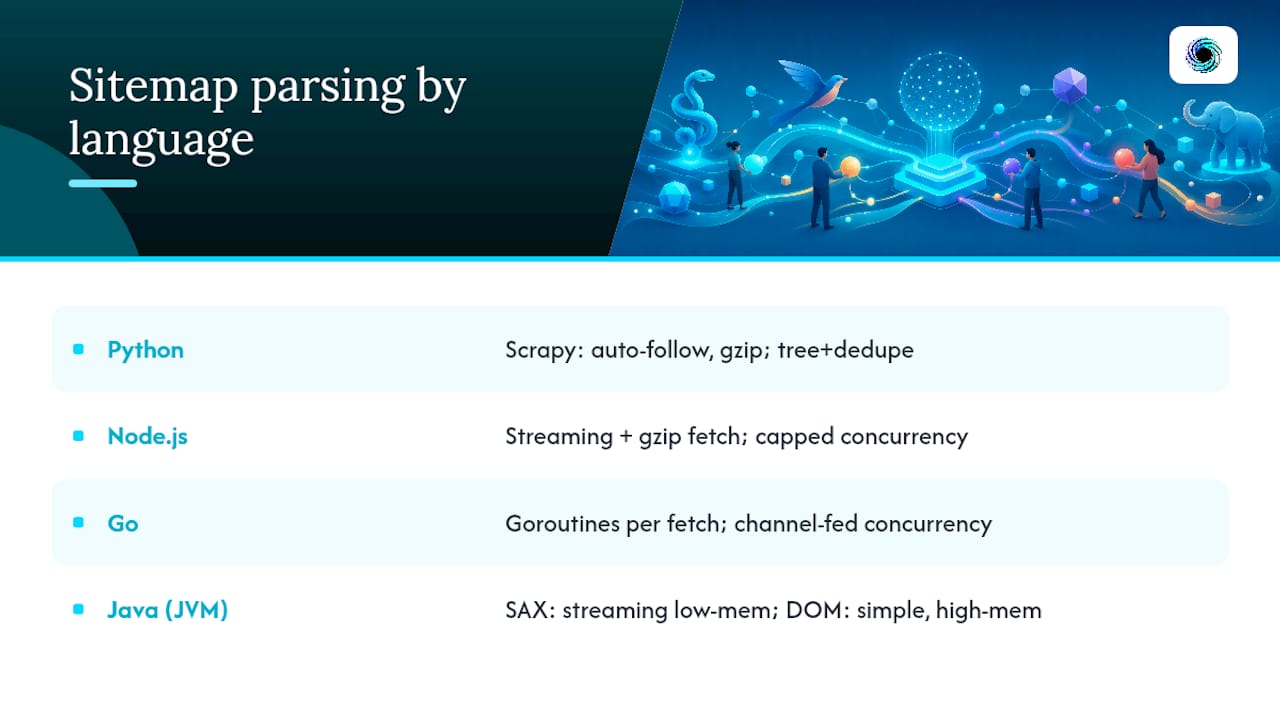
Go favors goroutine-based designs: one goroutine per child sitemap fetch, feeding results into a channel that your parser consumes. Projects like go-sitemap-parser structure index-to-child recursion this way, treating each fetch as an independent I/O-bound task rather than a blocking sequential loop.
Java and other JVM languages generally split between SAX-style streaming parsers (low memory, event-driven) and DOM parsers (simpler code, higher memory cost). For anything beyond a few thousand URLs, streaming wins, and it integrates more cleanly with job schedulers that expect incremental progress rather than an all-or-nothing parse.
If you're building this once and maintaining it forever isn't appealing, a hosted web-data API removes the library-selection question entirely. The decision checklist is simple: how many sites are you parsing, how often do formats break, and does your team want to own gzip edge cases and encoding bugs long-term?
Pitfalls, Testing, and Edge Cases in Sitemap Parsing
Malformed XML, wrong Content-Type headers, and gzip streaming failures cause more silent data loss than any other class of bug in sitemap parsing. Redirects buried inside sitemap entries, duplicate loc declarations, and recursive sitemap-index loops (a child sitemap pointing back to its own parent) round out the list of things that break naive implementations.
A working test checklist:
- Curl a sample of URLs from each parsed sitemap and confirm 200 status codes.
- Validate the XML against the sitemap schema before trusting its contents.
- Write unit tests for your parser class using recorded sample sitemaps, not live fetches.
- Compare sitemap-derived URL counts against a link-crawl sample to catch coverage gaps.
Handle recursion by tracking visited sitemap URLs in a set. Anything already processed gets skipped, which prevents infinite loops and duplicate work on the same child file.
Pro Tip: Stub every remote fetch in your test suite and keep a folder of real (anonymized) sample sitemaps, including at least one malformed one, so your test-driven workflow catches regressions before they hit production.
What the Efficiency Data Says About Sitemap-First Parsing
Sitemap-based crawling runs roughly 5 to 10 times cheaper and faster than link-based discovery on catalog-style sites. That gap exists because sitemap parsing skips category pages, pagination, and internal search results entirely. It fetches target URLs directly instead of crawling through the navigation layer to find them.
The gain shrinks fast on sites without solid sitemap coverage, and lastmod deserves a specific caveat: it only helps crawl scheduling when the dates are genuinely accurate. An automated pipeline that stamps every URL with today's date, regardless of whether the page changed, is worse than omitting lastmod altogether, since it trains crawlers to ignore the field as noise.
Why Teams Eventually Outsource Sitemap Maintenance
Writing a sitemap parser is easy. Keeping it correct across a year of gzip quirks, encoding surprises, and new client sites is the part that erodes team time. Once you're maintaining parsers for more than a handful of domains, or you need SLA-level reliability without babysitting edge cases, a hosted API starts making more sense than another internal library upgrade.
A Hosted Alternative When Sitemap Maintenance Gets in the Way
Gyrence gives teams that would rather not own gzip decompression bugs and sitemap-index recursion loops a way to skip the maintenance entirely. Its Map primitive builds a URL graph from a domain's sitemap structure, Fetch handles page retrieval and normalization with stream-safe parsing baked in, and Traverse (Gyre) manages crawl scheduling and prioritization outward from a starting URL. Pair that with Extract for schema-guided JSON pulls, and the whole discover-to-structured-data pipeline runs through one typed API instead of five separate libraries you have to patch.

Every response comes back as a typed, discriminated union, including failures, so your code can handle a broken sitemap or a timed-out fetch without guessing what went wrong. Billing runs on spending caps and predictable per-call cost rather than surprise overages when a client's sitemap balloons to 40 child files overnight. If you're evaluating whether to keep patching an in-house parser or hand the whole workflow to a managed crawler API, start a trial at the Gyrence console and run your first sitemap-driven crawl today.
Sources
- WordPress 6.5 enhances SEO with lastmod support (Search Engine Journal)
- Sitemaps
- What Is a Sitemap | Google Search Central
- Fetch and parse flow (Ultimate Sitemap Parser docs)
- aafeher/go-sitemap-parser (GitHub)
FAQ
Is Sitemap.xml Still Relevant?
Yes. Google and Bing both use sitemaps as a discovery mechanism, and for catalog-style sites, sitemap-based crawling remains roughly 5 to 10 times more efficient than link-based discovery.
What Are the Two Main Types of Sitemaps?
The two core structures are a urlset, a flat list of page URLs, and a sitemapindex, which points to multiple child sitemaps. Large sites typically use an index to stay under the 50,000 URL and 50 MB limits per file.
How Do I Extract the Sitemap of a Website?
Check robots.txt for a Sitemap: directive first, then try common paths like /sitemap.xml or /sitemap_index.xml. From there, a tool like Gyrence's Map primitive or a library that follows the standard fetch and parse flow can extract every loc entry automatically.
Is Lastmod Reliable for Crawl Prioritization?
Only when the publisher keeps it accurate. An automated pipeline that stamps every URL with the current date regardless of actual changes teaches search engines to ignore the field entirely.
What Is the Purpose of a Sitemap?
A sitemap gives crawlers an explicit inventory of a site's pages, which matters most for large sites, sites with rich media, or pages that are poorly linked internally. It's a direct feed rather than something a crawler has to infer from navigation links.