
Source citations for AI are structured, per-claim provenance records, not academic reference formatting. Each claim your model outputs needs provenance metadata including a resolvable source URL and character offsets marking the cited text, along with cryptographic hashes and attribution details, to enable verifiable tracing back to the evidence. Publish a per-run manifest and reference it with a Citation-Source header, so any consumer can walk from a sentence back to the exact bytes that supported it.
TL;DR:
- Provenance records must include precise offsets, content hashes, and source URLs to enable verifiable claims supported by exact source text spans.
- Multi-tool agent workflows require assigning stable IDs to each step and storing raw outputs to prevent evidence pooling, which causes conflation.
- Verification involves re-fetching sources, matching content hashes, and confirming entailment with natural language inference to prevent unsupported citations.
- Capturing provenance at retrieval, grounding, and post-generation stages is essential, with proper access controls and signature validation to ensure data integrity and security.
- Most current citation methods are superficial footnotes that do not confirm support or account for content drift, unlike robust provenance schemas that track source support at the claim level.
Table of Contents
- What Source Citations for AI Actually Require
- Provenance Capture in Multi-Tool Agent Workflows
- Verifying That a Citation Actually Supports Its Claim
- A Developer Checklist for Emitting Verifiable Citations
- Securing Provenance Data Without Leaking Private Information
- Why Most Citation Implementations Are Half-Measures
- Instrumenting Citations Without Building the Pipeline From Scratch
- Specs and Papers Worth Reading Next
- Sources
- FAQ
What Source Citations for AI Actually Require
Academic citation formats answer "who gets credit." Machine provenance answers a harder question: which bytes, at which offset, support this specific claim, and can a verifier reproduce that check without asking the model again?
That reframing matters because most teams building retrieval-augmented generation (RAG) pipelines still bolt citations on as a display feature. A model produces an answer, a separate step matches paragraphs against retrieved documents, and a footnote gets rendered. That approach breaks the moment two sources say similar things, or the moment a claim spans two retrieved chunks. Citing sources in RAG systems needs to happen at the data model level, not the UI layer.
A practical citation schema includes several fields: a resolvable source URL, a canonical stable identifier if available, cryptographic hashes of the full source and cited excerpt, character offsets indicating the exact supported text, citation type indicating the nature of the reference, and retrieval timestamp to account for content changes.
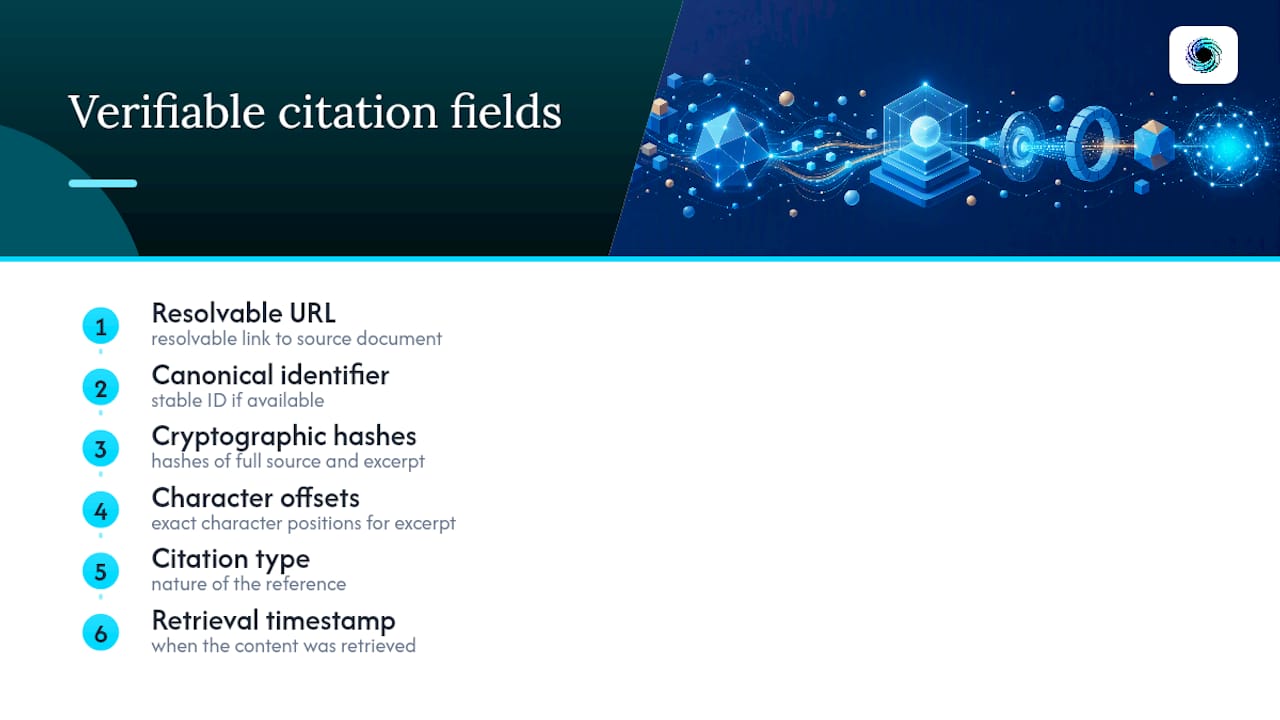
The Open Attribution telemetry SPEC formalizes most of these fields and recommends emitting both content_url and content_id whenever a canonical identifier exists, precisely because URLs are the weakest link in any provenance chain. Salesforce's citation documentation makes the UI case plainly: without claimStartOffset and claimEndOffset, an interface has no reliable way to insert an inline citation marker at the right spot in a long answer. Offsets aren't a nice-to-have for polish. They're the only way a renderer knows where to drop the little superscript number without guessing.
Provenance Capture in Multi-Tool Agent Workflows
Agent pipelines rarely pull from one source. A typical answer might route through a search call, a fetch, and an extraction step, each touching different evidence, and if you don't track that chain, you end up with citations that point to the wrong tool's output. Here's the sequence that keeps provenance intact end to end:
- Assign a stable tool ID and source ID to every step. The Model Context Protocol (MCP) trace format exposes both, and they need to survive the full pipeline, not just the retrieval stage.
- Store raw tool output alongside a step index and an
outputs_refpointer. This lets you reconstruct exactly what the model saw at step 3 versus step 7, instead of trusting a flattened summary. - Never pool evidence before attribution. When you merge three search results into one context blob before generation, you lose the ability to say which of the three actually backed a given sentence. ProvenanceGuard's research on MCP-based agents shows this pooling is the single biggest cause of cross-source conflation, where a claim gets credited to a source that never said it.
- Layer your manifests by verification depth. A
Citation-Sourceheader pointing to a hosted manifest is level one. A per-claim manifest with hashes and offsets is level two. A signed manifest with a hash chain across the full agent trace is level three, and it's what you want before shipping anything into a regulated workflow.
PROV-AGENT extends the W3C PROV standard specifically to model these agent interactions, linking prompts, tool executions, and model invocations into one queryable graph instead of a flat log. That queryability is what turns "we logged everything" into "we can answer which source supported claim 14 in run 8,204."
Verifying That a Citation Actually Supports Its Claim
A citation pointing at a real URL is not the same as a citation pointing at a URL that actually backs the claim. That gap is where most "hallucinated citation" complaints originate: the source exists, it's just not saying what the model attributed to it.
To verify a citation truly supports its claim, systems should: route claims to candidate evidence using embedding similarity while preserving source IDs; assess claim support with natural language inference or token-alignment methods to confirm entailment, not just mention; and re-fetch and verify that the excerpt hash matches the stored text at the recorded offsets, detecting content drift over time.
ProvenanceGuard's approach runs exactly this pattern: route claims to source-specific MCP evidence, check support with NLI and token-alignment proxies, and return a per-claim verdict rather than a single pass/fail for the whole answer. When the routed source ID doesn't match what the answer claims to cite, that's conflation, and the system should block or repair the claim before it ships, not flag it after a user already read it.
Pro Tip: Don't treat excerpt verification as exact-string matching. Paraphrased claims will never match character-for-character, so pair the excerpt hash with a lexical alignment heuristic that tolerates rewording while still catching genuine drift.
A Developer Checklist for Emitting Verifiable Citations
Provenance has to be captured at four distinct stages, and skipping any one of them leaves a gap a verifier can't close later.
- At retrieval, record every search result with a retrieval ID,
content_url, relevance score, and domain, before anything gets passed to generation. - At grounding, fetch the actual content, compute
content_hashfor the full document and separate chunk hashes for anything split into pieces, and record a canonicalcontent_idif one exists (DOI, ISCC, C2PA). - At generation, insert
claimStartOffset/claimEndOffsetpairs for each citation and emit aCitation-Sourceheader pointing to that run's manifest, so a consumer never has to guess where the provenance record lives. - After the response, verify the URL asynchronously, set
url_verified, log the verification timestamp, and record signer or attestation metadata if you're running a signed manifest tier.
Observability ties it together: log the agent ID, the chain depth for that response, an acceptance criteria score for citation quality, and every claim that got blocked or repaired during verification. That log is what lets you answer, six months later, why a specific answer cited what it cited.
Pro Tip: Build the manifest emission into your generation step, not a post-processing job. A manifest bolted on after the fact tends to drift from the actual tool trace, which defeats the entire point of provenance.
Teams instrumenting this from scratch often start with the retrieval stage, since it's the easiest to get right, using an agent web browsing checklist as a starting structure before building out the grounding and verification stages.
Securing Provenance Data Without Leaking Private Information
Provenance logs are forensic records, not debug logs, and they need access controls and retention policies that reflect that. A provenance trail that anyone on the team can read or edit isn't a provenance trail. It's a liability.
- Hash-chain your logs or sign attestations so tampering leaves evidence, and record the signing key metadata alongside the attestation URI rather than in a separate, disconnected system.
- Never store raw personally identifiable information (PII) in a provenance record. Use redacted representations or salted hashed pointers instead, particularly for anything touching regulated data.
- Apply stricter access controls and longer retention rules to provenance data than to ordinary application logs, since provenance is exactly what an auditor or incident responder will ask for first.
Security research on provenance logging in agent systems treats these logs as high-value targets precisely because they contain the evidentiary chain for every claim a system has ever made. Treat them accordingly, and document your provenance tracking approach before you need it for an audit, not during one.
Why Most Citation Implementations Are Half-Measures
Most teams shipping "citations" today are shipping footnotes. A URL next to a sentence looks like provenance, but it answers none of the questions that matter: was that URL fetched fresh or cached from three weeks ago, does the cited excerpt actually entail the claim, and would the citation survive a re-fetch if the source page changed an hour later.
The uncomfortable part is that fixing this isn't a model problem. GPT-4, Claude, or any frontier model can generate a citation-shaped string on request. The gap is entirely in the pipeline around the model: whether you preserved source IDs through multi-tool chains, whether you hashed the excerpt at the moment you retrieved it, whether you verified support instead of just relevance. Attribution fidelity, the idea that a citation should confirm the source actually supports the claim rather than simply prove the source exists, is the standard that separates real provenance from decoration.
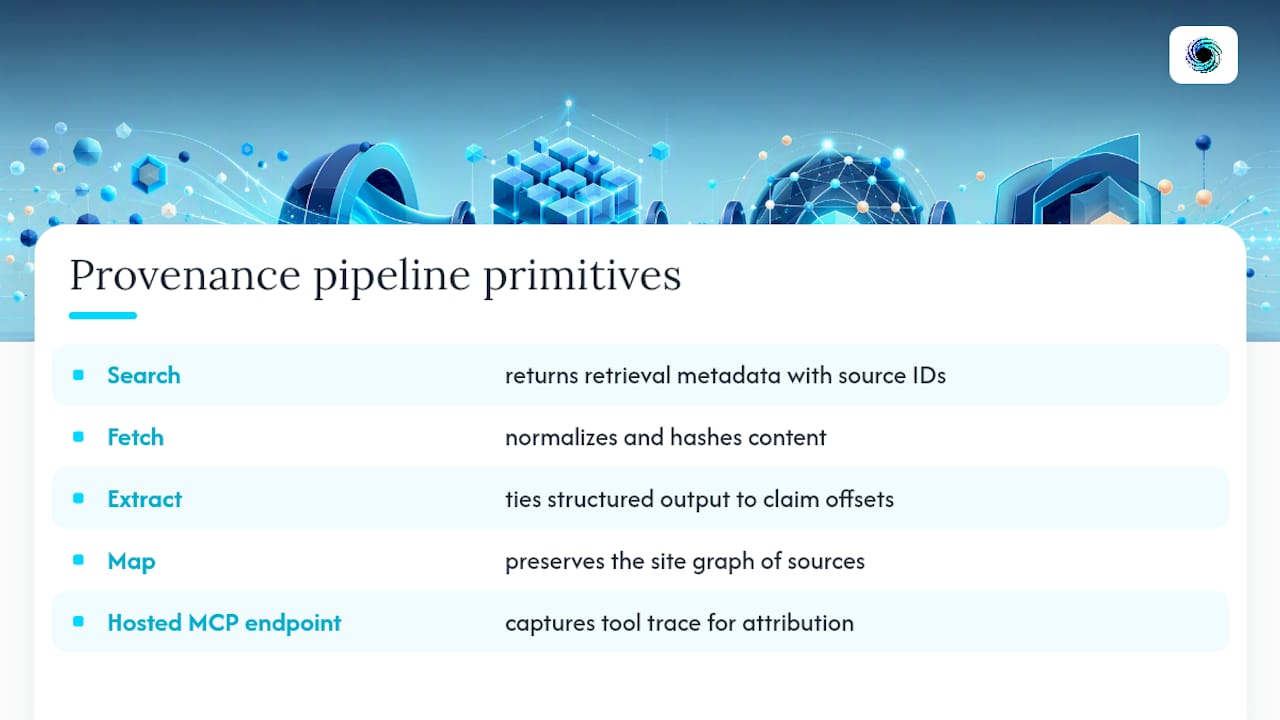
Gyrence's five primitives map onto this problem cleanly, because each one produces a typed, evidence-preserving object instead of a blob of text. Search returns retrieval metadata with source IDs intact. Fetch normalizes and hashes content instead of handing back raw HTML. Extract ties structured output to claim-level offsets instead of a flat summary. Map preserves the site graph a claim's source came from, and the hosted MCP endpoint captures the tool trace that keeps all of it attributable. None of that replaces the verification layer developers still have to build, but it removes the excuse that provenance capture is too tedious to instrument.
— Glen
Instrumenting Citations Without Building the Pipeline From Scratch
Building the checklist above from raw HTTP calls means writing your own hashing, offset tracking, and trace capture before you've written a single line of verification logic. Gyrence exists to skip that setup: every call across Search, Traverse, Fetch, Extract, and Map returns a typed response with the content already normalized and hashable, and the hosted MCP endpoint captures the tool trace your provenance chain depends on.
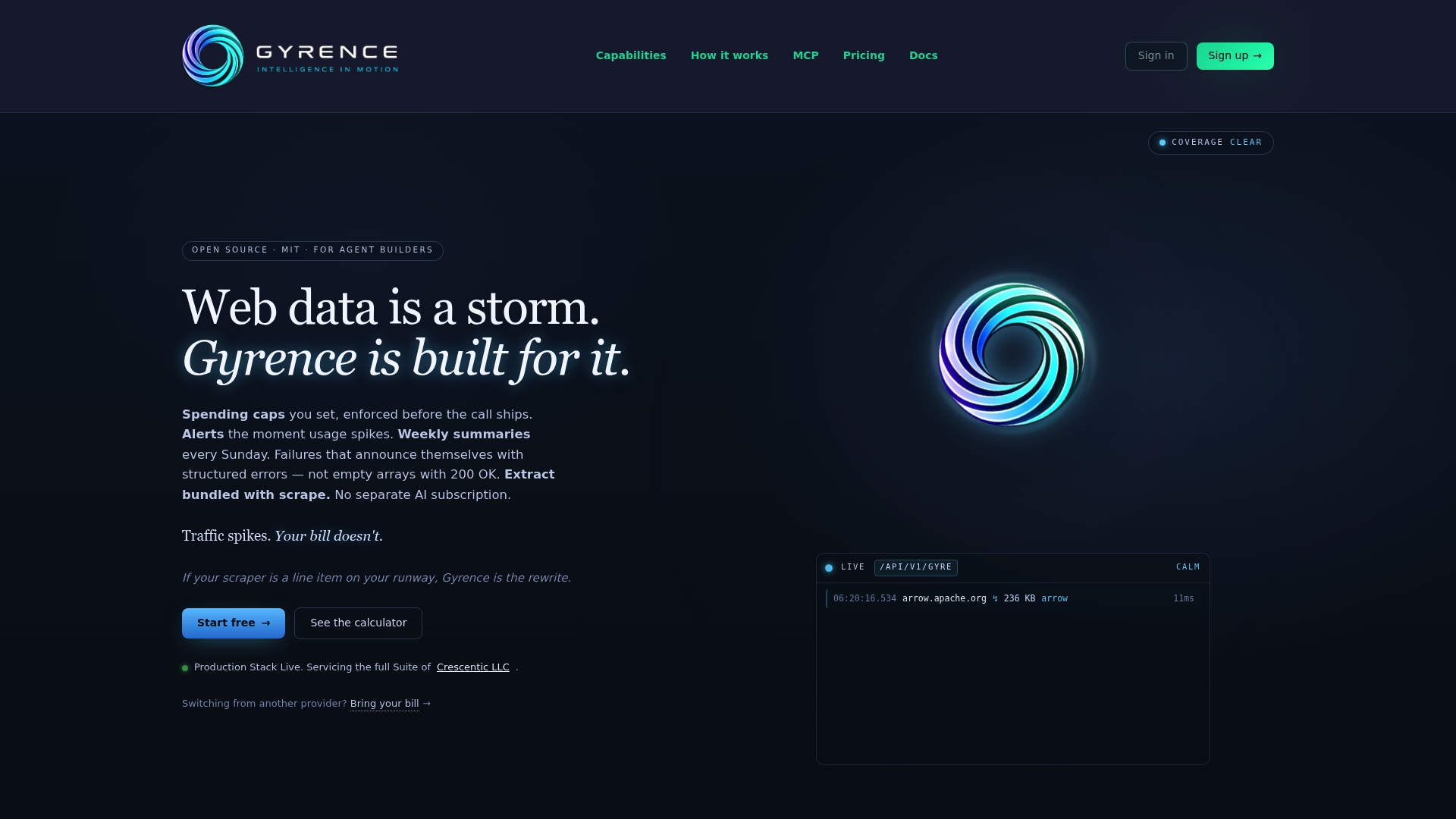
That matters most for agent builders who need url_verified and content hashes to actually be reliable rather than aspirational fields in a schema nobody populates. Gyrence's typed, discriminated-union responses surface failure modes explicitly instead of silently returning empty results, so your citation pipeline knows when a fetch failed versus when a source genuinely had no supporting text. Spending caps and predictable per-call pricing mean you can run verification passes across every citation candidate without wondering what the bill looks like at the end of the month. If you're instrumenting citation emission for a production agent, start with the Gyrence documentation and run a trial against your own retrieval pipeline.
Specs and Papers Worth Reading Next
- Open Attribution telemetry SPEC: field-level schema for citation and content metadata.
- ProvenanceGuard: source-aware verification for MCP-based agents.
- PROV-AGENT: W3C PROV extension for agent provenance graphs.
- Salesforce citation docs: offset and marker implementation guidance.
- Source-grounded AI content practices: background on evidence-tied generation.
Sources
- ProvenanceGuard: Source-Aware Factuality Verification for MCP-Based LLM Agents
- Add Citations in Agent Responses | Salesforce Developers
FAQ
What Fields Belong in a Minimal AI Citation Record?
At minimum, emit content_url, claimStartOffset/claimEndOffset, content_hash, excerpt_hash, source_id, citation_type, and url_verified for every claim your system generates.
How Is This Different From Academic Citation Formats?
Academic formats like APA, MLA, or IEEE credit authorship for human readers; machine-readable provenance verifies that a specific text span supports a specific claim, using offsets and hashes a program can check automatically.
What Causes Cross-Source Conflation in RAG Systems?
Pooling evidence from multiple sources before attribution causes conflation, since the system loses track of which source actually supported which sentence once results get merged into one context blob.
Why Use Content Hashes Instead of Just Storing the URL?
URLs rot and pages change, so a content_hash and excerpt_hash let you verify that the cited text still matches what was originally retrieved, catching drift a URL alone can't reveal.
Does Gyrence Handle Citation Verification Automatically?
Gyrence's primitives return typed, hashable content and preserve source IDs through MCP traces, which gives you the raw material for citation emission, though the verification logic (NLI checks, conflation detection) is still built on top.