
Structured JSON from press releases is the process of converting press release content into machine-readable JSON format that adheres to schema.org standards, making it parseable by AI engines, search platforms, and downstream applications. The industry standard for this is JSON-LD, a lightweight syntax that embeds structured metadata directly in a page's <script> tag without altering visible content. AI search engines parse structured data layers, not prose, for citation and knowledge panel population. That single fact changes how developers should approach every press release pipeline they build.
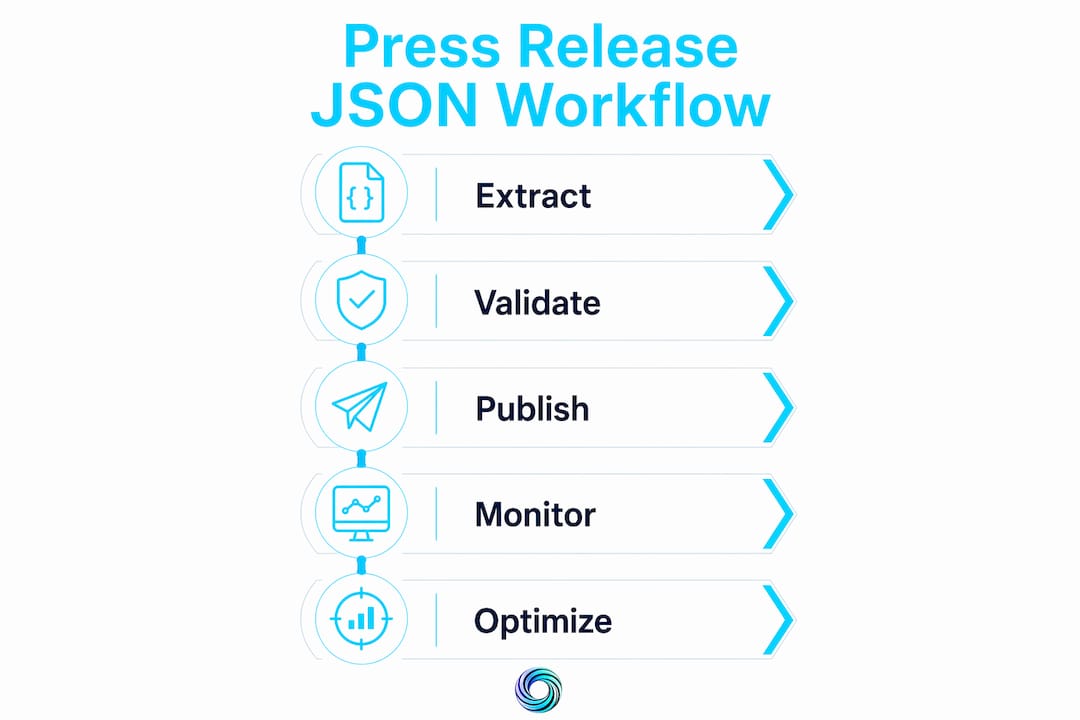
What structured JSON from press releases actually requires
The schema.org NewsArticle type is the correct starting point for any press release JSON-LD implementation. Five core fields must be marked up for AI compatibility: headline, image, datePublished, dateModified, and a structured author/publisher object. Missing any one of these fields is enough for an AI engine to skip the release entirely.
The publisher field requires a nested Organization object, not a plain string. That object must include name, url, and a logo property pointing to an image with defined width and height in pixels. The author field accepts either a Person or Organization type. For corporate press releases, Organization is the correct choice. For bylined analyst notes distributed as releases, use Person with name and url populated.

Here is the minimum viable JSON-LD structure for a press release:
{
  "@context": "https://schema.org",
  "@type": "NewsArticle",
  "headline": "Company X Reports Q2 2026 Earnings",
  "datePublished": "2026-07-15T08:00:00Z",
  "dateModified": "2026-07-15T09:30:00Z",
  "image": "https://example.com/images/q2-2026.jpg",
  "author": {
    "@type": "Organization",
    "name": "Company X",
    "url": "https://example.com"
  },
  "publisher": {
    "@type": "Organization",
    "name": "Company X",
    "url": "https://example.com",
    "logo": {
      "@type": "ImageObject",
      "url": "https://example.com/logo.png",
      "width": 600,
      "height": 60
    }
  }
}
For complex announcements such as product launches or partnership deals, specific schema types like PublicationEvent improve AI mapping beyond what a generic Organization schema delivers. This matters when the announcement contains structured facts that an AI assistant needs to surface accurately.
Pro Tip: Validate every JSON-LD block against the Google Rich Results Test before deployment. A single malformed property, such as a missing logo dimension, causes the entire structured block to fail silently.
How to extract and convert press release content into JSON
Extraction pipelines for press release data fall into two categories: scraping from wire services and consuming structured outputs directly. GlobeNewswire processes roughly 400 press releases daily and provides structured JSON with headline, body, ISO 8601 timestamps, source company, tickers, ISIN, category, and image URLs. That output is already partially structured, which means your pipeline can focus on normalization rather than raw extraction.
For sources that do not expose a structured feed, a scraping and parsing pipeline typically follows these steps:
- Fetch the page as clean HTML or markdown using a web data API that handles JavaScript rendering and bot detection.
- Identify the press release container using CSS selectors or XPath targeting the article body, headline, and metadata regions.
- Extract raw fields including headline text, publication date string, author byline, and any embedded ticker symbols or financial identifiers.
- Normalize dates to ISO 8601 format (
2026-07-15T08:00:00Z). Never store raw date strings like "July 15, 2026" in a structured pipeline. - Map fields to schema.org properties and serialize the result as JSON-LD or a flat JSON record depending on your downstream consumer.
The most common pipeline failure is mixing unstructured prose with structured fields in the same output object. Keep the
bodyfield as plain text and all metadata fields as typed, validated values. Never let a date field contain a sentence.
For structured JSON extraction from web sources, maintaining a canonical Organization JSON-LD record at a stable URL such as /press/about.jsonld and referencing it across all releases keeps publisher metadata consistent and reduces update overhead.
Pro Tip: Store datePublished and dateModified as separate fields from day one. Collapsing them into a single timestamp field creates a debt that breaks AI freshness signals later.
What are common validation challenges with press release JSON?
Schema errors in press release JSON-LD are common and often invisible until you check a validation tool. The most frequent causes for AI engines skipping a release include missing logo dimensions on the publisher object, a dateModified value identical to datePublished when the release was actually updated, and headline fields that exceed 110 characters.
The key issues to audit before publishing any release:
- Logo dimensions: The
logoImageObjectmust specifywidthandheight. Omitting these causes Google's parser to reject the publisher block. dateModifiedaccuracy: IncorrectdateModifiedhandling causes AI engines to exclude releases from rich results. Set it only when the content actually changes.- Schema type mismatches: Using
Articleinstead ofNewsArticleloses eligibility for news-specific rich results. - Boilerplate prose in structured fields: Pasting marketing copy into the
descriptionfield instead of a factual summary reduces citation probability.
Validation is ongoing, not a one-time check. Post-implementation monitoring through Search Console over at least two weeks confirms whether structured data is driving rich results. AI engines evolve their entity parsing continuously, so a schema that passes validation today may need adjustment after a platform update.
Pro Tip: Set a calendar reminder to re-run the Rich Results Test on your five most-trafficked press releases every 30 days. Schema requirements shift, and stale markup costs you citations you earned.
How can press release JSON data be applied in developer workflows?
Structured press release data has clear, high-value use cases across several engineering domains. The table below maps common application types to the JSON fields they depend on most.
| Application type | Primary JSON fields used | Key benefit |
|---|---|---|
| Financial NLP pipeline | headline, datePublished, ticker, ISIN | Enables time-series sentiment analysis tied to market events |
| AI agent data ingestion | headline, dateModified, publisher, image | Feeds agent memory with fresh, citable entity data |
| Media monitoring dashboard | headline, datePublished, category, source | Supports deduplication and source attribution at scale |
| Investor relations app | author, publisher, datePublished, body | Powers structured disclosure timelines for compliance |
| Content aggregation feed | All NewsArticle fields | Enables schema-compliant syndication without data loss |
Structured data for investment research is one of the fastest-growing use cases, where financial teams ingest normalized press release JSON to build event-driven models. The prerequisite is consistent field naming and ISO 8601 date formatting across all sources. Without that, deduplication breaks and downstream models produce unreliable signals.
Properly structured releases report 20–30% higher CTR due to improved visibility in AI and search engine results. That uplift is contingent on consistent markup and validation, not just initial implementation. For AI agent pipelines specifically, canonical Organization schema is what gets parsed into knowledge panels and cited in AI Overviews, not the prose body.
Key Takeaways
Structured JSON from press releases requires schema.org NewsArticle JSON-LD with five validated fields, a canonical Organization publisher block, and continuous post-deployment monitoring to maintain AI citation eligibility.
| Point | Details |
|---|---|
| Five required fields | headline, image, datePublished, dateModified, and author/publisher must all be present and valid. |
| Separate date fields | Store datePublished and dateModified as distinct values to preserve AI freshness signals. |
| Canonical publisher record | Maintain one Organization JSON-LD file at a stable URL and reference it across all releases. |
| Validate continuously | Run the Rich Results Test and monitor Search Console for at least two weeks after any schema change. |
| Match schema type to content | Use PublicationEvent for complex announcements instead of generic Organization to improve AI mapping. |
Why I think most press release pipelines are solving the wrong problem
Most developers I see building press release extraction pipelines spend the majority of their time on the scraper and almost none on schema fidelity. They get the headline and the date into a database and call it done. The problem is that a flat JSON record with a raw date string and no publisher block is not structured data. It is structured storage. Those are different things.
The shift that actually matters is treating the Organization block as a first-class entity record, not a repeated string you paste into every release. A canonical, linked Organization JSON-LD record at a stable URL is what AI engines use to build knowledge graph entries. Without it, you are feeding your pipeline data that looks structured to a human but reads as noise to a language model.
The web data schema design discipline that financial data teams apply to market feeds needs to move into press release pipelines. Treat every field as typed, every date as ISO 8601, and every publisher reference as a linked entity. That is the standard that makes your data citable, not just storable.
— Glen
Gyrence and structured press release data pipelines
Developers building press release extraction workflows need a web data layer that returns typed, validated output rather than raw HTML they have to parse themselves.
Gyrence's Extract primitive accepts a prompt or JSON schema and returns a discriminated-union response with the structured fields you defined, including failure cases when a field is missing or malformed. That means your pipeline knows immediately when a datePublished field is absent rather than silently writing null to your database. Gyrence also bundles LLM extraction, so you do not need a separate model call to normalize unstructured press release body text into typed JSON. Spending caps and structured failure modes keep your extraction costs predictable. Start building at gyrence.com.
FAQ
What is the correct schema.org type for a press release?
Use NewsArticle as the primary @type in your JSON-LD block. For complex announcements with event-specific metadata, nest a PublicationEvent to improve AI mapping accuracy.
Which fields are required for AI citation eligibility?
The five required fields are headline, image, datePublished, dateModified, and a structured author/publisher object with a valid Organization logo block including pixel dimensions.
How often should I validate press release JSON-LD?
Run the Google Rich Results Test at deployment and monitor Search Console for at least two weeks post-launch. Re-validate high-traffic releases every 30 days as schema requirements evolve.
Why does dateModified matter separately from datePublished?
AI engines use dateModified to assess announcement freshness. Setting it identically to datePublished when an update occurred causes the release to appear stale and reduces citation probability.
Can I use a flat JSON record instead of JSON-LD for press release data?
Flat JSON works for internal storage and NLP pipelines, but it does not produce rich results or AI citations. JSON-LD with schema.org types is required for search engine and AI engine visibility.