
For developer and data-engineering pipelines, prefer typed, schema-backed JSONL for streaming AI-ready output and Parquet or another columnar format for analytics and archival. The right choice comes down to four questions: who consumes the data, how strict the schema needs to be, whether you're streaming or batching, and what storage costs you're willing to carry.
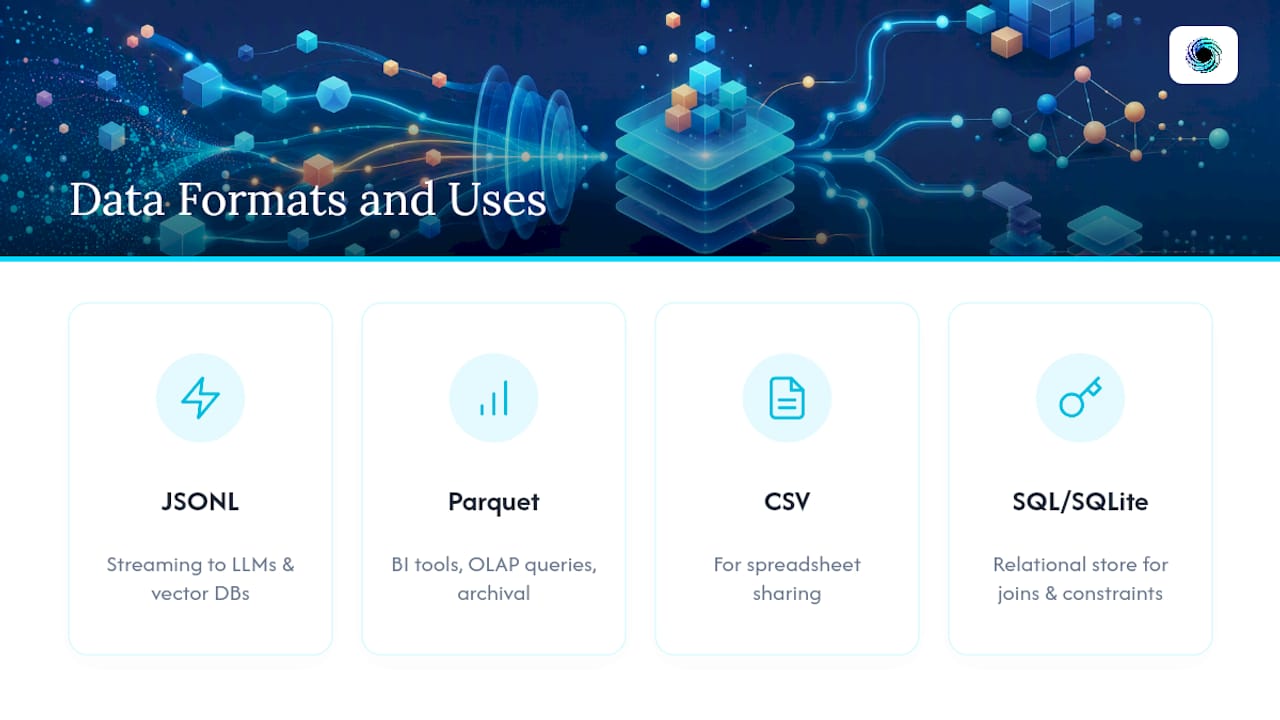
Here's the fast version: streaming into an LLM or a vector database → JSONL (also called NDJSON). Feeding a BI tool or running OLAP queries → Parquet. Handing data to someone in a spreadsheet → CSV. Loading into a relational store for joins and constraints → SQL/SQLite. Long-term archival where the schema might shift → Parquet or Avro. Every timestamp should be ISO 8601. Everything else follows from those five decisions.
Key Takeaways
The right structured output format is determined by your data's consumer, not by habit or convenience: JSONL for streaming agent ingestion, Parquet for analytics and archival, CSV for spreadsheets, and SQL for relational needs.
| Point | Details |
|---|---|
| Match format to consumer | JSONL for LLMs and vector databases, Parquet for analytics, CSV for spreadsheets, SQL for relational joins. |
| Enforce types at write time | Validate inside the scraper and use explicit nulls instead of omitted keys to avoid silent corruption. |
| Convert DOM to Markdown first | Trimming and converting HTML to Markdown before schema extraction cuts token usage and improves stability. |
| Attach provenance to every record | Include source URL, scrape timestamp, selector, and extraction confidence on every output. |
| Use typed APIs to skip the pipeline work | Gyrence's Extract primitive returns schema-guided, typed JSON with discriminated-union error handling built in. |
Table of Contents
- Which Structured Scraping Output Formats Should You Know?
- What Trade-Offs Should Guide Your Format Choice?
- How Do You Choose the Right Output Format?
- How Do You Map HTML to a Typed Schema?
- What Makes an Output Agent-Ready and Failure-Resistant?
- What Do Sample Outputs Look Like in Practice?
- Which Tools Read and Write These Formats?
- What Metadata Should Every Record Include?
- What's Gyrence's Take on Format Trade-offs?
- How Gyrence Delivers Structured, Agent-Ready Output
- Sources
- FAQ
Which Structured Scraping Output Formats Should You Know?
Every format on this list solves a different problem. None of them is universally "best" — they trade schema rigidity, compression, and read pattern against each other in ways that matter once you're past a hobby script and into a production pipeline.
- JSON — Human-readable, ubiquitous, and supported everywhere. Con: no native streaming support; a malformed record at the end of a large file can corrupt the whole payload.
- JSONL/NDJSON — One JSON object per line, so you can stream, append, and parse record-by-record without loading the whole file into memory. Con: no built-in schema enforcement, so type drift creeps in silently unless you validate on write.
- CSV — Opens in Excel, Google Sheets, and every BI tool without translation. Con: everything is a string until you cast it, and nested or array fields have to be flattened or serialized as JSON-in-a-cell, which gets ugly fast.
- Parquet — Columnar, compressed, and fast for analytical queries that only touch a few columns out of many. Con: it's a batch format; you write it once and query it, not a good fit for a live stream of scraped records.
- Avro — Embeds its schema in the file and handles schema evolution gracefully, which makes it a strong pick for long-lived pipelines. Con: it's row-oriented, so it doesn't get Parquet's analytical query speed.
- ORC — Similar to Parquet with strong compression, popular in Hive/Hadoop-centric stacks. Con: smaller ecosystem outside the Hadoop world, so tooling support is thinner than Parquet's.
- Feather (Apache Arrow) — Optimized for fast reads into pandas or R with almost zero serialization overhead. Con: not meant for long-term storage or cross-version compatibility, more of a working format than an archival one.
- XML — Still common in legacy enterprise feeds and government data exports. Con: verbose, slower to parse than JSON, and rarely the right choice for a new pipeline.
- SQLite/SQL dump — Gives you joins, indexes, and constraints in a single portable file. Con: not built for the kind of high-throughput streaming writes a live scrape produces.
- Markdown (optional, for human-readable extracts) — Useful when an LLM needs page context alongside structured fields, or when a human needs to sanity-check what got scraped. Con: it's a presentation format, not a data format. Don't treat it as your source of truth.
Vector databases and RAG pipelines want JSONL. Spreadsheets and quick audits want CSV. Analytics engines want Parquet or ORC. Relational stores want SQL. Pick based on the consumer, not habit.
What Trade-Offs Should Guide Your Format Choice?
Six axes decide which format wins for a given pipeline, and they rarely all point the same direction.
- Typing and schema strength. Parquet and Avro enforce a schema at write time; JSON and CSV don't unless you bolt on validation. If downstream code assumes
priceis a float and gets a string once, it breaks. - Row-oriented vs columnar. Row formats (JSON, CSV, Avro) suit record-by-record processing. Columnar formats (Parquet, ORC) suit queries that scan one or two columns across millions of rows, like "average price across all listings."
- Compression and storage cost. Parquet's columnar layout compresses far better than CSV or JSON for repetitive scraped data, sometimes cutting storage by more than half for wide, sparse fields.
- Streaming vs batch. JSONL streams naturally, appending one line at a time as a crawler produces records. Parquet is written in batches; you can't cleanly append to it the way you can a JSONL file.
- Random access vs sequential read. SQLite gives you indexed lookups. JSONL and CSV are sequential scans unless you build a separate index.
- Serialization cost.
orjsonserializes JSON dramatically faster than Python's built-injsonmodule, which matters when you're writing millions of scraped records per hour.
A high-cardinality numeric dataset headed for a BI dashboard wants Parquet. A crawler feeding an LLM agent in near real time wants JSONL. Python's ecosystem (pyarrow, pandas, orjson) covers all of these; JavaScript's is thinner for Parquet specifically, which is worth knowing before you commit a Node.js pipeline to a columnar format.
How Do You Choose the Right Output Format?
Run through this checklist before you write a single line of extraction code.
- Identify your consumer. An LLM or vector database wants JSONL. A BI tool wants Parquet. A human wants CSV or Markdown. This single question eliminates most of the other options immediately.
- Determine how stable your types need to be. If a
pricefield must always be a float and never a string, pick a format with schema enforcement (Parquet, Avro) or add validation on write. - Decide streaming vs batch. If records need to land the moment they're scraped, JSONL. If you're processing a finished crawl in one shot, Parquet or CSV both work.
- Estimate size and cost. A few thousand records a day tolerates CSV's bloat. Millions of records a day make Parquet's compression worth the added complexity.
- Plan for schema evolution. If field names or types will change over time, Avro's embedded schema or a versioned JSON Schema saves you from silent breakage later.
- Confirm toolchain support. Check that your stack (
pandas,pyarrow,duckdb, or a JS equivalent) actually reads and writes the format you're leaning toward before you commit.
Land on JSONL for anything feeding an agent or RAG pipeline. Land on Parquet for anything feeding analytics or long-term storage. Land on SQLite when you need joins and constraints more than raw throughput.
How Do You Map HTML to a Typed Schema?
The core transformation problem in scraping isn't fetching pages. It's converting a messy DOM into fields a downstream system can trust. The reliable pattern looks like this: trim the DOM to remove navigation, ads, and boilerplate, convert what's left to clean Markdown, then run schema-driven extraction against that cleaned text rather than against raw HTML. Stripping noisy attributes and converting to Markdown before extraction reduces token usage and increases extraction stability compared with brittle CSS selectors that break the moment a site redesigns its layout.

Use a canonical schema format rather than a plain-English prompt. JSON Schema, Pydantic (Python), or Zod (TypeScript) all work, and the property descriptions inside that schema do double duty as prompt tuning. A field named price with the description "the numeric listing price in USD, excluding shipping" removes ambiguity a bare field name leaves open.
For arrays and nested objects, extract in bounded batches rather than asking a model to return one massive array. Pagination should be handled explicitly in your crawl logic, not left to the model to infer.
| Field name | Selector | Type |
|---|---|---|
title | h1.product-title | string |
price | span.price-value | float |
inStock | .availability-badge | boolean |
reviews | .review-list .review | array<object> |
Pro Tip: Property descriptions in your schema are cheaper and more reliable than elaborate natural-language prompts. Write them like you're documenting an API for a stranger, because that's effectively what the model is.
What Makes an Output Agent-Ready and Failure-Resistant?
Structured output only earns trust once it survives contact with production traffic. A few habits separate a pipeline that degrades gracefully from one that silently corrupts data downstream.
- Validate inside the scraper, not after. Catching a type mismatch at extraction time is cheaper than debugging it three pipeline stages later.
- Use explicit nulls, never omitted keys. A missing
pricekey is ambiguous;"price": nulltells every consumer exactly what happened. - Standardize on ISO 8601 for every timestamp. Mixed date formats are one of the most common silent breakages in scraped datasets.
- Type numeric fields explicitly. Don't let
"42"and42coexist across records in the same field. - Include provenance metadata on every record: source URL, scrape timestamp, selector used, and an extraction confidence score.
Common failure modes worth watching for: schema drift, where a site changes its markup and a field starts returning empty strings instead of erroring loudly; token truncation, where an LLM cuts off a long array mid-response because large batches exceed context limits; and missing retrieval grounding, which shows up as plausible-looking but fabricated field values.
Pro Tip: Cap your LLM extraction batch sizes and set a hard spend ceiling per crawl. An ungoverned extraction job that retries on every partial failure is how a routine scrape turns into a five-figure bill.
What Do Sample Outputs Look Like in Practice?
A single JSON record with provenance metadata looks like this:
{
  "title": "Wireless Mechanical Keyboard",
  "price": 89.99,
  "inStock": true,
  "sourceUrl": "https://example.com/product/123",
  "scrapedAt": "2026-01-14T09:32:11Z",
  "extractionConfidence": 0.94
}
The same record in JSONL form is one line, with the next record starting fresh on the line below it, which is exactly what makes it streamable into a vector database without buffering an entire file first.
CSV handles the same data with an explicit header row and empty strings standing in for nulls:
| title | price | inStock | sourceUrl | scrapedAt |
|---|---|---|---|---|
| Wireless Mechanical Keyboard | 89.99 | true | https://example.com/product/123 | 2026-01-14T09:32:11Z |
Converting a JSONL file to Parquet in Python is a few lines with pandas and pyarrow:
import pandas as pd
df = pd.read_json("records.jsonl", lines=True)
df.to_parquet("records.parquet", compression="snappy")
Snappy compression favors read speed; gzip favors smaller file size if you're archiving rather than querying frequently. Either way, that one to_parquet call is usually the entire conversion step.
Which Tools Read and Write These Formats?
Python owns most of this ecosystem. orjson and ujson serialize JSON faster than the standard library. pandas and pyarrow handle Parquet and Feather. fastparquet is a lighter alternative to pyarrow for pure Parquet work. sqlite3 and the built-in csv module cover relational and spreadsheet output with zero dependencies. duckdb is worth knowing specifically because it queries Parquet files directly with SQL, no loading step required.
JavaScript's story is thinner but workable: node-stream-json for streaming large JSON payloads, and parquetjs for basic Parquet read/write when a Node pipeline needs it.
On the consumption side, vector databases generally expect JSONL input, RAG pipelines want chunked text paired with metadata, and analytics engines read Parquet directly. For schema management, a small team can keep schema definitions in-repo as versioned JSON Schema files; a larger org running many pipelines against the same data sources benefits from a shared schema registry so a field-name change doesn't break five consumers silently.
What Metadata Should Every Record Include?
Provenance metadata is what turns a bare data point into something debuggable. At minimum, attach these fields to every scraped record: url, scrapedAt, extractionAgent, selector or xpath, extractionConfidence, sourceChecksum, originalHtmlHash, responseStatus, and crawlId.
For records that fail extraction, don't just drop them. Emit an explicit error object instead:
| Field | Purpose |
|---|---|
errorCode | Machine-readable failure category (e.g. SELECTOR_NOT_FOUND) |
message | Human-readable description of what went wrong |
retryHint | Whether and how the record should be retried |
rawEvidenceSnippet | The raw HTML or text fragment that failed to parse |
Three failure modes deserve specific attention. Silent type corruption happens when a numeric field quietly becomes a string and nothing downstream complains until a calculation fails. Missing keys versus explicit nulls is a distinction worth enforcing at the schema level, since an omitted key is genuinely ambiguous. Truncated arrays from LLM outputs are detectable if you check array length against an expected minimum, or check that the last element looks structurally complete rather than cut off mid-object.
What's Gyrence's Take on Format Trade-offs?
Given the choice, JSONL wins for anything an agent will consume directly. It streams, it's forgiving of partial failures record-by-record, and schema-first design catches drift before it reaches a downstream consumer. Parquet earns its complexity for analytics and archival, where columnar compression and query speed matter more than write simplicity.
The reasoning comes down to reliability and cost predictability more than raw performance. A pipeline that fails loudly and cheaply beats one that fails silently and expensively, and format choice is one of the few decisions you make once that keeps paying off, or costing you, for the life of the pipeline.
How Gyrence Delivers Structured, Agent-Ready Output
Building your own extraction pipeline means owning every failure mode described above: schema drift, token truncation, silent type corruption, and the LLM bills that come from ungoverned retries. Gyrence's web data API handles that layer directly, through five composable primitives: Search, Traverse, Fetch, Extract, and Map, plus a hosted MCP endpoint for agents that connect natively.
Extract runs schema-guided extraction against a page and returns typed JSON that matches the schema you define, not a best-guess natural-language parse. Every call returns a typed, discriminated-union response, including failure cases, so your code branches on an explicit error type instead of guessing why a field came back empty. Spending caps mean an LLM extraction job that hits an unexpected wall of pages doesn't turn into a surprise invoice. If you're deciding between building a custom scraper-to-schema pipeline and calling an API that already returns typed, validated JSON, start with the Gyrence docs and run your first schema-guided extraction against a real page.
Sources
- Structured Data Extraction from Web Search Results | NewsCatcher
- Replacing Fragile CSS Selectors with LLM-Powered Zero-Shot JSON Extraction - DEV Community
FAQ
What's the difference between JSON and JSONL for scraping output?
JSON stores one large structure, often an array of records, while JSONL stores one record per line. JSONL streams efficiently and lets you process records individually, which is why it's preferred for AI pipeline ingestion.
When should I use Parquet instead of CSV?
Use Parquet when you're running analytical queries across large volumes of data and only need specific columns; its columnar layout and compression make it dramatically more efficient than CSV at scale. Use CSV when a human needs to open the file directly or when volume is small enough that compression doesn't matter.
How do I convert scraped JSON data to CSV?
Load the JSON into a pandas DataFrame with pd.read_json(), then call df.to_csv(). Watch for nested fields and arrays, which need to be flattened or serialized as JSON strings inside individual CSV cells first.
What metadata should I always include in structured scraping output?
Include the source URL, a scrape timestamp in ISO 8601 format, the selector or XPath used, an extraction confidence score, and the response status code on every record. These fields let you debug extraction failures without re-scraping the page.
Does Gyrence support schema-guided extraction out of the box?
Yes. Gyrence's Extract primitive accepts a schema or prompt and returns typed JSON with a discriminated-union response that surfaces failure cases explicitly, rather than a raw best-effort parse.