
A web data API evaluation checklist is a structured set of criteria that verifies an API's reliability, performance, pricing, security, and developer experience before you commit to integration. For developers and data teams, skipping this process means discovering failure modes in production, not in testing. The right checklist covers uptime SLAs, error handling, pricing transparency, anti-bot bypass rates, and data schema stability. APIs like Firecrawl and Tabstack each make strong marketing claims. Independent benchmarks and the frameworks below tell you what to actually verify.

1. web data API evaluation checklist: core dimensions
Every serious API assessment criteria framework starts with six dimensions. Miss one, and you will find the gap at the worst possible time.
- Reliability: Uptime SLA, incident response time, and structured error handling. Top-tier APIs require 99.99% availability with incident response under 15 minutes. Standard APIs meet 99.9%. Know which tier you need before you sign.
- Developer Experience: Quality of documentation, SDK language support, and sandbox parity with production. Multi-language SDKs and sandbox environments reduce integration time and let you test safely before going live.
- Pricing: Transparency of cost structure, behavior at scale, and absence of hidden fees. Per-request, tiered, and credit-based models each carry different risk profiles.
- Performance: Response latency, throughput under load, and anti-bot bypass success rates. These numbers must come from your own tests, not vendor marketing sheets.
- Security: Authentication methods (API keys, OAuth 2.0, JWT), compliance posture (SOC 2, GDPR), and data handling policies.
- Longevity and Flexibility: Vendor stability, explicit API versioning, and data portability. An API that changes its schema without notice will break your pipelines silently.
These six dimensions form the backbone of any serious evaluation checklist for APIs. The sections below break each one into concrete, testable checks.
2. how to verify reliability and error handling
Reliability is not a number on a status page. It is a set of behaviors you can observe and test.
- Check the published SLA. Confirm whether the vendor commits to 99.9% or 99.99% uptime. Calculate what each tier means in annual downtime: 99.9% allows roughly 8.7 hours per year; 99.99% allows about 52 minutes.
- Review the incident history. Most vendors publish a public status page. Look at the last 90 days. Count incidents, their duration, and how quickly the vendor communicated.
- Test structured error responses. APIs lacking structured error responses send generic HTTP 500s or raw HTML. That is insufficient for AI agents that need parseable diagnostics to execute retry and fallback logic. Call the API with a bad payload and inspect the response body.
- Simulate rate limit behavior. Fire requests above the documented rate limit. Observe whether the API returns a clean
429with aRetry-Afterheader or drops the connection silently. - Verify explicit versioning. Versioning API responses explicitly prevents silent failures by alerting consumers to breaking schema changes. Check whether the API uses version headers or path versioning (
/v1/,/v2/). - Test failure modes directly. Simulating errors and rate limits is the only way to confirm automation compatibility, especially for AI-driven agents that require clear error semantics.
Pro Tip: Use the sandbox environment to trigger every documented error code before writing a single line of production integration code. If the sandbox does not mirror production error behavior, treat that as a red flag.
3. comparing pricing models and predicting costs at scale
Pricing is where most teams get surprised. The model that looks affordable at 10,000 requests per month often behaves very differently at 100,000.
| Pricing Model | How It Works | Scale Risk |
|---|---|---|
| Per-request | Fixed cost per API call | Predictable; costs scale linearly |
| Tiered | Lower unit cost at higher volumes | Cost cliffs at tier boundaries |
| Credit-based | Operations consume credits from a pool | Rapid budget exhaustion without spend controls |
Credit-based pricing deserves special attention. A single large crawl can deplete a monthly budget in hours if the API does not expose granular spending caps. This is not a hypothetical. It is a documented behavior in several scraping API products.
The standard test is the 10x volume stress test. Model your current expected usage, then multiply it by ten. Calculate the cost at that scale under each pricing tier. If the number is nonlinear or unclear, the vendor has not been transparent about their cost curve.
Evaluators consistently underestimate how unpredictably costs scale without this analysis. Upfront pricing appears affordable until a pipeline runs longer than expected or a target site requires more retries.
Hidden costs to check: premium feature add-ons (JavaScript rendering, residential proxies, LLM extraction), support tier fees, and overage charges that activate without warning.
Pro Tip: Set a hard spending cap in your API console before your first production run. If the API does not offer a spending cap, build one yourself at the HTTP client layer using a request counter and a circuit breaker.
4. evaluating developer experience, performance, and data quality
These three dimensions are distinct but they interact. A fast API with poor documentation costs you days of integration time. A well-documented API with unreliable data quality costs you trust in your downstream systems.
Developer experience checks
- Time to first successful call: Can you make a working API call within 15 minutes of reading the docs? This is a reliable proxy for documentation quality.
- SDK coverage: Does the vendor ship SDKs for Python, TypeScript, and Go? Or do you write raw HTTP clients from scratch?
- Sandbox parity: The sandbox must behave identically to production. If it does not, your tests are not testing the right thing.
Performance benchmarks
Competitive scraping APIs demonstrate roughly 97.5% success rates against Cloudflare-protected retail sites, with average response times around 1 second. Use those numbers as your baseline when running your own pilot tests.
| Metric | Acceptable | Strong |
|---|---|---|
| Average response latency | Under 2 seconds | Under 1 second |
| Anti-bot bypass success rate | Above 90% | Above 97% |
| Structured JSON output accuracy | Above 95% | Above 99% |
| Uptime (30-day rolling) | 99.9% | 99.99% |
Data quality and provenance
Schema stability matters as much as schema accuracy. If the API changes its output structure without a version bump, your downstream data pipelines break silently. Verify that the vendor documents schema changes in a changelog and uses explicit versioning.
Marketing claims of 96% web coverage are often inflated. Independent tests on your specific high-priority domains are the only way to verify effective anti-bot bypass. Run a pilot against your ten most critical target sites before committing to a contract.
Source traceability is a separate concern. Every extracted record should carry a source URL and a timestamp. Without those fields, you cannot audit your data or debug extraction failures.
5. security and compliance checks
Security evaluation is not optional for teams handling production data. It is a contract requirement for most enterprise deployments.
Authentication is the starting point. The API must support API key rotation without downtime. OAuth 2.0 or JWT support is required if you are building multi-tenant applications. Verify that credentials are never logged in plaintext in the vendor's infrastructure.
Compliance posture matters for regulated industries. Ask the vendor directly: Do you hold SOC 2 Type II certification? Is your data processing GDPR-compliant? Where are your servers located? These questions have yes or no answers. Vague responses are a signal.
Data handling policies cover what the vendor does with the data you extract through their API. Some vendors retain request payloads for debugging. That retention creates a data liability if your extractions include personal information. Read the privacy statement before signing.
6. vendor stability and long-term fit
An API you depend on today needs to exist in 18 months. Vendor stability is a legitimate evaluation criterion, not a soft concern.
Check the vendor's funding status and customer base size. A bootstrapped vendor with 500 paying customers carries different longevity risk than a Series B company with enterprise contracts. Neither is automatically better, but you need to know which you are choosing.
API versioning policy is the technical proxy for vendor maturity. A vendor that maintains /v1/ and /v2/ endpoints simultaneously and publishes a deprecation timeline is operationally mature. A vendor that pushes breaking changes to a single endpoint with a blog post notice is not.
Data portability is the exit criterion. If you need to switch vendors, can you export your configuration, schemas, and historical data? Vendors that make export difficult are betting on your switching costs. Factor that into your evaluation.
Self-hosting is a real option for some teams. Open-source API cores offer control but require significant DevOps resources, which affects total cost of ownership and operational complexity. Model the engineering hours before treating self-hosting as a cost-saving move.
7. agent readiness: the ai-specific evaluation layer
Web data APIs used in AI agent workflows carry requirements that standard API assessments miss. This is the dimension most evaluation guides skip.
70% of API value to AI agents comes from execution reliability features: idempotency, structured error handling, and version headers. Raw data coverage is secondary. An agent that receives a generic 500 error cannot decide whether to retry, fall back, or escalate. An agent that receives a typed error with a machine-readable code and a suggested fix can handle the failure autonomously.
Typed, discriminated-union responses are the gold standard for agent-ready APIs. Every response, including failure cases, should carry enough information for an agent to reason about the result without human intervention. Check whether the API documents its error taxonomy explicitly or leaves you to discover error codes through trial and error.
Idempotency keys prevent duplicate operations when agents retry failed requests. Verify that the API supports idempotent POST requests before building any agent workflow that writes or triggers downstream actions.
Key takeaways
A reliable web data API evaluation checklist covers reliability, pricing transparency, performance benchmarks, developer experience, security, and agent readiness before you write a single line of production code.
| Point | Details |
|---|---|
| Verify SLA tier before signing | Top-tier APIs require 99.99% uptime; standard APIs offer 99.9%. Know which your use case demands. |
| Run the 10x cost stress test | Model costs at ten times your expected volume to expose pricing cliffs and hidden overage fees. |
| Test structured error responses | Confirm the API returns typed JSON errors, not generic 500s, before building any agent workflow. |
| Pilot against your actual targets | Marketing coverage claims are unreliable. Test anti-bot bypass on your ten highest-priority domains. |
| Check agent readiness explicitly | Idempotency, versioned responses, and typed failure modes are required for stable AI agent pipelines. |
The checklist most teams skip half of
Every team I have worked with runs the obvious checks: uptime SLA, pricing page, a quick test call. Almost none of them run the checks that actually matter at scale.
The pricing stress test is the most skipped item on any web data API review. Teams model their current usage and stop there. The cost cliff at 10x volume is invisible until you hit it in production, usually during a time-sensitive crawl with no budget left to switch vendors.
The second most skipped check is error taxonomy. I have seen data pipelines fail silently for days because the API returned a 200 status with an error payload buried in the response body. The pipeline treated it as a success. The data was garbage. Structured, typed error responses are not a nice-to-have for AI agent workflows. They are a hard requirement.
The agent readiness layer is genuinely new. Most API assessment criteria frameworks were written before LLM-based agents became a production reality. If your pipeline involves an AI agent making decisions based on web data, you need idempotency, typed discriminated-union responses, and explicit versioning. A vendor that does not support these features is not ready for your use case, regardless of how good their marketing looks.
My honest recommendation: treat the evaluation checklist as a contract negotiation tool. Every item you cannot verify is a risk you are accepting. Name it explicitly before you sign.
— Glen
Build on a foundation that names its failure modes
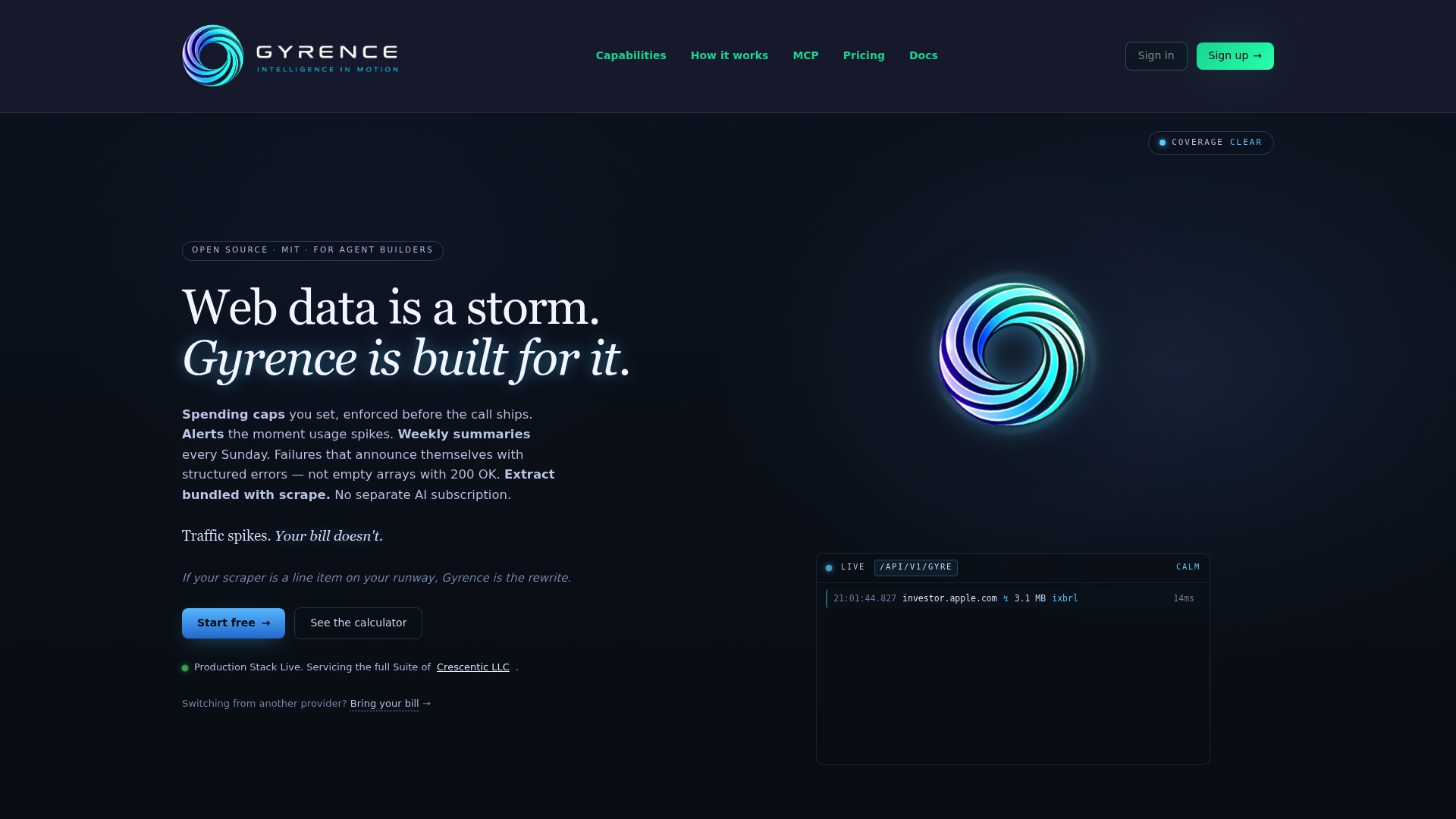
Gyrence is built for exactly the workflows this checklist describes. It ships five composable primitives: Search, Traverse, Fetch, Extract, and Map. Every call returns a typed, discriminated-union response, including the failure cases, so your agents can reason about results instead of guessing. Spending caps are built in at the API level, not bolted on after the fact. There are no surprise overages. Gyrence also ships a hosted MCP endpoint for direct agent integration and bundles LLM extraction so you are not paying separately for every layer of your stack. If you are building a reliable web data pipeline for AI agents or data teams, Gyrence is worth a serious look.
FAQ
What is a web data API evaluation checklist?
A web data API evaluation checklist is a structured set of criteria covering reliability, pricing, performance, security, and developer experience that teams use to assess an API before integration. It prevents production failures by surfacing risks during the evaluation phase.
What uptime SLA should i require from a web data API?
Standard APIs commit to 99.9% uptime. Top-tier APIs require 99.99% availability with incident response under 15 minutes. Choose the tier that matches your pipeline's tolerance for downtime.
How do i test pricing transparency for a scraping API?
Run a 10x volume stress test by modeling costs at ten times your expected usage. Credit-based pricing models carry the highest risk of rapid budget exhaustion without granular spending caps in place.
Why do AI agents need structured error responses from web data apis?
AI agents cannot execute retry or fallback logic from a generic HTTP 500. Typed JSON error responses with machine-readable codes let agents reason about failures autonomously without human intervention.
How do i verify anti-bot bypass claims before committing?
Run a pilot test against your ten highest-priority target domains. Published coverage claims like "96% web coverage" are marketing numbers. Independent tests on your specific targets are the only reliable verification method.