
TL;DR:
- Web data for competitive intelligence involves collecting and analyzing publicly available online information to generate real-time business insights. Sharing CI insights across teams enables companies to respond 23% faster to market shifts than organizations with siloed data.
Web data for competitive intelligence is the systematic collection and analysis of publicly available online information to produce real-time, decision-ready business insights. The industry term for this practice is competitive intelligence, or CI, and web data is now its primary raw material. Companies that share CI insights across departments respond to market shifts 23% faster than organizations that keep those insights siloed. That gap is not a rounding error. It is the difference between pricing ahead of a competitor move and reacting to one.
How do analysts build a competitive intelligence data feed from web sources?
Building a reliable CI data feed starts with defining scope before writing a single line of collection code. Analysts who skip this step end up with enormous datasets that answer no specific question. Start with the business question, then work backward to the data source.
The most productive public web data sources for CI programs include:
- Competitor pricing pages and product catalogs for real-time price and assortment tracking
- Job postings as leading indicators of competitor investment areas and technology bets
- Customer review platforms for early defect detection and sentiment shifts
- Press releases and investor relations pages for strategic announcements
- Shipping and logistics data as a proxy for inventory and demand signals
Automated web scraping handles the collection layer, but accuracy and timeliness matter more than volume. An API or official data feed is always preferable where one exists. It reduces legal friction and produces cleaner, more consistent records. Geographic targeting also matters. Collecting pricing data from a single region can distort your picture of a competitor's global strategy.
Pro Tip: Write your business question on a whiteboard before you configure any collection job. Every data source you add should trace directly back to that question. If it cannot, cut it.

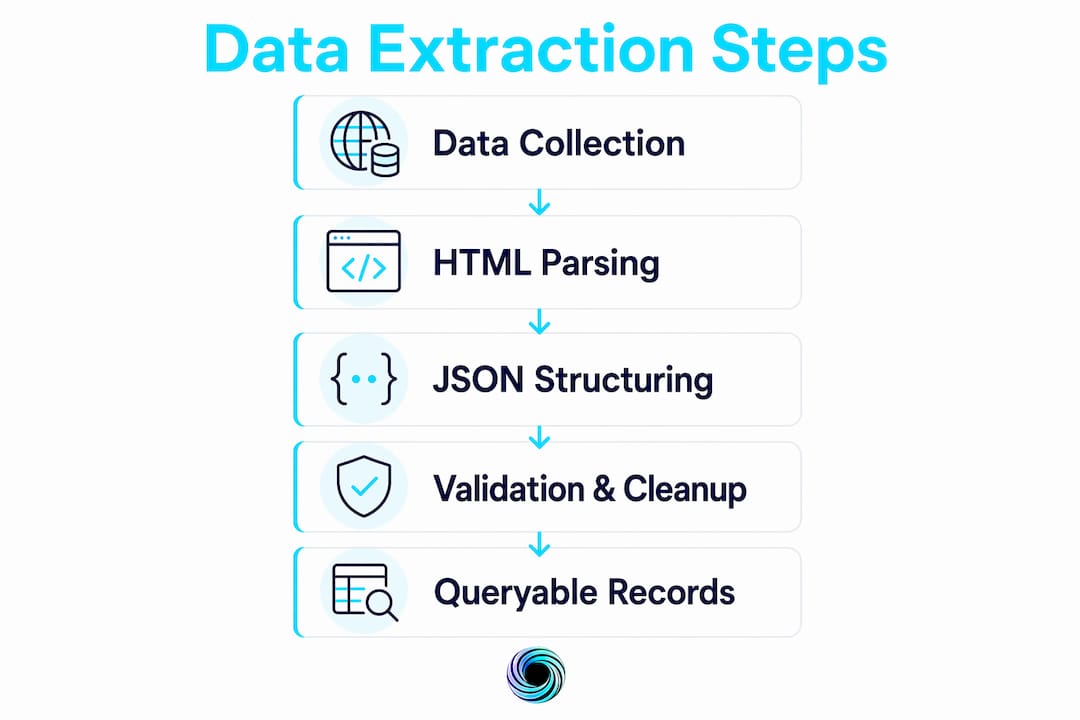
The structured JSON extraction step transforms raw HTML into typed records your analysts can actually query. Without it, you have a pile of text, not a data feed.
What technical challenges arise in web data collection for CI in 2026?
The anti-bot environment in 2026 is materially harder than it was two years ago. Sites have moved well past IP-based blocking. The dominant defense is now browser fingerprinting, which examines the full stack of signals a browser emits: User-Agent strings, TLS handshake parameters, client hints, and hardware signals like screen resolution and GPU renderer.
The most common scraper mistake is over-randomization. Randomizing every fingerprint signal actually raises detection risk because real browsers emit internally consistent signals. A Chrome 124 instance on a MacBook Pro has a predictable, coherent fingerprint. A scraper that randomizes each field independently looks like no real device on earth.
The subtler problem is soft blocking. Soft blocking occurs when a target site serves incomplete or corrupted data instead of a hard 403 error. Your pipeline reports success. Your HTTP status codes look clean. But the pricing fields are empty, or the product names are truncated. Downstream analytics break silently.
Overcoming these challenges requires:
- Browser orchestration tools that maintain consistent, realistic hardware and software personas across sessions
- Real-time validation logic that checks field completeness and logical consistency, not just HTTP status codes
- Dedicated scraping APIs that manage fingerprint coherence and session state on your behalf
Automated data validation is no longer optional. Raw, unvalidated pipelines fail too often to support production CI programs.
Pro Tip: Log full provenance metadata for every record: source URL, crawl timestamp, and session ID. This creates an audit trail you will need for both debugging and regulatory review.
How do you run compliant CI using public web data under 2026 regulations?
Compliance in 2026 is an operational discipline, not a legal checkbox. Large-scale CI data aggregation now triggers mandatory Data Protection Impact Assessments under several data protection frameworks. If your program combines public web data with internal customer records, a DPIA is required before collection begins.
The foundational compliance practice is the CI Intent Record. This is a documented statement specifying what data you collect, from which sources, for which business purpose, and for how long you retain it. CI Intent Records serve as the authorization anchor for every data record your pipeline produces.
A compliant CI program in 2026 follows this sequence:
- Define collection scope in writing before any scraping begins, naming specific sources and data fields
- Implement automated PII detection to flag and pseudonymize any personal data that enters the pipeline inadvertently
- Set retention policies with hard deletion dates tied to the stated business purpose
- Honor robots.txt and crawl-delay directives, and prefer official APIs where available
- Conduct a DPIA for any project processing large volumes of web data combined with internal records
- Maintain a complete audit trail linking every data record to its CI Intent Record ID
Respecting robots.txt and crawl-rate limits is both a legal risk reducer and a reliability improvement. Sites that detect aggressive crawling respond with soft blocking, which corrupts your data before you even notice. The web data quality standards your program needs to meet in 2026 are more specific than most teams expect.
What business results does web data intelligence actually produce?
Real-time CI data drives measurable outcomes across multiple business functions. The table below maps common functions to the web data signals that feed them.
| Business function | Web data signal | Example outcome |
|---|---|---|
| Pricing strategy | Competitor pricing pages | Same-day price adjustments before a promotional window |
| Product development | Customer review platforms | Early defect detection before a product recall |
| Demand planning | Job postings and shipping data | Leading indicator of competitor capacity expansion |
| Brand monitoring | News and social aggregators | Rapid response to negative press or viral complaints |
| Market entry | Geographic pricing and catalog data | Identification of underserved regional segments |
The change detection approach produces the most useful signals. Storing historical snapshots and diffing them over time surfaces the moves competitors are trying not to announce. A pricing page that quietly drops a SKU tells you more than a press release. Monitoring investor relations pages for new filings, as described in this change detection analysis, illustrates exactly how subtle those signals can be.
The 23% faster market response that shared CI programs produce is not automatic. It requires integrating web data outputs with sales, product, and finance teams on a regular cadence, not just delivering a monthly report to a single stakeholder.
Key Takeaways
Web data for competitive intelligence produces its highest value when collection is scoped tightly, validated automatically, and shared across teams rather than held by a single function.
| Point | Details |
|---|---|
| Define scope before collecting | Write the business question first; every data source must trace back to it. |
| Validate in real time | Soft blocking corrupts data silently; check field completeness, not just HTTP status. |
| Document CI intent formally | Every record needs a CI Intent Record ID for audit and regulatory compliance. |
| Prioritize change detection | Diffing historical snapshots surfaces competitor moves that static data misses. |
| Share insights cross-functionally | Teams that distribute CI insights respond to market shifts 23% faster. |
The discipline most CI programs are still missing
Most CI programs I have seen fail at the same point. They invest heavily in collection infrastructure and almost nothing in validation and governance. The pipeline runs, the data lands in a warehouse, and analysts trust it because the job completed without errors. That trust is misplaced.
Soft blocking is the failure mode that kills CI programs quietly. You do not get an alert. You get a pricing dataset where 15% of the fields are empty, and you do not find out until a pricing decision goes wrong. The fix is not more sophisticated scraping. It is validation logic that treats a missing field as a failure, not a null.
The compliance side has the same pattern. Teams treat the DPIA as a one-time document rather than a living record. Regulations in 2026 expect you to update it when your collection scope changes. Building internal consensus on CI intent, as the compliance frameworks now require, is actually a forcing function for better program design. It makes you articulate what you are trying to learn and why. That discipline produces better data feeds, not just safer ones.
The teams that get this right treat CI as an ongoing operational function with defined owners, review cycles, and quality metrics. They are not running one-off scraping projects. They are running a data product.
— Glen
Gyrence and the infrastructure behind reliable CI programs
CI programs that reach production scale need infrastructure that handles fingerprint coherence, structured extraction, and provenance logging without custom engineering for each new source. Gyrence is built for exactly that workload.
Gyrence provides five composable API primitives: Search, Traverse, Fetch, Extract, and Map. Each call returns a typed, discriminated-union response that includes failure cases, so your validation logic has something concrete to act on instead of guessing at empty fields. Spending caps mean your collection costs stay predictable. Bundled LLM extraction means you get structured JSON out of any page without building a separate parsing layer. For CI teams that need agent-ready web data with audit-grade provenance, Gyrence removes the infrastructure work that slows programs down.
FAQ
What is web data for competitive intelligence?
Web data for competitive intelligence is the collection and analysis of publicly available online information, including pricing pages, job postings, and review platforms, to produce real-time business insights that inform strategy.
How do I avoid soft blocking in CI scraping?
Soft blocking is best detected through field-level validation logic that flags incomplete or anomalous records immediately. Relying on HTTP status codes alone will miss it.
What is a CI Intent Record?
A CI Intent Record is a documented statement specifying what data a program collects, from which sources, for what business purpose, and for how long. It serves as the compliance anchor for every data record in the pipeline.
When is a DPIA required for competitive intelligence?
A Data Protection Impact Assessment is required when a CI program processes large volumes of public web data combined with internal records. This became a formal requirement under several data protection frameworks in 2026.
Why does change detection outperform static snapshots in CI?
Change detection surfaces competitor moves that static data misses, such as a quietly dropped SKU or a revised pricing tier. Diffing historical snapshots over time produces signals that a single point-in-time collection cannot reveal.