
TL;DR:
- Web data for credit research involves collecting online signals like digital footprints and corporate disclosures to improve risk assessment. Incorporating permissioned data with advanced machine learning enhances model accuracy, speed, and coverage while complying with FCRA regulations. Proper management of data quality and adaptability is essential for effective, compliant credit decision models.
Web data for credit research refers to the collection and analysis of online signals, including digital footprints, alternative financial data, and corporate disclosures, to improve credit risk assessment beyond what traditional bureau files provide. The industry term for this practice is "alternative data integration," and it is reshaping how analysts evaluate borrower risk in 2026. The Fair Credit Reporting Act (FCRA) governs how this data can be used in the United States, making compliance a non-negotiable part of any credit data workflow. Analysts who understand both the signal types and the legal guardrails will build more defensible, more accurate credit models.
What types of web data are most valuable for credit research?
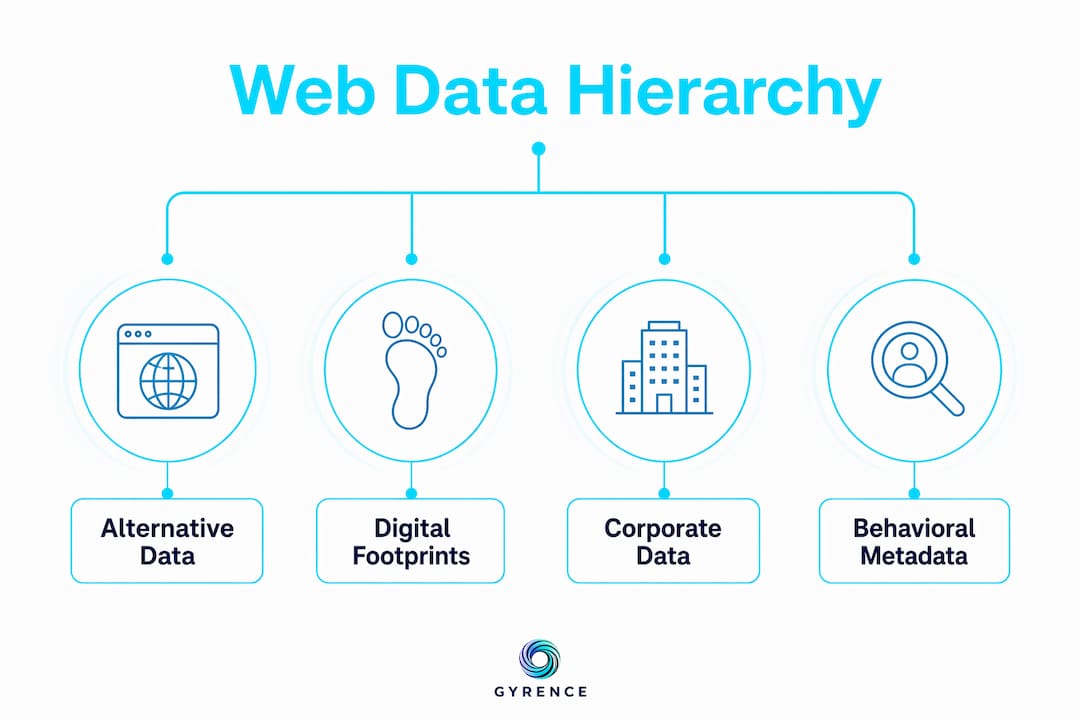
Web data for credit analysis falls into four distinct categories, each with different predictive power and collection complexity.
Digital footprint signals are the most granular category. Modern credit scoring models analyze 300 to 400 data points per applicant, including premium device ownership, subscription consistency, and professional network presence. That volume of signals gives analysts a behavioral portrait of a borrower that a FICO score alone cannot produce.
Alternative financial data carries the highest predictive weight. Permissioned cash flow data from bank transaction APIs, payroll records, and utility and rent payment histories are classified as "Very High" predictive power in credit risk modeling. This category requires explicit borrower consent, which also makes it the most defensible in a regulatory review.
Corporate web data serves institutional credit research. Analysts extract SEC/EDGAR filings, company websites, and news sentiment feeds to assess corporate creditworthiness. Real-time extraction from SEC filings delivers faster, investment-grade intelligence than waiting for vendor data packages. Speed matters when credit conditions shift quickly.

Behavioral metadata rounds out the picture. Device fingerprinting, session behavior, and biometric signals during application flows help detect synthetic fraud before it enters the credit model.
Pro Tip: Build a signal registry that maps each web data category to its FCRA classification before you write a single line of extraction code. Retrofitting compliance is far more expensive than designing for it upfront.
How is web data integrated into credit scoring models?
Turning raw web signals into credit model inputs requires a structured pipeline. The steps below reflect how production-grade teams actually build these workflows.
-
Extract from source. Web scraping pipelines pull data from public corporate disclosures, news feeds, and regulatory databases. Automated pipelines that combine XBRL financial data extraction with machine learning schema mappings allow efficient multi-year financial spread construction for covenant analysis.
-
Clean and validate. Raw web data contains noise: duplicate records, inconsistent date formats, and missing fields. Accounting-identity checks reconcile scraped regulatory data against internal financial models, flagging discrepancies before they corrupt a credit score.
-
Engineer features. Raw signals become model inputs through feature engineering. A borrower's subscription consistency score, for example, is derived from multiple raw signals across time, not a single data point.
-
Model with appropriate algorithms. Gradient boosting and neural networks are the standard for handling unstructured and heterogeneous web data. Traditional logistic regression cannot handle the dimensionality or the non-linear relationships that web signals produce.
-
Combine with vendor feeds. Successful firms treat web data extraction as a complement to traditional vendor feeds, not a replacement. The hybrid approach fills coverage gaps and reduces dependency on any single data source.
Pro Tip: Run your web-sourced features through a stability test before adding them to a production model. A feature that predicts well in one quarter but disappears from the web in the next will silently degrade your model's accuracy.
What regulatory and compliance considerations apply to web data in credit research?
Compliance is the constraint that determines which web signals you can actually use, not just which ones are technically available.
The FCRA sets the baseline in the United States. Any data used to make a credit decision about a consumer must meet FCRA standards for accuracy, permissibility, and dispute resolution. Permissioned data paths such as account aggregators are the accepted mechanism for ensuring that cash flow and transaction data aligns with these requirements.
Key compliance considerations for credit analysts include:
- Consent and permissioning. Data collected without explicit borrower consent creates legal exposure, regardless of its predictive value.
- Auditability. Every signal used in a credit decision must be traceable to its source and explainable to a regulator or a borrower who disputes the outcome.
- Data quality standards. The Consumer Financial Protection Bureau (CFPB) and federal banking regulators expect that alternative data inputs meet the same accuracy standards as bureau data. Analysts should consult FCRA and data defensibility guidance before deploying new signal categories.
- Fraud risk. Enriched web data actually reduces synthetic fraud risk by cross-referencing applicant-supplied information against independent online signals. A borrower who claims a professional credential that does not appear anywhere in their digital footprint is a higher-risk profile.
- Bias and fairness. Web signals can encode demographic proxies. Any model using alternative data requires fairness testing under Equal Credit Opportunity Act (ECOA) standards.
How can credit researchers apply web data to improve decisions?
The practical payoff from web data integration shows up in four areas: coverage, speed, early warning, and fraud detection.
Thin-file and no-file borrowers are the clearest use case. Data enrichment with alternative online signals fills gaps in borrower profiles using email and phone lookups, social media presence, e-commerce activity, and device information. Analysts who rely solely on bureau files will decline creditworthy applicants who simply lack a credit history.
Early deterioration signals give analysts time to act. A borrower whose subscription services start lapsing, whose professional network activity drops, or whose device type downgrades may be showing financial stress weeks before a missed payment appears on a bureau report.
Operational speed improves when web data pipelines deliver real-time updates. Automated alerts can flag a corporate borrower's negative news sentiment or a new regulatory filing the same day it appears, rather than waiting for a quarterly vendor data refresh.
Successful credit research teams treat their web data pipelines as integrated workflow suites, not just raw data sources. These suites include data validation, risk factor extraction, stress testing, and automated report generation. That architecture is what separates a research-grade pipeline from a one-off scraping script.
Pro Tip: Start with a single high-value signal category, such as cash flow data for thin-file applicants, and measure its lift on approval rates before expanding your pipeline. Incremental validation builds institutional confidence faster than a full-stack rollout.
Key Takeaways
Web data integration is the most direct path to improving credit model coverage and decision speed without replacing existing bureau infrastructure.
| Point | Details |
|---|---|
| Signal volume matters | Modern digital footprint models analyze 300–400 data points per applicant to improve thin-file approvals. |
| Permissioned data is non-negotiable | FCRA compliance requires consented, auditable data paths for any signal used in a credit decision. |
| Machine learning is required | Gradient boosting and neural networks handle the dimensionality of web data that logistic regression cannot. |
| Hybrid pipelines outperform single sources | Combining vendor feeds with custom web extraction fills coverage gaps and reduces single-source dependency. |
| Early signals beat lagging indicators | Web-based behavioral changes can flag credit deterioration weeks before a bureau report reflects it. |
The signal quality problem nobody talks about
Most conversations about web data in credit research focus on what signals to collect. The harder problem is signal quality, and I have seen it sink otherwise well-designed models.
Web data is a storm. Pages change structure without notice, companies remove disclosures, and behavioral signals shift meaning across economic cycles. A subscription consistency score that predicted default risk accurately in 2023 may measure something entirely different in 2026 if the subscription economy itself has changed. High-quality web data extraction requires domain expertise in financial reporting conventions, not just engineering skill.
The analysts I respect most treat their web data pipelines as living systems. They monitor feature drift, run regular stability checks, and maintain documentation that a compliance officer can actually read. The future of credit research favors AI-native scoring models that adapt to dynamic signals. But adaptive models built on unstable data inputs will adapt in the wrong direction. Get the data quality right first. The model sophistication can follow.
— Glen
Gyrence and structured web data for credit research
Credit research teams need web data that arrives clean, structured, and on a predictable cost basis. Gyrence delivers exactly that through five composable API primitives: Search, Traverse, Fetch, Extract, and Map. Each call returns a typed, discriminated-union response, including failure cases, so your pipeline knows what it received rather than silently processing bad data.
For analysts building SEC disclosure pipelines or extracting financial documents into structured JSON, Gyrence handles the extraction layer so your team focuses on the analysis. Spending caps and structured failure modes mean your scraping costs stay predictable, even at scale. Explore what Gyrence can do for your credit research workflows at gyrence.com.
FAQ
What is web data for credit research?
Web data for credit research is the use of online signals, including digital footprints, alternative financial data, and corporate disclosures, to assess credit risk beyond traditional bureau files. It is also called alternative data integration in the industry.
What web data signals have the highest predictive power?
Permissioned cash flow data from bank transaction APIs and payroll records carries the highest predictive power in credit risk modeling. Digital footprint signals such as subscription consistency and device type also contribute meaningfully, especially for thin-file applicants.
Is web scraping for credit research legal?
Web scraping is legal when it targets publicly available data and complies with a site's terms of service. Consumer credit decisions in the United States must also meet FCRA requirements, which means any scraped signal used in a credit decision must be accurate, permissioned, and auditable.
What machine learning models work best with web data?
Gradient boosting and neural networks are the standard choices for credit models that incorporate web-sourced signals. Traditional logistic regression cannot handle the dimensionality or non-linear relationships that alternative data produces.
How does web data help thin-file borrowers?
Data enrichment using online signals such as email lookups, social media presence, e-commerce activity, and device information fills gaps in borrower profiles that bureau files leave empty. This allows analysts to make informed credit decisions for applicants who have little or no traditional credit history.