
TL;DR:
- Web data must be collected with provenance-first processes, including detailed documentation of its origin and transformation. Regulatory research benefits from continuous monitoring, structured signals, and an audit trail to ensure compliance and fast risk detection. Building pipelines with typed failure responses, strict source hierarchy, and verifiable evidence makes data defensible and legally sound.
Web data is only as useful as your ability to defend it. For regulatory research, that means three things from the start: provenance-first ingestion, an API-first source hierarchy, and explicit mapping of external signals to internal risk models. Bodies like the EDPB, CNIL, and practitioners at Promise Legal have all converged on the same expectation: if you cannot show what you collected, when, and how you transformed it, the data is a liability, not an asset.
Quick-check before you build anything:
- Source hierarchy: official API or bulk download endpoint first, licensed feed second, authenticated portal only where permitted, scraping as last resort with documented governance checkpoints
- Evidence to capture per request: raw payload (HTML/PDF/JSON), request headers, HTTP status, content checksum (SHA-256 or equivalent), parser version, timestamp, actor identity
- Operational controls: typed failure responses (never silent), per-source spending caps, freshness SLOs, and human-in-the-loop approval for restricted sources
Table of Contents
- What can web data actually deliver for regulatory research?
- Legal and compliance checklist for US organizations
- How do you build an audit-ready provenance trail?
- Technical patterns for API-first, LLM-ready ingestion
- How do you map regulatory signals to internal risk models?
- What failure modes should you plan for?
- Implementation checklist and a sample audit artifact
- How do you choose a web data provider for regulatory research?
- Key Takeaways
- The tradeoff most teams underestimate
- Gyrence gives you the primitives to build this right
- Useful sources and primary references
- FAQ
What can web data actually deliver for regulatory research?
Regulatory teams that treat web data as a passive archive miss the real value. The payoff comes from continuous, structured monitoring that feeds directly into decision workflows.
Concrete use cases:
- Agency rulemaking: tracking Federal Register notices, OMB submissions, and agency comment periods as they publish
- Sanctions and watch-lists: OFAC SDN list updates, BIS Entity List changes, and state-level equivalents
- Enforcement actions: SEC, FTC, and CFPB enforcement bulletins that signal shifting interpretive priorities
- Product and supplier risk: mapping ingredient or component changes against FDA, EPA, or USDA guidance updates
- Audit evidence bundles: timestamped, signed captures that counsel can hand to a regulator without reconstruction
Outcomes that matter:
- Faster risk detection: a sanctions-list update captured very shortly after publication, not relying on manual next-day checks
- Defensible audit artifacts: raw payload plus signed hash means you can prove exactly what the source said on a given date
- Automated obligation mapping: signals routed to the right product, supplier, or matter without manual triage
- Reduced legal exposure: audit-ready provenance means counsel can answer a regulator's questions from the record, not from memory
"Regulatory intelligence delivers real value when external regulatory changes are mapped to internal risk models — collection alone is insufficient." — Promise Legal
Legal and compliance checklist for US organizations
US organizations scraping or ingesting web-derived regulatory data face a layered legal environment. Domestic law (Computer Fraud and Abuse Act, state privacy statutes, terms of service) governs the collection act itself. Cross-border data flows involving EU residents trigger GDPR obligations, and both the EDPB Guidelines 03/2026 and CNIL's legitimate-interest framework set concrete expectations that US teams cannot ignore when their pipelines touch EU-origin data.
Checklist:
- Classify data before collection: public regulatory text vs. personal data vs. special-category data (health, political opinion)
- Review terms of service and robots.txt for every source; the EDPB treats robots.txt and CAPTCHAs as signals in the legitimate-interest balancing test
- Document a three-part legitimate-interest test: purpose, necessity, and balancing against data subjects' rights
- Implement pre-collection filters to exclude special-category data automatically; CNIL requires you to demonstrate this capability
- Publish a public privacy notice where individual notice is impractical
- Establish a retention and deletion schedule per data category
- Define incident response for takedown requests, legal holds, and data-subject access requests
Pro Tip: Run a gap analysis against the ARDC responsible collection guidelines before your first production crawl. ARDC recommends project-level metadata recording and an abuse-reporting channel — both are cheap to add early and expensive to retrofit.
Reed Smith's analysis of the EDPB guidelines confirms that consent is rarely viable at scale for web scraping; legitimate interest with a documented three-part test is the practical basis, but it requires real safeguards, not boilerplate.
How do you build an audit-ready provenance trail?
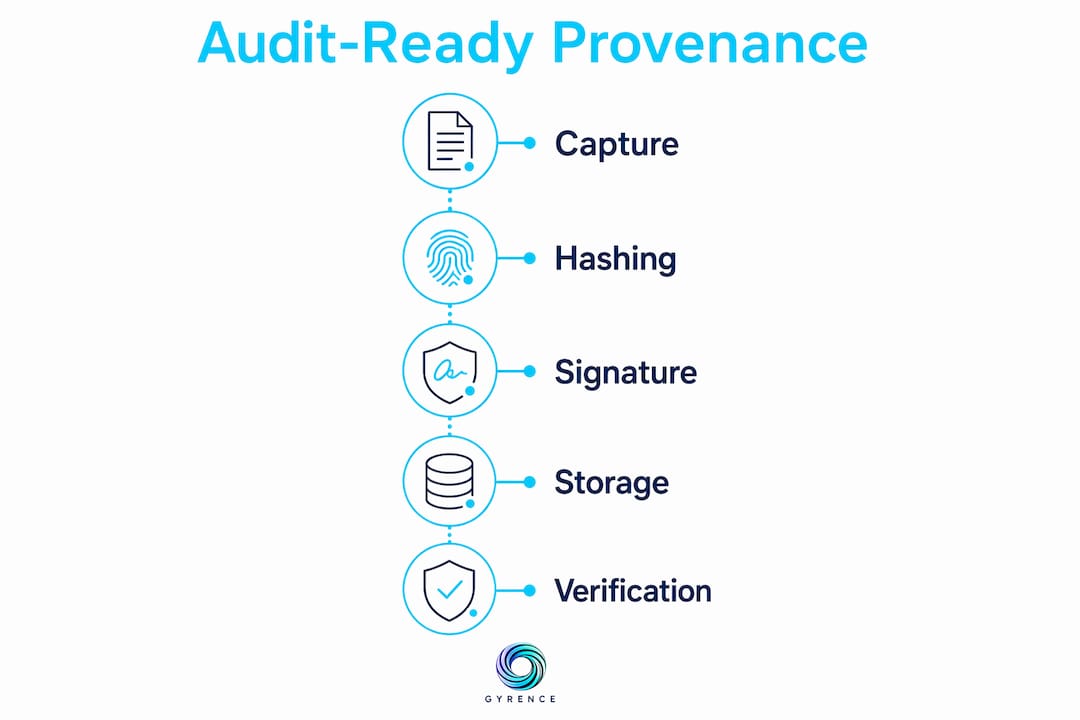
Reproducibility is the standard. An auditor — or opposing counsel — should be able to reconstruct exactly what your pipeline saw on a given date. Promise Legal's guidance defines the minimum evidence model: raw payload, request metadata, cryptographic checksum, parser version, derived artifact IDs, and actor identity.
| Field | What to store | Retention guidance |
|---|---|---|
| Raw payload | Original HTML/PDF/JSON response | Full retention period of the matter |
| Request metadata | URL, headers, HTTP status, parameters | Same as raw payload |
| Content checksum | SHA-256 of raw payload | Permanent (small, cheap) |
| Parser/schema version | Git commit hash or semver tag | Permanent |
| Timestamp | UTC ISO-8601 of request | Permanent |
| Actor identity | Service account or user ID | Permanent |
| Derived artifact ID | UUID linking raw to processed output | Same as derived artifact |
Store raw and derived artifacts separately. Raw captures go to an immutable store (append-only object storage with object-lock enabled). Derived artifacts — cleaned markdown, extracted JSON, embeddings — live in a versioned layer that references the raw record by checksum.
"Successfully defending web-collected evidence requires storing raw payloads, signed hashes, and parser/version metadata so you can answer what you saw, when you saw it, and how you transformed it." — Promise Legal
Pro Tip: Sign each raw capture with a content-addressable hash at write time and store the hash in a separate, append-only log. If the raw file is ever questioned, the log proves it has not been modified.
Technical patterns for API-first, LLM-ready ingestion
The API-first decision hierarchy is the defensible default: official APIs and bulk endpoints first, licensed feeds second, authenticated portals only where permitted, scraping as last resort. Every step down the hierarchy adds governance cost.
Core pipeline primitives:
- Connector/adapter per source: encapsulates auth, rate limits, and retry logic; versioned independently
- Raw capture store: immutable, append-only, checksum-indexed
- Versioned parsers: each parser tagged with a semver or commit hash; parser changes trigger re-extraction, not silent overwrite
- Normalized schema (structured JSON): consistent field names across sources; schema version stored with each record
- Dedupe/idempotency: content-hash key prevents duplicate ingestion on re-crawl
- Index and vector store: downstream LLM retrieval over structured, agent-ready outputs
A minimal connector skeleton:
record = {
  "source_id": "ofac-sdn-bulk",
  "request_url": url,
  "request_headers": dict(response.headers),
  "http_status": response.status_code,
  "raw_payload": response.content,
  "content_checksum": sha256(response.content),
  "parser_version": "v1.4.2",
  "captured_at": utcnow_iso8601(),
  "actor": service_account_id,
}
raw_store.put(record["content_checksum"], record)
Pro Tip: Use the content checksum as your idempotency key. If the same hash arrives twice, skip re-extraction. This also gives you a free change-detection signal: a new hash means the source changed.
For structured JSON extraction from unstructured regulatory pages, prompt-driven or schema-driven extraction produces LLM-friendly outputs without losing the raw capture that backs them.

How do you map regulatory signals to internal risk models?
Collecting signals is step one. Routing them to the right decision is where compliance teams actually save time. Open-source architectures like Meridian demonstrate geo-native, multi-source monitoring that feeds evidence vaults and real-time alerts directly into mandate-mapping workflows.
Mapping workflow:
- Assign a canonical source ID to every regulatory document or list entry
- Classify the signal: rule, guidance, enforcement action, watch-list entry, or product advisory
- Enrich: entity resolution (normalize supplier names), geotag, apply taxonomy (product category, jurisdiction)
- Apply to internal portfolio: match against product SKUs, supplier IDs, or open matters
- Score impact: freshness × source authority × proximity to portfolio
- Route: high-impact signals to expedited human review; low-impact to automated queue
Example mappings:
- OFAC SDN hit on a supplier → trigger supplier blocklist workflow, freeze pending payments
- FDA guidance update on a food additive → queue product-label change review for affected SKUs
- FTC enforcement action in a product category → trigger contract review for affected vendor agreements
What failure modes should you plan for?
Silent failures are the most dangerous. A broken connector that returns no error looks identical to a source with no new updates. ARDC guidelines emphasize internal oversight programs precisely because collection processes fail in ways that are invisible without explicit monitoring.
Failure modes and mitigations:
- Silent connector failure: typed failure responses (not null, not empty array) so downstream agents know the call failed
- Provenance loss: raw capture store is mandatory, not optional; never derive without storing the source
- Schema drift: parser error-rate alerts; version every parser; re-extract on version bump
- Cost runaway: per-source spending caps and crawl-rate throttles; your budget should not depend on a source staying small
- Legal/ToS conflict: human-in-the-loop approval gate for any authenticated or restricted source before first crawl
Monitoring rules:
- Freshness SLO per source: alert if a high-priority source has not updated within its expected cadence
- Completeness check: record count vs. expected range; a sudden drop is a connector failure, not a quiet day
- Parser error-rate threshold: more than 5% parse failures on a stable source signals schema drift
- Triage priority: sources tied to sanctions or enforcement actions get P1 alerts; product-guidance sources get P2
Implementation checklist and a sample audit artifact
Checklist for an audit-ready regulatory data pipeline:
- Source inventory: list every source, its legal basis, and its API or access method
- Legal review: documented balancing tests, ToS review, robots.txt check per source
- Connector per source: versioned, with typed failure responses
- Raw capture store: immutable, append-only, checksum-indexed, access-controlled
- Versioned parsers: semver or commit-hash tagged; re-extraction on version change
- Index and access controls: role-based access; raw and derived artifacts separated
- Retention policy: per data category, per jurisdiction, documented and enforced
- Incident response: takedown, legal hold, and data-subject request procedures
Sample capture record (retention tag included):
{
  "record_id": "uuid-v4",
  "source_id": "sec-edgar-bulk",
  "captured_at": "2026-03-15T14:22:00Z",
  "content_checksum": "sha256:abc123...",
  "parser_version": "v2.1.0",
  "actor": "ingest-svc@org.internal",
  "retention_class": "regulatory-evidence",
  "retain_until": "2033-03-15",
  "redistribution": "internal-only"
}
A regulator-ready artifact bundle contains: raw files, a manifest listing every record ID and checksum, signed checksums, parser version tags, and request logs. The veritas-eudr architecture demonstrates this ingest-to-validate-to-evidence-trail pattern with replay endpoints, which is the right model for any compliance-grade pipeline.
Pro Tip: For restricted or licensed sources, add a redistribution field to every capture record at write time. It costs nothing and prevents accidental sharing during an audit or litigation hold.
How do you choose a web data provider for regulatory research?
Vendor evaluation for regulatory use cases is stricter than for general analytics. The wrong provider creates liability. For cybersecurity and legal compliance controls, the same principle applies: the tool must support the governance model, not undermine it.
Selection criteria:
- Audit-ready provenance: does the provider return raw payloads, request metadata, and content checksums, or only processed output?
- Typed failure responses: does every call return a discriminated-union response that names the failure mode explicitly?
- Spending caps: can you set hard limits per source or per time period so a runaway crawl cannot blow your budget?
- Structured JSON extraction: schema-driven or prompt-driven extraction with schema versioning?
- API-first connectors: official API support, not just HTML scraping?
- Security and segmentation: can raw and derived artifacts be stored in separate, access-controlled locations?
- Legal and terms transparency: does the provider document which sources are licensed vs. scraped?
Validation steps:
- Request a sample evidence bundle: raw payload, checksum, parser version, and request log for a single capture
- Test incremental sync: verify ETag/If-Modified-Since handling and that unchanged sources do not generate duplicate records
- Verify role-based access: confirm raw and derived artifact separation in the provider's storage model
- Run a short proof-of-concept on one high-impact source before committing to a full pipeline
Gyrence's five primitives (Search, Traverse, Fetch, Extract, Map) map directly to these criteria: every call returns a typed response including failure cases, spending caps are configurable per request, and the Extract primitive produces structured JSON with schema versioning. The single-API access pattern means your connector layer stays thin and auditable. When evaluating AI tooling for legal or compliance workflows, the guidance on choosing AI tools for law and accounting firms applies directly: validate the evidence model before you validate the features.
Key Takeaways
Traceable, API-first ingestion with typed failure responses and documented legal balancing tests is the minimum viable standard for defensible regulatory research with web data.
| Point | Details |
|---|---|
| Provenance is mandatory | Capture raw payload, checksum, parser version, and actor identity for every request. |
| Source hierarchy matters | Prefer official APIs and bulk endpoints; treat scraping as a last-resort option requiring robust governance checkpoints. |
| Legal balancing tests | Document a three-part legitimate-interest test per source before collection begins. |
| Typed failures prevent blind spots | Silent failures look identical to quiet sources; typed responses make the difference explicit. |
| Gyrence maps to each criterion | Gyrence's Extract and Fetch primitives return typed responses, support spending caps, and produce schema-versioned JSON designed to support audit-ready pipelines. |
The tradeoff most teams underestimate
The conventional wisdom is that web scraping is a speed problem. Build fast, iterate, fix the data quality issues later. That framing is wrong for regulatory research, and the cost of getting it wrong is not a bad dashboard: it is a compliance gap you cannot explain to a regulator.
The harder truth is that brittle scraping pipelines are not just technically fragile. They are legally fragile. A connector that silently fails for three days during a sanctions-list update is not a monitoring outage. It is a documented gap in your compliance program. Automation does not eliminate that risk; it just moves it. Governance is what contains it.
Teams that budget for evidence capture, parser versioning, and human validation checkpoints from the start spend less time in crisis mode later. The pipeline that runs quietly for two years and produces a clean artifact bundle on demand is worth more than the one that ingested twice as many sources but cannot answer a single auditor question from the record.
Gyrence gives you the primitives to build this right
Regulatory research pipelines need infrastructure that names its failure modes, not one that hides them. Gyrence is built for exactly that: a single API with five composable primitives (Search, Traverse, Fetch, Extract, Map), typed discriminated-union responses for every call including failures, configurable spending caps, and structured JSON extraction with schema versioning. You get the raw capture, the checksum, and the structured output in one call, without stitching together three separate tools.
For teams ready to evaluate: review the Gyrence API documentation, request a sample evidence bundle from a single high-impact source, and run a short proof-of-concept before committing to a full pipeline. The Gyrence platform is designed so that evaluation is fast and the evidence model is visible from day one.
Useful sources and primary references
| Source | Type | Notes |
|---|---|---|
| EDPB Guidelines 03/2026 on web scraping | Official EU guidance | Legitimate-interest three-part test, robots.txt signals, lifecycle safeguards |
| CNIL legitimate-interest focus sheet | Official French DPA guidance | Special-category filters, reasonable expectations, transparency obligations |
| Promise Legal: API-first compliant AI workflows | Practitioner legal/technical blog | API-first hierarchy, evidence model, audit-record fields |
| ARDC responsible collection guidelines | Technical/governance guidelines | Project metadata, oversight programs, abuse reporting |
| Reed Smith: EDPB scraping guidelines analysis | Law firm practitioner blog | Consent viability, legitimate-interest checklist, gap analysis |
| veritas-eudr (GitHub) | Open-source reference | Ingest-validate-evidence-trail pattern with replay endpoints |
| Meridian (GitHub) | Open-source reference | Geo-native monitoring, evidence vault, regulatory mandate mapping |
| SGS Food Nexus | Industry platform | Mapping external regulatory changes to internal risk models |
FAQ
What is the minimum evidence a regulatory capture record must contain?
At minimum: raw payload, request URL and headers, HTTP status, SHA-256 content checksum, parser version, UTC timestamp, and actor identity. These fields let an auditor reconstruct exactly what your pipeline saw and how it transformed the data.
Does GDPR apply to US organizations scraping EU regulatory websites?
Yes, when the scraped data includes personal data of EU residents. The EDPB Guidelines 03/2026 require a documented legitimate-interest test, pre-collection filters for special-category data, and a public privacy notice even when individual notice is impractical.
Why are typed failure responses critical for regulatory pipelines?
A silent failure (null return, empty array) is indistinguishable from a source with no updates. Typed failure responses name the failure mode explicitly, so downstream agents and monitoring systems can alert and triage rather than assume the source is clean.
How does Gyrence support audit-ready regulatory data collection?
Gyrence returns typed discriminated-union responses for every API call, including failure cases, and its Extract primitive produces schema-versioned structured JSON. Spending caps prevent cost runaway, and the single-API model keeps the connector layer thin and auditable.
What is the correct source hierarchy for regulatory data ingestion?
Official APIs and bulk download endpoints first, licensed third-party feeds second, authenticated portals only where explicitly permitted, and web scraping as last resort with documented governance checkpoints. This hierarchy is defensible to counsel and regulators.