Use webhooks for the fast path, polling when the provider can't push data or your network won't accept inbound traffic, and a hybrid model for anything touching money, fulfillment, or access control. The last case is the default in production systems, not the exception: webhooks deliver the event fast, and a scheduled polling sweep catches what the webhook missed. Nothing here requires a coin flip.
TL;DR:
- Polling is necessary when the provider lacks webhook support or when network restrictions prevent inbound traffic, with interval, cursor-based, or long polling variants available.
- Webhooks function best for real-time events but require a public HTTPS endpoint, signature verification, and retry mechanisms, with at-least-once delivery and potential silent drops.
- Combining webhooks with periodic reconciliation polls ensures data consistency, especially for critical processes involving payments, access, or fulfillment.
- Achieving high reliability requires small, idempotent handlers, durable queuing, event de-duplication, and monitoring of recovery rates, queue depths, and latency.
- Managed services like WebDoppler can replace self-operated webhook receivers, reducing operational overhead while supporting hybrid webhook and polling architectures.
Table of Contents
- What Is Polling and How Does It Work?
- What Is a Webhook and When Does It Fit?
- Webhooks vs Polling: Comparing Latency, Cost, and Risk
- How Do You Decide Between Webhooks, Polling, and Hybrid?
- Building Reliable Receivers and Pollers: An Implementation Checklist
- Running the Hybrid Pattern in Production
- Common Mistakes Teams Make With Webhooks
- A Managed Alternative for Teams Tired of Running Receivers
- Sources
- FAQ
What Is Polling and How Does It Work?
Polling means your system asks a provider "anything new?" on a fixed schedule, instead of waiting for the provider to tell you. It's the older pattern, and it's still the correct one in a specific set of conditions.
Three variants cover most real-world implementations:
- Interval polling: hit an endpoint every N seconds or minutes and compare against the last known state. Simple, but every request costs money and most return nothing new.
- Cursor-based incremental sync: request only records changed since a stored cursor (a timestamp or an opaque token), which cuts payload size and avoids reprocessing.
- Long polling: the server holds the connection open until new data exists or a timeout hits, narrowing the gap between polling and push without a full webhook infrastructure.
Interval choice sets your staleness ceiling directly: poll every 60 seconds and your worst-case data is 59 seconds old. Polling stays the only viable path when the provider offers no webhook support, or when your service sits behind a firewall that can't expose a public endpoint for inbound calls.
What Is a Webhook and When Does It Fit?
A webhook is a provider-initiated HTTP request sent to your endpoint the moment an event happens: a payment clears, a message arrives, a status flips. Instead of you asking, the provider tells you, which is why webhooks are the backbone of real-time data push in modern API communication methods.
The catch is that "real-time" comes with operational strings attached. Microsoft's change notifications documentation describes webhook delivery as a trigger, then recommends fetching authoritative data from the API afterward rather than trusting the payload alone. That single design detail explains most of what makes webhooks work well in production:
- At-least-once delivery: providers retry on failure, so your endpoint will see duplicates. Build for that from day one.
- Public endpoint requirement: your receiver has to be reachable over HTTPS, with a valid TLS certificate.
- Signature verification: every legitimate provider signs its payloads (typically HMAC) so you can confirm the request wasn't forged.
- Retry windows: most providers give up after a bounded number of attempts, usually with exponential backoff.
Webhooks fit payments, chat and messaging, and alerting best, because latency there has a direct cost. The trade is real: shorter latency and far fewer requests, in exchange for a receiver you now have to operate and secure.
Webhooks vs Polling: Comparing Latency, Cost, and Risk
Every polling interval is a bet on how stale data you can tolerate. Poll every five minutes, and your worst-case staleness is five minutes. Push that interval down to catch events sooner, and your request volume rises proportionally. At scale, that math turns brutal fast, since naive polling loops frequently come back empty, meaning most of the requests you're paying for return nothing.
Here's how the two patterns actually stack up:
- Latency: webhooks deliver in near real time; polling is bounded by your interval, full stop.
- Cost: polling multiplies compute and API calls across every polled resource; webhooks concentrate cost into receiver infrastructure instead of call volume.
- Reliability: webhooks can silently drop events during outages or misconfigured endpoints; polling naturally re-checks state, so missed data self-corrects on the next cycle. Ordering guarantees are weak on both sides.
- Security: webhooks need TLS, HMAC signature verification, and often IP allow lists; polling only needs standard outbound TLS and API key management, which is a smaller attack surface.
- Rate limits: polling eats into rate limits directly since every check is a call; webhooks don't touch your rate limit at all until the resulting data fetch happens.
Neither pattern wins outright. They fail in different directions, which is exactly why most serious integrations end up running both.
How Do You Decide Between Webhooks, Polling, and Hybrid?
Five questions, answered in order, get you to a defensible choice faster than any vendor comparison chart will.
- Does the provider offer webhooks at all? If not, polling is your only option. Stop here.
- Can your infrastructure accept inbound public HTTPS traffic? If your service sits behind a corporate firewall with no path to expose an endpoint, polling wins by default.
- Does the workflow depend on sub-minute freshness? If yes, webhooks (or long polling as a fallback) are close to mandatory.
- Does missing an event cost money, break fulfillment, or affect access control? If yes, don't run webhooks alone. Add a reconciliation poll.
- What's your webhook recovery rate once you're running both? If reconciliation is consistently recovering more than 1% of events that the webhook missed, that's not noise. It's a signal your webhook delivery has a systemic reliability problem worth investigating.
Pro Tip: Default to hybrid for anything touching money, fulfillment, or access control, even if your recovery rate looks fine today. The cost of building reconciliation later, after a customer notices a missed payment event, is always higher than building it up front.
Building Reliable Receivers and Pollers: An Implementation Checklist
Idempotency is not optional. Because webhook providers deliver at-least-once, duplicate and out-of-order deliveries are a normal operating condition, not an edge case.
For webhook receivers:
- Return a
200immediately, before doing any real work. Don't let processing time block the acknowledgment. - Verify the HMAC signature using a timing-safe comparison, never a plain string equality check.
- Enqueue the verified event to a durable queue (SQS, RabbitMQ, or BullMQ) instead of processing inline.
- Route repeated failures to a dead-letter queue (DLQ) for manual inspection.
- Rotate signing secrets on a schedule, and support graceful key rollover.
For pollers, use cursor-based sync with a durable checkpoint, apply backoff with jitter on failure, and batch requests to avoid overlapping ranges that double-process the same window.
Across both systems: dedupe by event ID against an event store, keep an audit log, and schedule your reconciliation job explicitly rather than running it ad hoc. Watch three metrics daily: recovery rate, queue depth, and processing latency. A recovery rate creeping upward is your earliest warning that something in the webhook path is degrading.
Running the Hybrid Pattern in Production
The production-ready version of this pattern looks the same across most companies once you strip away vendor-specific details. A thin webhook payload arrives, gets its signature verified, and lands in a durable queue. A worker then does the authoritative fetch (per Microsoft's own guidance) and performs an idempotent upsert against your data store, keyed by event ID.
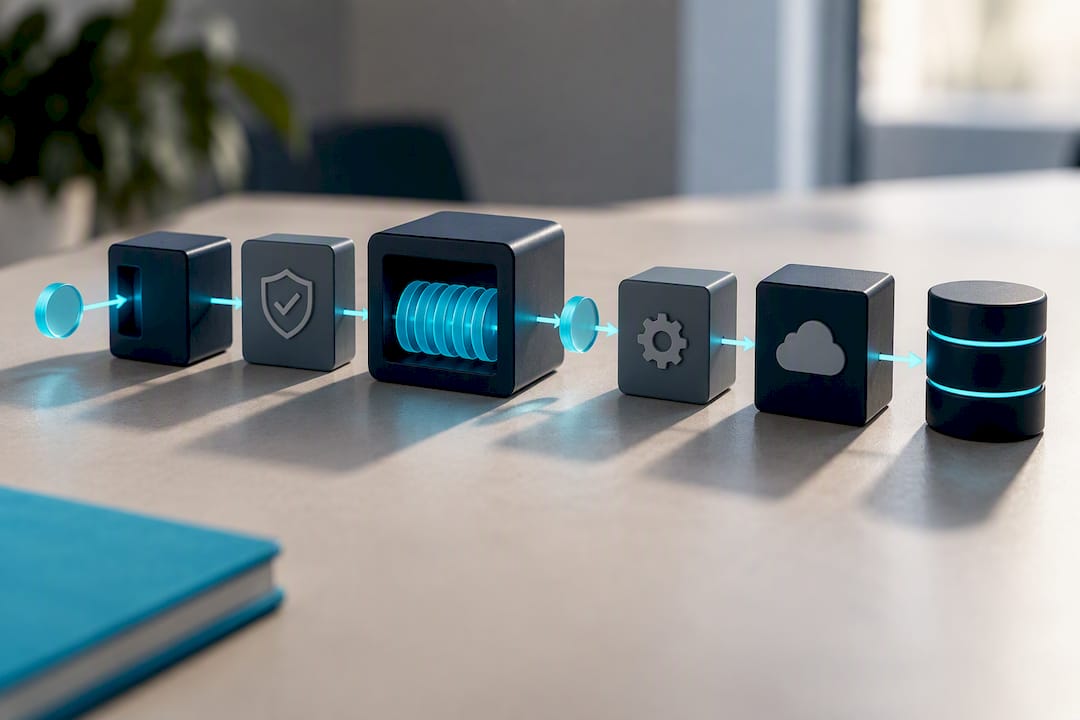
Running alongside that fast path, a reconciliation poll sweeps every 15 to 60 minutes depending on how much staleness the business can absorb, backfilling anything the webhook missed. This is the pattern behind single-API ingestion pipelines built for production reliability rather than demo speed.
Above that consistently, treat it as a webhook health incident, not routine noise.
- Set up alerts to notify when the recovery rate unexpectedly increases.
- Alert on a DLQ that's growing instead of draining.
- Alert on sustained queue depth, which usually means your workers can't keep pace with inbound volume.
Pro Tip: Log the source of every record (webhook vs reconciliation poll) at write time. When something breaks, that one field tells you in seconds whether the fast path or the sweep is at fault.
Common Mistakes Teams Make With Webhooks
Webhooks are not set-and-forget. Every team that treats them that way eventually discovers a silent gap, usually during an incident review, when they realize events stopped flowing days ago. Always build a reconciliation job, even a lightweight one.
Keep handlers small and idempotent. Move real work off the HTTP request path and into a queue immediately. A slow handler doing database writes inline is a timeout waiting to happen.
If your team can't commit to operating a reliable receiver, a managed relay or a hosted monitoring service is a reasonable substitute for building one from scratch.
— Glen
A Managed Alternative for Teams Tired of Running Receivers
Every option above (raw webhooks, polling loops, DIY hybrid systems) works, but each one puts you on the hook for uptime, retries, and signature verification. Gyrence takes a different route for teams that would rather not own that infrastructure. WebDoppler monitors pages and data sources for you and delivers change alerts as hosted webhooks, meaning Gyrence runs the retry logic, the stored event history, and the delivery reliability instead of your team maintaining a receiver stack around the clock.
This isn't a mandatory swap for the architecture described above. It's an adjacent path for teams wanting change detection without staffing the operational overhead a self-hosted webhook system demands. Gyrence's pricing page lists the Free, Founders, Pay-As-You-Go, Standard, Growth, and Scale plans, including Standard at $75 per month, so you can size the commitment before you touch a line of receiver code. If reducing webhook ops is the actual goal rather than owning another piece of infrastructure, start there.
Sources
- Activepieces: Webhook idempotency — how to handle duplicate events (2026)
- Microsoft Docs: Change notifications delivery (webhooks)
- DEV Community: Webhooks vs. polling APIs — which architecture should you choose?
FAQ
What Are the Downsides of Using Webhooks?
Webhooks require a public HTTPS endpoint, signature verification, and durable queuing to avoid dropped or duplicated events, which is real operational overhead most teams underestimate. They can also fail silently during outages, so a reconciliation poll is the standard safeguard against missed data.
Is a Webhook Just an API?
No. A webhook is an HTTP request the provider sends to you when an event happens, while a typical API call is a request you send to the provider to ask for data. Webhooks are usually paired with a follow-up API call to fetch the authoritative record the notification refers to.
What Replaced Webhooks?
Nothing has broadly replaced webhooks. The current best practice pairs webhooks with scheduled polling reconciliation, since relying on push notifications alone leaves gaps that a periodic sweep catches. Managed monitoring services like WebDoppler handle that hybrid delivery for teams that don't want to run their own receiver.
What Is Polling in an API?
Polling is when your application repeatedly requests data from an API on a schedule instead of waiting for the provider to push it. It's the right choice when a provider offers no webhook support or when your network can't accept inbound connections, and it remains a reliable fallback even in systems that primarily use webhooks.
Does Gyrence Support a Hybrid Webhook and Polling Setup?
Yes. WebDoppler delivers hosted webhook alerts on data and page changes, and the underlying Gyrence API can be polled directly for reconciliation or on-demand fetches, giving teams both sides of the hybrid pattern without operating their own receiver stack.