
TL;DR:
- Converting websites to Markdown reduces token costs by up to 80% and enhances retrieval accuracy for AI applications. The structured format improves semantic chunking in RAG pipelines and facilitates clearer version control through cleaner diffs. However, HTML remains necessary for complex tables, interactive elements, and layout-specific content when precise structure or interaction is required.
Website to Markdown conversion is defined as the process of stripping raw HTML from web pages and rendering the content as clean, structured Markdown text. The website to markdown conversion benefits are concrete: token costs drop 60–80% compared to raw HTML, LLM comprehension improves, and documentation pipelines get dramatically simpler. Markdown has become the de facto standard for developer-facing content, from README files to API references, precisely because its syntax is minimal, predictable, and version-control-friendly. For developers and data professionals building AI agents, RAG pipelines, or internal documentation systems, the format you feed into your pipeline is not a cosmetic choice. It is an architectural one.
1. Website to Markdown conversion benefits: token costs drop sharply

Markdown eliminates the redundant syntax that makes HTML expensive to process. A heading in HTML costs six characters of tag overhead (<h1></h1>); in Markdown, it costs one (#). Multiply that across an entire page and the savings compound fast.
Clean Markdown runs 60–80% smaller than the equivalent rendered HTML. That reduction directly cuts inference cost and latency in any LLM workflow.
- Cookie banners, navigation bars, and wrapper
<div>elements all consume tokens without contributing meaning. Markdown conversion strips this noise, focusing model attention on the actual content. - Lower token counts reduce per-call API costs in OpenAI, Anthropic, and Google Gemini pricing models.
- Shorter inputs also reduce the risk of hitting context window limits on long documents.
The practical implication is direct: if you are running hundreds of web pages through an LLM daily, switching to Markdown input can cut your inference bill by more than half without changing your model or prompt.
2. Markdown's structure improves RAG pipeline accuracy
Retrieval-augmented generation (RAG) depends on clean semantic chunking. The quality of your chunks determines the quality of your retrieval, and retrieval quality determines whether your agent answers correctly or hallucinates.
Markdown's hierarchical structure enables better semantic chunking than noisy HTML. Headings, lists, and code blocks in Markdown map directly to logical content boundaries, making it straightforward to split a document at meaningful points.
- Predictable heading levels (
#,##,###) give chunking algorithms clear split signals. - Fenced code blocks stay intact instead of bleeding into surrounding prose.
- Nested lists preserve hierarchy that flat text would lose.
Pro Tip: Add a Source: metadata block at the top of each converted Markdown file. Source metadata improves citation anchors for LLMs, giving your RAG system precise retrieval hooks beyond token savings alone.
Developers building structured web data for RAG pipelines consistently report fewer hallucinations when the input format is Markdown rather than raw HTML. The reason is mechanical: models hold strong priors for Markdown structure because LLMs trained on README files and technical docs recognize its patterns reliably.
3. Version control and team collaboration become cleaner
Markdown is the industry standard for developer-facing documentation. It produces clean diffs and human-readable files, which makes code review and collaborative editing far less painful than working with HTML.
HTML diffs are noisy. A single content change in an HTML file can produce dozens of lines of diff output because of surrounding tags, attributes, and indentation. A Markdown diff shows exactly what changed in the text.
- GitHub Flavored Markdown (GFM) is the recognized standard for README files, wikis, and API references across open-source and enterprise repositories.
- Pull request reviews on Markdown files are faster because reviewers read the content directly, not the markup.
- Documentation stored as Markdown integrates with static site generators like Jekyll, Hugo, and Docusaurus without conversion overhead.
Markdown has become the preferred format for developer documents precisely because version control systems handle it well. That is not a trend. It is a settled norm in 2026.
4. Conversion best practices that protect semantic integrity
Most automated converters fail to maintain semantic integrity. Using GFM syntax for headings, nested lists, and code blocks is the critical step that separates a useful Markdown file from a degraded one.
Follow these practices to avoid common conversion failures:
- Preserve heading hierarchy. Map
<h1>through<h6>to#through######exactly. Flattening all headings to bold text destroys the document's logical structure. - Protect code blocks. Use triple-backtick fences with language identifiers (
```python,```json). Inline code that loses its fencing becomes unreadable prose. - Maintain nested lists. Two-space or four-space indentation in GFM preserves parent-child relationships that matter for structured content.
- Use content negotiation. The
Accept: text/markdownheader lets compatible servers deliver clean Markdown directly, bypassing client-side conversion entirely and eliminating a class of conversion errors. - Strip boilerplate before conversion. Remove navigation, footers, and cookie consent blocks before running the converter, not after.
Pro Tip: Libraries like Turndown (JavaScript) and html2text (Python) handle most conversion cases well. Test your output against a known-good Markdown linter before feeding it into a production pipeline.
5. When HTML is still the right choice
Markdown is not universally superior. Its advantage depends on preserving signal while minimizing noise for the specific use case. Several content types require HTML's full structural expressiveness.
- Complex tables. Markdown cannot express merged cells or row/column spans. A financial report with merged headers loses critical meaning when converted to a flat Markdown table.
- Interactive forms. Agentic automation that needs to fill inputs, click buttons, or submit data requires DOM access. Markdown has no equivalent.
- Layout-dependent content. Pages where visual position carries meaning (side-by-side comparisons, multi-column pricing grids) lose that meaning in linear Markdown.
- Precise element targeting. When an agent needs to locate a specific button by its
idoraria-label, the HTML DOM is the only reliable source.
The decision rule is straightforward: if your workflow needs to read and reason about content, use Markdown. If it needs to interact with or precisely replicate structure, keep HTML. Understanding why agents fail on unstructured HTML helps clarify exactly where that line sits.
Key takeaways
Converting websites to Markdown is the single most cost-effective change a developer can make to an LLM or RAG pipeline, cutting token costs by 60–80% while improving retrieval accuracy and documentation quality.
| Point | Details |
|---|---|
| Token cost reduction | Clean Markdown cuts token usage 60–80% versus raw HTML, directly lowering inference costs. |
| RAG chunking quality | Markdown's predictable headings and code blocks produce cleaner semantic chunks and fewer hallucinations. |
| Version control clarity | GFM produces minimal diffs, making documentation reviews faster and collaboration easier. |
| Conversion integrity | Preserve H1–H6 hierarchy, fenced code blocks, and nested lists to avoid LLM performance loss. |
| HTML still has a role | Complex tables, interactive forms, and DOM-dependent automation require HTML, not Markdown. |
Markdown in 2026: what I've learned building AI pipelines
The developers who struggle most with LLM output quality are almost always feeding raw HTML into their pipelines. I have seen this pattern repeatedly. The HTML is technically "correct," but it is full of nav tags, cookie consent scripts, and wrapper divs that consume tokens and dilute the signal. The model produces vague, hedged answers. The team blames the model. The real problem is the input format.
Switching to clean Markdown is not glamorous work. It requires you to think carefully about your conversion step, test your output, and handle edge cases like tables and code blocks explicitly. Most teams skip this and pay for it in inference costs and retrieval failures.
The content negotiation approach (Accept: text/markdown) is underused. If you control the server, or if you are building an API that serves content to agents, adding Markdown support at the delivery layer eliminates an entire class of client-side conversion bugs. That is a meaningful reliability gain.
My advice: treat your Markdown conversion step as a first-class component of your pipeline. Version it, test it, and monitor it. The format you feed your models is as important as the models themselves.
— Glen
Gyrence's Fetch primitive delivers clean Markdown by default
Gyrence's MCP endpoint for AI agents connects directly to Claude, Cursor, and any Model Context Protocol-compatible agent, returning fetched pages as clean, structured Markdown without a separate conversion step.
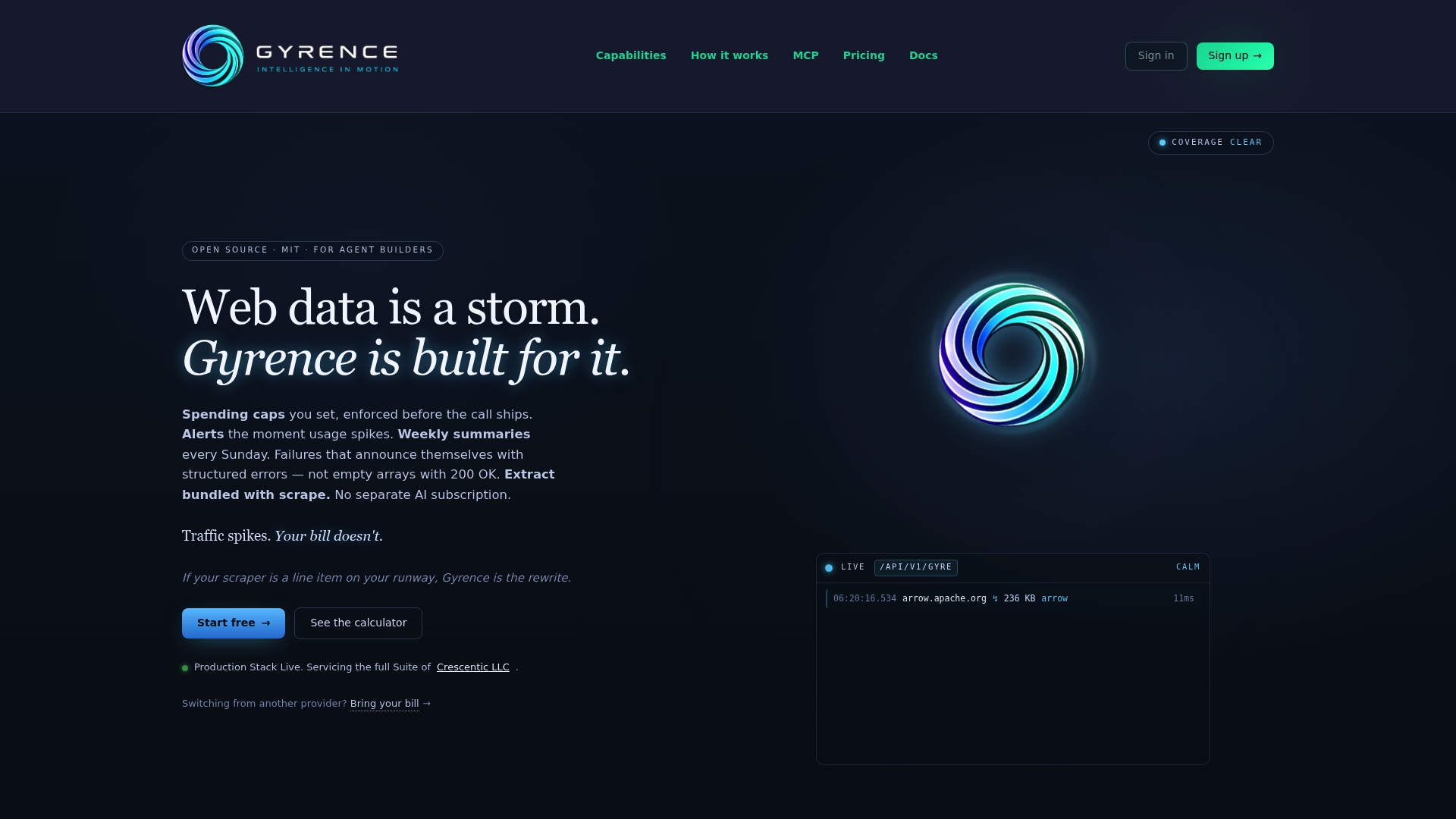
The Fetch primitive strips boilerplate, preserves heading hierarchy, and returns a typed response that includes failure modes explicitly. Your agent knows whether a fetch succeeded, returned partial content, or failed entirely. That is the kind of honest output that makes LLM-friendly Markdown pipelines reliable in production. Spending caps mean your bill matches your expectations. Visit gyrence.com/mcp to connect your first agent.
FAQ
What are the main website to markdown conversion benefits?
Converting websites to Markdown reduces token costs by 60–80% compared to raw HTML, improves semantic chunking in RAG pipelines, and produces cleaner diffs for version control. These gains directly lower inference costs and improve LLM output quality.
Why does Markdown perform better than HTML for LLMs?
LLMs were trained extensively on Markdown-formatted content including README files and technical documentation, so they hold strong structural priors for the format. Markdown also eliminates tag noise that consumes tokens without contributing meaning.
When should I keep HTML instead of converting to Markdown?
Keep HTML when your content includes complex tables with merged cells, interactive forms, or layout-dependent structures where visual position carries meaning. Markdown cannot express these patterns without losing critical information.
What is GitHub Flavored Markdown and why does it matter?
GitHub Flavored Markdown (GFM) is the recognized standard for developer documentation, adding support for fenced code blocks, tables, and task lists beyond the base Markdown spec. Using GFM syntax during conversion preserves the semantic structure that LLMs and documentation tools expect.
How does content negotiation improve Markdown delivery?
Sending an Accept: text/markdown header lets compatible web servers return clean Markdown directly, eliminating the need for client-side HTML-to-Markdown conversion and the errors that come with it.