
TL;DR:
- Clean page markdown is a boilerplate-free, structured Markdown extraction that retains meaningful content from web pages. It reduces token count compared to raw HTML and improves language model interpretability by preserving semantic hierarchy. Using heading-based chunking and atomic units like tables enhances retrieval accuracy and reasoning in AI workflows.
Clean page markdown is defined as the boilerplate-free, semantically structured Markdown extraction of a web page, retaining only headings, lists, tables, and code blocks while discarding navigation bars, ads, tracking pixels, and layout noise. For developers building Retrieval-Augmented Generation (RAG) pipelines or AI agent workflows, understanding what does clean page markdown mean is the difference between feeding a language model useful signal and drowning it in HTML garbage. The format sits between raw HTML and plain text: it preserves structure without the token cost of verbose tags.
What is clean page markdown in web scraping and AI pipelines?
Clean page markdown is not just a formatting preference. It is a deliberate data contract between your scraper and your language model.
Raw HTML is the worst input format for LLMs. A noisy page that costs 12,000 tokens as HTML can be reduced to 3,500 tokens as clean Markdown. That is a reduction that directly cuts inference costs and improves retrieval quality. HTML tags carry no semantic weight for a model trained on prose and code. They are noise.
Plain text solves the token problem but creates a new one. Strip all markup and you lose the hierarchy. A ## heading becomes indistinguishable from body copy. A table becomes a wall of pipe characters or, worse, a jumbled string. The model cannot tell where one topic ends and another begins.
Clean Markdown hits the middle ground precisely because it aligns with the model's training corpus. GitHub READMEs, Stack Overflow posts, and technical documentation are all Markdown-heavy. Models interpret #, -, and | as structural signals, not decoration. That alignment is why clean markdown improves LLM interpretability without adding token overhead.
Here is how the three formats compare at a glance:
| Format | Token cost | Structure preserved | LLM readability |
|---|---|---|---|
| Raw HTML | Very high (3–5x bloat) | Yes, but noisy | Poor |
| Plain text | Low | No | Moderate |
| Clean Markdown | Low (5–10% overhead) | Yes, semantic | High |
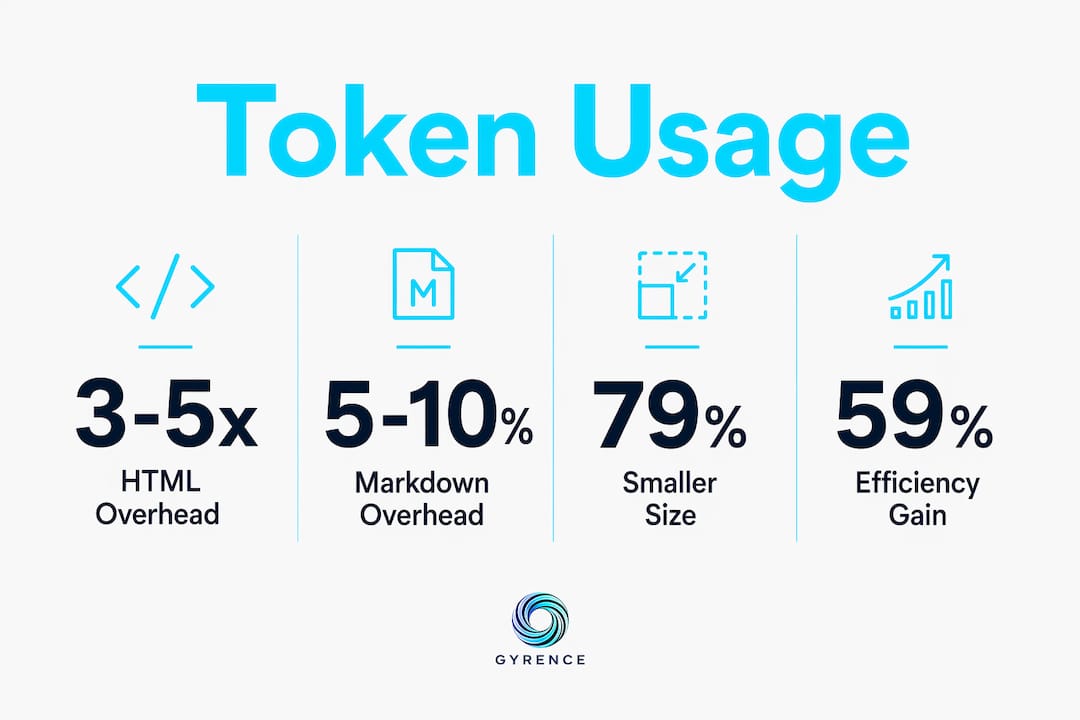
The token overhead for Markdown sits at roughly 5–10% compared to the 3–5x bloat that HTML tags introduce. That gap compounds fast across thousands of pages in a scraping run.
How does clean page markdown improve chunking and embedding quality?
Structural chunking is the practice of splitting documents at natural semantic boundaries rather than arbitrary character counts. Clean Markdown makes this possible because headings are explicit boundary markers.

When you split a document at every ## or ###, each chunk maps to a discrete topic. Embedding vectors for header-based chunks outperform arbitrary 500-token splits in retrieval accuracy. The reason is simple: a 500-character split may cut a paragraph mid-sentence, producing a chunk with no coherent meaning. A heading-based chunk contains a complete idea.
The risks of ignoring structure compound quickly:
- Broken tables. Splitting a Markdown table mid-row destroys the column-to-value relationship. The model retrieves half a table and hallucinates the rest.
- Orphaned code blocks. A code block split after the opening fence but before the closing fence produces unparseable text.
- Context loss. A paragraph that references "the table above" becomes meaningless when the table lands in a different chunk.
Treating tables and code blocks as atomic units during chunking is the industry standard for preserving relational context. Never split inside them. Finish the unit, then cut.
Pro Tip: Before chunking, run a Markdown linter to catch unclosed fences and malformed tables. A single broken table can corrupt an entire embedding batch.
Retrieval quality and reasoning accuracy both depend on chunks that carry complete, coherent context. Clean Markdown is the format that makes that possible at scale.
What does a clean page markdown extraction workflow look like?
A production-grade clean markdown pipeline follows a defined sequence. Skipping any step degrades output quality downstream.
- Fetch the page with JavaScript execution. Static HTML fetches miss content rendered by React, Vue, or Angular. Dynamic content requires a headless browser or a JavaScript-aware fetch API. Gyrence's Fetch primitive handles this natively, returning the fully rendered DOM before conversion.
- Remove boilerplate. Strip navigation, footers, cookie banners, ads, and tracking scripts. Tools like Mozilla Readability isolate the main article content before any conversion happens.
- Convert to Markdown. Libraries like Turndown translate the cleaned HTML DOM into Markdown syntax. The output preserves
#headings,-lists,|tables, and fenced code blocks. - Validate structure. Check that headings are hierarchical, tables are complete, and code fences are closed. Malformed Markdown produces bad chunks.
- Chunk semantically. Split at heading boundaries. Keep tables and code blocks intact as single units.
- Generate embeddings and store. Pass each chunk to your embedding model. Store vectors with metadata: source URL, heading path, and page title.
This full pipeline reduces noise, improves retrieval quality, and stabilizes reasoning across downstream tasks. The steps are not optional. Each one removes a failure mode that would otherwise surface in your model's outputs.
Clean markdown output from web scraping is not a post-processing nicety. It is a first-class requirement for any pipeline that feeds a language model.
How do developers use clean page markdown effectively?
Clean Markdown shows up across three primary use cases: web scraping for knowledge base ingestion, RAG pipeline construction, and AI assistant context injection. Each use case shares the same core requirement: structured, low-noise input.
Best practices that hold across all three:
- Chunk at heading boundaries. Use
#,##, and###as your split points. Never split mid-paragraph. - Preserve atomic units. Tables and code blocks must land in a single chunk. Split before or after, never inside.
- Retain metadata. Keep the source URL, page title, and heading path with each chunk. Retrieval without provenance is unreliable.
- Validate before embedding. A malformed chunk produces a bad vector. Garbage in, garbage out applies at every layer.
Common mistakes that degrade pipeline quality:
- Fetching static HTML for JavaScript-rendered pages and wondering why content is missing.
- Splitting on character count alone and producing incoherent chunks.
- Discarding heading hierarchy during conversion, flattening all content to the same semantic level.
- Ignoring dynamic content capture, which causes clean markdown output to miss the majority of page content on modern sites.
Pro Tip: Test your chunking logic on a page with a complex table before running it at scale. If the table survives intact, your pipeline handles the hard cases.
For a deeper look at producing LLM-friendly Markdown from live web pages, the techniques around heading normalization and metadata retention are worth reviewing before you build your ingestion layer.
Key Takeaways
Clean page markdown is the most token-efficient, structurally complete format for feeding web content into language models and RAG pipelines.
| Point | Details |
|---|---|
| Clean markdown definition | Boilerplate-free Markdown that preserves headings, lists, tables, and code blocks from web pages. |
| Token efficiency | Clean Markdown reduces token count by up to 80% compared to raw HTML, cutting inference costs directly. |
| Structural chunking | Splitting at Markdown heading boundaries produces semantically complete chunks that improve retrieval accuracy. |
| Atomic units | Tables and code blocks must never be split mid-way; treat them as single, indivisible chunks. |
| Pipeline sequence | Fetch with JavaScript execution, remove boilerplate, convert, validate, chunk, embed, and store. |
Why clean page markdown is the format I keep coming back to
Every few months, a new data format gets pitched as the right way to feed web content into a language model. JSON-LD, raw HTML with prompt engineering, plain text with custom delimiters. I have tested most of them in real pipelines. Clean Markdown wins every time, and not by a small margin.
The reason is not just token count. It is that Markdown is the only format where the structure is both human-readable and machine-interpretable without a schema. You can eyeball a clean Markdown document and immediately see where the topics are. Your chunker can do the same thing programmatically. That alignment between human review and automated processing is rare and genuinely useful.
What I have found in practice is that teams underestimate the cost of bad chunking. A retrieval system built on arbitrary character splits will hallucinate at a rate that looks like a model problem. It is not. It is a data problem. Switch to structured web data for RAG with heading-based chunking, and retrieval accuracy improves without touching the model.
The tooling around clean Markdown extraction is maturing fast. The gap between a hand-rolled pipeline and a well-designed API is closing. But the underlying principle stays constant: structure your data before you embed it, or you will pay for the disorder in every retrieval call.
— Glen
Gyrence and the clean markdown pipeline
Gyrence is built for exactly this workflow. Its Fetch primitive retrieves any web page with full JavaScript execution, strips boilerplate, and returns clean Markdown ready for chunking and embedding. No stitching together Mozilla Readability, Turndown, and a headless browser yourself.
The Extract primitive goes further: pass a prompt or JSON schema and Gyrence returns structured data directly from the cleaned page. Every call returns a typed, discriminated-union response, including failure cases, so your pipeline knows what it got and why. Spending caps mean your scraping bill stays predictable. Visit Gyrence's web data API to see how the five primitives fit together for clean markdown ingestion at scale.
FAQ
What does clean page markdown mean exactly?
Clean page markdown is Markdown extracted from a web page with all boilerplate, ads, and layout noise removed, retaining only semantically meaningful content like headings, lists, tables, and code blocks.
Why is clean markdown better than raw HTML for LLMs?
Raw HTML introduces 3–5x token bloat compared to Markdown, and LLMs interpret HTML tags as noise rather than structure. Clean Markdown aligns with the training corpus of most language models, improving both comprehension and reasoning accuracy.
How much does clean markdown reduce token count?
Clean Markdown output is approximately 79% smaller than raw HTML and 59% smaller than Readability-only output, directly reducing inference latency and cost.
What tools convert web pages to clean markdown?
Mozilla Readability isolates article content from boilerplate, and the Turndown library converts cleaned HTML to Markdown syntax. API-based solutions like Gyrence handle both steps plus JavaScript rendering in a single call.
What is structural chunking in a RAG pipeline?
Structural chunking splits a document at Markdown heading boundaries rather than arbitrary character counts, producing semantically complete chunks that improve embedding quality and retrieval accuracy.