
TL;DR:
- An idempotent web fetch leaves server state unchanged when repeated, ensuring safe retries.
- Using typed failure responses and atomic deduplication mechanisms helps maintain consistent, reliable data collection and transaction processing.
An idempotent web fetch is any HTTP request whose repeated execution leaves server state identical to a single execution. RFC 7231 formalizes this: a method is idempotent when "the intended effect on the server of multiple identical requests is the same as the effect for a single request." The MDN glossary adds a useful precision: idempotency constrains intended resource state, not side effects like logging or analytics.
You need to care about this property in specific, high-stakes situations:
- Retries after network failures — a dropped TCP connection mid-flight means you don't know whether the server processed the request.
- Payment and charge endpoints — a duplicate POST to
/chargescan bill a customer twice. - Write-heavy scraping and fetch loops — crawlers that retry on timeout can create duplicate records if the fetch isn't designed for it.
- Background jobs and queue workers — at-least-once delivery guarantees mean your handler will see duplicates.
- CDN and load-balancer retries — infrastructure layers retry silently; your application code may never know.
Idempotency is about server state, not HTTP status codes. A retry that returns 404 instead of 200 can still be perfectly idempotent. Gyrence, for example, returns typed, discriminated-union responses that include explicit failure-mode flags, so clients can decide whether a retry is safe without guessing from a raw status code.
Table of Contents
- Which HTTP methods are idempotent?
- Why idempotency matters for reliable web fetches
- How to make non-idempotent fetches safe
- Common pitfalls that break idempotency guarantees
- Minimal code examples for idempotent web fetches
- How to test and validate idempotency
- How a web-data API surfaces idempotency and failure modes
- Key Takeaways
- The real cost of treating idempotency as an afterthought
- Predictable, typed web fetches at scale with Gyrence
- Useful sources
- FAQ
Which HTTP methods are idempotent?
The spec is clear on method classification. Where real-world practice diverges is where bugs live.
| Method | Idempotent | Safe | Notes |
|---|---|---|---|
GET | Yes | Yes | Reads only; no state change intended |
HEAD | Yes | Yes | Same as GET, no body returned |
OPTIONS | Yes | Yes | Capability discovery; no mutation |
TRACE | Yes | Yes | Diagnostic echo; avoid in production |
PUT | Yes | No | Replaces a resource; same result on repeat |
DELETE | Yes | No | First call removes; subsequent calls find nothing to remove |
POST | No | No | Creates or triggers; each call may produce a new resource |
PATCH | No | No | Partial update; semantics depend on implementation |
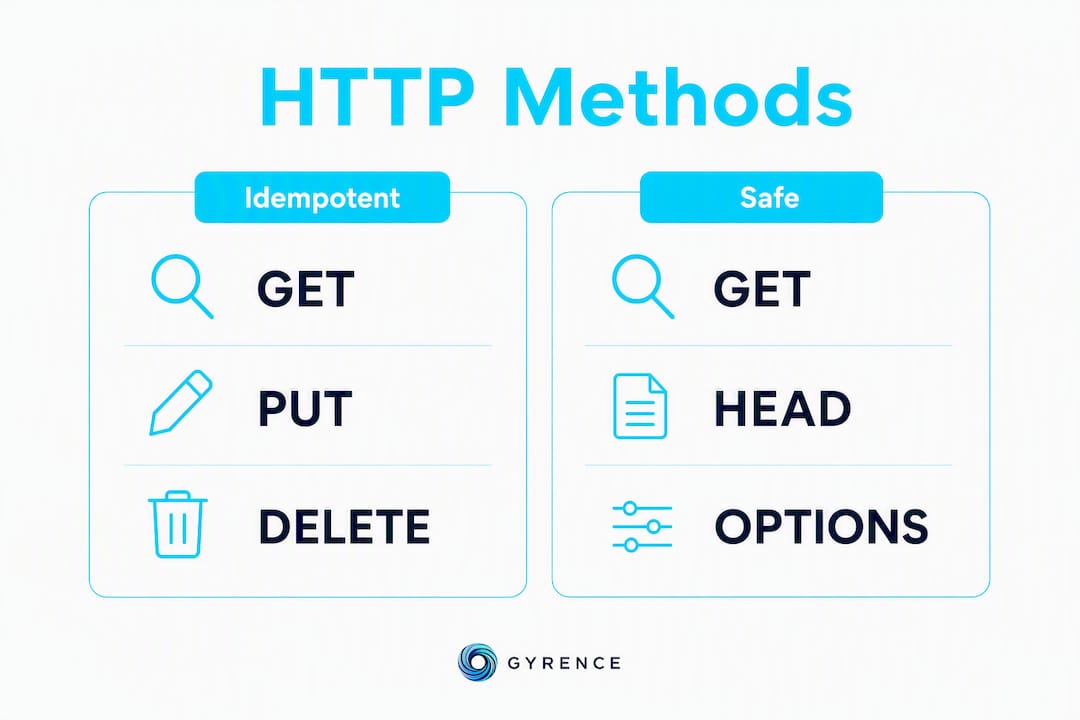
Safe means the method produces no intended state change. Idempotent means repeating it doesn't compound the effect. Every safe method is idempotent, but not every idempotent method is safe. PUT and DELETE mutate state yet remain idempotent because the end state converges.
The status-code trap is worth calling out directly. RFC 7231 and RFC 9110 both confirm that a DELETE returning 200 on the first call and 404 on the second is still idempotent: the resource is gone either way. What breaks idempotency isn't a different status code; it's a hidden stateful side effect, like decrementing an inventory counter on every call regardless of whether the resource existed.
PATCH deserves special attention. A PATCH that says "set field X to value Y" is idempotent in practice. A PATCH that says "increment field X by 1" is not. The method itself carries no idempotency guarantee; the payload semantics determine it.
Why idempotency matters for reliable web fetches
The practical stakes are higher than most developers expect until something goes wrong in production.
Safe automatic retries are the headline benefit. When a fetch is idempotent, any HTTP client, proxy, or load balancer can retry on timeout or connection reset without coordinating with the application layer. That simplicity compounds across a distributed system.
- Simpler client logic — clients don't need to track "did this request land?" They retry and let the server deduplicate.
- Predictable caching and CDN behavior —
GETresponses can be cached and served from edge nodes precisely because the method is idempotent and safe. - Fewer duplicate transactions — payment processors, order systems, and inventory APIs that enforce idempotency avoid the class of bugs that generate duplicate charges or phantom stock adjustments.
- Cleaner data pipelines — in RAG web ingestion workflows, duplicate fetches of the same URL produce duplicate chunks in your vector store, which distorts retrieval quality.
The failure modes from getting this wrong are concrete. Distributed-systems analysis identifies mismatches between method intent and server implementation as the leading cause of duplicate charges and inventory drift. A POST endpoint that creates an order but doesn't deduplicate on a client-supplied ID will create two orders when a mobile client retries after a 30-second timeout. The Fivetran engineering blog documents how credential errors and infrastructure stoppages trigger retries that create duplicate work when the server hasn't enforced deduplication.
For web scraping and fetch loops, idempotency reduces the de-duplication burden downstream. If your fetch layer guarantees that retrying the same URL with the same parameters returns the same stored result rather than triggering a new extraction, your pipeline stays clean without a separate dedup pass.

How to make non-idempotent fetches safe
The standard pattern is the Idempotency-Key header, now documented on MDN. The client generates a unique key per logical operation and sends it with every retry of that operation. The server deduplicates on that key.
Here's the server-side state machine to implement:
- Authenticate and rate-limit first. Idempotency validation belongs after auth and rate-limiting but before business logic. Placing it earlier leaks information; placing it later risks duplicating side effects.
- Look up the key in your dedupe store. Use an atomic
SET NX(set if not exists) operation in Redis or a database row with a unique constraint. This is the critical path — it must be reliable. - If the key exists and state is
COMPLETE, return the stored response immediately with anX-Idempotent-Replayed: trueheader. - If the key exists and state is
IN_FLIGHT, return409 Conflict. A concurrent request is already processing this operation. - If the key is new, mark it
REGISTERED, thenIN_FLIGHT, execute business logic, store the final response, and transition toCOMPLETEorFAILED. - Set a TTL. A 24-hour window is a practical default per implementation guidance. After expiry, treat the key as new.
The state transitions are: REGISTERED → IN_FLIGHT → COMPLETE (or FAILED). Design explicit remediation for FAILED states — don't let them silently expire without an alert.
Upsert and resource-ID strategies work well when you control the data model. Accept a client-specified resource ID in the request body (POST /orders with { "id": "<client-uuid>", ... }), then use an upsert on that ID. Retries hit the same row and return the existing record. This is simpler than a separate key store and works naturally with most relational databases.
Pro Tip: Generate Idempotency-Key values as high-entropy UUIDs (v4 or v7). Short keys or sequential IDs create collision risk across clients. Treat the key-lookup cache as a first-class dependency: if it's unavailable, fail closed rather than bypassing deduplication.
Platform engineering practices at the load-balancer and service-mesh layer also matter here. Infrastructure that retries without forwarding the Idempotency-Key header breaks the contract before your application code even sees the request.

Common pitfalls that break idempotency guarantees
Even well-designed systems fail here. The bugs are usually subtle.
- Hidden side effects — a
PUTthat updates alast_modifiedtimestamp on every call, or fires a webhook on every request, violates the idempotency contract even if the primary resource state converges. The spec permits non-mutating side effects like logging; it does not permit stateful ones. - Short TTLs and cache misses — if your dedupe store expires keys before a client's retry window, a late retry creates a duplicate. Size your TTL to exceed your client's maximum retry interval by a safe margin.
- Key collisions — using non-unique keys (sequential integers, short hashes) across clients or sessions means unrelated operations share a key and one gets a replayed response from a different operation.
- Wrong middleware placement — validating idempotency keys before authentication means unauthenticated requests can poison the key store. After business logic means the side effect already ran.
- Inconsistent behavior across replicas — if your dedupe store isn't replicated consistently, two replicas may both see a key as new and both execute the operation. Use a single authoritative store or a distributed lock.
- Infrastructure retries without key forwarding — load balancers and service meshes configured to retry on
5xxwill retry without theIdempotency-Keyheader unless explicitly configured to forward it. - Stale
IN_FLIGHTentries — a crashed worker leaves a key stuck inIN_FLIGHT. Without a timeout and cleanup job, subsequent retries return409forever. Build a reaper process or use a TTL on theIN_FLIGHTstate itself.
Adding Idempotency-Key lookups to inherently idempotent methods like GET or PUT is also an anti-pattern. It adds latency and usually signals that the endpoint has hidden mutations the team hasn't acknowledged.
Minimal code examples for idempotent web fetches
curl with Idempotency-Key
IDEM_KEY="f47ac10b-58cc-4372-a567-0e02b2c3d479"

curl -X POST https://api.example.com/charges \
  -H "Content-Type: application/json" \
  -H "Idempotency-Key: $IDEM_KEY" \
  -d '{"amount": 4999, "currency": "usd", "customer_id": "cus_123"}'
On retry, send the identical request with the same $IDEM_KEY. The server returns the stored response with X-Idempotent-Replayed: true.
Node.js fetch with retry logic
const { randomUUID } = require('crypto');

async function chargeWithRetry(payload, maxRetries = 3) {
  const idempotencyKey = randomUUID(); // generate once per logical operation

  for (let attempt = 0; attempt < maxRetries; attempt++) {
    const res = await fetch('https://api.example.com/charges', {
      method: 'POST',
      headers: {
        'Content-Type': 'application/json',
        'Idempotency-Key': idempotencyKey, // same key on every retry
      },
      body: JSON.stringify(payload),
    });

    if (res.ok || res.status === 409) return res; // 409 = IN_FLIGHT, back off
    if (res.status >= 500) continue;              // server error, retry
    break;                                         // 4xx client error, stop
  }
}
Server-side pseudocode (Redis atomic dedupe)
function handleRequest(req):
  key = req.headers["Idempotency-Key"]
  if not key: return 400

  existing = redis.GET(key)
  if existing.state == "COMPLETE":
    return existing.response + header("X-Idempotent-Replayed", "true")
  if existing.state == "IN_FLIGHT":
    return 409

  redis.SET_NX(key, {state: "IN_FLIGHT"}, TTL=86400)  // 24-hour TTL

  try:
    result = runBusinessLogic(req)
    redis.SET(key, {state: "COMPLETE", response: result}, TTL=86400)
    return result
  catch error:
    redis.SET(key, {state: "FAILED", error: error}, TTL=86400)
    return 500
Pro Tip: Return X-Idempotent-Replayed: true on every replayed response. Clients and monitoring systems can use this header to distinguish fresh executions from cache hits, which is critical for debugging duplicate-detection logic.
How to test and validate idempotency
Testing idempotency requires deliberate failure injection, not just happy-path coverage.
- Automated retry tests — send the same request twice with the same key and assert the response body and side effects are identical. Verify
X-Idempotent-Replayed: trueon the second call. - Concurrency tests — fire two identical requests with the same key simultaneously. One should succeed; the other should return
409. Verify no duplicate business events were created. - Network partition tests — use a proxy like Toxiproxy to drop the response after the server processes the request. Retry from the client and confirm no duplicate side effect.
- TTL and cache-eviction tests — expire the key manually and retry. Confirm the server treats it as a new request and executes business logic again (this is correct behavior after expiry).
IN_FLIGHTtimeout tests — simulate a crashed worker by leaving a key inIN_FLIGHT. Confirm your reaper process transitions it toFAILEDwithin the expected window and that subsequent retries are handled correctly.
Metrics to monitor in production:
- Rate of
X-Idempotent-Replayed: trueresponses (high rate signals aggressive client retries or upstream infrastructure retries). 409spike rate (may indicateIN_FLIGHTentries not clearing, or a client bug reusing keys across different operations).IN_FLIGHTduration histogram (entries stuck beyond your TTL indicate crashed workers).- Duplicate business events in downstream systems (the ground truth that idempotency is working end-to-end).
In staging, simulate partial failures freely. In production, rely on metrics and structured logs rather than injecting faults directly.
How a web-data API surfaces idempotency and failure modes
A managed web-data API adds a layer of complexity: the fetch target is the open web, which is inherently non-deterministic. Pages change, rate limits fire, and network timeouts are routine. Here's how typed responses and explicit failure modes make idempotency observable.
| Failure Mode | Typed Response Field | Recommended Client Action |
|---|---|---|
| Transient network timeout | status: "timeout", retryable: true | Retry with same request parameters |
| Rate-limited page | status: "rate_limited", retryAfter: <seconds> | Back off and retry after the specified delay |
| Content changed during fetch | status: "partial", contentHash: <hash> | Log the hash; decide whether to re-fetch or accept partial |
| Extraction failure (LLM) | status: "extraction_failed", rawHtml: <string> | Fall back to raw HTML; alert for manual review |
| Auth / spending cap hit | status: "blocked", reason: "spending_cap" | Stop retrying; alert operator |
Gyrence returns exactly this kind of typed, discriminated-union response for every Fetch and Extract call. Clients don't parse status codes and guess; they pattern-match on a typed result and branch deterministically. The retryable flag tells an agent loop whether to retry or escalate. Spending caps prevent a runaway retry loop from generating an unexpected bill. WebDoppler monitoring and webhook alerts surface anomalies before they compound.
For teams building agent-driven fetch loops, this matters operationally: an agent that retries a failed fetch without knowing whether the failure was transient or permanent will either miss data or hammer a rate-limited target. Typed failure modes make that decision explicit.
Key Takeaways
An idempotent web fetch is one where repeating the request leaves server state unchanged, per RFC 7231 and RFC 9110, and implementing this correctly requires typed failure modes, atomic key stores, and cross-layer enforcement.
| Point | Details |
|---|---|
| Core definition | A fetch is idempotent when N identical requests produce the same server state as one request, per RFC 7231. |
| Method classification | GET, HEAD, OPTIONS, PUT, and DELETE are idempotent; POST and PATCH are not by default. |
| Idempotency-Key pattern | Clients generate a UUID per logical operation; servers use atomic SET NX and a 24-hour TTL to deduplicate. |
| Biggest operational caveat | Hidden side effects (webhooks, timestamps, counters) break the contract even when the primary resource state converges. |
| Gyrence typed responses | Gyrence surfaces retryable, status, and failure-mode fields so clients branch on facts, not guesses. |
The real cost of treating idempotency as an afterthought
Most teams bolt idempotency on after their first production incident. That's understandable, but the retrofit is always more expensive than the original design. A payment endpoint that's been running without deduplication for six months has a shadow population of duplicate charges that need reconciliation, customer support tickets, and often a manual audit.
The part that gets underestimated is the cross-layer problem. You can write a perfect server-side dedupe store and still have your load balancer retry a POST without forwarding the Idempotency-Key header. Or your service mesh retries on 503 and your application sees two requests with no key at all. Idempotency is an operational contract that spans every layer between the client and the database, and a single weak link breaks it under network failure.
Prioritize the highest-consequence endpoints first: payments, order creation, account provisioning. These are the places where a duplicate has a real cost. GET endpoints and read-heavy fetch loops are lower risk, but even there, duplicate fetches in a RAG pipeline or a data audit workflow create downstream noise that's tedious to clean up. The discipline of designing for idempotency from the start is cheaper than the alternative.
Predictable, typed web fetches at scale with Gyrence
If your team is building fetch loops, agent pipelines, or data ingestion workflows, the engineering burden of managing retries, deduplication, and failure-mode handling is real. Gyrence removes that burden by returning typed responses for every fetch operation: each call tells you whether the result is fresh, replayed, partial, or blocked, so your client code branches on facts rather than parsing raw HTTP.
Spending caps mean a retry storm won't generate a surprise bill. WebDoppler monitoring alerts you when a target page changes between fetches. Every Fetch and Extract call returns a discriminated-union result that includes the failure cases, so your agent or pipeline can reason about what happened without a custom error-parsing layer. For teams that need a single API for web data access with predictable costs and honest failure reporting, Gyrence is the practical next step. Start with a free trial at gyrence.com.
Useful sources
- RFC 7231: HTTP/1.1 Semantics and Content — the primary specification defining idempotent and safe methods.
- RFC 9110: HTTP Semantics — the current consolidated HTTP semantics standard, superseding RFC 7231.
- MDN Glossary: Idempotent — concise developer-facing definition with method table.
- MDN: Idempotency-Key header — reference for the client header pattern and UUID key generation guidance.
- DistributedRequest: HTTP method semantics and safety — cross-layer enforcement analysis and anti-pattern identification.
- Fivetran: Idempotence and data pipeline reliability — operational failure modes and retry-driven duplicate work in pipelines.
FAQ
What does "idempotent" mean in simple terms?
An operation is idempotent when running it once produces the same result as running it ten times. In HTTP, that means the server's resource state is unchanged whether you send the request once or retry it five times after a network failure.
Which HTTP methods are not idempotent?
POST and PATCH are not idempotent by default. Each POST typically creates a new resource, and a PATCH that increments a value compounds on every call. You can make them safe to retry by adding an Idempotency-Key header and server-side deduplication.
What is the purpose of idempotency in API design?
Idempotency lets clients retry failed requests safely without coordinating with the server about whether the original request landed. This is the foundation of reliable distributed systems, especially for payments, order creation, and any write operation that crosses a network boundary.
What are common problems with idempotency in practice?
The most frequent failures are hidden side effects (webhooks or counters that fire on every request), short TTLs that expire before a client's retry window, and infrastructure layers (load balancers, service meshes) that retry requests without forwarding the Idempotency-Key header.
How does Gyrence handle idempotency for web-data fetches?
Gyrence returns typed, discriminated-union responses that include a retryable flag and explicit failure-mode fields for every Fetch and Extract call. Clients can branch deterministically on the result type rather than guessing from a raw HTTP status code, and spending caps prevent retry loops from generating unexpected costs.