
TL;DR:
- Real-time web data access enables continuous retrieval of live web information for AI, analysis, and research. It relies on architecture choices like micro-batch for practicality and uses protocols like MCP to provide structured, reliable data. This approach reduces AI hallucinations and supports timely decision-making across various applications.
Real-time web data access is defined as the continuous retrieval and processing of web information as it changes, delivering current data to applications and agents without meaningful delay. For AI developers, data analysts, and researchers, this capability determines whether a system works with facts or with stale assumptions. LLMs have knowledge cutoffs and require external live data to produce accurate, grounded outputs. Without live web data retrieval, AI agents hallucinate, pricing models drift, and compliance systems miss regulatory changes. The industry standard for structured, agent-ready live access has shifted toward managed APIs and protocols like Model Context Protocol (MCP), which handle the operational complexity that raw HTTP requests cannot.
What is real-time web data access and how does it work architecturally?
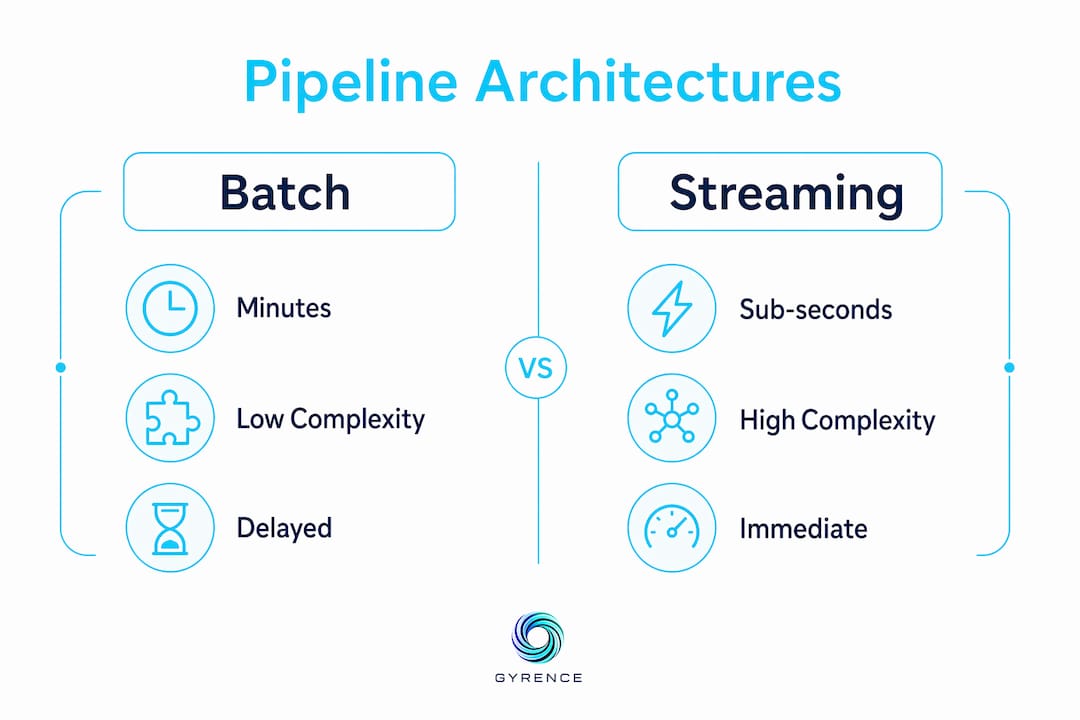
Three pipeline architectures dominate real-time information access: batch, micro-batch, and streaming. Each trades latency against cost and engineering complexity.

| Architecture | Latency | Complexity | Typical use case |
|---|---|---|---|
| Batch | Minutes to hours | Low | Nightly report generation, bulk indexing |
| Micro-batch | Seconds to minutes | Medium | Pricing updates, search index refresh |
| Streaming | Sub-second | High | Fraud detection, live market feeds |
The streaming-first with batch backfill pattern is the dominant pipeline design in 2026. It combines immediate event streaming via tools like Apache Kafka or Apache Pulsar with periodic batch jobs on data lakes like Apache Iceberg for correctness and cost control. This hybrid approach gives teams real-time responsiveness without sacrificing data accuracy.
Latency and cost are the two forces that shape every architecture decision. Streaming pipelines built on Apache Flink deliver sub-second results but require significant infrastructure investment. Micro-batch pipelines, by contrast, refresh data every few seconds to minutes and run on far simpler infrastructure. The right choice depends entirely on what your application actually needs.
Pro Tip: Before committing to a streaming architecture, write down your actual latency requirement in seconds. If the answer is "under 60 seconds," micro-batch almost certainly covers your use case at a fraction of the cost.
Managed search APIs abstract much of this complexity. Services that handle proxy rotation, CAPTCHA solving, and structured result delivery let developers focus on AI application integration rather than infrastructure plumbing. That abstraction has real value when your team's core competency is data analysis, not distributed systems engineering.
How does Model Context Protocol change AI agent web data integration?
Model Context Protocol (MCP) is an open standard that allows AI agents to communicate bidirectionally with web data sources, returning structured, typed outputs rather than raw HTML strings. This is a meaningful upgrade over basic web search tools, which return unstructured text that agents must parse and interpret themselves. MCP servers manage browser rendering, CAPTCHA solving, IP rotation, and JSON normalization on behalf of the agent.
The practical difference shows up immediately when working with modern web pages. Most production websites use JavaScript frameworks that static HTTP GET requests cannot fully render. MCP solves this by executing full browser rendering before returning data, so the agent receives the same content a human browser would see.
Key capabilities MCP servers provide for AI agent workflows:
- Full browser rendering of JavaScript-heavy pages, capturing dynamic content that static scrapers miss
- Structured JSON extraction with typed schemas, so agents receive data they can reason about directly
- CAPTCHA and IP rotation management handled server-side, removing operational burden from the calling application
- Discriminated-union responses that include failure cases, so agents know when a fetch failed rather than silently receiving empty data
Pro Tip: When evaluating MCP endpoints, check whether failure responses are typed. An endpoint that returns an empty result on failure forces your agent to guess. A typed failure response lets it branch correctly.
Gyrence ships a hosted MCP endpoint alongside its five composable primitives: Search, Traverse, Fetch, Extract, and Map. Developers working on AI agent web data pipelines can call a single API to search the web, fetch and clean pages to markdown, or extract structured JSON using a prompt or schema. Every response is a typed, discriminated-union result, including the failure cases.
What are the common pitfalls in implementing live data access?
The most expensive mistake teams make is over-engineering for streaming when micro-batch would meet their actual latency requirements. Full streaming pipelines require dedicated infrastructure, operational expertise, and ongoing maintenance. If your use case refreshes data every few minutes, that investment delivers no measurable benefit.
Four pitfalls appear repeatedly in production implementations:
- Misaligned latency targets. Teams specify "real-time" without defining what that means in seconds. The result is a streaming pipeline built for sub-second delivery serving a dashboard that refreshes every five minutes.
- Ignoring client-side rendering. Static HTTP requests fail silently on JavaScript-rendered pages. The response arrives with a 200 status code but contains no useful content. Agents downstream receive garbage or nothing.
- Underestimating operational costs. Proxy pools, CAPTCHA services, and browser farms each carry ongoing costs. Teams that build these in-house often spend more on maintenance than on the actual data work.
- No structured failure handling. Pipelines that swallow errors produce silent data gaps. Downstream models train or reason on incomplete datasets without knowing the data is missing.
Evaluating latency requirements honestly before choosing an architecture is the single highest-leverage decision in pipeline design. Managed infrastructures address the operational pitfalls by abstracting proxy handling, rendering, and error reporting into a single API surface.
What are the real-world benefits of real-time web data access?
Live web data retrieval powers a wide range of production applications across AI, research, and market intelligence.
- AI agent grounding. LLMs trained on static datasets hallucinate when asked about current events, prices, or regulations. Grounding agents with live web data reduces hallucination rates by giving models access to current facts rather than memorized approximations.
- Competitive and pricing intelligence. Continuous web monitoring lets analysts track competitor pricing, product availability, and promotional changes as they happen. Batch jobs running nightly miss intraday price moves that matter in fast-moving markets.
- Regulatory and compliance tracking. Legal and compliance teams use live data pipelines to monitor government portals, regulatory bodies, and official publications for rule changes. A missed update can carry significant legal exposure.
- Real-time research and content generation. Researchers and content teams using retrieval-augmented generation (RAG) pipelines depend on fresh structured web data to produce accurate, current outputs. Stale retrieval indexes produce stale answers.
Continuous access to updated data allows AI workflows and analysts to make timely decisions and generate content that reflects the current state of the world. The gap between a system that refreshes daily and one that refreshes in seconds is not just technical. It is the difference between acting on yesterday's market and acting on today's.
Key Takeaways
Real-time web data access requires matching your pipeline architecture to your actual latency needs, using structured protocols like MCP, and handling failure cases explicitly.
| Point | Details |
|---|---|
| Architecture choice matters | Match batch, micro-batch, or streaming to your actual latency requirement before building. |
| MCP delivers structured access | Model Context Protocol returns typed JSON and handles browser rendering, CAPTCHA, and IP rotation. |
| Failure handling is non-negotiable | Typed failure responses let agents branch correctly instead of silently processing empty data. |
| Over-engineering is the top pitfall | Most use cases need micro-batch, not full streaming. Honest latency assessment prevents wasted cost. |
| Live data grounds AI accuracy | Connecting LLMs to current web data reduces hallucinations caused by static training cutoffs. |
The latency question nobody asks early enough
After working with data pipelines across AI and research contexts, the pattern I keep seeing is teams that commit to a streaming architecture before they have written down a single latency requirement. The word "real-time" gets used in a product brief, and engineers interpret it as sub-second. The result is a Kafka cluster, an Apache Flink deployment, and an Apache Iceberg data lake serving a dashboard that a human checks twice a day.
The honest question to ask is: what is the worst acceptable data age for this specific decision? For most competitive intelligence and research workflows, the answer is somewhere between 30 seconds and 5 minutes. That is a micro-batch problem, not a streaming problem. The cost and complexity difference is substantial.
MCP is the piece of this I am most interested in watching. The shift from unstructured search results to typed, discriminated-union responses changes what agents can actually do with web data. When a fetch fails, the agent knows it failed. When extraction succeeds, the schema is guaranteed. That reliability is what makes autonomous agent workflows viable in production, not just in demos. The teams building on structured access protocols now will have a significant head start as multi-source live data integration becomes the baseline expectation for AI systems.
— Glen
Gyrence and production-ready web data access
Gyrence is built for teams that need live web data without building the infrastructure themselves.
Gyrence's five composable primitives, Search, Traverse, Fetch, Extract, and Map, cover every stage of the web data pipeline through a single API or hosted MCP endpoint. Spending caps and structured failure modes mean your pipeline never silently fails and your bill never surprises you. Bundled LLM extraction handles JSON output directly, so you get agent-ready structured data without a separate processing step. Teams working on AI grounding, RAG pipelines, or market intelligence can connect to the Gyrence API and start pulling structured web data in minutes, not weeks.
FAQ
What is real-time web data access?
Real-time web data access is the continuous retrieval and processing of web information as it changes, delivering current data to applications without meaningful delay. It enables AI agents, analysts, and researchers to work with live information rather than static snapshots.
How does MCP differ from a standard web search tool?
Model Context Protocol returns typed, structured JSON and handles full browser rendering, CAPTCHA, and IP rotation server-side. Standard web search tools return unstructured text that agents must parse themselves, with no guaranteed schema.
When should I use streaming versus micro-batch?
Use streaming only when your application requires sub-second data freshness. If data fresh within seconds to minutes is sufficient, micro-batch architecture delivers the same result at lower cost and complexity.
How does live web data reduce AI hallucinations?
LLMs have training cutoffs and cannot access events after that date. Connecting them to live web data provides current facts, which grounds responses and reduces the rate of fabricated or outdated outputs.
What structured data formats does real-time web access typically return?
Production pipelines return JSON with typed schemas, markdown-cleaned page content, or discriminated-union responses that include both success payloads and explicit failure cases. Typed outputs are what make structured JSON extraction reliable for downstream agent reasoning.