
Structured financial data extraction is the automated process of retrieving, normalizing, and mapping financial data from unstructured documents into a predefined schema designed for accurate analytics and accounting. The core challenge is not reading the numbers. It's getting them into a machine-operable format without losing sign conventions, scale factors, or the narrative context that explains why a figure moved. Financial documents, from SEC 10-K filings to earnings transcripts, are built for human readers. Extraction pipelines have to reverse that design decision at scale.
What structured extraction actually involves:
- Retrieval: Locating target fields (revenue, EPS, net debt) within free-form text, tables, and footnotes across multi-page documents
- Normalization: Converting heterogeneous representations ("22–24%" becomes midpoint 23%, "$1.2B" becomes 1,200,000,000) into a canonical numeric form
- Schema mapping: Aligning extracted values to a predefined target schema so downstream systems receive typed, consistent records
- Quantitative and qualitative pairing: Capturing both KPI values and the management commentary that contextualizes them
- Output integration: Writing validated records to databases, ERPs, or analytics platforms in formats like JSON or CSV
The difference between unstructured and structured data in finance is the difference between a PDF annual report and a database row. The PDF contains the same information, but a query engine cannot touch it. Structured extraction bridges that gap programmatically, turning human-readable filings into machine-operable datasets that feed risk models, reconciliation workflows, and regulatory reporting.
How financial data extraction evolved from templates to AI agents
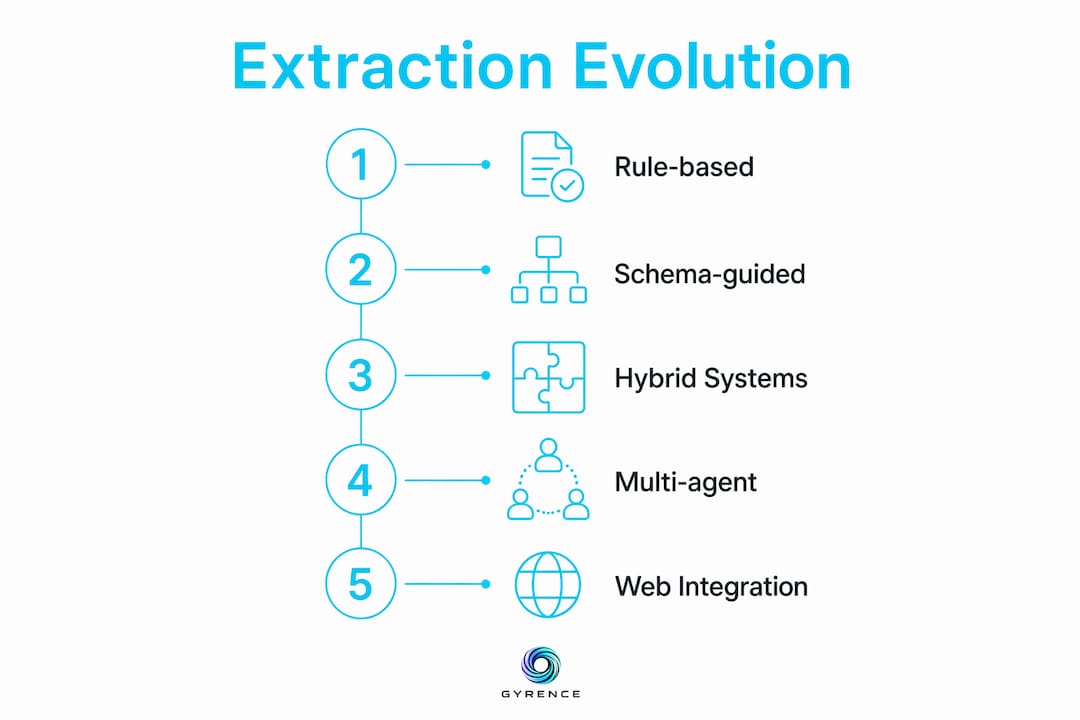
Rule-based extraction was the starting point, and it worked well enough when document layouts were predictable. A pipeline would define regex patterns and positional templates, then scan for keywords like "total," "amount," or column header labels to anchor table boundaries. When the document format matched the template, recall was high. When it didn't, the pipeline broke silently.

The brittleness is structural. Rule-based systems cannot generalize across layout variants. A single reformatted balance sheet, a new footnote placement, or a shifted column header can produce zero output with no error signal. Financial documents are notoriously heterogeneous: fund filings, earnings releases, 10-Qs, and investor transcripts each carry different table structures, and even the same issuer changes formatting between fiscal years.
Modern AI-powered extraction replaces positional heuristics with contextual understanding. Transformer-based NLP models read table structure semantically, not spatially, so they handle merged cells, multi-row headers, and narrative-embedded figures that regex cannot parse. The current state of the art goes further, separating the extraction and querying layers into specialized agents:
- Extraction Agent: Identifies KPIs from raw financial text, standardizes formats, and verifies accuracy using domain-tuned prompts and rule-based logic
- Text-to-SQL Agent: Translates natural language analyst queries into executable SQL over the structured output, removing the need for schema expertise on the user side
Schema-guided extraction adds a third layer of control. Tools like Pydantic enforce type-checked validation inline during extraction, so a field typed as Decimal cannot silently accept a string. Outputs that fail schema validation are flagged immediately for re-extraction rather than propagating bad data downstream.
Hybrid architectures combine the best of both approaches. Regex-first methods handle well-structured, predictable fields with high precision, while LLM-augmented reasoning handles the ambiguous cases: narrative-embedded figures, non-standard table layouts, and footnote references. This combination outperforms pure LLM extraction on recall and produces traceable outputs that link each value back to its source location.
Pro Tip: When building a production pipeline, use deterministic regex for fields with stable formats (CUSIP, ISIN, date fields) and reserve LLM calls for fields that require contextual interpretation. This keeps latency and cost predictable while maintaining accuracy where it matters most.
What a production extraction workflow actually looks like
A well-designed financial data extraction pipeline runs through eight sequential stages. Each stage has specific failure modes, and skipping validation at any point compounds errors downstream.
-
Document ingestion: Ingest raw files (PDF, HTML, XBRL, scanned images) and normalize them to a common intermediate format. For scanned documents, OCR runs here. LlamaParse is one tool used at this stage to convert complex PDFs into clean markdown or structured text before extraction logic runs.
-
Document classification: Identify document type (10-K, 10-Q, 8-K, earnings transcript) and filing period. Classification determines which extraction schema applies and which table types to expect.
-
Table detection and parsing: Locate table boundaries, detect headers, and segment rows and columns. This is where multi-page fragmentation becomes a problem. A holdings table spanning 44 pages with no bounding boxes requires a detection model that can reconstruct continuity across page breaks.
-
Schema definition: Before extraction runs, define the target schema explicitly. The schema specifies field names, types, units, and validation constraints. An upfront schema prevents the pipeline from producing outputs that are structurally incompatible with the destination system.
-
Extraction: Run the extraction model against detected tables and narrative sections. For schema-guided systems, the LLM receives the current schema embedded in its prompt context and returns a structured output that is immediately validated against it.
-
Validation: Apply cross-column reconciliation (assets = liabilities + equity), sign convention verification, period consistency checks, and unit scale propagation. A value that passes OCR but fails reconciliation is flagged, not silently written.
-
Normalization and mapping: Convert all extracted values to canonical forms and map them to the destination schema's field names. This includes resolving unit discrepancies (thousands vs. millions), standardizing date formats, and handling null values consistently.
-
Output integration and traceability: Write validated records to the target system and store provenance metadata linking each extracted value back to its source page, table, and cell. Traceability is not optional for audit-grade pipelines. Every extracted figure needs a citation path back to the original document.
Feedback and correction loops sit across stages 5–8. When validation fails or a human reviewer flags an error, the correction feeds back into the extraction schema, updating it for future runs. This is how pipelines adapt to new document templates without requiring a full rebuild.
Common failure modes you need to account for
Most extraction failures are not dramatic. They are silent. A pipeline that produces output with no errors but wrong values is harder to catch than one that crashes, and financial data has no tolerance for undetected errors.
The most common failure modes in production pipelines:
- Multi-page table fragmentation: A table that spans multiple pages gets split at page boundaries. Without explicit continuity logic, the pipeline treats each page fragment as a separate table, losing rows or duplicating headers. Real-world financial tables in fund filings can span dozens of pages with no bounding boxes.
- Column interleaving: Complex layouts with nested column headers or side-by-side tables produce column misalignment. A value extracted from column 3 gets written to the field mapped to column 2.
- Sign convention errors: Accounting documents use parentheses to denote negative values. An OCR model that strips parentheses or a parser that ignores them flips the sign on every negative figure in the output. A loss becomes a profit. This is one of the most consequential silent failures in financial extraction.
- Scale propagation failures: A header declaring "in thousands" appears on page 1. A table on page 8 inherits that scale implicitly. If the pipeline does not propagate the scale declaration, every value in that table is off by a factor of 1,000.
- Inconsistent null handling: Empty cells, dashes, "N/A," and "—" all represent missing data but are encoded differently. A pipeline that treats them inconsistently produces type errors or phantom zeros downstream.
- Generic benchmark mismatch: Standard NLP benchmarks like FUNSD do not capture financial document complexity. A model that scores well on generic form understanding can still fail on fund holdings tables with heterogeneous layouts.
Production-grade pipelines address these failure modes through monitoring, not just initial testing. Accuracy drift is real: a pipeline that performs well at launch degrades as issuers change their formatting. Provenance tracking lets you detect drift by comparing extracted values against prior-period outputs and flagging anomalies before they reach downstream systems. For a practical look at auditing extracted values across sources without losing precision, the governance layer is where most teams underinvest.
How structured extraction feeds into financial analytics workflows
Structured extraction is not the end goal. It is the prerequisite for everything that happens next. Once financial data exists in a typed, schema-conformant format, it can flow into the systems that actually generate insight.
Key integration points:
- Analytics platforms and BI tools: Structured KPI records feed directly into tools like Tableau, Power BI, or custom Python notebooks. Without extraction, analysts manually copy figures from PDFs, introducing transcription errors and delays.
- ERP and accounting systems: Normalized transaction data from invoices, bank statements, and balance sheets integrates with ERP platforms for automated reconciliation and ledger updates.
- Risk assessment models: Quantitative risk models require consistent, machine-readable inputs. Extraction pipelines that normalize units and validate signs produce inputs that models can consume without preprocessing.
- Regulatory and compliance reporting: Audit trails depend on traceable data. Extraction pipelines that store provenance metadata satisfy the traceability requirements of SOX, SEC reporting, and fund regulatory filings.
- Investment research workflows: Analysts querying structured KPI databases via natural language (through a Text-to-SQL layer) can retrieve figures from hundreds of filings in seconds rather than hours.
The deeper value comes from connecting quantitative KPIs with qualitative narratives. A revenue figure extracted from a 10-K means more when paired with the management discussion section that explains the drivers. Extraction systems that capture both and link them by document section give AI agents the context to reason about financial results, not just retrieve them. Timeliness matters here too. Periodic filings (quarterly, annual) need to synchronize with continuous data flows from market data feeds and real-time disclosures. A pipeline that processes a 10-K three days after filing is less useful than one that processes it within hours.

TASER and the multi-agent architecture setting the current standard
The most technically advanced extraction systems in 2025–2026 use multi-agent architectures with schema-guided prompting and recursive feedback loops. TASER (Table Agents for Schema-guided Extraction and Recommendation) is the clearest published example of this approach applied to real financial documents.
TASER was built to handle financial holdings tables in regulatory fund filings, documents that govern $68.9 trillion of investments globally. The dataset used to train and evaluate it included thousands of manually labeled pages, thousands of tables, and holdings totaling hundreds of billions of dollars. The tables themselves are extreme: the maximum row count per table is 426 rows, more than double the average for all other table types in the same filings, and 99.4% of tables have no bounding boxes.
The TASER pipeline runs three specialized agents:
- Table Detector Agent: Evaluates candidate pages and identifies which ones contain Financial Holdings Tables. Only pages that pass detection proceed to extraction, reducing noise in downstream stages.
- Extractor Agent: Processes detected pages by prompting the LLM with the current Portfolio schema embedded in the prompt context. Output is validated inline against the schema using Pydantic and Instructor, producing type-checked instrument entries. Outputs that fail validation (missing fields, type errors, undeclared instruments) are flagged as feedback for re-extraction.
- Recommender Agent: Reviews unmatched holdings, proposes schema refinements using LLM-driven clustering, and triggers re-extraction with the updated schema. This loop repeats until all entries are matched or no further schema modifications are possible.
The results from this architecture are concrete. TASER outperforms Table Transformer by 10.1% on table detection. Larger batch sizes in the continuous learning process produce a substantial increase in actionable schema recommendations, resulting in a noticeable increase in extracted holdings.
| Agent | Role | Key mechanism |
|---|---|---|
| Table Detector Agent | Identifies Financial Holdings Table pages | Page-level classification before extraction |
| Extractor Agent | Parses tables into schema-conformant records | Pydantic inline validation, type-checked output |
| Recommender Agent | Refines schema for unmatched holdings | LLM-driven clustering, iterative re-extraction |
The parallel multi-agent system described in the KPI extraction research takes a complementary approach. Its Extraction Agent achieves high accuracy in transforming financial filings into structured data, matching human annotator performance. The paired Text-to-SQL Agent enables natural language querying over the structured output, with most responses rated correct by human evaluators. Together, these two architectures show that the schema-guided, multi-agent pattern generalizes across both table-heavy holdings data and narrative-embedded KPIs.
Pro Tip: Embed your schema directly in the LLM prompt context rather than post-processing the output against it. Inline Pydantic validation catches type errors at generation time, giving the agent immediate feedback for correction rather than requiring a separate validation pass that adds latency and loses the generation context.
Gyrence gives your agents structured, typed financial data from the web
Financial data does not live only in PDFs you already have. A large share of it sits on SEC EDGAR, company investor relations pages, financial news sites, and regulatory portals. Getting that data into a structured format requires fetching, parsing, and extracting it before any schema validation can run.
Gyrence is built for exactly this. Its Extract primitive takes a URL and a schema or prompt, fetches the page, and returns validated JSON. Every call returns a typed, discriminated-union response, including explicit failure cases, so your agent knows whether extraction succeeded, partially succeeded, or failed, rather than receiving a silent empty object. Spending caps mean your bill does not grow unbounded when a pipeline retries against a slow target. The hosted MCP endpoint lets agents call Gyrence directly without managing a separate scraping infrastructure.
For teams building financial data pipelines, Gyrence handles the web ingestion layer so you can focus on schema design and downstream analytics. Start at gyrence.com.
Key Takeaways
Schema-guided, multi-agent extraction is the only architecture that reliably handles the layout complexity, scale, and sign-convention pitfalls of real-world financial documents at production quality.
| Point | Details |
|---|---|
| Schema definition is upstream work | Define your target schema before extraction runs to prevent type mismatches in downstream systems. |
| Sign and scale errors are silent | Parenthesis-stripping and missing scale propagation produce wrong values with no error signal. |
| Multi-agent systems outperform monolithic models | TASER outperforms Table Transformer by 10.1% on detection using its three-agent pipeline. |
| 95% accuracy is achievable | The Extraction Agent in the KPI multi-agent system matches human annotator accuracy at approximately 95%. |
| Provenance is required for audits | Every extracted value needs a traceable path back to its source page and cell for compliance reporting. |
FAQ
What is structured data extraction in finance?
Structured financial data extraction is the automated process of retrieving fields like revenue, EPS, and net debt from unstructured documents (PDFs, HTML filings, transcripts) and normalizing them into a typed, schema-conformant format that downstream systems can query directly.
What are the two types of data extraction?
The two primary types are logical extraction, which pulls data from live or accessible sources in full or incremental loads, and physical extraction, which processes static documents like PDFs or scanned images using OCR and parsing. In financial workflows, both types are common and often combined in the same pipeline.
What are the three types of financial data?
Financial data typically divides into quantitative structured data (balance sheet figures, KPIs, transaction records), semi-structured data (XBRL filings, tagged HTML), and unstructured data (earnings transcripts, management discussion sections, analyst reports). Extraction pipelines handle all three, though each requires different parsing logic.
What is an example of structured finance data?
A Financial Holdings Table in a fund's annual regulatory filing is a concrete example: it lists every instrument held (equity, bond, option, swap), with fields for CUSIP, quantity, market value, and asset class, all in a tabular format that extraction pipelines convert to JSON or database records.
How accurate can automated financial extraction get?
A multi-agent system evaluated on SEC filings achieved approximately 95% accuracy in transforming financial filings into structured data, matching human annotator performance, with natural language retrieval responses rated highly by human evaluators.