
TL;DR:
- Structured SERP data transforms search results into stable, typed JSON formats that enable reliable automation. It reduces maintenance by eliminating HTML parsing loops and supports scalable AI workflows with clean, contextual snippets. Using APIs for structured data accelerates development, improves accuracy, and streamlines international and multi-result-type search tracking.
Structured SERP data is defined as a machine-readable, schema-consistent representation of search engine results pages, formatted for programmatic consumption rather than human browsing. Unlike raw HTML, it delivers fields like position, title, link, snippet, and timestamp in a predictable JSON structure that developers can query, store, and pipe directly into automated workflows. For web developers and data engineers, understanding structured SERP data is the difference between building brittle scrapers and building reliable data pipelines. It powers SEO rank tracking, market intelligence dashboards, and Retrieval-Augmented Generation (RAG) context for AI agents.
What is structured SERP data and what does it contain?
Structured SERP data is the organized, typed output of a search engine results page, returned as JSON with consistent field names and data types. A SERP API response typically wraps results inside an organic_results array, where each object carries a fixed set of fields. That predictability is the entire point. Your downstream code never needs to guess whether the rank position is in a <span> or a <div>.

The core fields in a structured SERP response are:
| Field | Type | Use case |
|---|---|---|
position | Integer | Rank tracking and time-series analysis |
title | String | Content relevance scoring |
link | String | Competitor URL monitoring |
snippet | String | RAG context input for AI agents |
timestamp | ISO 8601 | Trend detection across collection runs |
domain | String | Domain-level authority aggregation |
The contrast with raw HTML is stark. An HTML scraper must locate the correct CSS selector, handle rendering differences across browsers, and re-parse the page every time Google updates its layout. A structured response removes that fragility by delivering pre-parsed, typed fields. You store them directly in a relational database or a time-series store like InfluxDB without any intermediate transformation layer.
Structured SERP data also covers result types beyond the standard blue links. Maps, news panels, image carousels, shopping ads, and featured snippets each appear as typed objects in the response. That coverage is nearly impossible to replicate with a custom HTML scraper without maintaining separate parsing logic for each result type.
How does structured SERP data benefit SEO analysis and AI workflows?
Structured data enables developers to build dashboards, calculate ranking changes, and generate summaries without writing or maintaining fragile HTML parsers. The practical gains fall into three categories.
- Database storage. JSON fields map directly to table columns. You insert a batch of SERP results into PostgreSQL or BigQuery without a transformation step.
- Time-series analysis. The
timestampfield lets you track rank position changes over days, weeks, or months. Spotting a competitor's ranking drop becomes a simple SQL query. - AI grounding. Structured SERP data provides the clean, reliable context inputs that AI agents require for RAG tasks. An agent searching for recent product reviews can receive a ranked list of snippets as structured JSON, not a wall of HTML to parse at inference time.
- Competitor monitoring. Domain-level fields let you track which URLs appear for target keywords across collection runs, without rebuilding your parser after each Google layout change.
- Localized data collection. Multi-country search data collection is complex with raw HTML due to localization variants and rendering differences. Structured SERP APIs handle location parameters natively, simplifying international SEO tracking.
Pro Tip: Schedule SERP data collection at consistent intervals, such as daily at the same hour, and always pass explicit location and language parameters. Inconsistent timing and missing locale parameters are the two most common causes of noisy rank-tracking data.
How does structured SERP data differ from traditional web scraping?
Raw HTML scraping gives you full control and zero cost per request. It also gives you a maintenance job. Scraping scripts require frequent updates every time a site changes its HTML structure, which for Google happens regularly. Each update breaks your selectors, corrupts your data, and costs engineering time to fix.
Structured SERP data delivered by a SERP API isolates you from that maintenance cycle. The API vendor absorbs the HTML parsing complexity. You receive a typed JSON response with a stable schema. The trade-off between control and reliability is real, but for most SEO and AI workflows, reliability wins.
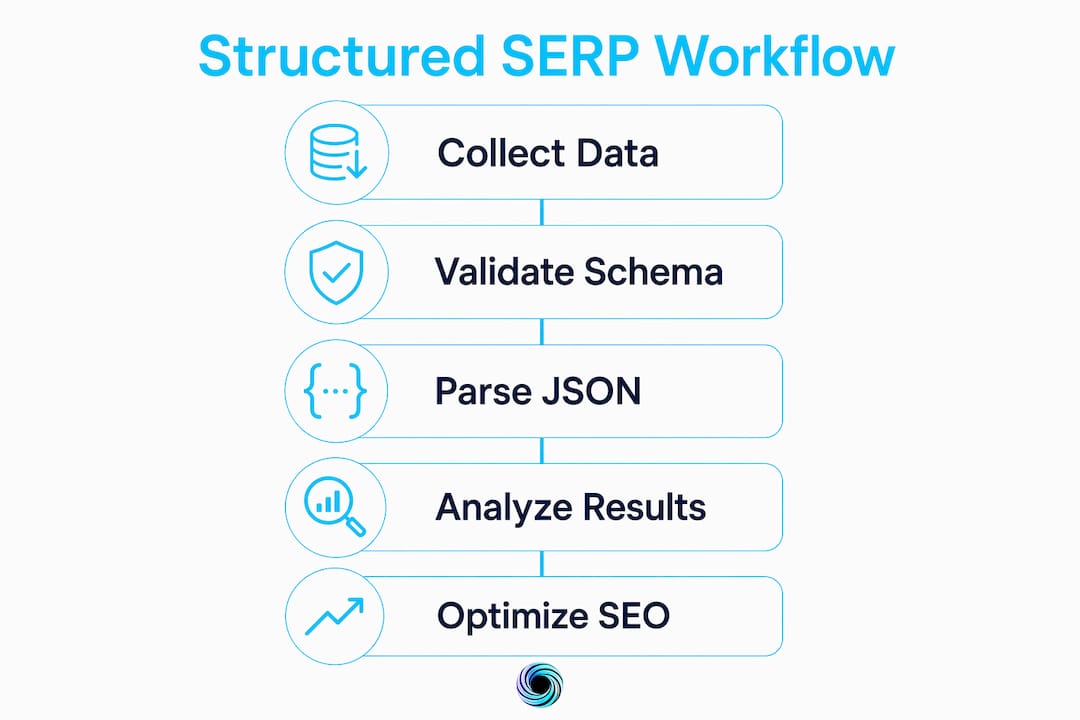
The typical structured data workflow looks like this:
- Authenticate. Send your API key with each request header.
- Query. Pass the keyword, location, language, and result count as parameters.
- Receive. The API returns a typed JSON object with
organic_results,ads,related_searches, and other typed arrays. - Validate. Check that required fields like
positionandlinkare present and non-null before inserting. - Store. Write the validated records to your database with the collection timestamp.
- Schedule. Automate the cycle with a cron job or a workflow orchestrator like Apache Airflow.
Custom scraping still makes sense when you need data that no API exposes, such as a proprietary site's internal structure or a non-Google search engine with no API coverage. For standard SERP collection, the structured API path is faster to ship and cheaper to maintain.
Pro Tip: Always implement exponential backoff on API errors and log the full error response, not just the status code. Structured SERP APIs return typed failure modes that tell you exactly why a request failed, which is far more useful than a generic 429 or 503.
Best practices for integrating structured SERP data into your projects
Consuming structured SERP data correctly matters as much as choosing the right source. A few practices separate reliable pipelines from ones that silently corrupt your data.
- Validate every response. Treat the API response as untrusted input. Check for null fields, unexpected types, and empty result arrays before writing to your database.
- Handle pagination explicitly. Most SERP APIs return 10 results per page by default. If you need positions 11–100, request each page separately and merge the results with consistent position offsets.
- Pass location and language parameters on every call. Omitting them produces results for the API's default locale, which pollutes location-specific rank-tracking datasets.
- Store raw JSON alongside normalized fields. Schema changes happen. Keeping the raw response lets you re-parse historical data without re-collecting it.
- Set spending caps before you automate. Scheduled collection at scale can generate unexpected API costs. Configure hard limits at the account level before your cron job runs overnight.
- Use typed response models. Deserialize JSON into typed structs or dataclasses in your language of choice. Untyped dictionary access is the fastest path to silent data corruption.
The structured JSON extraction pattern applies here directly. Treat each SERP response as a schema-validated document, not a flexible blob. That discipline pays off when you scale to thousands of keywords across multiple countries.
Key takeaways
Structured SERP data is the most reliable input format for automated search workflows, and the gap between it and raw HTML scraping widens as your data volume grows.
| Point | Details |
|---|---|
| Core format is JSON | Fields like position, link, and snippet map directly to database columns without transformation. |
| Reduces parser maintenance | SERP APIs absorb HTML changes, so your pipeline stays stable when Google updates its layout. |
| Enables AI grounding | Clean, typed snippets give RAG agents reliable context without runtime HTML parsing. |
| Localization requires explicit params | Always pass location and language parameters to avoid polluting rank-tracking data with default-locale results. |
| Validate before storing | Check for null fields and empty arrays on every response to prevent silent data corruption. |
Structured SERP data is maturing faster than most teams realize
The demand for structured SERP APIs has accelerated sharply over the past two years, and the driver is not SEO teams. It is AI engineering teams building RAG pipelines and autonomous agents that need web search as a grounded data source. That shift changes what "good" structured SERP data looks like.
SEO teams historically cared about position and URL. AI teams care about snippet quality, freshness signals, and result-type diversity. A response that includes only organic_results is not enough for an agent that needs to distinguish between a news article, a product listing, and a forum post. The web search tools that serve both audiences well are the ones worth building on.
My honest observation after working with these data flows: most teams underinvest in data validation and overinvest in collection frequency. Collecting SERP data every hour when your analysis runs daily is waste. Skipping null checks on position corrupts your entire rank-tracking history. Get the validation right first, then tune the schedule.
The future of structured SERP data points toward richer typing, including entity annotations, freshness scores, and structured schema.org metadata embedded directly in responses. Teams that build their pipelines around typed schemas now will absorb those additions without a rewrite. Teams that treat JSON as a flexible blob will rebuild from scratch.
— Glen
Gyrence and structured SERP data for developers
Gyrence is a web data API built for exactly this kind of work. Its five composable primitives, Search, Traverse, Fetch, Extract, and Map, return typed, discriminated-union responses on every call, including the failure cases. That means your pipeline knows whether a request failed due to a rate limit, a parsing error, or an empty result set, rather than receiving a silent null.
For developers building agent-ready data pipelines, Gyrence bundles LLM extraction with spending caps so your collection costs stay predictable. The hosted MCP endpoint connects directly to AI agents without custom integration work. If you are collecting structured SERP data at scale and your current setup surprises you with bills or silent failures, Gyrence is worth a look.
FAQ
What is structured SERP data in simple terms?
Structured SERP data is search engine results delivered as typed JSON fields, such as position, title, link, and snippet, instead of raw HTML. It is designed for programmatic use in automated workflows.
How does structured SERP data differ from web scraping?
Web scraping parses raw HTML directly and breaks when page layouts change. Structured SERP data comes from an API that handles parsing for you, delivering a stable schema regardless of HTML changes.
Why is structured SERP data useful for AI agents?
Structured SERP data gives AI agents clean, typed snippets as RAG context inputs, eliminating the need to parse HTML at inference time and improving the reliability of search-grounded responses.
What fields does a typical structured SERP response include?
A standard response includes position, title, link, snippet, domain, and timestamp. Some APIs also return typed objects for ads, news panels, image carousels, and featured snippets.
When should I use raw scraping instead of structured SERP data?
Use raw scraping when you need data from a source that no API covers, such as a proprietary site or a non-standard search engine. For standard Google SERP collection, a structured API is faster to build and cheaper to maintain.