
For LLM and RAG pipelines, the right ZenRows alternative depends on one technical constraint: do you need agent-ready typed outputs, or raw bypass power? Gyrence is the agent-first pick, returning typed discriminated-union responses with spending caps and bundled LLM extraction. For heavy anti-bot targets, managed browser APIs handle Cloudflare and DataDome without custom engineering. For high-volume, cost-sensitive work, a self-hosted library plus residential proxies wins on unit economics.
-
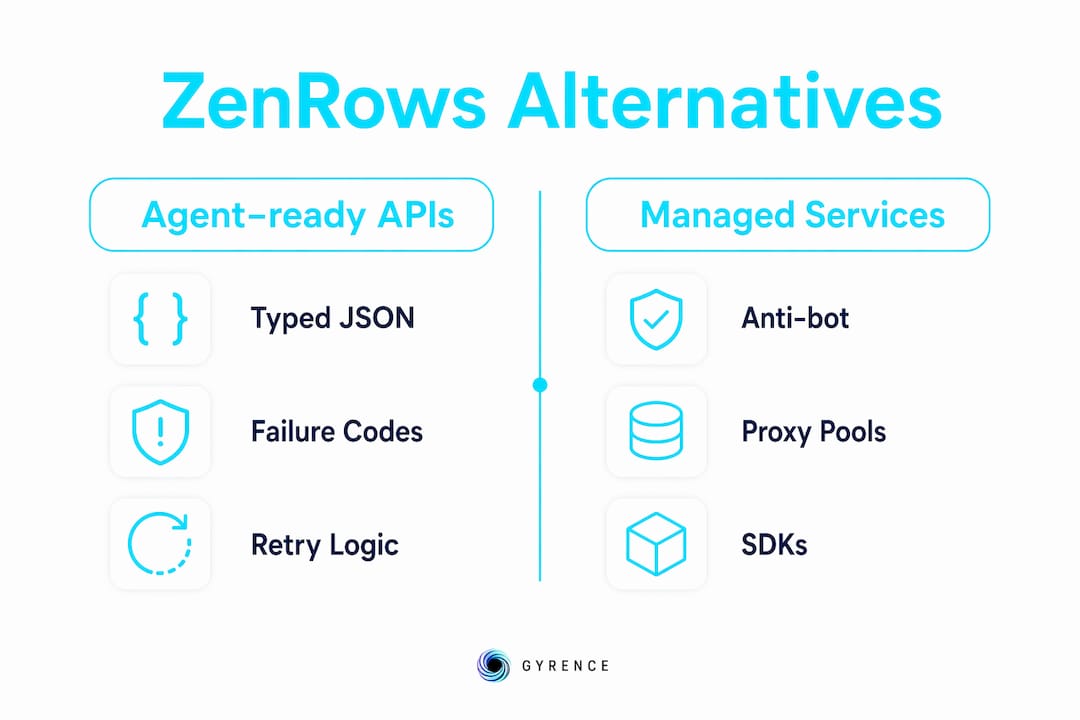
Agent-ready APIs (Gyrence, similar managed services): pick these when your pipeline ingests structured JSON or Markdown directly into an LLM or vector store. Typed failure modes let agents retry without guessing.
-
Anti-bot specialists (managed browser services): pick these when your targets run Cloudflare, DataDome, or Akamai and bypass engineering would cost more than the API bill.
-
DIY libraries + proxy layer (Playwright, Scrapy + residential proxies): pick these at high volume when you have engineering bandwidth and per-call cost is the ceiling.
Pro Tip: For RAG ingestion, the fastest path to production is an API that returns clean Markdown or typed JSON with provenance fields. You skip a normalization layer entirely.
Table of Contents
- Which ZenRows alternatives actually compare on the features that matter?
- How do you pick the right alternative for your project?
- What does each alternative actually excel at?
- Why Gyrence handles LLM failure modes differently
- How do you wire scraped web data into an LLM or RAG pipeline?
- How do pricing models affect your bill when you leave ZenRows?
- How we evaluated these alternatives
- Key Takeaways
- The failure mode problem nobody talks about enough
- Gyrence: agent-ready web data with no billing surprises
- Useful sources and further reading
- FAQ
Which ZenRows alternatives actually compare on the features that matter?
| Dimension | Agent-ready API | Anti-bot specialist | Managed scraping API | Marketplace Actors | DIY libraries + proxies |
|---|---|---|---|---|---|
| Best for | LLM/RAG pipelines | Defended targets | General scraping | Flexible task automation | High-volume, cost-sensitive |
| JS rendering | Yes (headless) | Yes (full browser) | Yes (configurable) | Yes (Playwright-based) | Yes (self-managed) |
| Proxy / IP rotation | Bundled | Bundled residential | Bundled | External or bundled | You manage |
| Output formats | Markdown, typed JSON | Raw HTML | Raw HTML, some JSON | Configurable | Raw HTML |
| Failure transparency | Typed discriminated union | Partial | Partial | Varies by Actor | None (you build it) |
| Pricing model | Per-call, spending caps | Per-call or subscription | Credits or subscription | Pay-per-run | Proxy cost + infra |
| SDKs / docs | Public docs + console | Vendor-specific | Vendor-specific | Marketplace docs | Open-source |
| Compliance / SLA | ToS-aware, public docs | Enterprise SLA available | Enterprise SLA available | Community | Self-managed |
Approach trade-offs at a glance:
- Agent-ready APIs: typed outputs and explicit failure codes accelerate LLM integration; higher per-call cost than DIY at extreme volume.
- Anti-bot specialists: highest success rate on defended targets; pricing can spike with JS-heavy pages and screenshot requests.
- Managed scraping APIs (ScraperAPI, Zyte): broad site coverage, mature SDKs, credit-based pricing; output is usually raw HTML, so you still own normalization.
- Marketplace Actors (Apify): flexible, community-maintained; quality varies by Actor and adds a dependency on third-party code.
- DIY libraries + proxy layer (Playwright, Scrapy): cheapest at scale; residential proxies are the main operational cost and the layer that most often determines real-world success.
How do you pick the right alternative for your project?
Choose by technical constraint: full control favors Playwright or Scrapy; agent-ready outputs favor managed APIs that return typed JSON or Markdown.
- What does your target site run? Static HTML → any tool works. SPA or anti-bot protected → you need headless rendering and likely a managed service.
- What format does your pipeline consume? If your LLM ingestion expects Markdown or typed JSON, an agent-ready API eliminates a preprocessing step.
- What is your engineering bandwidth? Low bandwidth → managed API. High bandwidth + high volume → DIY library plus proxy layer.
- Do you need predictable billing? Spending caps and per-successful-call pricing prevent runaway costs during development.
- What SLA do you need? Production pipelines with uptime requirements need a vendor with an enterprise SLA, not a community Actor.
Questions to ask any vendor before committing:
- Do failed or blocked requests count against my quota?
- Do responses include typed failure codes (CAPTCHA, 404, parse-failure)?
- Is there a spending cap or hard budget limit?
- What is the concurrency ceiling on my plan?
- Are IP pools geographically scoped to the U.S. or global?
Red flags: opaque null or empty-string failure responses; per-request multipliers buried in pricing footnotes; no provenance or request-ID metadata; no public docs or live console.
What does each alternative actually excel at?
Agent-ready APIs
These return clean Markdown or typed JSON with explicit failure modes. Gyrence fits here (covered in depth below). The category suits teams building RAG ingestion pipelines who cannot afford a normalization layer between fetch and embed. Expect public docs, a live console, and SDKs. Free tiers or trial credits are common.
Managed anti-bot and browser services
Bright Data and Zyte sit in this category. They handle Cloudflare, DataDome, and Akamai without custom bypass engineering. For heavily defended targets, anti-bot specialist APIs save more engineering time than they cost in API fees. Output is typically raw HTML; you own parsing. Enterprise SLAs are available. No free tier at meaningful scale.

Managed scraping APIs
ScraperAPI and similar tools offer credit-based pricing, broad site coverage, and mature SDKs. Output is raw HTML by default, though some offer basic JSON extraction. Good for teams that need reliable fetching without building proxy infrastructure, and who are comfortable writing their own parsers.
Marketplace Actors (Apify)
Apify's Actor marketplace lets you run community-built scrapers for specific sites without writing code. Quality varies by Actor. Best for one-off data pulls or prototyping. Not ideal for production LLM pipelines where output schema consistency matters.
Self-hosted libraries plus proxy layer (Playwright, Scrapy)
Full control, lowest unit cost at scale. Playwright handles JS-heavy SPAs; Scrapy handles high-throughput crawls. You manage proxy rotation, retry logic, and failure handling yourself. Managed APIs trade money for engineering time; at high volume, the DIY path wins on cost.
Why Gyrence handles LLM failure modes differently
Gyrence provides five composable primitives: Search (web search), Traverse (crawl outward from a URL), Fetch (page to Markdown), Extract (structured JSON via prompt or schema), and Map (domain URL graph). Every call returns a typed, discriminated-union response, including failure cases.
Core features for agent pipelines:
- Typed failure responses:
blocked,parse-failure,not-found,timeout— each with a structured payload, not an empty string. - Spending caps: set a hard budget ceiling; the API stops before you exceed it.
- Bundled LLM extraction: pass a schema or prompt; get typed JSON back without a separate extraction step.
- Provenance metadata: every response includes domain, fetch timestamp, and request ID.
- Hosted MCP endpoint: connect directly to agent frameworks via the Model Context Protocol.
- Public docs and live console available without a sales call.
Failure-mode response table:
| Failure type | Gyrence response field | Agent action enabled |
|---|---|---|
| Anti-bot / CAPTCHA block | status: "blocked", block_reason | Retry with different proxy or skip |
| Network timeout | status: "timeout", elapsed_ms | Retry with backoff |
| Parse / schema failure | status: "parse-failure", raw_excerpt | Log, flag for human review |
| Page not found (404) | status: "not-found" | Remove URL from queue |
How do you wire scraped web data into an LLM or RAG pipeline?
Prefer typed JSON or Markdown outputs with provenance fields for RAG ingestion. Raw HTML forces a normalization step that adds latency and error surface.
Integration pattern (REST + Python + LangChain-style ingestion):
# 1. Fetch page as Markdown with provenance
response = gyrence.fetch(url=target_url, format="markdown")

# 2. Gate on failure type — do not ingest failed fetches
if response.status != "success":
    log_failure(response.status, response.request_id)
    return

# 3. Attach provenance metadata to each chunk
chunks = chunk_markdown(response.content, max_tokens=512)
docs = [
    {"text": c, "source": response.url,
     "fetched_at": response.fetch_timestamp,
     "request_id": response.request_id}
    for c in chunks
]

# 4. Embed and store
vector_store.add_documents(docs)
Provenance checklist for every ingested chunk:
source_url: canonical URL of the fetched pagefetch_timestamp: ISO 8601 datetime of the requestrequest_id: vendor-issued ID for debugging and re-fetchingfailure_code: present only on failed calls; gates ingestion logiccontent_hash: optional; detects stale chunks on re-crawl
Pro Tip: Chunk at the section level (H2/H3 boundaries) rather than fixed token counts. Section-level chunks preserve semantic coherence and reduce hallucination in retrieval.
For autonomous agent web search, preserve the failure_code field even on successful ingestion. Agents that can inspect provenance can decide whether to re-fetch stale content rather than hallucinating an answer.
How do pricing models affect your bill when you leave ZenRows?
ZenRows uses a credit-based subscription model. When switching, the pricing shape matters as much as the headline rate.
Pricing model taxonomy:
- Per-successful-call: you pay only when the fetch succeeds. Best for unpredictable targets where failure rates are high.
- Credits / subscription: fixed monthly pool. Predictable if your volume is stable; wasteful if blocked requests consume credits.
- Per-GB transferred: favors lightweight pages; punishes JS-heavy or media-rich targets.
- Infrastructure cost (DIY): proxy bandwidth plus compute. Cheapest per-call at scale; highest setup cost.
Main cost drivers to watch:
- JS rendering / headless browser: typically significantly more expensive than a plain HTTP fetch.
- Residential proxy routing: the primary cost in DIY stacks and a hidden multiplier in managed APIs.
- Anti-bot bypass layers: priced as a separate add-on by most vendors.
- Concurrency: higher concurrency tiers often require plan upgrades.
Predictability checklist:
- Set a spending cap before your first production run.
- Use a separate test API key with a low budget ceiling during development.
- Disable JS rendering on static pages; enable it only where the target requires it.
- Monitor blocked-request rates weekly; a spike signals a proxy pool or bypass issue.
How we evaluated these alternatives
Evaluation axes used to build this shortlist:
- Access difficulty handling: static HTML, SPA/JS-heavy, Cloudflare-protected, e-commerce listings, SERP pages.
- Output format quality: raw HTML, Markdown fidelity, typed JSON schema adherence.
- Failure-mode transparency: does the API return typed failure codes or ambiguous nulls?
- Price predictability: spending caps, per-successful-call vs. credit burn on failures.
- SDK and docs experience: public docs, live console, code examples in Python and JavaScript.
- Latency and concurrency: time-to-first-byte on representative pages; concurrency ceiling per plan.
Testing covered representative page types: static HTML, SPA/JS-rendered pages, Cloudflare-protected targets, e-commerce product listings, and search result pages. No exhaustive performance benchmarks are claimed; success rates vary by target and change as sites update their defenses. Data sources include vendor documentation, third-party tool guides, and practitioner notes.
Key Takeaways
For LLM and RAG pipelines, an agent-ready API returning typed JSON or Markdown with explicit failure codes eliminates the normalization layer that slows most scraping integrations.
| Point | Details |
|---|---|
| Match tool to constraint | Choose by technical need: typed outputs for LLM pipelines, anti-bot specialists for defended targets, DIY for high-volume cost control. |
| Test across page types | Run your evaluation matrix across static, SPA, anti-bot-protected, and e-commerce pages before committing to any vendor. |
| Set spending caps first | Configure a hard budget ceiling and a low-budget test key before any production run to prevent runaway costs. |
| Require typed failure codes | Reject any API that returns ambiguous nulls on failure; typed responses let agents retry intelligently without LLM guesswork. |
| Gyrence for agent pipelines | Gyrence's five composable primitives, spending caps, and discriminated-union failure responses make it the direct fit for RAG and agent workflows. |
The failure mode problem nobody talks about enough
Most ZenRows alternative comparisons focus on bypass rates and proxy pool size. Those matter, but they are the wrong first question for teams building LLM pipelines. The question that actually breaks production systems is: what does your API return when it fails?
An empty string or a generic 500 passed to an LLM produces a hallucinated answer with no signal that the fetch failed. A typed blocked response with a block_reason field lets your agent decide: retry with a different proxy, skip this URL, or flag it for human review. That distinction determines whether your RAG pipeline is trustworthy or just fast.
The second underrated issue is billing opacity. Per-request multipliers buried in pricing footnotes, credits consumed by failed fetches, and JS-rendering surcharges that appear only at invoice time are how scraping bills surprise teams. Spending caps are not a nice-to-have; they are the only reliable guardrail.
Pick the tool that names its failure modes and caps your spend. Everything else is negotiable.
Gyrence: agent-ready web data with no billing surprises
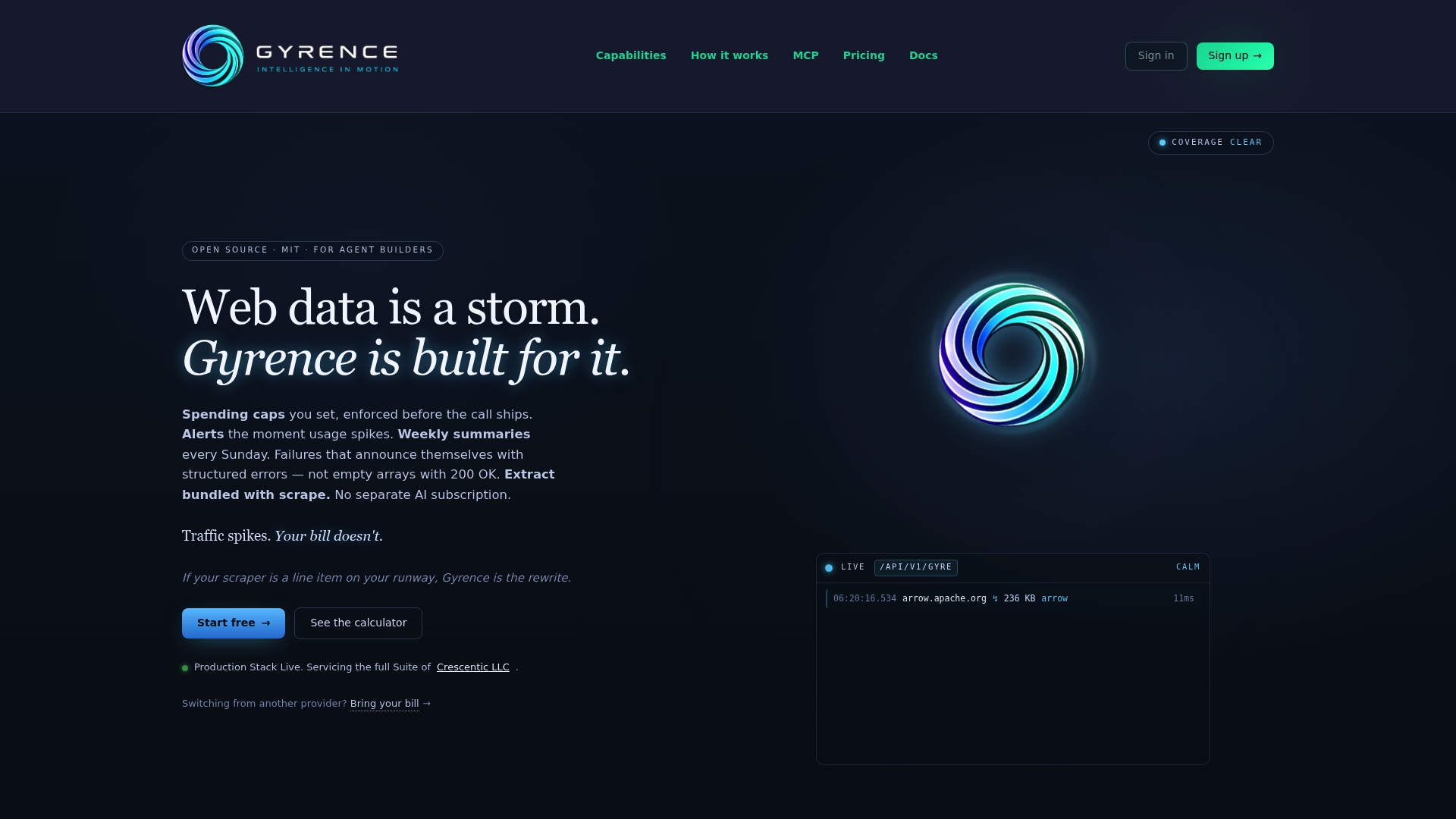
If your pipeline needs typed, structured web data without a normalization layer or an unpredictable bill, Gyrence is built for exactly that. Five composable primitives (Search, Traverse, Fetch, Extract, Map) plus a hosted MCP endpoint give you the full data surface an AI agent needs. Spending caps mean your bill stops where you tell it to. Typed discriminated-union responses mean your agent always knows what happened, including the failure cases.
Get started without a sales call:
- Docs: gyrence.com/docs — full API reference, code examples, and integration guides.
- Console: gyrence.com/app — live request builder, spending cap controls, and request logs.
- Landing page: gyrence.com — overview, pricing model, and trial access.
For teams comparing structured extraction approaches before committing to a vendor, the docs are public and the console is live. No demo required.
Useful sources and further reading
- Best web scraping tools (Context.dev) — covers agent-ready output formats, anti-bot trade-offs, and test page type guidance.
- Best Web Scraping Tools 2026 (DataImpulse) — categorizes tool families and explains proxy cost drivers for defended targets.
- WebPeel practitioner notes — typed failure responses and discriminated-union API design for agent workflows.
- Gyrence API docs — full reference for Search, Traverse, Fetch, Extract, and Map primitives.
- Structured web data for RAG (Gyrence blog) — chunking strategies, provenance fields, and ingestion patterns.
- AI agent web browsing checklist (Gyrence blog) — safety and reliability checklist for agent-driven web retrieval.
U.S. legal note: always review a target site's robots.txt and terms of service before scraping; compliance obligations vary by site and use case.
FAQ
What is the best ZenRows alternative for RAG pipelines?
An agent-ready API that returns typed JSON or Markdown with explicit failure codes is the best fit. Gyrence provides exactly that, with spending caps and bundled LLM extraction.
Do Playwright and Scrapy replace managed scraping APIs?
They can, but only if you have engineering bandwidth to manage proxy rotation, retry logic, and failure handling yourself. Managed APIs trade money for engineering time; at high volume the DIY path wins on cost, not convenience.
How do I avoid bill shock when switching from ZenRows?
Set a spending cap before your first production run, use a separate low-budget test key during development, and confirm whether failed or blocked requests consume your quota.
Why do typed failure responses matter for LLM agents?
An ambiguous null or generic error passed to an LLM produces a hallucinated answer with no signal that the fetch failed. Typed responses like blocked or parse-failure let agents retry or skip programmatically, keeping your pipeline trustworthy.
Which tools offer a free tier for testing?
Most agent-ready and managed scraping APIs offer trial credits or a limited free tier. Gyrence provides public docs and a live console without a sales call; check individual vendor pages for current trial terms, as these change frequently.