
Rotating IP addresses is not illegal in itself in the U.S. What matters is what you do behind the rotation: which pages you reach, whether you were told to stop, and what terms you agreed to. A proxy changes where a request appears to come from. It does not grant permission. If you use rotation to get around a block, you add risk. If you use it for load or geography on public pages, you add very little. The safest setup for a small team is one that does not depend on evasion: capped, traceable calls that surface blocks instead of hiding them. That is how we built Gyrence.
Table of Contents
- TL;DR
- What IP rotation actually does
- The federal law: the CFAA
- Where rotation raises the risk
- Beyond access: privacy and copyright
- Agents add a wrinkle
- A lower-risk routine
- Our view
- Run it with caps and typed failures
- FAQ
- Sources
TL;DR
- IP rotation is a technique, not a legal category. U.S. exposure comes from authorization, contracts, copyright and privacy, not from the proxy.
- Public, unauthenticated pages are treated differently from login-protected ones. Rotating to continue after a cease-and-desist or an IP block is the highest-risk pattern.
- Terms of service can create contract claims even where computer-access law does not apply.
- Treat a block as an answer. Stop, back off, or seek authorized access.
- Log source URL, timestamps, status and content hash so every record is traceable.
This is general information for developers, not legal advice. For a specific project, especially one touching personal data or a site that has sent you a notice, talk to a lawyer.
What IP rotation actually does
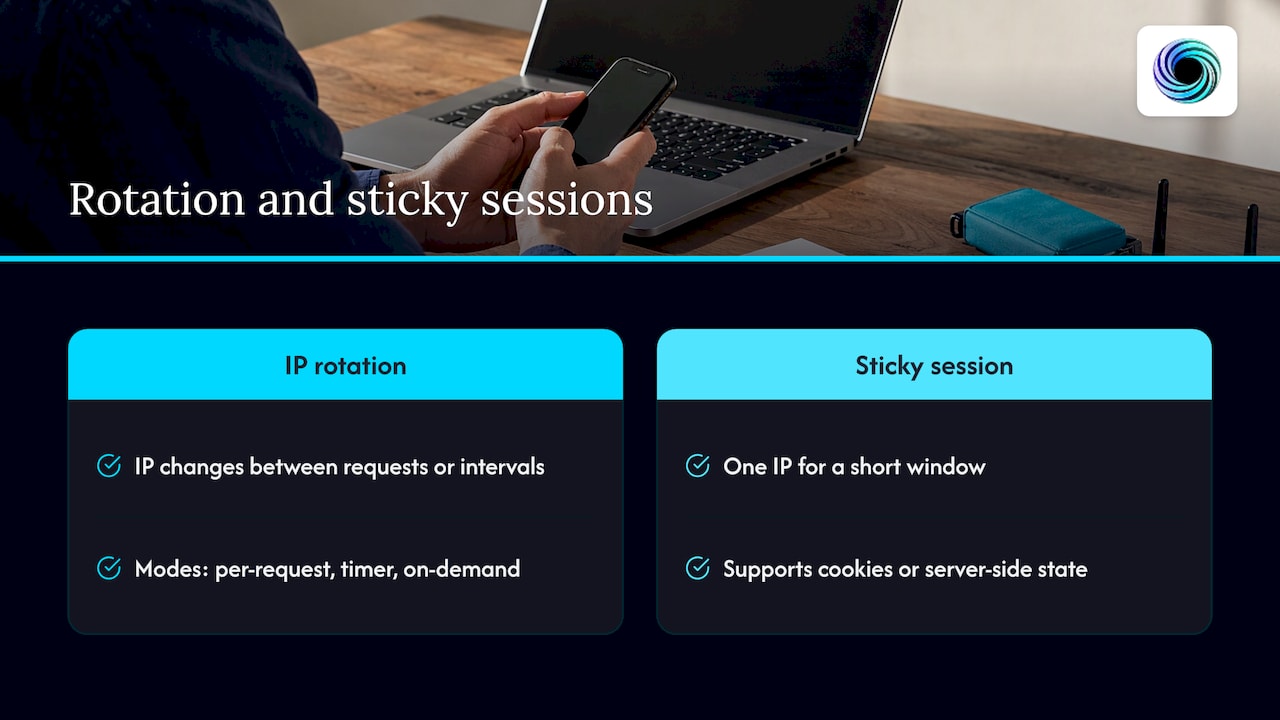
IP rotation means changing the public IP a website sees between requests, connections or time intervals. In scraping, a gateway usually picks an exit IP from a pool and forwards each request. Rotation can happen per request, on a timer or on demand. A sticky session keeps one IP for a short window, which matters when a site relies on cookies or server-side state.
Note what that describes: a change of network origin. It says nothing about whether you may read the page, copy it or reuse it. As one responsible-collection guide puts it, a proxy does not grant a license, expand a quota or waive a contract.
The federal law: the CFAA
The main federal statute is the Computer Fraud and Abuse Act, 18 U.S.C. § 1030. It prohibits intentionally accessing a protected computer without authorization or exceeding authorized access. The statute ties "exceeding authorized access" to obtaining information you are not entitled to obtain.
Two decisions shape how developers read it:
- In Van Buren v. United States (2021), the Supreme Court read "exceeds authorized access" narrowly. It concerns areas of a computer you are not entitled to enter, not merely using accessible information for a bad purpose.
- In hiQ v. LinkedIn, the Ninth Circuit's 2022 opinion dealt with public profile pages at the preliminary-injunction stage. It did not resolve the dispute or every claim and defense, including DMCA, trespass and misappropriation theories. Later proceedings found hiQ likely breached LinkedIn's User Agreement.
The practical reading: open public pages are generally treated differently from password-protected areas. The Supreme Court has not settled every question about "without authorization."
Where rotation raises the risk
Courts look at the whole pattern. Rotation shows up as evidence when it sits next to these facts:
- A cease-and-desist plus a technical block. Access after a platform implements technical barriers and sends a cease-and-desist is a higher-risk pattern under the CFAA. In Craigslist v. 3Taps (2013), a court let a CFAA claim proceed where the defendant allegedly kept scraping after being blocked, using different IPs and proxies to hide its identity. That was a pleading-stage ruling, not a final finding.
- Login-protected pages. In Ryanair v. Booking (2022), a Delaware court allowed CFAA theories to proceed on allegations of login-protected pages, technical barriers and continued access after revocation. It did not hold that rotation alone creates liability.
- Agreed terms. Terms may independently create contract claims, especially where users affirmatively assented. Bypassing effective technical controls can also raise CFAA or DMCA issues.
State law adds another layer. Commentary reports that most states have analogous computer-access statutes with varying scope and private rights of action.
Beyond access: privacy and copyright
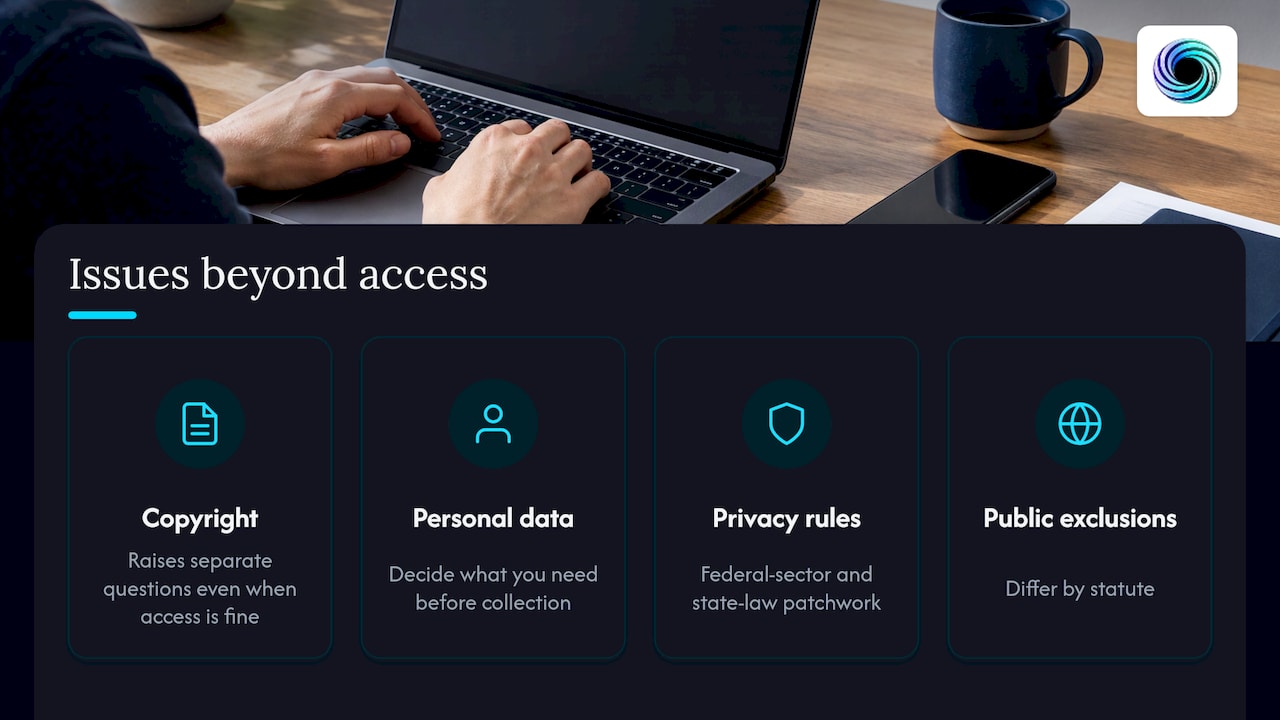
Even when access is fine, the data can be the problem. Copyrighted content and personal information raise separate questions. U.S. privacy rules are a federal-sector and state-law patchwork, and public-information exclusions differ by statute. If your pipeline collects personal data, decide what you need before you collect it. Our guide to ethical scraping with rate limits, schema and PII controls covers the engineering side.
Agents add a wrinkle
If an AI agent browses on a user's behalf, the user's permission to operate an account may not alone establish platform authorization. Terms, authentication boundaries and blocks still matter. Delegated access and tool permissions are also a security question, which this piece on MCP and agent security addresses. For a working checklist, see our AI agent web browsing checklist.
A lower-risk routine
Counsel's guidance converges on a few habits: follow data-owner restrictions, use authorized paid APIs where available, assess the data collected, and review indemnification terms. Before scaling, assess data type, public availability, login or CAPTCHA requirements, robots.txt and terms you agreed to. Treat a cease-and-desist as a change in the risk calculation.
Then add engineering discipline:
- Budget per source. Spreading requests across IPs does not reduce aggregate load. Enforce a request budget per site across all workers, and stop on persistent errors or denial signals. Our note on rate limits and backoff shows a 20-second backoff pattern.
- Keep a trail. Record source URL, UTC request and response time, status, parser or schema version, content hash and result class. That makes every record defensible in a compliance review. Our five audit-ready controls expand on this.
- Count failures in cost. Measure cost per accepted record, including failed requests, so a block-and-retry loop never hides inside your bill.
- Know the source. Public filings are a different case from a login-gated platform. See our take on EDGAR scraping for a worked example.
Our view
Most scraping legal trouble starts when a team treats a block as an obstacle instead of an answer. Rotation makes that mistake cheap to repeat and expensive to explain later.
We built Gyrence the other way around. Every call returns a typed, discriminated-union response, failures included, so an agent or a pipeline can see that a fetch was blocked and decide what to do, rather than guess. Spending caps and predictable cost-per-call mean a retry storm cannot turn into a surprise invoice. WebDoppler monitoring and webhook alerts tell you when a source changes.
Honest primitives do not make a legal decision for you. They give you the evidence to make it: what was fetched, when, with what result.
Glen
Run it with caps and typed failures
Gyrence offers Search, Traverse, Fetch, Extract and Map, plus a hosted MCP endpoint, with spending caps and no separate AI extraction charge. Plans include Free, Founders and Pay-As-You-Go, plus Standard at $75 per month, Growth at $299 per month and Scale at $549 per month. See Gyrence pricing or start from the Gyrence homepage.
For source-change monitoring with alerts, look at WebDoppler.
FAQ
Is IP rotation illegal?
No statute bans rotating IPs as such. Risk comes from what you access and whether you were told to stop. Rotating to continue after a block or cease-and-desist is the pattern courts have let claims proceed on.
Does rotating IPs violate the CFAA?
Not by itself. The CFAA turns on access without authorization, and public pages are treated differently from login-protected ones. The Supreme Court has not resolved every aspect, so a lawyer should review any project near a revoked-access situation.
Can rotation get me sued even if the pages are public?
Yes, on other theories. Site terms you agreed to can support contract claims, and copyright or privacy rules can apply to the data itself. Our overview of the four legal axes of web scraping maps them.
What should I do if I get a cease-and-desist?
Stop the collection from that source and take the notice to a lawyer. Continuing through new IPs after a notice and block is the highest-risk path.
Sources
- How IP Rotation Works: A Technical Breakdown
- Responsible Web Data Collection: Authorization and Controls
- 18 U.S.C. § 1030
- Web Scraping in the Age of AI: Guidance for Data Owners and Scrapers
- hiQ Labs v. LinkedIn, Ninth Circuit opinion
- How 2 Tech Statutes Are Being Applied To Agentic AI
- Delaware court on CFAA scope and screen scraping
- Are residential proxies legal?
- Web Scraping for Research: Legal, Ethical, Institutional
- AI & Data Scraping: Copyrights, Contracts & Other Legal Issues
- Web Scraping Proxies: Setup, Sessions & Data Quality
- MCPs: The New Frontier in AI Agent Security