
Choosing a web scraping API that delivers structured data with honest failure reporting and cost control remains difficult. Competing APIs often hide bot defenses, inflate costs for high volume use, or gate self hosting and transparent billing behind custom sales. This list details pricing, control, and output transparency among five Olostep.com alternatives so technical teams can select the right API without overspending or missing diagnostics.
Table of contents
Gyrence
At a glance
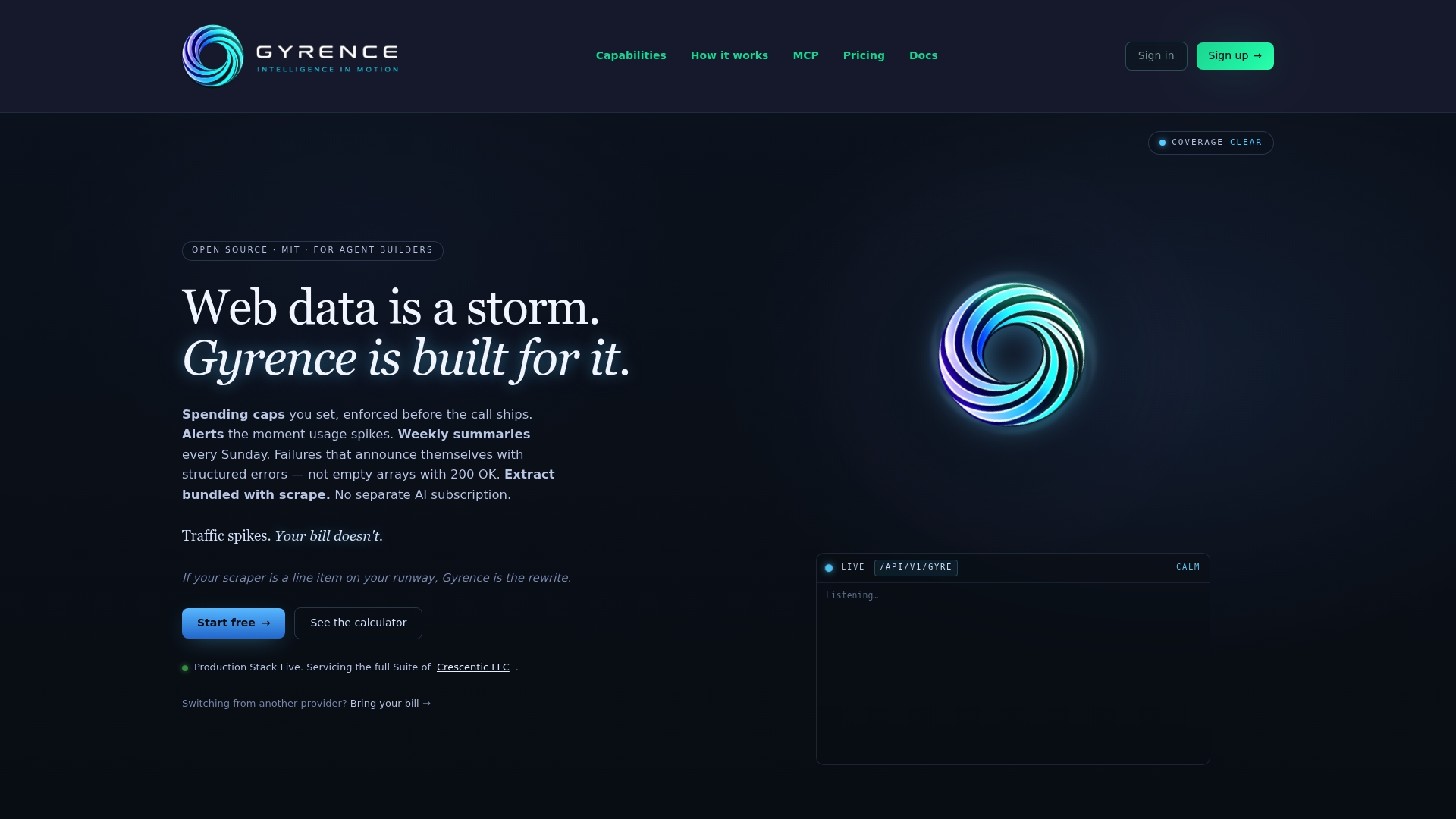
Five composable primitives, Search, Gyre, Fetch, Extract, and Map, power programmatic access to web content. The system is open source and built to run self hosted, so teams keep control of their data pipeline. It also includes built in bot defense detection and a credit based billing model for predictable costs.
Core features
-
Five primitives: Search, Gyre, Fetch, Extract, and Map provide modular building blocks for retrieval pipelines. Use them together or independently to tailor extraction flows.
-
Structured extraction powered by AI: Schema guided extraction returns typed JSON suitable for downstream agents and RAG ingestion. The extractor accepts prompts or explicit schemas.
-
Self hosted friendly architecture: The codebase supports on premises deployment so teams retain control of data and infrastructure. That reduces reliance on third party hosting.
-
Bot defense detection: The runtime detects and reports bot defenses honestly, so agents see failure modes instead of silent empty results. That visibility prevents wasted compute and debugging time.
-
Predictable credits and billing: A credit based billing system with spending caps and pay as you go options gives financial guardrails for production use. Teams can avoid surprise bills during scale.
Key differentiator
Gyrence centers on open source primitives that return structured results and explicit failure cases. Its extractor emphasizes schema guided output so agents receive typed JSON they can reason about. The platform reports bot defenses rather than masking them, which helps automated systems handle retries and fallbacks. That focus on transparency suits agent driven retrieval more than opaque scrapers.
Pros
-
Open source and transparent. Teams can audit code, extend primitives, and run the stack on their own infrastructure.
-
Bundled primitives reduce glue code. Search, traversal, fetch, extraction, and mapping work together so integration time drops.
-
Honest failure reporting for bot defenses. The system surfaces defenses so your agent can choose alternative strategies instead of guessing why results are missing.
-
Predictable billing with caps and pay as you go options. Finance teams get spending controls that match engineering rate limits.
-
Designed for building real agents. The outputs are agent ready, typed, and suitable for RAG web ingestion and analytic pipelines.
Cons
- Limited support for PDFs, Office documents, images, audio, and video, which means multimedia sources need separate tooling.
Who it's for
Gyrence fits engineering teams and data analysts building AI driven web agents or research pipelines who want control over data and costs. It matches groups that can operate self hosted infrastructure and write integration code. If you need turnkey multimedia extraction or a managed residential proxy pool, this product is a poor fit.
Unique value proposition
Flexible credit based billing with free, founder, and pay as you go tiers lets teams cap spending while running a self hosted retrieval stack. That combination reduces surprises on the invoice and keeps sensitive data inside your environment. For teams building agents that must reason about failure modes, the typed responses and honest error reporting lower operational risk and debugging time.
Real world use case
A financial analytics firm runs Gyrence self hosted to monitor thousands of news sites and extract article metadata into typed JSON. The firm uses the extractor to enforce a schema for headline, author, and publish date. Seeing bot defense signals saved weeks of debugging during an aggressive data collection campaign.
Pricing
Gyrence uses a credit based model with a free tier, founder tier, pay as you go, standard, growth, and scale options. The system supports spending caps so teams can limit monthly usage. Enterprise arrangements are available for large scale deployments.
Website: https://gyrence.com
Firecrawl
At a glance
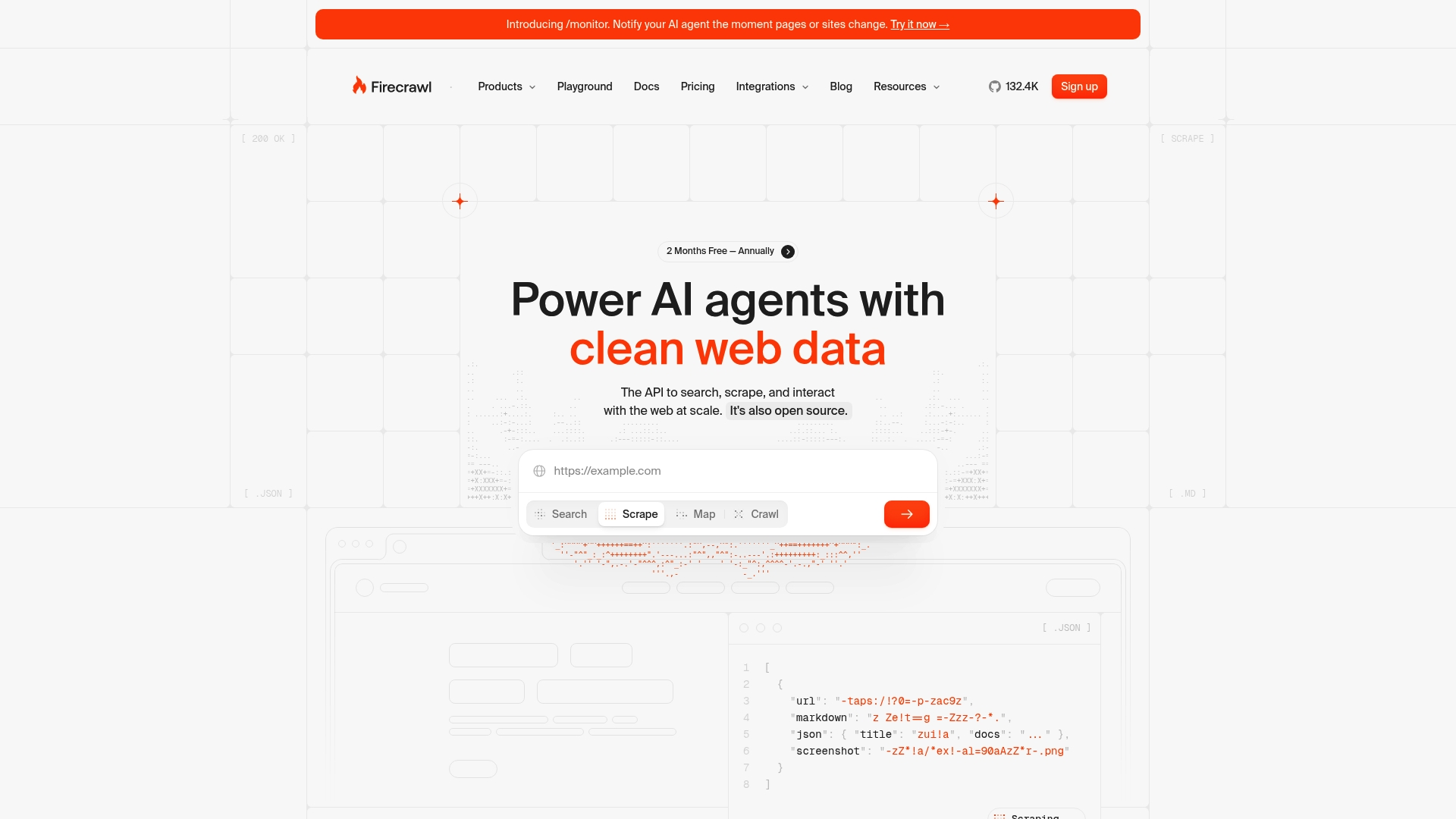
Firecrawl's marketing materials state 96% web coverage and claim over 150,000 companies use the service. The vendor positions the crawler as able to handle JavaScript-heavy pages and return cleaned content in markdown, JSON, or screenshots. It also highlights open source visibility and connectors for MCP, CLI, and SDKs.
Core features
Firecrawl groups its capabilities around search, extraction, and interaction. Key items:
- Search the web and return full content from results in a single API call.
- Extract page content into markdown, structured JSON, and screenshots for downstream use.
- Interact with pages by clicking, scrolling, and submitting forms to handle SPA workflows.
- Integrate with AI agents via MCP, a CLI, or language SDKs for programmatic pipelines.
Key differentiator
The product pairs that claimed coverage figure with emphasis on speed and token-efficient extraction. It is also open source, which gives teams access to the code and community contributions. The combination targets AI teams that need live, cleaned web content rather than raw HTML.
Pros
-
Excels with dynamic pages. Teams report better success on JavaScript-heavy sites compared with basic crawlers.
-
Fast, focused extraction. The vendor emphasizes returning only relevant content to reduce downstream token costs.
-
Open source transparency. Access to source and community patches helps debug edge cases and extend connectors.
-
Agent-friendly connectors. MCP, CLI, and SDK support makes embedding into AI agents and pipelines straightforward.
-
Broad coverage claim. That coverage claim suggests fewer missed pages when building large-scale ingestion.
Cons
-
Cost at scale can grow quickly for heavy usage. The product data flags high-volume billing as a common tradeoff.
-
Occasional reliability gaps on highly protected or unusually complex sites. Some targets still require custom handling.
-
Documentation and extraction accuracy vary on nonstandard layouts. Expect manual tuning for fringe HTML patterns.
-
Requires API key setup and developer work to get the most reliable results.
When it may not fit
If you run extremely high page volumes on a tight budget, the platform may not be the most economical choice. Teams that require guaranteed uptime across every anti-bot architecture should plan for supplemental tooling. Small projects that need a low-effort, fully managed scraper may find the open source plus DIY tuning model heavier than they want.
Who it's for
AI developers, data scientists, and enterprises building large-scale web data pipelines will find Firecrawl a close fit. It targets teams that need live, structured content for agents, research, enrichment, or monitoring. Organizations that value open source transparency during troubleshooting will benefit most.
Real world use case
A research team at Replit integrated Firecrawl to feed agent-based research workflows with cleaned markdown pages. Gamma and Lovable used the same approach to accelerate onboarding and enrichments by extracting structured fields from live pages. These examples show how the tool plugs into agent pipelines to provide ready-to-use web data.
Pricing
The vendor advertises a free tier starting at 1,000 pages/month and an annual plan that includes two months free on yearly billing. Paid plans scale to higher usage levels, so budget projections must account for volume growth and page complexity.
Website: https://firecrawl.dev
Apify
At a glance
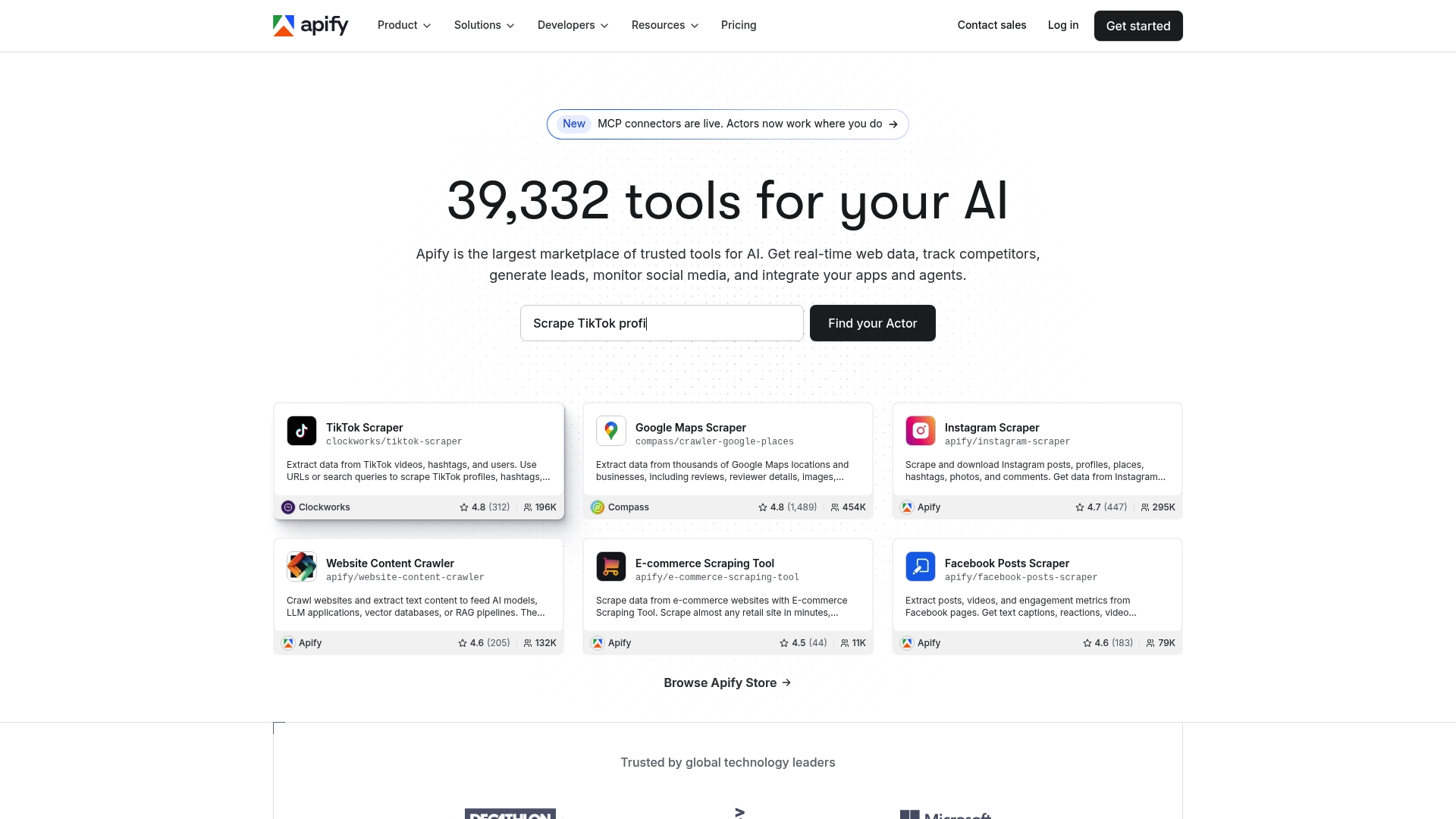
Apify reports a marketplace of 39,332 pre built Actors. That library lets teams pick a ready script instead of writing a custom crawler for many common sites. The platform combines those Actors with cloud execution and developer SDKs so teams can move from prototype to scale quickly.
Core features
Apify offers a marketplace of pre built Actors for scraping and automation, plus a rich API to run and monitor jobs. The vendor states enterprise security and compliance support, including SOC2, GDPR, and CCPA. Open source libraries like Crawlee support JavaScript and Python usage in local or cloud runs. MCP connectors and dataset exports let you push JSON, CSV, or XLSX into other tools.
Key differentiator
Apify's scale of pre built scripts is the defining angle. That marketplace reduces development time for routine targets and for common monitoring tasks. For teams that reuse or adapt community actors, Apify shortens rollout and maintenance compared with building every scraper from scratch.
Pros
- Large actor ecosystem speeds project start. Teams often find a usable Actor and avoid building a crawler from zero.
- Cloud execution and datasets support high volume collection. This fits projects that need reliable scheduled runs and persistent storage.
- Open source tooling supports local development and debugging. You can run the same libraries on a developer machine and in Apify cloud.
- Broad integrations ease pipeline wiring. The platform connects to storage, vector DBs, and common collaboration tools.
- Security and compliance focus for enterprise customers. The vendor states those controls as part of its positioning.
Cons
- Credit based pricing can be hard to forecast for first time users. Several users report surprise bills when jobs scale.
- Support responsiveness varies by account level and workload urgency. That variability can matter for incident recovery.
- Advanced features assume developer expertise. Non technical teams may need engineering support for complex workflows.
- Some scraper parameters and edge case behaviors require iterative tuning. Expect debugging time on brittle pages.
When it may not fit
Apify may not fit teams that need strictly predictable per page pricing or simple monthly packages. Small projects with one off scrapes could find the platform more complex than necessary. Organizations without developer resources will face a learning curve for advanced features and actor customization.
Notable integrations
- Notion
- Slack
- GitHub
- Google Drive
- Zapier
- Airbyte
- Pinecone
- LlamaIndex
Who it's for
Apify targets developers, data scientists, and AI teams that need high volume web data and flexible automation. It fits teams that want to reuse community scripts and integrate results into data pipelines. Enterprises that require compliance controls and scheduled cloud execution will find the platform aligned to those needs.
Real world use case
A SaaS company used Apify Actors to automate competitor price monitoring. They ran scheduled jobs, stored results in datasets, and routed alerts to Slack via MCP connectors. As their data needs grew, they increased cloud capacity and reused Actors for new pages.
Pricing
Apify offers a free tier and paid plans. Pricing starts at $29 per month for Starter, $199 per month for Scale, and $999 per month for Business, with pay as you go options and custom enterprise plans.
Website: https://apify.com
ScrapeGraphAI
At a glance
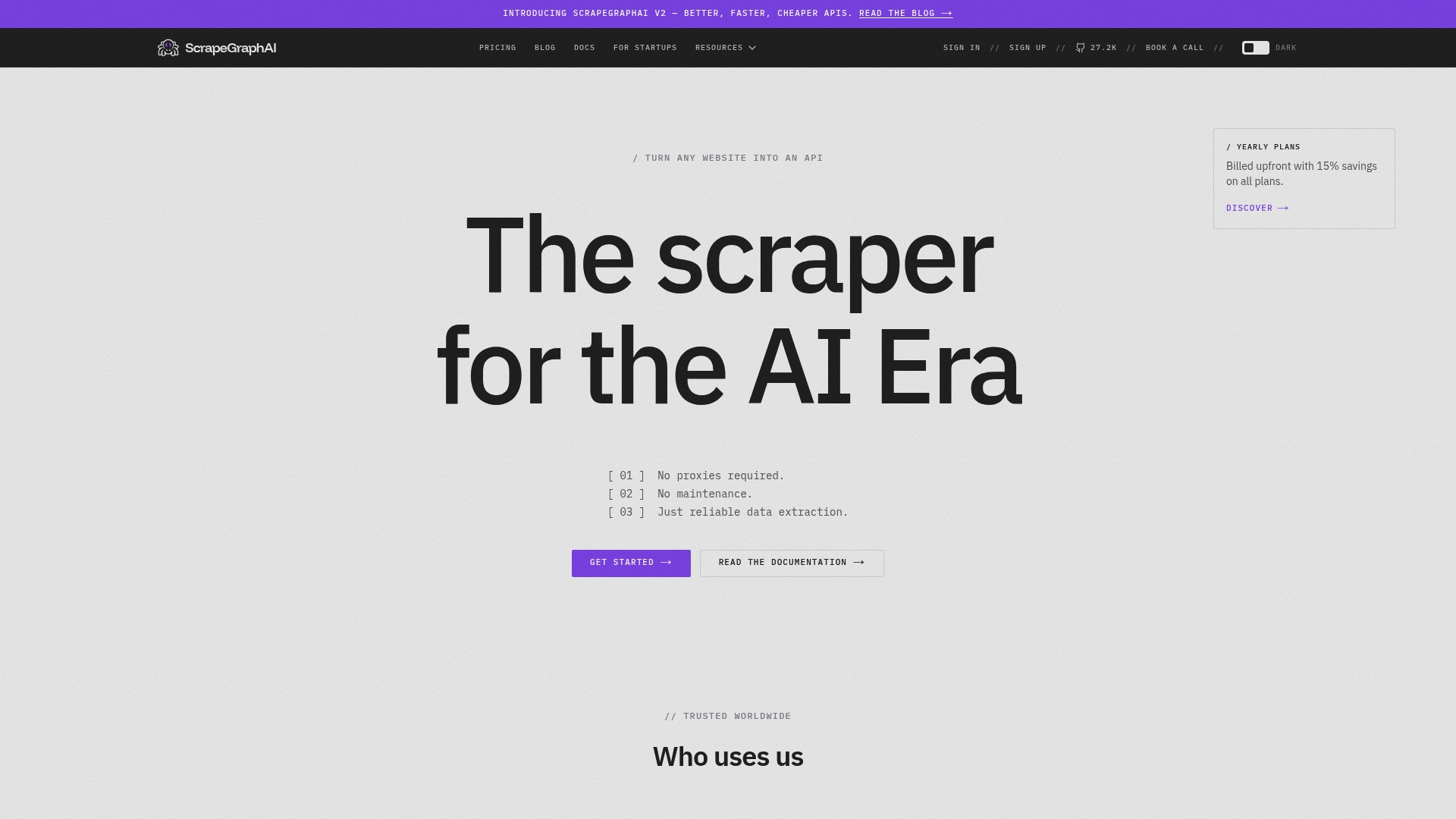
ScrapeGraphAI ships with a prompt driven extractor that automatically adapts when a page layout changes. The vendor advertises a free entry tier with 500 credits. The stack removes manual selector maintenance and aims for fast setup for small teams and automation projects.
Core features
- AI powered extraction that accepts natural language prompts and returns structured outputs.
- No proxies required for basic scraping, plus built in proxy rotation for tougher targets.
- Automatic adaptation to layout changes so extractors need less manual maintenance.
- Multi format outputs: Markdown, JSON, HTML, and page screenshots.
- SDKs, CLI, and integrations for embedding into pipelines and automation tools.
Key differentiator
ScrapeGraphAI centers on prompt based extraction that self adapts to site changes without manual updates. That design shortens setup time for prototypes and weekly monitors. Compared with Gyrence, ScrapeGraphAI targets fast onboarding and prompt workflows rather than typed, discriminated responses and granular primitives for agent reasoning.
Pros
- Affordable entry with a credit model. The credit packs let teams start small and scale spending predictably.
- Prompt driven flow removes the need to write complex CSS or XPath selectors. Teams iterate faster on extraction changes.
- Bundled anti bot features and proxy rotation reduce initial infrastructure work for small deployments.
- Wide SDK support, including Python and JavaScript, plus CLI tools for automation and local testing.
- Fast to prototype. A monitoring job for a handful of pages goes from idea to production in hours.
Cons
- The product is still evolving for very large scale jobs. Some users report backend support is needed for heavy throughput.
- Complex workflows can require vendor assistance to tune reliability under load.
- Billing depends on credits usage. Costs can grow if you scrape very large datasets frequently.
When it may not fit
If you run enterprise scale crawls that demand turnkey horizontal scaling, this may not fit. If your agents require strictly typed, discriminated failure responses as part of decision logic, consider an API focused on typed outputs and spending caps. If you need a pure self managed proxy fleet, the bundled approach here may not match that preference.
Notable integrations
- Python SDK
- JavaScript SDK
- CLI tools
- LangChain
- CrewAI
- LlamaIndex
- Vercel AI
- n8n (automation platform)
Who it's for
Startups, small to medium sized data teams, and developers who need quick extraction without building selector logic. It fits automation enthusiasts looking to prototype scrapers fast. It also suits teams that prefer a prompt based workflow over manual selector maintenance.
Real world use case
A startup runs weekly checks on competitor product pages. ScrapeGraphAI extracts price and review fields via prompts and pushes JSON to dashboards. The team reduced manual selector fixes and kept the monitoring job running with minimal intervention.
Pricing
From a free tier with 500 credits up to enterprise custom plans. The vendor also sells one time credit packs for burst usage. Pricing scales with credits consumed rather than per seat.
Website: https://scrapegraphai.com
HasData
At a glance
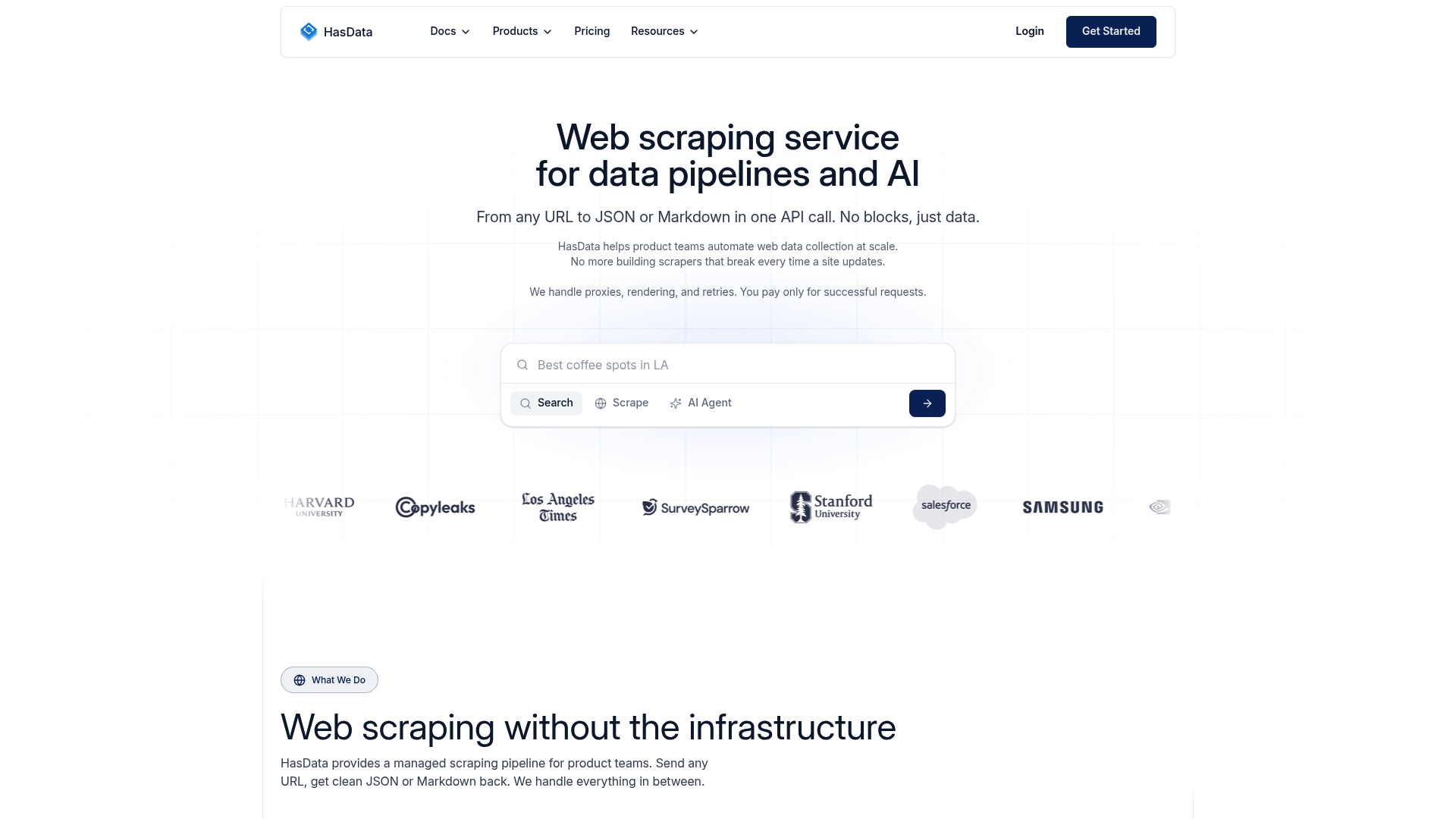
HasData reports serving over 100 million requests daily. That scale signals a focus on high-volume pipelines for product teams rather than ad hoc scraping tasks. The vendor advertises managed handling of proxies, rendering, and anti-bot measures so teams can call an API and receive structured outputs. The entry price and trial options make evaluation low friction.
Core features
HasData bundles managed pipeline pieces you normally build yourself. Key capabilities include:
- Headless browser rendering for dynamic content and single page applications, including JavaScript heavy pages.
- Automatic proxy rotation with geo targeting to vary origin and reduce blocking.
- APIs covering web scraping plus targeted endpoints for Google SERP, Maps, News, Amazon, Flights, and product pages.
- No code scrapers for popular sites and pre collected datasets for common sources.
- AI and LLM ready outputs delivered as JSON or Markdown, plus SDKs for Python and NodeJS.
Key differentiator
HasData positions itself as a managed infrastructure layer. The product removes the need to operate browsers, proxies, and evasion tooling yourself. That focus shortens setup time for teams that want typed, ready data from an API rather than a custom scraping stack. It serves narrower use cases than full crawler platforms by trading deep process control for convenience.
Pros
- Reliable request capacity. HasData reports 99.9% uptime, which suggests the service aims to support production workloads. That claim is vendor reported.
- Low integration friction. SDKs for Python and NodeJS and straightforward APIs let developers instrument pipelines quickly.
- Anti bot and CAPTCHA handling are built in, reducing the time you spend on blocking and retries.
- Structured outputs ready for ingestion. JSON or Markdown responses fit RAG workflows and product databases without heavy post processing.
- Flexible pricing and a free trial make it simple to test without long commitments.
Cons
- Customer support response times appear slow. User commentary indicates troubleshooting can take longer than expected.
- Pricing and credit usage policies are not fully transparent. That opacity can produce unexpected bills for heavy usage.
- Coverage gaps on complex sources. Support for highly dynamic targets like Google Maps can be inconsistent or limited.
- Limited process management features. The service lacks detailed job cancellation and deep monitoring compared with self hosted stacks.
When it may not fit
If you require tight control over crawl orchestration and internal monitoring, HasData may feel restrictive. Teams that must guarantee consistent snapshots of extremely complex maps or app UIs may encounter gaps. If your workflows require fine grained concurrency controls and per job cancellation, look elsewhere.
Who it's for
Product teams and developers who want scalable web data extraction without running scraping infrastructure will find HasData relevant. It suits groups prioritizing speed to production over low level control. It also fits teams preparing data for LLM ingestion or analytics pipelines.
Real world use case
A SaaS vendor uses HasData to pull search engine rankings and local listing attributes for thousands of client sites. The API delivers JSON records that feed the vendor's dashboard and alerting pipeline, reducing engineering time spent on proxies and rendering.
Pricing
The vendor advertises a free trial and tiered subscriptions. Plans start at $49 per month with higher tiers at $99 and $249 per month. The vendor reports a credit rate starting at $0.08 per 1,000 requests for the web data API.
Website: https://hasdata.com
Comparison of alternatives
For those seeking alternatives to olostep.com, a variety of capable platforms offer specialized solutions for web data extraction and automation. This review provides a detailed comparison of several options, evaluating their features, strengths, and unique considerations.
Performance features and distinctions
Each platform excels in handling specific workflows and challenges. Gyrence emphasizes transparency with its self-hosted, credit-based model which economically scales processing capabilities while ensuring transparency in bot defense reporting. On the other hand, Firecrawl offers experienced handling of complex JavaScript-delivered content and maintains efficient resource usage by focusing on relevant, cleaned outputs. Meanwhile, Apify accelerates project initiation and scaling with its vast actor ecosystem, which saves time in configurations.
Best fit
- Opt for Gyrence if you prioritize open-source transparency and error diagnostics within your agent workflows.
- Choose Apify to take advantage of pre-built scripts that reduce development time when interacting with well-documented processes.
- Firecrawl is suitable when processing JavaScript-heavy or dynamic webpages efficiently.
Our pick
Gyrence ranks as the top choice for projects that demand granular control, economic scalability, and a strong emphasis on data accuracy and transparency in extraction. Its commitment to hosting flexibility and error visibility allows developers to create reliable data pipelines. However, if your operation depends on pre-built components for ease of scaling and compliance support, options like Apify may suit those particular needs better.
To determine which web scraping solution aligns best with your team's needs based on feature completeness and transparency, consider the following comparison:
| Platform | Key Differentiator | Best For | Pricing | Notable Limitation |
|---|---|---|---|---|
| Gyrence | Open source primitives and transparency | Teams needing self-hosted control | Credit-based; free tier | Limited multimedia format extraction |
| Firecrawl | 96% web coverage claim and speed focus | AI-driven high-volume web pipelines | Free tier, annual plans | High-volume usage scaling costs |
| Apify | Extensive marketplace of prebuilt Actors | Developers looking for ready-made scripts | From $29/month | Credit pricing hard to forecast |
| ScrapeGraphAI | Prompt-based adaptation for layout changes | Small teams preferring ease of use | Free tier, credit packs | Suitable primarily for small projects |
| HasData | Managed infrastructure for high-capacity requests | Product teams desiring simplicity | From $49/month | Limited fine-grained control options |
Choose Gyrence for precise, transparent web scraping API solutions
The search for reliable olostep.com alternatives often reveals common challenges: unpredictable billing, opaque failure modes, and limited control over data pipelines. Gyrence addresses these problems head-on with five composable primitives—Search, Traverse, Fetch, Extract, Map—designed for developers who need typed structured data and honest error reporting. Unlike platforms that hide bot defenses or surprise you with costs, Gyrence offers a predictable-pricing scraping API and outputs ready for RAG web ingestion and AI agent reasoning.
Key benefits include:
- Spending caps to prevent cost overruns
- Structured failure modes for transparent debugging
- An MCP web scraping endpoint for streamlined integration
Explore how Gyrence structures your web data pipeline and consult the developer documentation to connect your AI agents with reliable, LLM-friendly scraper technology. Take control of your scraping bill today and receive precise, typed JSON responses that eliminate guesswork for your AI workflows.
FAQ
How does gyrence's self-hosted architecture benefit teams in managing their data pipeline?
Gyrence's self-hosted architecture allows teams to maintain full control over their data and infrastructure. This setup minimizes reliance on third-party hosting, ensuring that sensitive data stays within the team's environment. Teams can efficiently manage and customize their web scraping processes without external interruptions.
What is the difference between Gyrence and firecrawl regarding dynamic page handling?
Firecrawl excels at scraping JavaScript-heavy sites and provides fast, focused extraction of relevant content. In contrast, Gyrence's structured extraction focuses on schema-guided output, making it ideal for teams that require explicit typed JSON responses for analytical workflows. Gyrence is typically better suited for structured data retrieval while Firecrawl shines in handling complex dynamic pages.
Can Gyrence support a credit-based billing model for predictable costs?
Yes, Gyrence includes a credit-based billing system that offers spending caps and pay-as-you-go options, making financial planning easier for teams. This model allows teams to avoid unexpected expenses as they scale their operations, providing a transparent cost structure for web scraping.
Does Gyrence offer built-in bot defense detection, and how does this feature help users?
Gyrence includes built-in bot defense detection that reports any bot defenses encountered, allowing users to see failure modes rather than receiving silent empty results. This visibility helps teams quickly identify issues and optimize their scraping strategies to avoid wasted computational resources.
How does gyrence's output compare to that of HasData in terms of structured data?
Gyrence emphasizes producing structured, typed JSON outputs that are suited for downstream applications, while HasData provides JSON and Markdown responses tailored for ingestion into various analytics pipelines. Gyrence's focus on detailed error reporting and type safety is particularly beneficial for teams needing precise control over data processing.
Can i integrate Gyrence with other automation tools effectively?
Yes, Gyrence supports integrations with other automation tools, enabling easy embedding into existing workflows. This functionality allows teams to leverage the modular building blocks of Gyrence in more complex systems, enhancing overall data extraction efficiency.