
The reliable pattern for spending caps on metered scraping is atomic reserve, execute, and settle, paired with scoped hard caps and short-window circuit breakers. This prevents concurrent requests from blowing past a budget before the ledger catches up. Enforcement is not instant: reporting lag means soft alerts warn you early while hard blocks stop new spend at the reservation step. Workspace-level caps can be built on this model.
TL;DR:
- Spending caps should be set slightly below the actual budget to account for delays and estimated costs that may cause small overages.
- Reserve and settle processes hold estimated costs before a request executes, ensuring budgets are not exceeded even under high concurrency.
- Hierarchical scope layering, from workspace to individual API keys and users, helps prevent a single agent from depleting the entire budget unnoticed.
- Enforcing hard limits is riskier during outages, as fail-closed blocks requests if the enforcement service is unreachable, potentially halting all scraping.
- Implementing short-window circuit breakers alongside monthly caps is essential to stop rapid budget exhaustion from looping or misbehaving agents.
Table of Contents
- What spending caps mean for metered scraping
- Design patterns that prevent runaway spend
- Scoping spend policies across your architecture
- Implementation tradeoffs you have to design for
- Operational checklist for reliable spend controls
- How Gyrence applies these controls to scraping workloads
- What most teams get wrong about spend caps
- Get workspace-level spending caps running
- Reference docs for implementing these controls
- Sources
- FAQ
What spending caps mean for metered scraping
A spending cap is a workspace-level limit on API credit or dollar spend for scraping calls, enforced at the point a request would consume budget. It is not a forecast or a suggestion: it is a rule that either lets a call through or stops it.
Two enforcement modes exist. Hard limits block new requests once spend reaches the ceiling, the way Cloudflare AI Gateway's spend limits return a 429 response when a rule's budget is exceeded.
Caps rarely bite at the exact dollar. Billing systems reconcile usage on a delay, and in-flight requests are allowed to finish even after a cap trips, which is why Google Cloud's spend cap documentation notes that enforcement runs on estimated gross costs and reporting lag can cause small overages. It is recommended to set your operational ceiling slightly below your real budget to absorb that lag.
Standard windows layer on top of the base cap:
- Hourly: catches a looping agent before it burns a day's budget.
- Daily: the most common operational circuit breaker.
- Weekly: smooths out bursty crawl jobs.
- Monthly: the budget your finance team actually cares about.
Design patterns that prevent runaway spend
The core pattern is a two-phase flow: estimate the cost of a scraping call, reserve that amount atomically, execute the request, then settle the reservation against actual cost. Reservation happens before the call leaves your server, so a request that would exceed budget never fires.

For operations with a known, fixed cost, atomic consume skips the two-phase dance: check the balance and deduct in one step. It is faster and simpler, but only safe when cost is deterministic ahead of time.
The concurrency problem is the reason "single-step atomic" matters more than "fast." If ten agents each check a balance, see room, then deduct separately, all ten can pass the check before any deduction lands, and the budget goes deeply negative. Atomic ledger operations, such as a Redis Lua script that checks and deducts in one uninterruptible step, close that gap. The hardcap project demonstrates this with zero over-serving under sustained concurrent load, and libraries like llm-hard-cap apply the same reserve-then-reconcile logic specifically to LLM and API calls.
A minimal budget service exposes:
- POST /budgets to create or update a scoped spending policy.
- POST /reserve to atomically hold estimated cost before a call executes.
- POST /settle to reconcile a reservation against actual cost.
- POST /consume to atomically deduct a known, fixed cost in one step.
- GET /usage to read current spend against every active window.
Pro Tip: Build your reserve step with a per-call cost calculator rather than a flat estimate. Tighter estimates mean smaller negative balances at settlement time.
Scoping spend policies across your architecture
Caps only work if they sit at the right layer. A single workspace-wide monthly budget stops total drain but does nothing if one runaway agent hits the same ceiling as everyone else on the fastest possible path. The fix is hierarchical policy evaluation with "most restrictive wins": every request is checked against every scope that applies, and the tightest one blocks first.
A workable layering looks like this:
- Workspace monthly budget: the top-level financial ceiling, rarely touched directly.
- API-key daily cap: isolates one integration's spend from another's.
- Per-user hourly circuit breaker: stops one misbehaving agent instance fast.
- Custom-condition splits: headers or metadata attached to a request let one API key serve multiple end customers while tracking spend separately for each.
Prefer narrow scopes for anything experimental: a new agent, a beta feature, an untrusted third-party integration. Reserve broad, org-level scopes for the safety net you hope never triggers.
Implementation tradeoffs you have to design for
Every enforcement choice trades something away. Hard blocking protects the budget but stops legitimate traffic the moment the ceiling is hit, including requests that would have been fine. Alerts protect nothing directly. They just tell you spend is climbing while calls keep flowing.
The fail-closed versus fail-open decision matters just as much. Fail-closed rejects a request when the budget service itself is unreachable, which protects the ledger but can take down scraping entirely during an outage. Fail-open lets requests through when the check fails, which keeps things running but opens a window where spend goes untracked.
Reservations need a TTL. A crashed client that reserved budget and never settled will leak that reservation forever unless it expires and gets reclaimed automatically.
- Set reservation TTLs short enough to reclaim leaked holds within minutes, not hours.
- Reconcile settle amounts against reserve amounts, since actual cost can exceed the estimate.
- Treat a brief negative balance at settlement as normal, not a bug, when reserve-then-settle is the design.
- Log every reservation, settle, and consume event for later audit.
Reserving an estimate and settling the actual amount is the pattern that allows enforcement at reserve time, even though documented implementations note that budgets can briefly go negative at settlement if the real cost runs higher than the reservation.
Operational checklist for reliable spend controls
Reliable caps are a practice, not a one-time config screen.
- Keep policies in version control and deploy changes through an admin API rather than editing a dashboard by hand.
- Set alerts at 50%, 80%, and 100% of every active window, with a real-time dashboard for at-a-glance spend.
- Run automated concurrency tests that simulate reserve and settle flows under load before shipping a policy change.
- Keep an audit trail of every budget change and policy rollback, tied to who made it and when.
Automated alert thresholds echo standard Cloud Billing guidance on catching spend trends before a cap actually trips. Layering a short daily or hourly window on top of a monthly cap, a pattern also recommended in LangSmith's LLM Gateway spend policy docs, stops a looping agent long before it reaches the monthly ceiling.
Pro Tip: Treat every spend policy change like a code deploy: reviewed, versioned, and reversible.
How Gyrence applies these controls to scraping workloads
The five primitives, Search, Traverse, Fetch, Extract, and Map, plus a hosted MCP endpoint, can draw from the same workspace-level credit budget. Spending caps can be set at the workspace and API-key level to prevent a single runaway crawl from silently exceeding an allotted budget.
Calls can return typed, discriminated-union responses, including failure cases, so agents hitting a cap receive structured signals instead of opaque errors. Combined with predictable per-call costing, this approach supports workspace budgets, per-key scopes, and clear failure modes when a limit is reached, helping avoid surprising bills. Full primitive and budget API shapes are documented at Gyrence's docs.
What most teams get wrong about spend caps
The mistake we see most often is treating a monthly cap as sufficient protection on its own. A monthly ceiling catches slow leaks, not fast ones. An agent stuck in a retry loop can burn a week's budget in an hour, long before any monthly threshold registers.
Test your caps under concurrent load before you trust them in production, and keep a short-window breaker running underneath the monthly number, not instead of it.
— Glen
Get workspace-level spending caps running
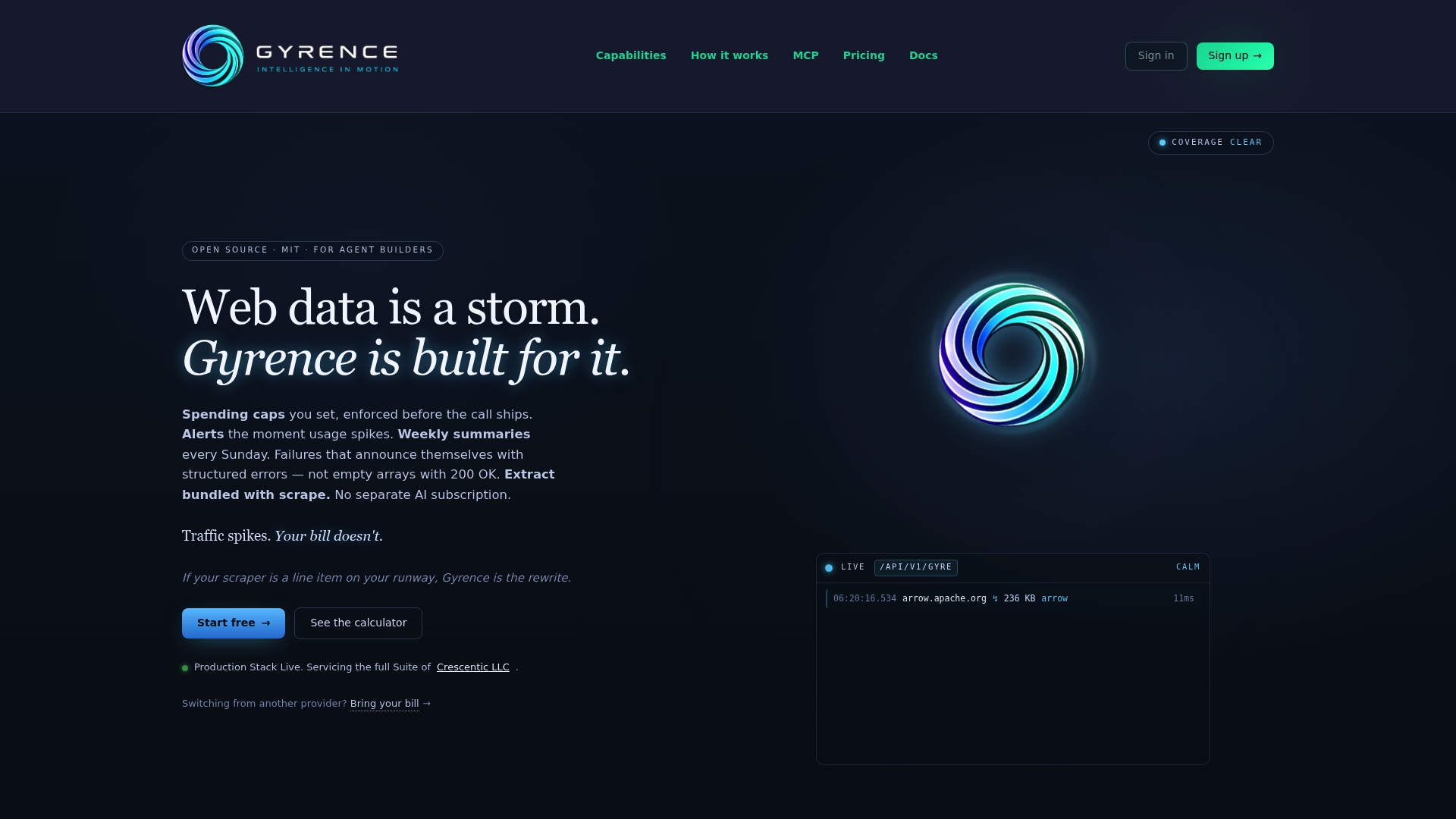
Setting up caps that actually hold under concurrency does not require building the reserve, settle, and consume machinery yourself. Workspaces can have spending caps built into the billing layer, scoped to the workspace or the API key, to help prevent a single agent from exceeding the budget unnoticed. The Pay-As-You-Go plan fits teams testing scrape volume before committing to a fixed monthly tier, while Standard, Growth, and Scale add higher throughput as usage grows.
For monitoring tied to budget events, WebDoppler adds webhook alerts on top of the dashboard. Read the API primitives in the docs or sign into the console to configure a workspace cap directly.
Reference docs for implementing these controls
For exact API shapes, see Cloudflare's spend limits, Google Cloud's spend caps, the hardcap repository, and llm-hard-cap on npm. For pricing-model context specific to scraping, see Forecast Usage Based Call Automation for Procurement.
Sources
- Spend limits · Cloudflare AI Gateway docs
- Manage spend cap budgets | Cloud Billing | Google Cloud Documentation
- pradyumnvermaa/hardcap
- llm-hard-cap
FAQ
What is a spending cap in a metered scraping API?
A spending cap is a workspace-level limit on how much credit or dollar spend a scraping API can consume before new requests are blocked or flagged. It's typically paired with alerts at lower thresholds and a hard block at the ceiling itself.
Why do spending caps sometimes allow small overages?
Billing systems reconcile usage on a delay, and requests already in flight when a cap trips are usually allowed to finish. Google Cloud's documentation notes that enforcement relies on estimated costs, so setting your operational cap slightly below your real budget absorbs that lag.
What's the difference between reserve/settle and atomic consume?
Reserve and settle is a two-phase flow: you hold an estimated cost before a call runs, then reconcile it against the actual cost afterward. Atomic consume skips that and deducts a known, fixed cost in a single step, which works only when the cost is deterministic upfront.
How do I stop one agent from draining an entire monthly budget?
Layer a short-window circuit breaker, hourly or daily, underneath your monthly cap so a looping or misbehaving agent gets stopped fast rather than slowly draining the full budget. LangSmith's spend policy guidance recommends exactly this layering for LLM and API gateways.
Does Gyrence support workspace-level spending caps?
Yes. Gyrence enforces spending caps at the workspace and API-key level across its Search, Traverse, Fetch, Extract, and Map primitives, with predictable per-call costing detailed on its pricing page.