
Extracting structured product data at scale is defined as the automated, repeatable process of fetching, parsing, and validating product attributes from multiple web sources into typed, machine-readable output. Tools like Extracto, llm-extractor, and Shopextract have made this achievable without building everything from scratch. The core pipeline combines rate-limited crawling, schema-first JSON extraction, and fault-tolerant checkpointing. Get any one of those three wrong and your data quality collapses silently.
What does it take to extract structured product data at scale?
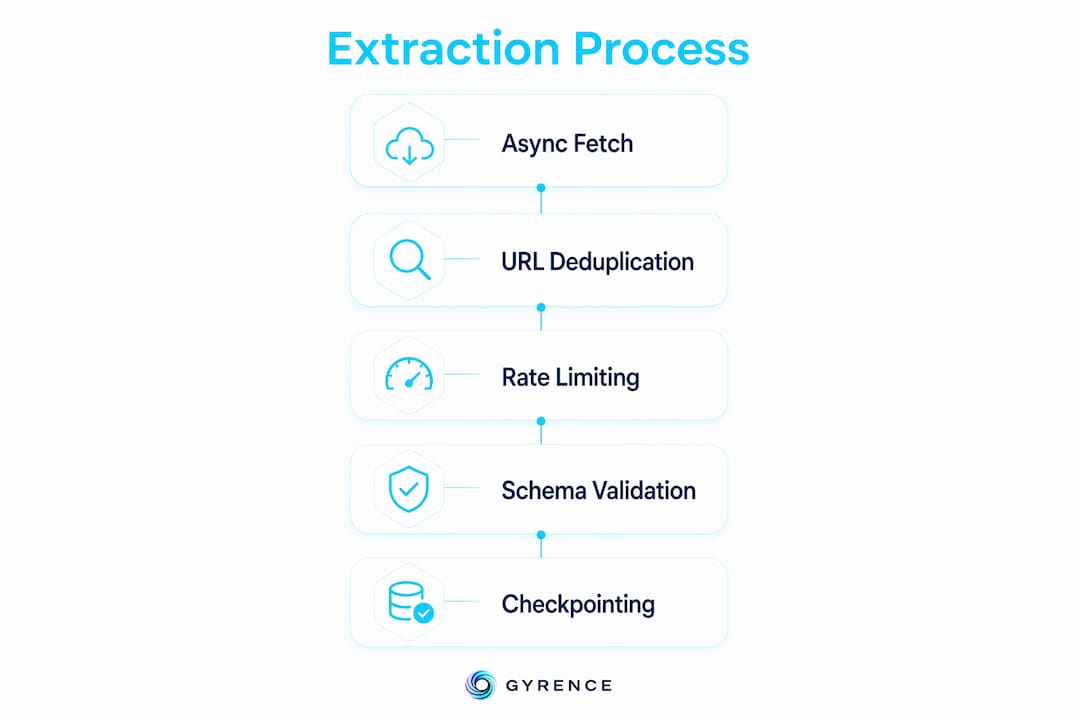
Scalable bulk data extraction is not a single script. It is a pipeline with at least four distinct infrastructure layers, each of which can fail independently.
The four layers are:
- Fetch layer: Async HTTP clients with per-domain concurrency controls
- Deduplication layer: URL canonicalization using Bloom filters or Redis SETs
- Extraction layer: Schema-validated JSON output with LLM fallback
- Persistence layer: Checkpointed state so interrupted crawls resume cleanly
Async fetch queue pipelines with bounded size and backpressure prevent memory overloads during large crawls. Bounded queues force producers to slow down when consumers fall behind, which keeps your process stable across millions of URLs.
URL deduplication is where most teams cut corners. Canonicalization of URLs must include lowercasing the scheme and host, sorting query parameters, and stripping tracking tokens like utm_source or session IDs. Skip that step and you will crawl the same product page dozens of times under different URLs.
Pro Tip: Use Redis SETs for deduplication when your crawl spans multiple workers. Bloom filters are faster but produce false positives that silently drop valid URLs.
| Infrastructure component | Purpose | Common implementation |
|---|---|---|
| Per-domain token bucket | Rate limiting per target site | asyncio + token bucket class |
| Bloom filter / Redis SET | URL deduplication | redis-py, pybloom-live |
| Bounded async queue | Backpressure control | asyncio.Queue(maxsize=N) |
| Checkpoint file / DB | Resume after failure | SQLite, Redis, or flat JSON |
Per-domain token-bucket rate limiting combined with robots.txt adherence optimizes crawl reliability and legal compliance. A global rate limit is not sufficient. Two tokens per second per domain is a common starting point that avoids triggering anti-bot defenses.
How do schema-first workflows improve extraction accuracy?
Schema-first extraction is the practice of defining your output structure before you write a single prompt or selector. The llm-extractor library enforces JSON schema and applies correction prompts when outputs fail semantic rules. That means a missing price field or an out-of-range discount value triggers an automatic retry with a corrective instruction, not a silent null in your database.
Free-text extraction produces output that looks correct until you query it. Schema-first extraction fails loudly and early, which is the behavior you want in a production pipeline.

| Approach | Failure mode | Correction mechanism |
|---|---|---|
| Free-text LLM extraction | Silent semantic errors, wrong types | None. Errors reach the database. |
| Schema-first with llm-extractor | Schema violation detected immediately | Correction prompt + retry loop |
Semantic validation rules in schema-first extraction catch business logic errors beyond basic type checks. A price field typed as number still passes if the LLM returns -9.99. A semantic rule that enforces price > 0 catches that. These rules are the difference between a pipeline that produces data and one that produces correct data.
Pro Tip: Define your schema before you write your first prompt. Retrofitting a schema onto an existing free-text pipeline is significantly harder than building schema-first from day one.
Observability matters here too. Track retry counts per URL, schema failure rates per domain, and correction prompt success rates. Those three metrics tell you whether your extraction layer is working or quietly degrading.
Open-source tools for large-scale product data extraction
Two open-source projects implement most of the patterns above out of the box: Extracto and Shopextract.
-
Extracto is an AI-powered web scraper built for multi-URL, schema-enforced extraction. Extracto features batch mode, checkpoint resume, proxy rotation, rate limiting, and schema enforcement for scalable extraction. Key flags include
--batchfor processing URL lists,--proxyfor rotation,--rate-limitfor per-domain throttling,--schemafor output validation, and--resumeto restart interrupted jobs. -
Shopextract targets e-commerce specifically. Its tiered fallback strategy combines platform APIs for supported stores, unified crawl via JSON-LD and Open Graph tags, browser CSS selectors, and finally LLM-powered extraction for JavaScript-heavy pages. That cascade means you get fast, cheap extraction when structured data is available and accurate extraction when it is not.
-
llm-extractor handles the extraction layer for any LLM backend. It wraps your prompt with schema enforcement and retry logic, so you get typed JSON regardless of which model you call.
-
Proxy rotation is non-negotiable at scale. Extracto's
--proxyflag accepts a list of proxy endpoints and rotates them per request. Without rotation, a single IP hitting one domain at volume will get blocked within hours.
| Tool | Primary use case | Key capability |
|---|---|---|
| Extracto | Multi-URL batch extraction | Schema enforcement, checkpoint resume |
| Shopextract | E-commerce product pages | Tiered fallback: API → JSON-LD → CSS → LLM |
| llm-extractor | LLM output validation | Semantic rules, correction prompts, retries |
Checkpointing and caching in extraction tools prevent cost and time loss during mid-crawl failures. If your pipeline processes 50,000 URLs and crashes at 40,000, a checkpoint lets you resume from where you stopped. Without it, you pay for 40,000 API calls twice.
What are the biggest challenges in product data harvesting at scale?
The most common failure modes in large-scale data extraction are predictable. Most of them are also avoidable.
- robots.txt violations: Ignoring robots.txt leads to legal risks and technical failures where sites serve misleading data or ban crawlers outright. Parse and cache the robots.txt file for each domain before you crawl a single URL.
- Retry logic errors: Effective retry strategies use exponential backoff with jitter, distinguish retryable errors (429, 503) from fatal errors (404, 403), and cap total retries. Retrying a 403 wastes compute and signals bad intent to the target server.
- Schema mismatches: Sites change their markup without notice. A field that returned a string last week may return an array today. Your schema validator catches this immediately if you log schema failures per domain.
- Silent data quality degradation: Monitoring and alerting on extraction pipelines detects source changes and extraction failures early before they affect downstream data quality. Set alerts on schema failure rate thresholds, not just HTTP error rates.
Treat every domain as a contract that can change without notice. Your pipeline should detect the breach, not your analyst.
Key takeaways
Scalable product data extraction requires async pipelines, per-domain rate limiting, schema-first validation, and checkpointing to produce reliable, typed output at volume.
| Point | Details |
|---|---|
| Build per-domain rate limits | Token buckets per domain prevent bans and produce more reliable data than global limits. |
| Use schema-first extraction | Define JSON schema before writing prompts to catch semantic errors before they reach your database. |
| Checkpoint every long crawl | Tools like Extracto's --resume flag eliminate redundant API costs after pipeline failures. |
| Apply tiered fallback | Shopextract's API-to-LLM cascade maximizes coverage across diverse e-commerce platforms. |
| Monitor schema failure rates | Alerting on extraction failures per domain catches upstream site changes before data quality degrades. |
Why I build schema-first and checkpoint everything
The first time I ran a large crawl without checkpointing, the pipeline crashed at roughly 80% completion. The API bill for that run was real. The data was not recoverable without starting over. That experience made checkpointing non-negotiable for me on any job over a few thousand URLs.
Schema-first extraction took longer to convince me. Free-text output feels faster to prototype. But the first time a silent null propagated into a pricing model and produced wrong recommendations, I understood the cost of skipping validation. The correction prompt approach in llm-extractor is the right pattern. It catches the failure at extraction time, not three weeks later in a data audit.
The ethical dimension also matters practically, not just legally. Respecting robots.txt and per-domain rate limits keeps your pipeline running. Sites that detect aggressive crawlers serve garbage data or block you entirely. You can read more about data quality compliance to understand what responsible crawling looks like in practice. The teams that build polite, schema-validated pipelines get better data and fewer surprises. That is the architecture worth building.
— Glen
Gyrence handles the infrastructure so you can focus on the data
Building and maintaining async pipelines, rate limiters, schema validators, and checkpoint logic takes weeks of engineering time before you extract a single product record.
Gyrence provides web data infrastructure built for exactly this workload. Its five composable primitives, Search, Traverse, Fetch, Extract, and Map, cover every stage of a product data pipeline. The Extract primitive accepts a JSON schema or natural language prompt and returns typed, validated output. Retries, rate limiting, and structured failure modes are built in. Spending caps mean your bill matches your budget. Every response is a typed discriminated union, including the failure cases, so your pipeline can reason about what went wrong instead of silently dropping records. See the full API evaluation checklist to understand what to look for before committing to any web data infrastructure.
FAQ
What is structured product data extraction?
Structured product data extraction is the automated process of pulling product attributes like price, title, and availability from web pages into typed, machine-readable formats such as JSON. Schema validation confirms the output matches the expected structure before it enters your database.
How do I automate product data extraction at scale?
Combine an async fetch queue with per-domain rate limiting, URL deduplication, schema-validated LLM extraction, and checkpoint resume. Tools like Extracto and Shopextract implement these patterns with configurable flags.
Why does per-domain rate limiting matter more than global rate limiting?
Global rate limits spread your request budget across all domains equally, which can still overwhelm a single target site. Per-domain token buckets cap requests to each site independently, which prevents bans and produces more reliable data.
What is the best fallback strategy for JavaScript-heavy product pages?
Shopextract's tiered approach works well: try the platform API first, then JSON-LD and Open Graph tags, then CSS selectors, and finally LLM-powered extraction. Each tier is faster and cheaper than the next, so you only use LLMs when simpler methods fail.
How do I handle pipeline failures mid-crawl?
Use a tool that supports checkpoint resume, such as Extracto's --resume flag, combined with local caching. This avoids re-fetching and re-paying for pages already processed, and lets you restart from the exact failure point.