
Structured JSON extraction from the web is the process of programmatically retrieving web content and converting it into typed, machine-readable JSON for direct use in applications, AI pipelines, and data systems. The industry term for this practice is web data extraction, and in 2026 it sits at the center of every serious AI agent workflow. Tools like webcli, TheCrawler, and ref have pushed the field forward by combining cascaded extraction strategies with LLM-powered schema validation. If you are building a data pipeline or an agent that reasons over live web content, the method you choose determines your accuracy, your latency, and your bill.
What are the most effective methods for structured JSON extraction from web?
The most effective extraction strategy is a layered cascade that starts with the cheapest method and escalates only when necessary. 90% of useful web data is accessible without resorting to browser rendering. That single fact should anchor every architecture decision you make.
Here is how a well-designed cascade works, ordered from fastest and cheapest to slowest and most expensive:
- Direct HTTP/API calls. Many sites expose REST or GraphQL endpoints. Call them first. You get clean JSON with zero parsing overhead.
- RSS and Atom feeds. News sites, blogs, and product catalogs frequently publish feeds. Parsing a feed is deterministic and 100% accurate with zero LLM cost.
- JSON-LD and Microdata. These structured formats are embedded directly in HTML
<script>tags or element attributes. Extracting them requires a simple DOM query, not an LLM. - HTML parsing. When structured formats are absent, parse the raw HTML with a library like BeautifulSoup or Cheerio. Target specific CSS selectors or XPath expressions.
- JavaScript rendering. Use a headless browser like Playwright only as a last resort. It adds 2–10 seconds of latency per page and multiplies infrastructure cost.
The multi-layered fallback strategy is not just a performance optimization. It is a cost control mechanism. Teams that skip straight to browser rendering for every request routinely overspend by an order of magnitude.
Pro Tip: Before writing a single line of scraping code, inspect the page source for <script type="application/ld+json"> blocks. JSON-LD is present on a surprising share of e-commerce, news, and event pages. Extracting it costs nothing and returns perfectly structured data.

How do AI agents use MCP for structured JSON web extraction?
The Model Context Protocol (MCP) is the standard in 2026 for AI agents to discover and execute web extraction tasks natively. MCP-based servers allow agents to call extraction tools directly without manual API handling. The agent declares what it needs, the MCP server routes the call to the right extraction primitive, and the result comes back as typed JSON the agent can reason over immediately.
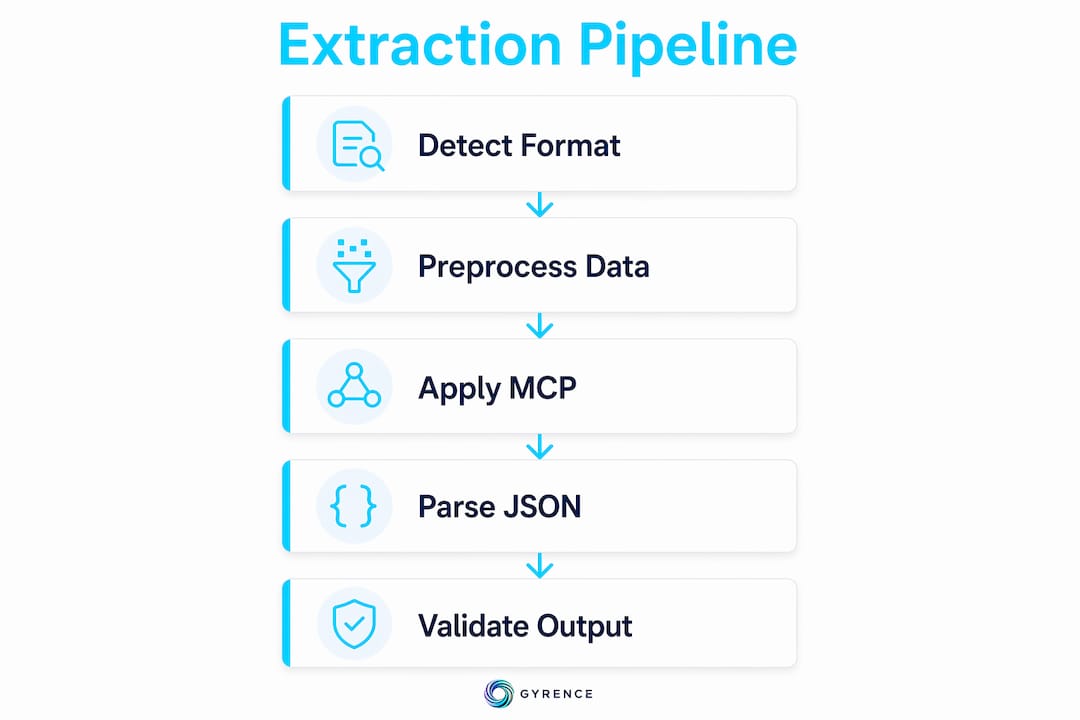
The critical bottleneck in this workflow is token cost. Raw HTML fed directly to an LLM is wasteful and often counterproductive. A full page of HTML can contain 50,000 tokens of boilerplate, navigation, and script tags that carry zero semantic value. The fix is aggressive preprocessing.
Converting raw HTML to cleaned markdown before passing it to an LLM reduces token usage by 95–99% while maintaining extraction quality. That is not a marginal improvement. It is the difference between a pipeline that costs $0.002 per page and one that costs $0.15 per page at scale.
The preprocessing steps that matter most are:
- Strip all
<script>,<style>, and<nav>blocks before any LLM call. - Convert remaining HTML to markdown using a library like Turndown or html-to-text.
- Truncate sections that fall below a relevance threshold relative to the extraction target.
- Pass only the cleaned markdown plus your JSON schema to the LLM.
Tools like mollendorff-ai/ref implement this pipeline end to end. The result is that token-efficient content formatting improves both accuracy and cost efficiency, because the LLM sees signal instead of noise. You can read more about this approach in this LLM-friendly markdown guide from Gyrence.
Pro Tip: Run a token count on your raw HTML versus your cleaned markdown before committing to a model. The ratio will almost always justify the preprocessing investment, even for simple extraction tasks.
Open-source tools for web data scraping: how do they compare?
Four open-source tools represent the current state of the art for structured JSON web extraction. Each takes a different architectural position.
| Tool | Extraction Method | Output Format | Best Use Case |
|---|---|---|---|
| webcli | Cascaded HTTP, RSS, JSON-LD, then Playwright | JSON with schema validation | General-purpose pipelines needing cost control |
| TheCrawler | LLM-powered with JSON Schema validation and fallback modes | JSON, markdown, PDF/DOCX | Adaptive pipelines with mixed document types |
| trawl | LLM called once per site structure to derive selectors | JSON via Go-based extractor | High-volume extraction with zero recurring API cost |
| ref | Aggressive HTML-to-markdown preprocessing before LLM | Token-optimized markdown then JSON | AI agent workflows with strict token budgets |
TheCrawler, built by manchittlab, supports adaptive extraction across PDFs, DOCX files, markdown, and commerce data. That breadth makes it the right choice when your input corpus is heterogeneous. It handles JSON Schema validation natively, so your output is type-safe from the start.
trawl takes the most cost-aggressive position. It calls an LLM only once per site structure to derive CSS selectors, then runs all subsequent extractions in Go without any further API calls. For teams extracting thousands of pages from a fixed set of domains, the economics are compelling.
The tradeoff with trawl is brittleness. When a site redesigns its layout, the derived selectors break. webcli handles this more gracefully through its fallback cascade. ref is the right choice when your downstream consumer is an LLM or a RAG system, because it optimizes for token efficiency rather than raw throughput.
For structured data from websites that includes tables, lists, and forms, the MCP-based extractor from agenson-tools adds context to each extracted element. That context, including headers, field labels, and validation metadata, is what makes the JSON useful for pricing comparisons and directory listings rather than just readable.
What best practices optimize a JSON extraction pipeline?
A reliable extraction pipeline requires more than a working scraper. It requires a system that stays correct over time and handles failure explicitly.
-
Validate against a JSON Schema on every run. Do not assume the site's structure is stable. Use a library like Ajv (JavaScript) or jsonschema (Python) to validate every extracted document before it enters your database. Failures surface layout changes before they corrupt downstream systems. Gyrence's guide on schema validation practices covers this in depth.
-
Build an adapter registry for known domains. Sites like LinkedIn, Amazon, and major news publishers have well-documented structures. Maintain a registry of domain-specific adapters that skip the cascade and go directly to the correct extraction method. This cuts latency and eliminates unnecessary LLM calls for high-frequency targets.
-
Monitor extraction accuracy, not just success rate. A scraper can return a 200 status and still return garbage. Track field-level fill rates. If the
pricefield drops from 98% populated to 60% populated across a domain, a layout change has occurred. Alert on field-level metrics, not just HTTP status codes. -
Embed compliance checks into the pipeline. Structured JSON extraction for compliance use cases, such as financial data aggregation or regulatory monitoring, requires that you log the source URL, extraction timestamp, and schema version for every record. This audit trail is not optional in regulated industries. Check the data exfiltration mitigation guide for security considerations relevant to AI-connected pipelines.
-
Test against a fixed set of reference pages on every deploy. Treat extraction accuracy like unit test coverage. Maintain a corpus of 20–50 reference pages with known correct outputs. Run extraction against them on every code change. Regressions surface immediately rather than silently corrupting production data.
Pro Tip: Use iterative schema refinement during the first week of a new extraction target. Extract 50 pages, review field-level accuracy, tighten the schema, and re-extract. Three iterations typically get you to 95%+ field accuracy before you commit to production volume.
Key takeaways
The most reliable structured JSON extraction pipelines combine a layered fallback cascade with aggressive preprocessing and schema validation at every stage.
| Point | Details |
|---|---|
| Start with the cheapest method | Use HTTP APIs, RSS feeds, and JSON-LD before considering HTML parsing or browser rendering. |
| Preprocess before LLM calls | Converting HTML to markdown reduces token usage by 95–99% and improves extraction accuracy. |
| Validate every output | JSON Schema validation on every extracted document catches layout changes before they corrupt data. |
| Match tool to use case | Use trawl for high-volume fixed domains, TheCrawler for mixed document types, and ref for agent workflows. |
| Compliance requires audit trails | Log source URL, timestamp, and schema version for every record in regulated extraction pipelines. |
What i've learned building extraction pipelines at scale
The biggest mistake I see teams make is treating structured JSON extraction as a solved problem after the first successful scrape. It is not. Web data is a storm. Sites change layouts, add JavaScript rendering, rotate selectors, and block scrapers on a schedule that has nothing to do with your deployment calendar.
The teams that build durable pipelines share one habit: they treat extraction accuracy as a first-class metric, not an afterthought. They instrument field-level fill rates, alert on drops, and maintain reference corpora for regression testing. The teams that don't do this spend two weeks every quarter firefighting silent data corruption.
On the AI agent side, I think the industry is still underestimating how much token cost matters. Most agent frameworks I've reviewed pass raw HTML or full-page text to the LLM without any preprocessing. The cost difference between that approach and a properly preprocessed markdown pipeline is not 10%. It is often 50x. At production scale, that gap determines whether your agent workflow is economically viable.
My practical advice on tool selection: start with the simplest tool that covers your extraction targets. If 80% of your targets expose JSON-LD or RSS feeds, you do not need an LLM at all. Reach for LLM-powered extraction only for the targets where structured formats are absent and the data is genuinely valuable. Tools like trawl and TheCrawler make that selective approach easy to implement.
The future I see is extraction pipelines that are fully self-healing: they detect layout changes, re-derive selectors automatically, and fall back gracefully without human intervention. trawl's one-shot selector derivation is a step in that direction. MCP-connected agents that can re-extract on demand are another. We are not there yet, but the architecture is taking shape.
— Glen
How Gyrence handles structured web extraction for agent workflows
Gyrence is built for exactly the extraction architecture this article describes. Its five composable primitives, Search, Traverse, Fetch, Extract, and Map, cover every layer of the cascade without requiring you to stitch together separate tools. The Extract primitive accepts a prompt or a JSON Schema and returns typed, validated JSON. Every call returns a discriminated-union response that includes failure cases, so your agent knows what happened instead of receiving a silent null. Spending caps mean your web data infrastructure bill is predictable. The hosted MCP endpoint connects directly to agent frameworks without manual API wiring. If you are building structured JSON web extraction for agents or data pipelines, Gyrence gives you the primitives to do it without surprises.
FAQ
What is structured JSON extraction from the web?
Structured JSON extraction from the web is the process of programmatically retrieving web content and converting it into typed JSON objects for use in applications, databases, or AI systems. It covers methods ranging from JSON-LD parsing to LLM-powered schema extraction.
When should i use an LLM for web data extraction?
Use an LLM only when the target page lacks machine-readable formats like JSON-LD, RSS, or a public API. JSON-LD, Microdata, and RSS feeds provide 100% accurate data at zero LLM cost, so they should always be checked first.
How does MCP improve structured JSON web extraction for agents?
MCP allows AI agents to call extraction tools directly as native capabilities, removing the need for manual API handling. MCP-based extraction servers return typed JSON that agents can reason over without additional parsing steps.
What is the fastest way to reduce token costs in extraction pipelines?
Convert raw HTML to cleaned markdown before any LLM call. This preprocessing step reduces token usage by 95–99% and typically improves extraction accuracy because the model processes signal rather than boilerplate.
Which open-source tool is best for high-volume JSON extraction?
trawl is the strongest choice for high-volume extraction from a fixed set of domains. It calls an LLM only once per site structure to derive selectors, then runs all subsequent extractions in Go with zero recurring API cost.