
Financial document extraction to JSON is the process of converting bank statements, invoices, 10-K reports, and tax forms into validated, machine-readable JSON that downstream systems can consume directly. Tools like Fintract and LlamaParse have made this process faster, but the hard part was never parsing text. It was always validation. Raw OCR output breaks accounting equations silently, and most pipelines don't catch it until the data is already in production.
What methods exist for financial document extraction to JSON?
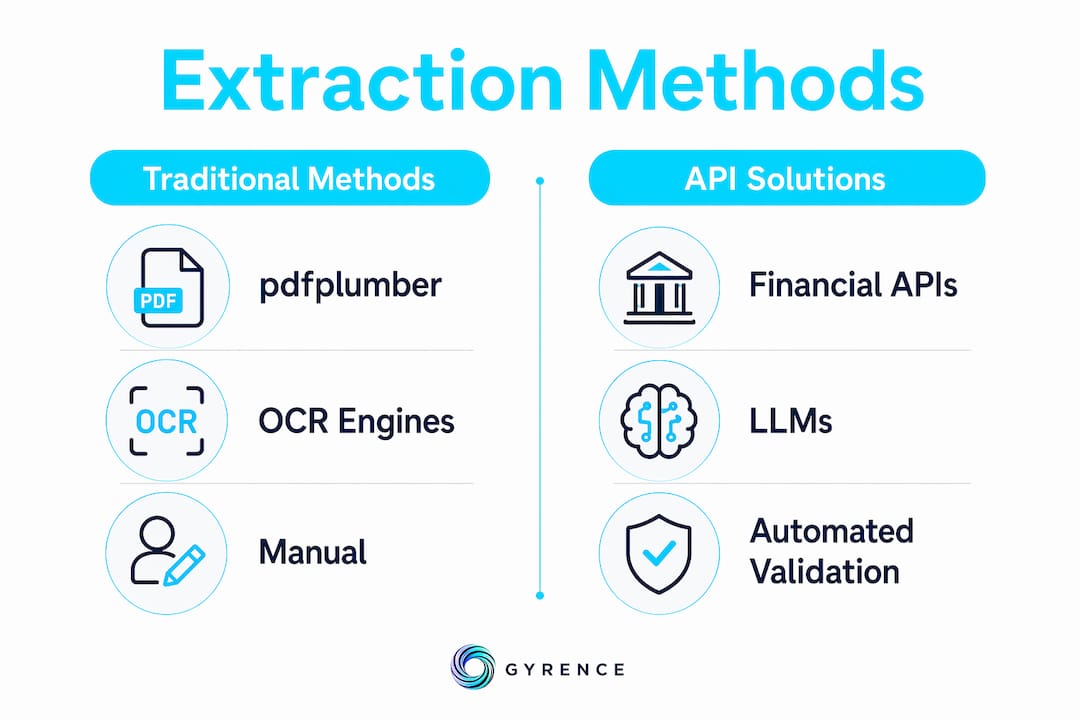
The extraction method you choose determines how much post-processing pain you inherit. Each approach sits at a different point on the accuracy-versus-maintenance curve.
Digital PDF extraction uses Python libraries like pdfplumber and tabula-py to pull text and tables from machine-readable PDFs. These libraries work well for clean, text-based files but fail on scanned documents or complex multi-column layouts. You own the maintenance burden entirely.

OCR plus post-processing handles scanned documents using engines like Tesseract or PaddleOCR. The output is raw text. Generic OCR tools do not maintain table structures or validate extracted data, unlike specialized financial extraction APIs that use vision-first parsing. That gap matters enormously when a misaligned row shifts every figure in a balance sheet.
Multimodal LLMs like GPT-4o can interpret complex layouts and return structured output. The risk is hallucination. An LLM may confidently return a revenue figure that does not exist in the source document. Without a validation layer, you will not know.
Production-grade financial extraction APIs handle classification, OCR, table extraction, field mapping, and validation in a single request. One POST call returns validated JSON for bank statements, invoices, receipts, and accounting statements. These APIs typically cost between $0.05 and $0.15 per page, with flat-rate pay-as-you-go pricing and no subscription minimums. That cost is almost always lower than the engineering time required to maintain a custom pipeline.
| Method | Accuracy | Maintenance | Validation |
|---|---|---|---|
| pdfplumber / tabula-py | Medium | High | None |
| Tesseract / PaddleOCR | Low-Medium | High | None |
| GPT-4o (multimodal LLM) | High | Medium | Hallucination risk |
| Financial extraction API | High | Low | Built-in |
Pro Tip: Never use a general-purpose OCR tool as your primary extraction layer for financial documents. The table structure loss alone will corrupt downstream calculations.
How to validate and design JSON schemas for financial documents
Validation is not a post-processing step. Validation logic must verify mathematical consistency at extraction to prevent errors from LLM hallucinations or OCR mistakes. Running checks after the fact means errors have already propagated.
The three checks every financial extraction pipeline needs:
- Balance reconciliation: Total debits equal total credits across a statement period.
- Accounting equation: Assets equal liabilities plus equity. Any deviation signals an extraction fault.
- Totals verification: Line-item subtotals sum to the reported total. A mismatch of even one cent indicates a missed row.
A well-designed JSON schema for a bank statement includes fields for account_number, statement_period, opening_balance, closing_balance, transactions[], and source_citation. The source_citation field links each extracted value back to its page coordinate in the source document. That link is what makes audits tractable and error tracing fast.
Agentic workflows interpret document layout, link extracted values to page coordinates, and flag reconciliation gaps before data integration. This is the architecture that separates a production system from a prototype.
Pro Tip: Embed your validation logic inside the extraction step, not after it. A schema that returns a validation_status field alongside each extracted value gives you a typed failure mode you can act on immediately.
What are key standards and normalization practices for financial data?
Normalization is what makes extracted JSON actually usable across companies and time periods. Without it, you are comparing apples to filing cabinets.
Modern financial extraction pipelines support over 10 standardized document types and normalize thousands of raw XBRL tags into fewer than 300 canonical concepts with 95% coverage. Specifically, 11,966 raw XBRL tags map to approximately 286 canonical values across US public companies. That compression is what makes cross-company analysis possible.
The normalization challenges worth knowing before you build:
- Non-standard tag variants: Companies use their own XBRL tag names. Static mapping layers break when companies use non-standard tag variants. Dynamic resolution layers that map vendor tags to canonical concepts are the only reliable fix.
- Fiscal period misalignment: A company with a June fiscal year-end does not align with a calendar-year peer. Your mapping layer must handle this explicitly.
- Look-ahead bias: Point-in-time financial analysis requires using the filed date, not the period-end date. Using the period-end date introduces forward-looking bias that corrupts backtesting results.
- Overlapping concepts: Revenue, net revenue, and total revenue are three different tags that may or may not refer to the same number depending on the filer.
The payoff for getting normalization right is significant. Downstream analytics, investment models, and compliance checks all run against a stable, predictable schema instead of a different structure for every document source. For structured data in investment research, canonical mapping is the difference between a pipeline that works once and one that works at scale.
How can developers integrate financial JSON extraction into their workflows?
The integration pattern for financial document automation is straightforward once extraction and validation are solved. Upload a PDF to an extraction API, receive validated JSON, and pipe it into your database, reporting tool, or downstream model.
Automated platforms can map management accounts to standard taxonomies and build profit-and-loss statements and balance sheets in minutes, replacing days of manual effort. That speed matters most in M&A due diligence and quarterly reporting cycles where analyst time is the bottleneck.
Practical use cases where this pattern delivers the most value:
- Automated financial reporting: Extract invoice and statement data on ingest, write directly to a data warehouse.
- Investment analysis: Normalize 10-K and 10-Q filings to canonical JSON for model inputs without manual reformatting.
- Compliance checks: Flag missing fields or failed validation checks before data reaches a compliance system.
Source citations embedded in the JSON output are not optional for production systems. Every extracted value should carry a reference to its source page and coordinates. That traceability is what satisfies audit requirements and lets you debug extraction errors without re-reading the original document.
Pro Tip: Build an error monitoring layer that watches for validation_status: failed responses from your extraction API. Set an alert threshold and route failed documents to a human review queue rather than letting bad data flow downstream silently.
For a deeper look at schema validation in extraction pipelines, the patterns transfer directly from web data to financial documents.
Key Takeaways
Financial document extraction to JSON requires built-in validation at the extraction step, not after it. Pipelines that skip this produce errors that compound silently downstream.
| Point | Details |
|---|---|
| Choose the right extraction method | Production pipelines need API-based extraction with built-in validation, not raw OCR. |
| Validate at extraction, not after | Check accounting equations and totals at the moment of extraction to catch OCR and LLM errors immediately. |
| Use dynamic canonical mapping | Static XBRL tag maps break on non-standard filers. Dynamic resolution layers maintain schema stability. |
| Use filed date for point-in-time analysis | Period-end dates introduce look-ahead bias. Filed date is the correct anchor for historical accuracy. |
| Embed source citations in JSON output | Linking extracted values to page coordinates makes audits and error tracing tractable. |
What I have learned from building with financial JSON pipelines
The most common mistake I see developers make is treating OCR as equivalent to extraction. They are not the same thing. OCR reads characters. Extraction understands structure. A tool that returns raw text from a balance sheet has not extracted anything useful. It has just moved the problem downstream.
The second mistake is deferring validation. I have watched teams build entire reporting pipelines on top of unvalidated extraction output, then spend weeks debugging why their totals do not reconcile. The fix is always the same: push validation into the extraction step and make it a hard gate, not a soft warning.
For production work, specialized financial extraction APIs are the right call. The engineering cost of maintaining a custom pipeline that handles scanned documents, complex table layouts, multi-column reports, and XBRL normalization is genuinely high. The $0.05 to $0.15 per page cost of a purpose-built API is almost always cheaper than the alternative when you account for developer time.
The one area where I think most teams underinvest is canonical mapping. Normalization feels like a nice-to-have until you try to run a cross-company analysis and realize every filer uses different tag names for the same concept. Build the mapping layer early. It pays back immediately.
— Glen
How Gyrence fits into your financial data pipeline
Gyrence is built for developers who need structured, agent-ready data without unpredictable costs or hidden failure modes. Once your financial documents are converted to validated JSON, Gyrence handles the next layer: fetching, extracting, and mapping web-sourced financial data into the same structured format your pipeline already expects. Every API call returns a typed, discriminated-union response, including the failure cases, so your agents reason on results rather than guessing. Spending caps mean your bill matches your budget. If you are building a financial data pipeline that needs reliable web data alongside document extraction, start with Gyrence and see how the five composable primitives fit your workflow.
FAQ
What is financial document extraction to JSON?
Financial document extraction to JSON is the process of parsing bank statements, invoices, and financial reports into validated, machine-readable JSON. The output is structured data ready for direct use in databases, APIs, or analytical models.
Why does OCR alone fail for financial documents?
OCR outputs raw text without preserving table structure or verifying accounting equations. Specialized financial extraction APIs use vision-first parsing to maintain row-column relationships and validate financial math at extraction.
How much does financial document extraction API pricing cost?
API-based financial extraction typically costs between $0.05 and $0.15 per page on a flat-rate, pay-as-you-go basis with no subscription minimums required.
What is XBRL normalization and why does it matter?
XBRL normalization maps thousands of company-specific financial tags to a smaller set of canonical concepts. Without it, cross-company analysis breaks because different filers use different tag names for identical financial line items.
How do I avoid look-ahead bias in financial JSON data?
Use the document's filed date rather than its period-end date as the timestamp anchor. Period-end dates reflect information that was not yet public, which corrupts point-in-time backtesting and historical analysis.