
A single API for web data access is a unified cloud endpoint that handles the entire web data extraction pipeline, including JavaScript rendering, proxy rotation, and structured parsing, in one HTTP request. The industry term for this architecture is a "web data API." Developers and data teams use it to replace fragmented scraping toolchains built from headless browsers, proxy managers, and custom parsers. Gyrence is built on exactly this model, exposing five composable primitives (Search, Traverse, Fetch, Extract, Map) through a single endpoint so your pipeline never depends on stitching together five separate tools.
How does a single API handle complex web data extraction?
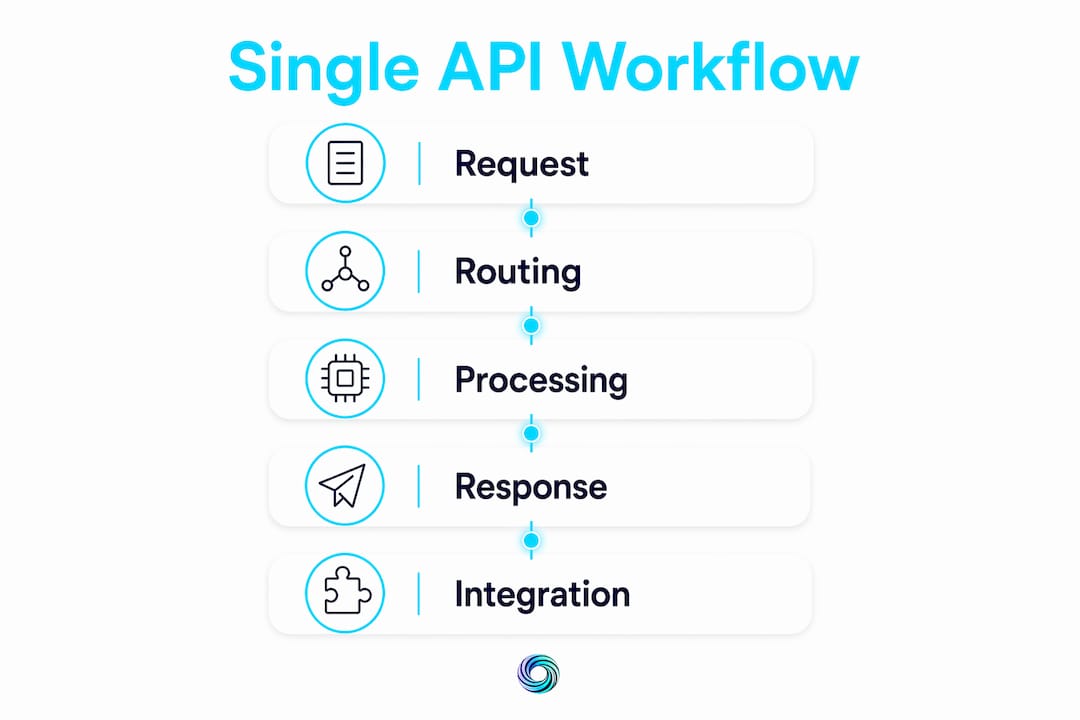
A web data API manages every extraction layer on the provider's server, not yours. That means JavaScript rendering, anti-bot circumvention, and content parsing all happen before the response reaches your code.
The synchronous request/response flow is what makes this practical. You send one HTTP call with your target URL and parameters. The API returns data in JSON, HTML, or Markdown on the same response. No polling, no callback queues to manage.
The server-side capabilities that a mature web data API handles include:
- JavaScript rendering: Full headless browser execution on the provider's infrastructure, not your compute budget.
- Proxy rotation: Automatic IP cycling to avoid rate limits and geo-blocks without you managing a proxy pool.
- Browser interactions: Actions like wait, scroll, and click execute before extraction, supporting content that only loads after user interaction.
- Structured output: The API returns typed data in your requested format, whether that is clean Markdown for LLM ingestion or JSON for downstream pipelines.
The API gateway mediates every request, routing it to backend services and packaging the result for your client. Think of it as a front desk that accepts one simple request and coordinates everything behind it.
Pro Tip: Request Markdown output when feeding pages to an LLM. Clean Markdown strips navigation chrome and ads, which cuts token count and improves extraction quality.

What pricing and maintenance benefits do single API solutions offer?
DIY scraping infrastructure has a hidden cost that never shows up in your cloud bill: engineering hours. Maintaining headless browser fleets, rotating proxies, and updating CSS selectors after site redesigns consumes developer time that compounds weekly.
Web data APIs shift that cost model. Consumption-based pricing that charges for successfully delivered results is becoming the standard approach. You pay for data you actually receive, not for infrastructure that sits idle between jobs.
The operational advantages compound across three areas:
- Retry logic is built in. Request-based pricing models include automatic retry and error handling for common web failures. Your pipeline does not need to implement exponential backoff from scratch.
- Pagination is handled server-side. Multi-page data sets return without you writing cursor logic or managing session state.
- Spending caps prevent bill shock. Providers like Gyrence expose hard spending limits so a runaway batch job does not produce a surprise invoice at month end.
The shift from fixed infrastructure cost to variable request cost also changes how you budget. A research enrichment job that runs once a week costs almost nothing in idle time. A production pipeline that runs hourly scales cost proportionally to actual usage.
Developer best practices for single API endpoint integration
The most common integration mistake is treating a web data API like a static data source. Web content changes. Selectors break. Domains restructure. Your integration needs to account for that from day one.
Developers need to understand the difference between query parameters and path parameters at the endpoint level. Path parameters identify the resource (the target URL). Query parameters shape and filter what comes back (output format, wait conditions, extraction schema). Conflating the two leads to malformed requests that fail silently.
The deeper challenge is normalizing heterogeneous JSON responses across different domains. Even a unified API returns structurally different content depending on the target site. Build a validation layer that coerces raw API responses into your internal domain model before any downstream system touches the data.
Key integration practices worth enforcing on every project:
- Use fixed base URLs with relative paths. Stable base URL usage prevents scheduled jobs from breaking when the API provider updates routing logic. Never hardcode full dynamic URLs into cron jobs.
- Rotate authentication tokens safely. Store bearer tokens in environment variables, not in source code. Implement token refresh logic before expiry, not after a 401 response breaks your pipeline.
- Validate every response shape. Do not assume a 200 status means usable data. Check for typed failure modes in the response body. Gyrence returns discriminated-union responses so your code can branch on success vs. failure without guessing.
- Avoid over-fetching. Request only the output format you need. Fetching full HTML when you only need structured JSON wastes credits and adds parsing overhead on your side.
Pro Tip: Log the raw API response alongside your parsed output during development. When a domain changes its structure, you will have the original payload to debug against without re-fetching.
A quick reference for the parameters that matter most in production:
| Parameter type | Purpose | Common pitfall |
|---|---|---|
| Path parameter | Identifies the target URL resource | Encoding special characters incorrectly |
| Query parameter | Shapes output format and wait behavior | Omitting required fields, causing silent failures |
| Auth header | Passes bearer token for access | Hardcoding tokens in source code |
| Schema parameter | Defines JSON extraction structure | Using overly rigid schemas that break on minor DOM changes |
How does single API web data access fit into real-world workflows?
The most useful mental model is to treat web data as a live database. A stable API connector replaces the manual scrap-export-import cycle with a refreshable source you query on demand. That shift changes what your data team can build.
Practical workflow patterns where this model pays off:
- ETL and ELT pipelines: Schedule API calls to pull structured product data, pricing, or news content directly into your warehouse. No intermediate file exports.
- Analytics dashboards: Refresh competitive intelligence data on a schedule without manual intervention. The API call is the data source.
- Research data enrichment: Augment internal records with live web data by passing a list of URLs through a batch Extract call. Gyrence's structured JSON extraction guide covers schema design for exactly this pattern.
- RAG pipelines for AI agents: Fetch and clean pages to Markdown, then pass the output directly to an LLM context window. The structured web data for RAG approach eliminates the HTML cleaning step your team would otherwise own.
Request-based pricing supports all of these patterns because cost scales with actual usage. A batch job that enriches 500 records costs proportionally less than one enriching 50,000. Your infrastructure bill reflects real work, not reserved capacity.
Key Takeaways
A single web data API replaces fragmented scraping toolchains with one typed endpoint that handles rendering, anti-bot logic, and structured output, so your team ships pipelines instead of maintaining infrastructure.
| Point | Details |
|---|---|
| Unified endpoint architecture | One HTTP call handles JavaScript rendering, proxy rotation, and parsing on the provider's side. |
| Consumption-based pricing | You pay for successfully delivered results, not idle infrastructure or failed requests. |
| Validation layer is non-negotiable | Normalize heterogeneous JSON responses into your internal domain model before downstream systems consume the data. |
| Fixed base URLs prevent breakage | Use stable base URLs with relative paths to keep scheduled jobs intact when providers update routing. |
| Treat web data as a live source | Replace export cycles with refreshable API connectors to keep analytics and AI pipelines current. |
The part most teams skip until it hurts
Most developers I have worked with adopt a web data API to solve a scraping problem. They get the API working, the data flows, and they ship. Then three months later a target site restructures its DOM, a token expires at 2 a.m., or a batch job quietly returns empty arrays for a week before anyone notices.
The single API model solves the infrastructure problem. It does not solve the data quality problem. That is your job. The teams that get the most out of unified web data APIs are the ones that invest early in typed response validation, structured failure logging, and schema versioning. They treat the API response as untrusted input until it passes their validation layer.
The other thing worth saying: spending caps matter more than most vendors admit. A runaway extraction job against a large domain can generate thousands of requests before your monitoring catches it. Gyrence builds hard caps into the billing model because the honest answer is that agents and scheduled jobs make mistakes. Your bill should not be the first signal that something went wrong.
The future of this space is agents calling web data APIs directly via Model Context Protocol. Gyrence already exposes a hosted MCP endpoint for exactly that. The architecture is the same. The discipline around validation and failure handling is even more important when an LLM is deciding what to fetch.
— Glen
Gyrence: web data infrastructure built for production
Gyrence gives developers and data teams a single API covering Search, Traverse, Fetch, Extract, and Map, with spending caps and typed failure modes baked in from the start.
Every response returns a discriminated-union structure, including the failure cases, so your pipeline branches on real outcomes instead of catching silent errors downstream. Bundled LLM extraction means you get structured JSON or clean Markdown without managing a separate parsing layer. There are no surprise overages because hard spending caps are part of the product, not an enterprise add-on. If you are building a data pipeline or an AI agent that needs reliable web data, explore Gyrence and see what the primitives look like in practice. The API evaluation checklist is a good starting point for scoping your requirements.
FAQ
What is a single API for web data access?
A single API for web data access is a unified cloud endpoint that handles JavaScript rendering, proxy rotation, and structured data parsing in one HTTP call. It replaces multi-tool scraping setups with a single, typed request/response interface.
How does a web data API handle JavaScript-heavy sites?
The API runs a headless browser on the provider's infrastructure, executes wait, scroll, and click actions as needed, then returns the rendered content. Your code never manages a browser instance directly.
What output formats does a web data API return?
Most web data APIs return JSON, HTML, or Markdown on the same synchronous response. Markdown is the preferred format for LLM ingestion because it strips layout noise and reduces token count.
How do spending caps work in request-based pricing?
Spending caps set a hard limit on how many credits or dollars a job can consume in a billing period. Gyrence enforces caps at the account level so a runaway batch job stops before it generates an unexpected bill.
What is the biggest integration mistake developers make?
The most common mistake is skipping response validation. A 200 status does not guarantee usable data. Build a validation layer that checks response shape and handles typed failure modes before passing data to downstream systems.